Exotec’s 15-slide deck is a masterclass in positioning for a late-stage hardware round. By framing their Skypod system as the intersection of high performance (traditionally held by rigid legacy systems) and high flexibility (traditionally held by manual labor), they carved out a unique market quadrant. The deck emphasizes speed to value, claiming a six-month go-live period, and long-term customer lock-in through 10-year service agreements. While the deck lacks granular unit economics or a specific financial 'ask' slide, it leans heavily on the strength of a 360-person team and a proven abili…
Key takeaways
- The deck positions Exotec as a high-performance and high-flexibility solution, outmatching traditional high-end order preparation systems (Slide 6).
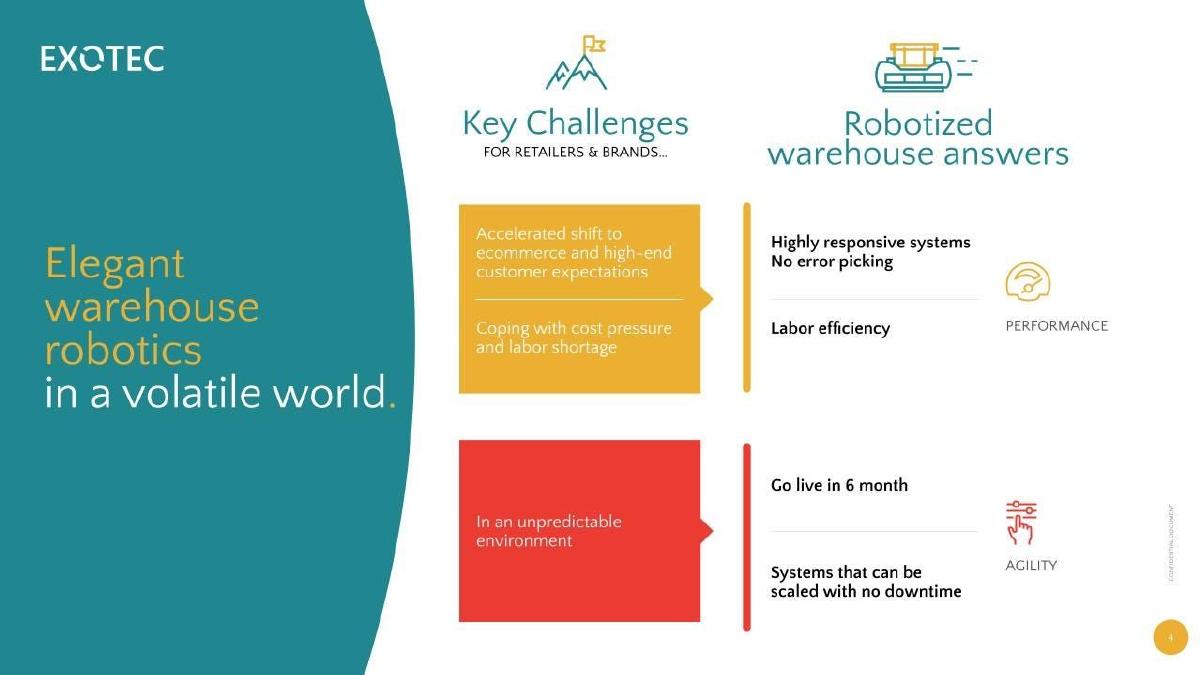
- Exotec promises a rapid deployment timeline, stating they can 'Go live in 6 month' even in unpredictable environments (Slide 4).
- The company emphasizes energy efficiency, claiming Skypod consumption is 10 times lower than traditional automated systems (Slide 8).
- A 'Partner for life' strategy is highlighted, with 10-year contracts and 24/7 control center supervision that handles 90% of troubleshooting invisibly (Slide 10).
- The business model includes a recurring revenue or expansion element via 'Robot rental' for peak seasons (Slide 10).
- Exotec projects reaching 360 full-time employees in 2021, supported by 150 engineers and 5 in-house headhunters (Slide 14).
- The team slide highlights 8 senior sales executives recruited directly from major competitors like Knapp, TGW, and Manhattan (Slide 14).
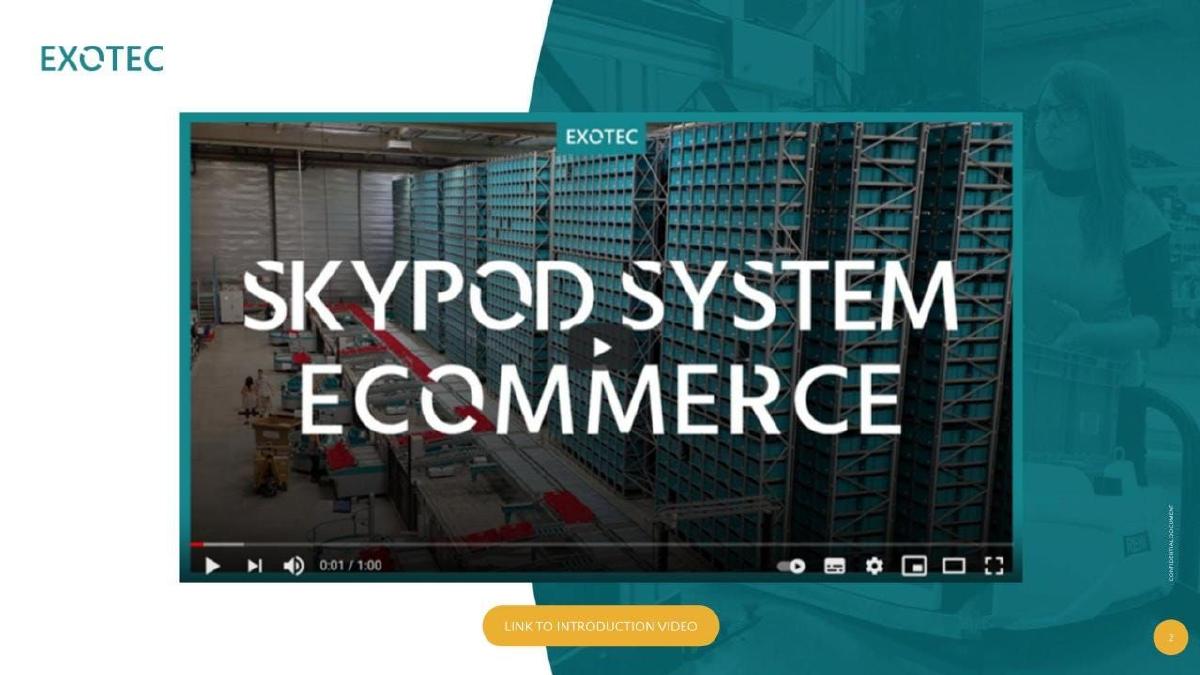
- The deck uses a video-first introduction to immediately demonstrate the physical scale of the Skypod system in a warehouse setting (Slide 2).
Exotec Pitch Deck Teardown: Scaling the Future of Fulfillment
Exotec, the French robotics unicorn, raised $335M in a Series D round in 2022. This teardown examines the 15-slide deck that helped propel them to a multi-billion dollar valuation. The deck is a study in high-level strategic positioning, focusing on the intersection of hardware reliability and software-driven agility.
Slide 1-2: The Visual Hook
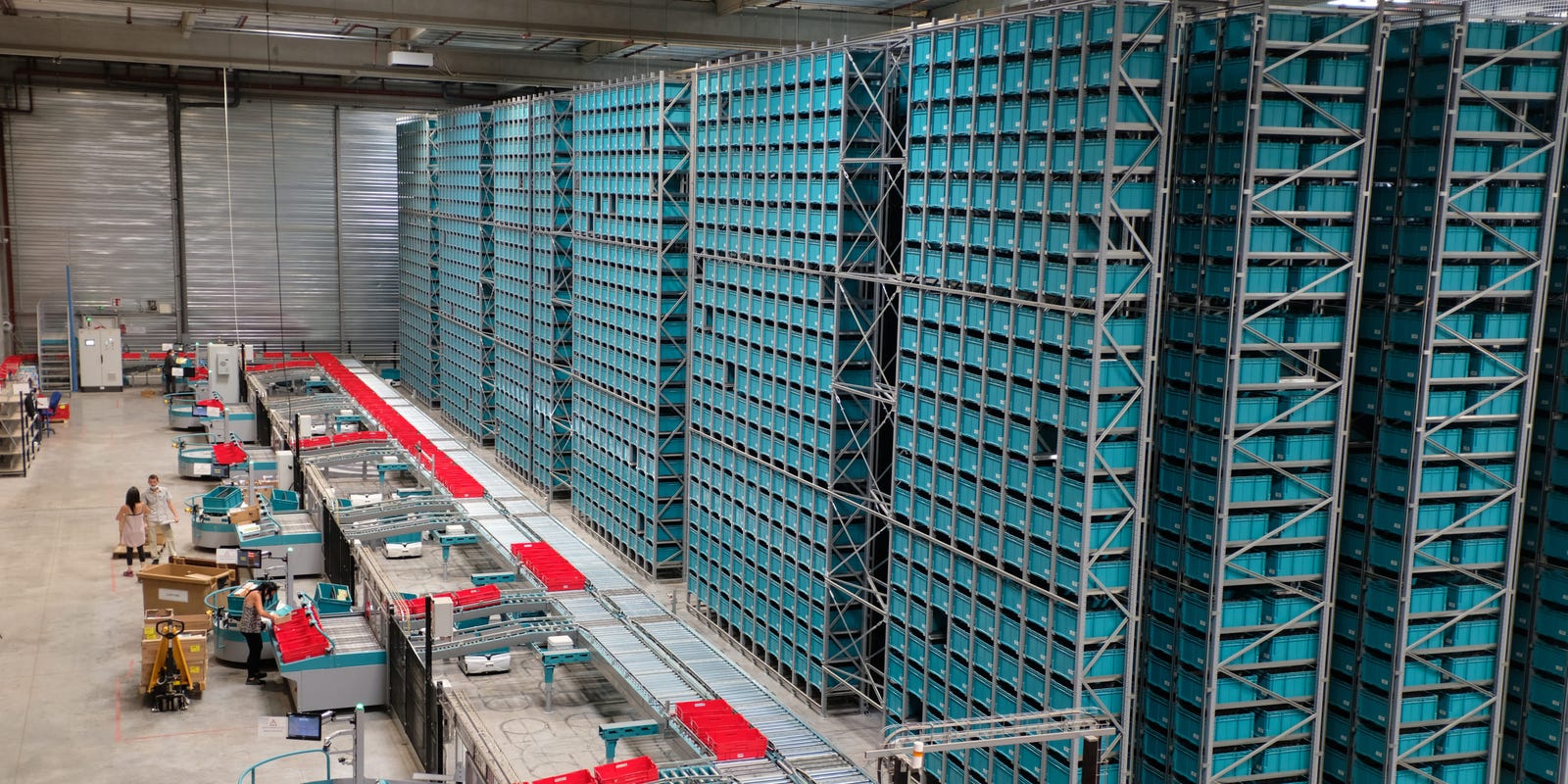
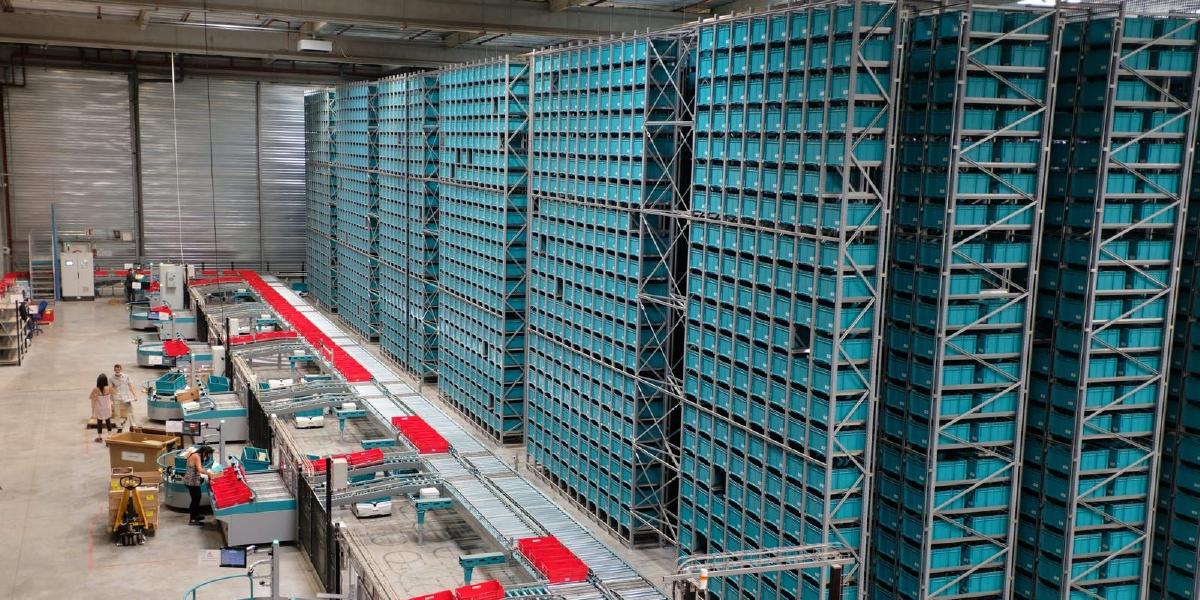
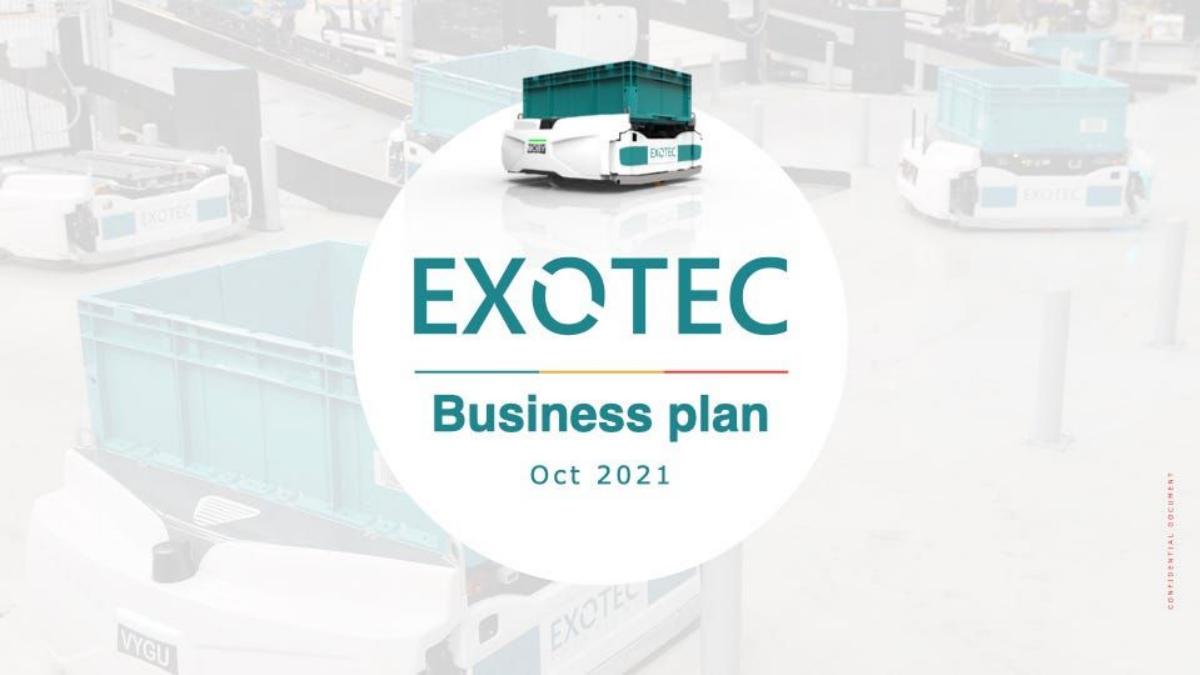
Slide 1 opens with a high-resolution, full-bleed image of a warehouse utilizing the Skypod system. The visual impact is immediate: it shows massive scale, with blue bins stacked nearly to the ceiling. This isn't a prototype; it is a functioning industrial solution. Slide 2 follows up with a link to an introduction video titled 'Skypod System Ecommerce.' For a hardware company, showing the product in motion is critical. It validates the technology's readiness and helps investors visualize the 'elegant warehouse robotics' mentioned later in the deck.
Slide 4: The Problem and Solution Framework
Slide 4 breaks down the 'Key Challenges' for retailers into three buckets: e-commerce expectations, cost/labor pressure, and unpredictable environments. Exotec counters these with specific 'Robotized warehouse answers.' The most aggressive claim here is the 'Go live in 6 month' promise. In the world of industrial automation, where lead times for custom conveyor systems or ASRS (Automated Storage and Retrieval Systems) often stretch into 18-24 months, a six-month deployment is a massive competitive advantage. They also highlight 'Agility,' specifically the ability to scale systems with 'no downtime,' which addresses the volatility of modern retail.
Slide 6: The Competitive Landscape
Slide 6 is the classic 2x2 matrix, but it is executed with precision. The axes are 'Performance' and 'Flexibility.' Exotec positions 'Legacy Automation' (Shuttle Technology) as high performance but low flexibility—meaning once you bolt it to the floor, you can't easily change it. Conversely, 'Manual Preparation' and 'New Players' are flexible but low performance. Exotec claims the top-right quadrant, asserting they 'outmatch the performance of traditional high-end order preparation systems, while being vastly more agile and flexible.' This slide is the core of their investment thesis: they are the only ones offering both speed and adaptability.
Slide 8: Human-Centric Automation
Slide 8 takes an interesting tactical turn by claiming 'Robots are humanizing the warehouse.' This is a strategic PR move to counter the 'robots take jobs' narrative. They focus on three points: ergonomics improvement, user-friendly HMIs (Human-Machine Interfaces), and energy efficiency. The claim that a Skypod system consumes 10 times less energy than traditional automated systems is a significant 'Green' metric that appeals to ESG-conscious investors, particularly in the European market where Exotec is headquartered.
Slide 10: The Business Model and Customer Success
Slide 10, titled 'Partner for life of our customers,' outlines the long-term value of the company. They state that their products are 'critical for 90% of our customers,' leading to 10-year relationships. The slide details a four-part service model: full-service maintenance, a 24/7 control center that handles 90% of troubleshooting remotely, robot rentals for peak seasons, and constant software upgrades. The 'Robot rental' mention is particularly important for investors, as it suggests a path to flexible, high-margin recurring revenue on top of the initial hardware sale.
Slide 12: The Vision for Category Leadership
Slide 12 is a transition slide that outlines the pillars of their growth: Design, Marketing, and Sales. They explicitly state their goal is to 'Build the brand of the « category king » of warehouse robotics.' This language is borrowed from Silicon Valley playbooks, signaling to Series D investors that Exotec isn't just a hardware manufacturer, but a brand aiming to define an entire market segment. The emphasis on 'no compromise on our quality' serves to reassure investors that rapid scaling won't break the product.
Slide 14: The Team and Talent Engine
Slide 14 is perhaps the strongest slide in the deck for a late-stage round. It doesn't just list founders; it demonstrates a 'talent vacuum' strategy. They highlight 8 senior sales executives recruited from top-tier competitors like Knapp, TGW, and Manhattan. They also mention having 5 full-time in-house headhunters. By showing they can poach the best people from the industry incumbents, they prove they have the 'assets in hands to become leader' (as stated on Slide 12). The slide also notes a projected headcount of 360 full-time employees in 2021, including 150 engineers, providing a sense of the company's operational scale.
What Exotec Does Well
Industrial Proof: The deck uses photography and video to prove the system works at scale. For a $335M round, investors need to see that the 'heavy lifting' of R&D is largely complete and the capital will be used for deployment and market capture.
Clear Positioning: The 2x2 matrix on Slide 6 is a textbook example of how to frame a market. By defining the competition as either 'fast but rigid' or 'flexible but slow,' Exotec makes their own solution seem like the only logical choice for a modern retailer.
Recruitment as a Metric: Highlighting the specific competitors they have hired from is a brilliant way to show market dominance. It signals to investors that the people who know the industry best are betting their careers on Exotec.
What is Missing from the Deck
Unit Economics: There is no mention of the Cost of Goods Sold (COGS), the average contract value (ACV), or the payback period for a customer. While these are likely in the data room, their absence in the pitch deck makes it harder to judge the efficiency of the business model.
Financial Performance: The deck is entirely qualitative regarding revenue. There are no charts showing year-over-year growth, current ARR (Annual Recurring Revenue), or projections. For a Series D, this is a notable omission, suggesting this deck was used as a 'teaser' or high-level vision document rather than the full financial disclosure.
The 'Ask': The deck does not state how much money they are looking for or how they intend to spend it. While the publisher reports a $335M raise, the deck itself is silent on the terms of the round.
Founder Takeaways
Sell the 'Category King' narrative: If you are in a crowded space, don't just say you are better; say you are creating a new category that makes the old one obsolete. · Use 'Speed to Live' as a weapon: In B2B and industrial tech, time-to-value is a massive differentiator. If you can deploy in months while others take years, make that a headline. · Show, don't just tell, your talent: Don't just list your team's names. List where they came from and why their presence proves you are winning the war for talent in your specific sector. · Address the 'Human' side: Especially in automation, proactively addressing how your tech interacts with and improves the lives of workers can head off potential regulatory or PR concerns from investors.
Frequently asked questions
- What is Exotec's primary value proposition for retailers?
- Exotec focuses on solving the 'Key Challenges' of labor shortages, cost pressure, and the accelerated shift to e-commerce. According to Slide 4, they offer 'highly responsive systems' with 'no error picking' and the ability to scale with no downtime. Their standout claim is a 6-month deployment window, which is significantly faster than many legacy industrial automation projects that can take years to implement.
- How does Exotec differentiate itself from competitors like Knapp or TGW?
- On Slide 6, Exotec uses a 2x2 matrix to place itself in the top-right quadrant (High Performance / High Flexibility). They categorize 'Shuttle Technology' (Legacy Automation) as high performance but low flexibility, and 'Manual Preparation' as high flexibility but low performance. By claiming the best of both worlds, they position themselves as a superior alternative to both old-school conveyors and basic warehouse labor.
- What does the deck say about the company's workforce and recruitment?
- Exotec places a heavy emphasis on its 'virtuous cycle' of talent. Slide 14 notes they expected to reach 360 employees in 2021, including 150 'best-in-class' engineers. Notably, they employ 5 full-time in-house headhunters to aggressively recruit from competitors. Their sales leadership is specifically cited as coming from industry incumbents like Savoye and Jungheinrich, signaling a deep bench of market expertise.
- Does the deck include financial projections or a specific funding ask?
- No. The 15-slide deck provided does not include a traditional 'Ask' slide, nor does it detail specific revenue figures, margins, or P&L projections. This is common in late-stage (Series D) decks where such sensitive data is usually reserved for a secure data room or a secondary, more detailed management presentation once initial interest is established.
- How does Exotec address the 'human' element of warehouse automation?
- Slide 8, titled 'Robots are humanizing the warehouse,' argues that their technology improves working conditions. They highlight ergonomic workstation design and intuitive Human-Machine Interfaces (HMIs). This framing attempts to pivot the narrative away from 'robots replacing humans' toward 'robots assisting humans' by removing the most physically taxing aspects of warehouse labor.