Hardware-as-a-Service and Robots-as-a-Service Pitch Deck
How to present renting hardware for a monthly fee instead of selling it: what the fee covers, what it costs, who owns the device and when it pays back.
How to Present Hardware as a Service on a Pitch Deck
Six slides from real pitch decks show how founders explain renting out hardware (robots, cameras, sensors, equipment) for a recurring fee instead of selling it: what the fee includes, what it costs, who pays for the device, and how the company gets its money back.
TL;DR
A hardware-as-a-service slide should say what the customer pays each month, what that fee includes, and who carries the cost of the device. Curastory is the only example here that prints prices: video equipment rentals at $35 and $50 a month, shown next to its main 30% marketplace fee. Giraffe360 lists exactly what its fixed monthly subscription covers (a robotic camera, cloud processing and all digital content, with analytics charged extra) but gives no amount. Vade explains why it gives cities its sensors for free and charges a subscription instead: it avoids slow municipal purchasing, and "cities pay for the data instead of the hardware". Blue White Robotics shows renting robots as the first step of a three-phase plan, with the customer's savings at each phase but not its own price. Exotec offers rental only as an add-on for peak season, inside a 10-year service relationship. Higgins earns a 30% margin on leasing equipment while giving its software away.
Hardware-as-a-service slides from real pitch decks
Each example shows the exact stored slide above its analysis and links to the full teardown. Stage and year are given only where the deck states them. Figures are the company's own claims.
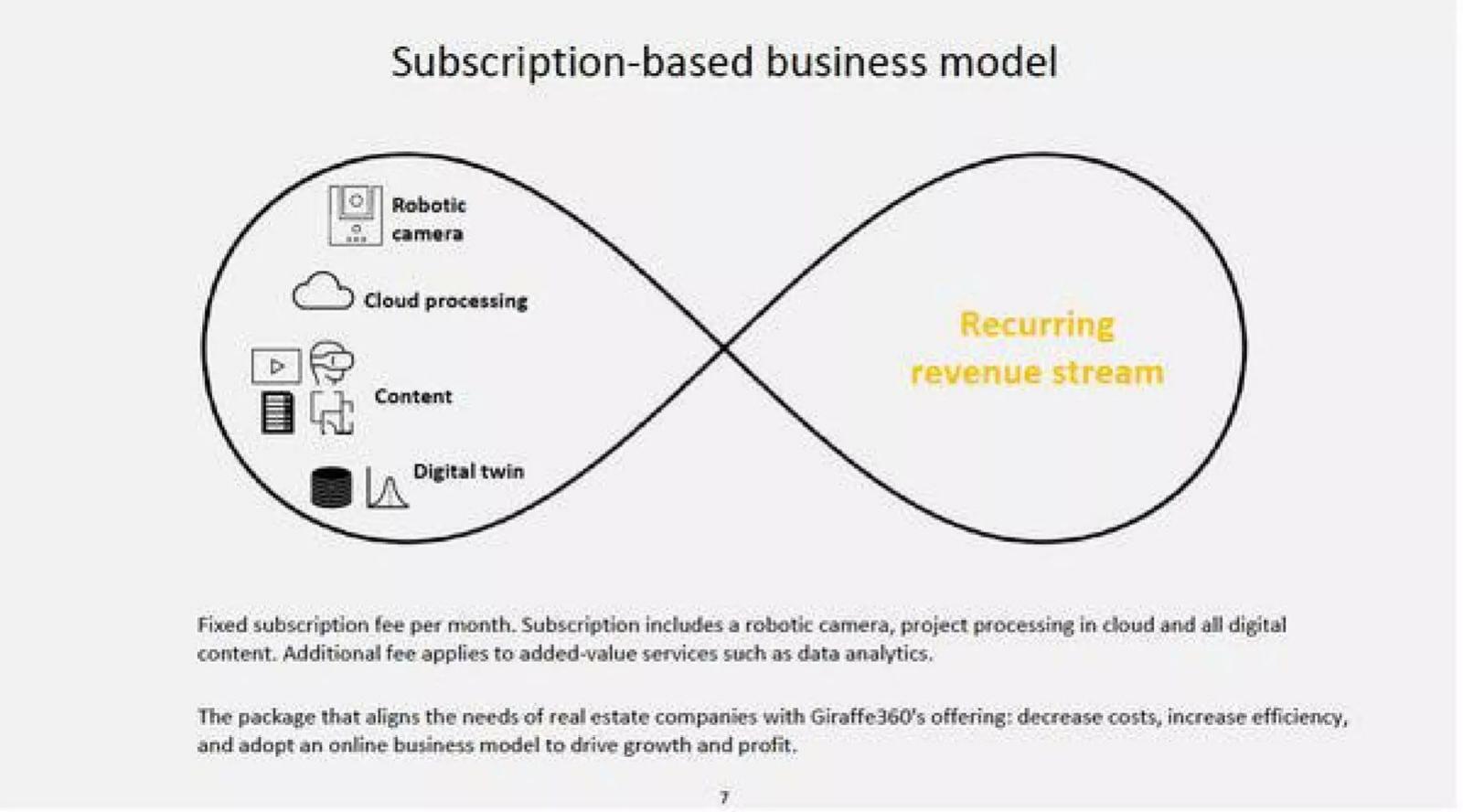
Giraffe360 business model slide — slide 7
Robotic camera and cloud processing for real estate photography.
Giraffe360 deck, slide 7. Exact stored slide matched to this analysis.
Our analysis: The clearest statement in this set of what a hardware subscription includes, with an upsell named.
Evidence and limitation: A fixed fee with no amount leaves investors unable to size it.
What a founder can adapt: List everything your fee includes, then add the amount and the minimum term.
Supporting analysis
What the deck claims: "Fixed subscription fee per month. Subscription includes a robotic camera, project processing in cloud and all digital content. Additional fee applies to added-value services such as data analytics."
Presentation choice: The clearest statement in this set of what a hardware subscription includes, with an upsell named.
When it does not fit: A fixed fee with no amount leaves investors unable to size it.
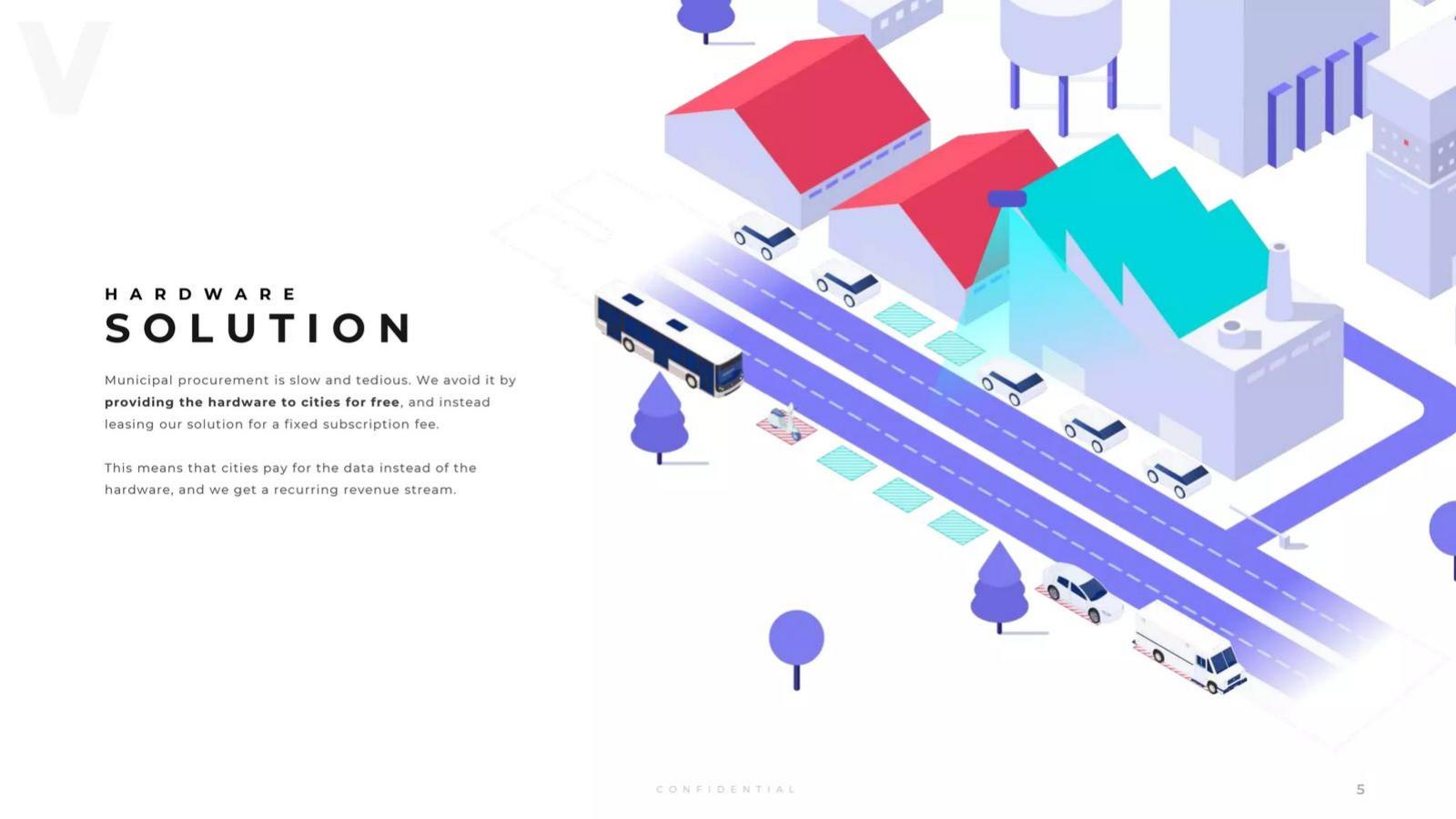
Camera sensors for city parking and curb data. Deck marked confidential.
Vade deck, slide 5. Exact stored slide matched to this analysis.
Our analysis: Explains why this customer rents instead of buying: a service fee avoids a slow capital purchase.
Evidence and limitation: Giving hardware away without showing its cost and how long fees take to repay it.
What a founder can adapt: Say in one sentence why your buyer prefers renting.
Supporting analysis
What the deck claims: "Municipal procurement is slow and tedious. We avoid it by providing the hardware to cities for free, and instead leasing our solution for a fixed subscription fee. This means that cities pay for the data instead of the hardware, and we get a recurring revenue stream."
Presentation choice: Explains why this customer rents instead of buying: a service fee avoids a slow capital purchase.
When it does not fit: Giving hardware away without showing its cost and how long fees take to repay it.
Blue White Robotics business model slide — slide 6
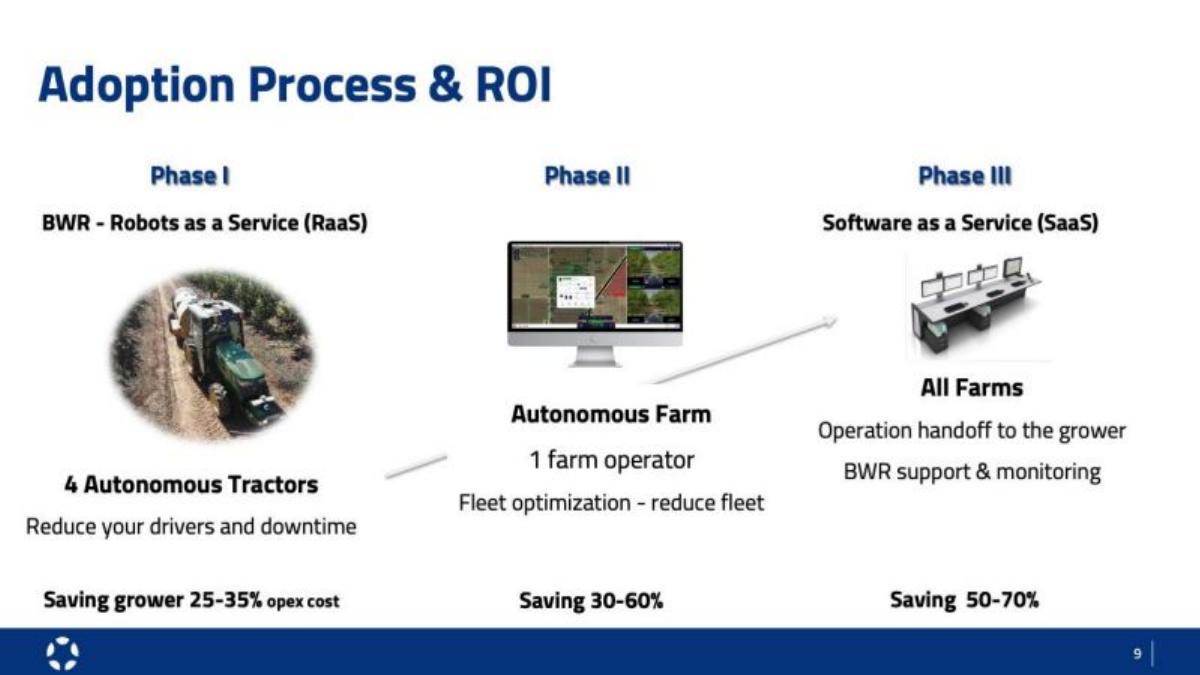
Autonomous tractor technology for farms.
Blue White Robotics deck, slide 6. Exact stored slide matched to this analysis.
Our analysis: Shows renting robots as a low-risk first step toward a software model, but gives only customer savings, no price.
Evidence and limitation: Savings ranges with no source or baseline.
What a founder can adapt: Add your revenue per customer at each phase, not only what the customer saves.
Supporting analysis
What the deck claims: Phase I "Robots as a Service (RaaS)", 4 autonomous tractors, saving grower 25–35% opex; Phase II autonomous farm, 1 operator, saving 30–60%; Phase III "Software as a Service (SaaS)", handoff to the grower, saving 50–70%.
Presentation choice: Shows renting robots as a low-risk first step toward a software model, but gives only customer savings, no price.
When it does not fit: Savings ranges with no source or baseline.
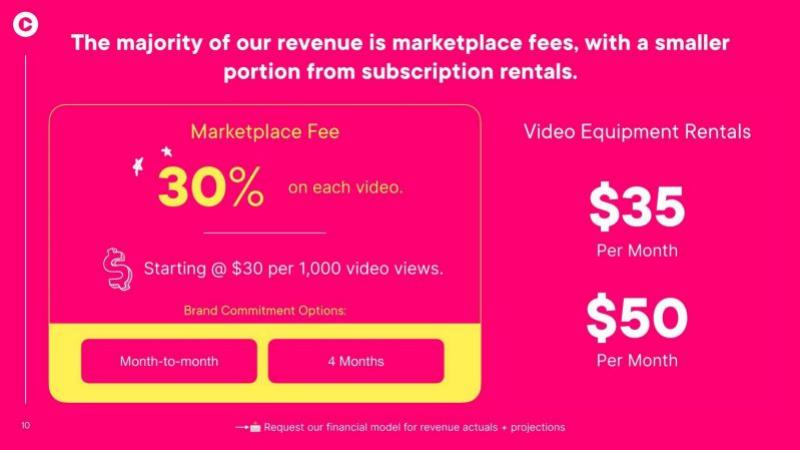
Video creator platform connecting athletes and brands. Seed deck, 2021.
Curastory deck, slide 10. Exact stored slide matched to this analysis.
Our analysis: The only slide here that prices its hardware rental, and the headline says how much weight to give it.
Evidence and limitation: Two price tiers with no description of what each includes.
What a founder can adapt: Print rental prices and say what share of revenue they are.
Supporting analysis
What the deck claims: "The majority of our revenue is marketplace fees, with a smaller portion from subscription rentals." Marketplace fee 30% on each video, starting at $30 per 1,000 views; video equipment rentals $35 and $50 per month.
Presentation choice: The only slide here that prices its hardware rental, and the headline says how much weight to give it.
When it does not fit: Two price tiers with no description of what each includes.
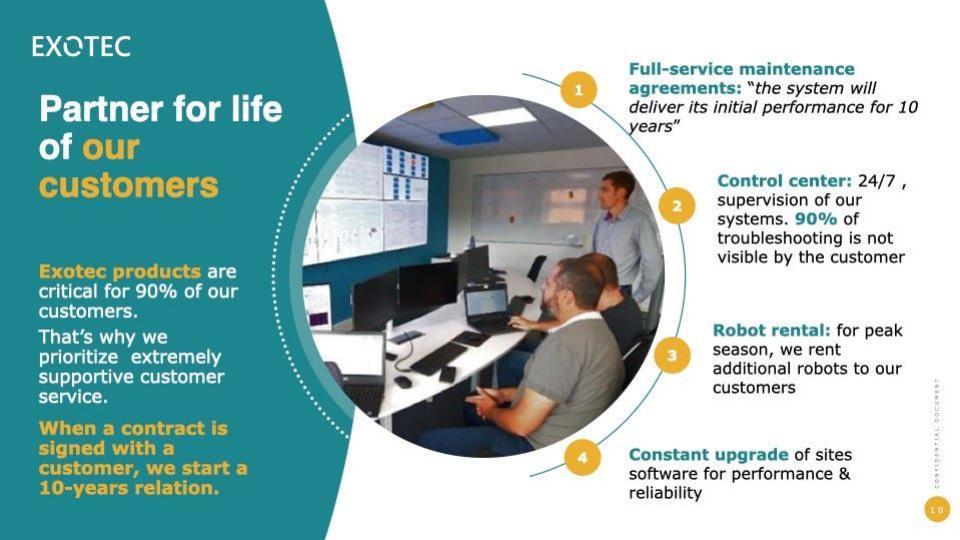
Exotec deck, slide 11. Exact stored slide matched to this analysis.
Our analysis: A contrast example: rental is an add-on to a sale, solving seasonal demand and adding recurring income.
Evidence and limitation: Listing services without prices leaves investors unsure if they matter financially.
What a founder can adapt: If rental is secondary, say what problem it solves and what share of revenue it brings.
Supporting analysis
What the deck claims: Full-service maintenance ("the system will deliver its initial performance for 10 years"); 24/7 control center; "Robot rental: for peak season, we rent additional robots to our customers"; constant upgrade. "When a contract is signed with a customer, we start a 10-years relation."
Presentation choice: A contrast example: rental is an add-on to a sale, solving seasonal demand and adding recurring income.
When it does not fit: Listing services without prices leaves investors unsure if they matter financially.
What each hardware-as-a-service slide tells an investor
Most slides explain the idea; few give the price, the hardware cost or the payback.
Example
Fee stated
What fee includes
Who carries hardware cost
Why customer rents
Giraffe360
No (fixed monthly)
Yes
Implied (company)
Partly
Vade
No (fixed subscription)
Data
Company (free hardware)
Yes
Blue White Robotics
No
No
Not stated
Yes (savings)
Curastory
Yes ($35 / $50 a month)
No
Implied (company)
No
Exotec
No
Peak-season robots
Company (rental robots)
Yes (peak season)
Higgins
Margin only (30%)
No
Not stated
No
Key Takeaways
State the monthly or yearly fee and the contract length.
List what the fee includes: device, software, maintenance, replacements.
Say who owns the hardware and who pays to build it.
Show how many months of fees it takes to recover the cost of one unit.
Explain why customers prefer renting to buying, in their own terms.
Test your hardware-as-a-service slide before you send it
Answer these with numbers, even if they are targets.
Fee. What does the customer pay each month, and for how long do they sign?
Includes. What does the fee cover: device, software, maintenance, replacements?
Unit cost. What does one unit cost to build and install, and who pays for it?
Payback. How many months of fees, after service costs, repay one unit?
Why rent. Why does your customer prefer renting to buying?
Copyable framework: [Device] for [fee] a month on a [term]-month contract, including [items]; unit cost [cost], paid back in [months] months
Illustrative example 1 — written by us
Before: Flexible robots-as-a-service model.
After: Robots as a service: [fee] per robot per month, [term]-month minimum; robots built by [partner], financed by [who]; payback [months] months
What improved: Our illustrative example of a one-line mention and a rewrite; not any company's text. Bracketed parts are placeholders, not company facts. It turns a label into a model an investor can test.
What this guide covers
Hardware as a service means the customer pays a recurring fee to use a physical product instead of buying it outright. The startup keeps ownership, or at least the responsibility, and bundles the device with software, maintenance and support. Robots-as-a-service (RaaS) is the best-known version, but the same model covers cameras, sensors, kiosks, payment terminals and equipment rental.
Investors like recurring revenue, and renting turns a one-off hardware sale into a subscription. It also changes the money the startup needs. When you sell a robot, the customer pays for it up front. When you rent it, you pay to build it and get your money back slowly, month by month. A slide that shows only the recurring fee hides the part investors most want to understand: how much cash each unit ties up and how long it takes to come back.
Our hardware business model guide covers selling a device and earning from refills, consumables or usage. The SaaS guides cover subscriptions with nothing physical to deliver. Neither explains how to present renting the hardware itself. We found a few dozen slides in our corpus that mention robots-as-a-service, equipment leasing or hardware subscriptions. Seven were readable (one later removed under the restriction-notice rule), came from companies that were private when they made the deck, and differ enough to teach something.
Say what the fee includes
The first job of the slide is to tell an investor what the customer actually gets for the monthly fee. A hardware subscription can include the device, software, cloud processing, repairs, replacements and upgrades. Each one costs the startup money, so the list is also a list of costs.
Giraffe360, which makes a robotic camera for real estate photography, titles its slide "Subscription-based business model". An infinity loop links four items (robotic camera, cloud processing, content, digital twin) to "Recurring revenue stream". The text underneath is precise about scope: "Fixed subscription fee per month. Subscription includes a robotic camera, project processing in cloud and all digital content. Additional fee applies to added-value services such as data analytics."
That tells an investor three things: the camera is not sold separately, processing is bundled rather than charged per property, and there is an upsell. What the slide leaves out is the fee itself, the contract length, and whether heavy users cost more to serve than light ones under a fixed price. A stronger version would add one line: the monthly fee, the minimum term and the cost of building one camera.
Explain why the customer rents instead of buying
Renting is not automatically better for the customer. Over a long enough period, buying is usually cheaper. A good slide says what makes renting the better choice for this particular buyer.
Vade, which makes camera sensors for city parking and curb management, gives the clearest reason in this set. Its "Hardware solution" slide says: "Municipal procurement is slow and tedious. We avoid it by providing the hardware to cities for free, and instead leasing our solution for a fixed subscription fee. This means that cities pay for the data instead of the hardware, and we get a recurring revenue stream."
That is a sales argument, not just a pricing choice: a city can often approve a service fee faster than a capital purchase. It also tells an investor that Vade carries the cost of every sensor it installs. The slide doesn't say how much a sensor costs to build and install, what the subscription is, or how long a city signs for, so there is no way to tell how many months it takes Vade to recover the hardware cost. Those three numbers would turn a good argument into a model an investor can test.
Blue White Robotics, which makes autonomous tractor technology for farms, uses its "Adoption process and ROI" slide to show renting as a first step. Phase I is "BWR - Robots as a Service (RaaS)" with four autonomous tractors, "Saving grower 25-35% opex cost". Phase II is an autonomous farm with one operator and a smaller fleet, saving 30–60%. Phase III is "Software as a Service (SaaS)" across all farms, with the operation handed to the grower and BWR providing support, saving 50–70%.
The slide makes a useful point: renting robots lowers the risk for a grower trying autonomy for the first time, and the company plans to move to a software-only model once trust is built. But the savings are the customer's, not the company's revenue. There is no price for the robot service, no cost per tractor and no indication of how revenue changes when the company stops supplying hardware. The same deck's "Unfair advantage" slide repeats the idea in one line ("robot as a service approach, working closely with the grower") without adding detail.
Put a price on it
Of the six slides, only one prints what customers pay for the hardware. That is the most common gap in this model, and the easiest to fix.
Curastory, a video creator platform, earns most of its money from brands: its headline reads "The majority of our revenue is marketplace fees, with a smaller portion from subscription rentals." The left panel shows a 30% marketplace fee on each video, starting at $30 per 1,000 video views, with month-to-month or four-month commitments for brands. The right panel shows "Video Equipment Rentals" at $35 and $50 per month.
This is a good model for a startup where hardware rental is a secondary stream. The prices are clear, and the headline tells the investor how much weight to give the rental line. What it doesn't say is what each tier includes or what the equipment costs Curastory to buy. A footnote points to the financial model for actual revenue, which is reasonable for a seed deck, but one line saying how long a $35 kit takes to pay for itself would answer the obvious question on the slide.
Rental as part of a larger relationship
Some companies sell their hardware but offer rental for specific situations. That can be a strength, as long as the slide makes clear which is the main model.
Exotec, which builds warehouse robotics systems, presents rental as one of four parts of its customer service on a slide titled "Partner for life of our customers". Its customers buy the system; Exotec then provides full-service maintenance ("the system will deliver its initial performance for 10 years"), a 24/7 control center that handles 90% of troubleshooting without the customer noticing, "Robot rental: for peak season, we rent additional robots to our customers", and constant software upgrades. The slide says "When a contract is signed with a customer, we start a 10-years relation."
This is a contrast example. Rental is not the business model; it solves a specific problem (seasonal demand in retail warehouses) and gives Exotec recurring income from customers who have already bought. An investor learns how the company keeps earning after the sale. The slide gives no prices for rental or maintenance and no share of revenue from either, so the reader can't tell whether these services are meaningful income or mainly a selling point.
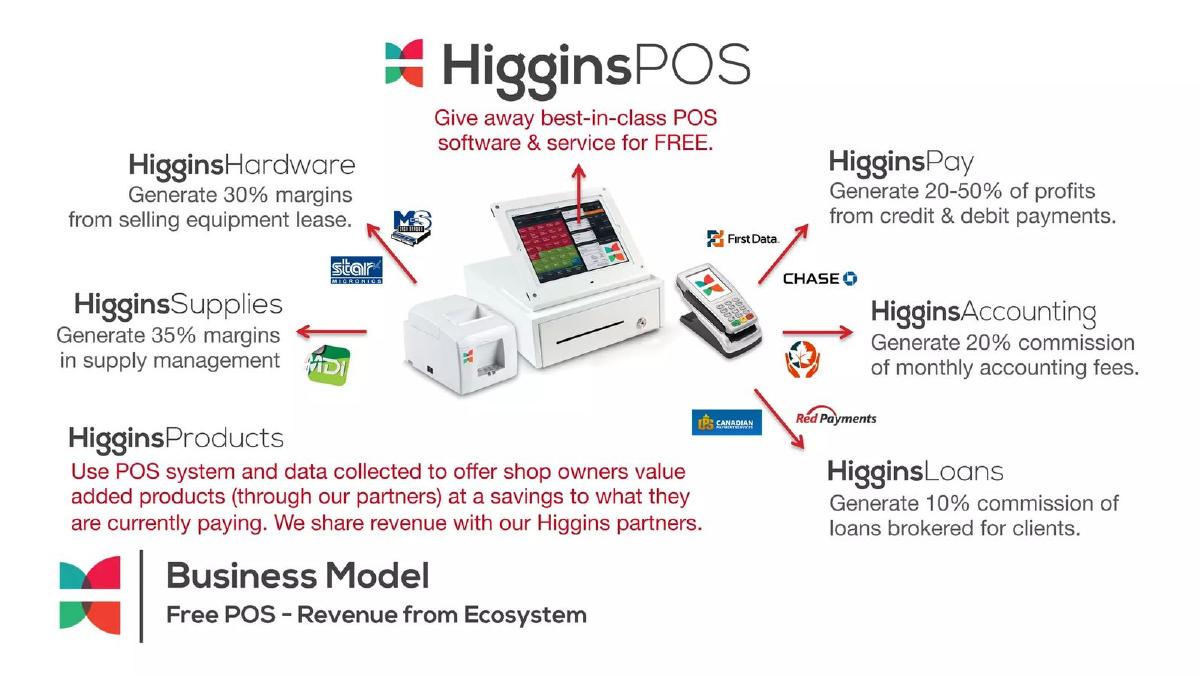
Higgins, a point-of-sale company, takes a different route. Its business model slide is titled "Free POS – Revenue from Ecosystem": the software is given away, and money comes from six streams around it. One of them is hardware: "Generate 30% margins from selling equipment lease." The others are supplies (35% margins), payments (20–50% of profits from card payments), accounting (a 20% commission on monthly fees), loans (a 10% commission) and partner products.
Here the equipment lease is a profit centre, not a cost the company recovers over time. That is a legitimate model, but the slide doesn't say whether Higgins finances the leases itself or passes them to a partner, which decides whether the 30% margin comes with credit risk. It also gives no sense of which of the six streams is largest.
The numbers investors look for
None of the six slides shows all of them, which is why this section exists. A hardware-as-a-service slide is strongest when it includes the cost to build and deploy one unit, the monthly fee, the contract length, and the number of months it takes for fees (after service costs) to repay the unit.
A simple worked example shows why. Suppose a robot costs $30,000 to build and install, rents for $2,000 a month, and costs $500 a month to maintain and support. Each robot earns $1,500 a month after service costs, so it takes 20 months to recover the hardware. On a 36-month contract, the company earns back the robot and $24,000 more. On a 12-month contract with no renewal, it loses money on every unit. These figures are illustrative, not drawn from any deck in this guide, but they show why contract length and payback matter as much as the fee itself.
If you have a financing partner who buys the hardware and leases it to customers, say so. It changes how much capital the startup needs, and investors will ask.
Common mistakes
No price. Give the monthly fee and the contract length.
Hidden hardware cost. Say what one unit costs and who pays for it.
No payback. Show how long fees take to repay a unit.
Customer savings as revenue. Customer savings are not your income; show both.
One-line claim. Back a RaaS claim with ownership, pricing and margin.
Diagnostic checklist
Monthly fee and contract length stated.
What the fee includes listed.
Unit cost and who carries it stated.
Payback period per unit shown.
Reason customers rent instead of buy.
Frequently asked questions
How we chose these examples
Corpus: published pitch deck teardowns on StartupFundraising.com. Founder-uploaded private decks are excluded.
Removed in v2 (2026-10-05): Realtime Robotics, because a page of its deck carries a restriction notice. Selection (2026-10-01): we searched extracted slide text for robots-as-a-service, hardware subscriptions, equipment leasing and rental, then read each candidate from images made from the original deck files.
Eligibility: each company was private when its deck was made. Exotec (Series D, January 2022), Blue White Robotics (Series C, January 2024), Giraffe360 (Series A, November 2022), Vade (seed rounds in 2020 and 2022) and Curastory (seed round, September 2021) were confirmed from public funding announcements. Higgins was matched by name and location to a privately held Toronto company; its deck shows no sign of a listing.
Not used: ANYbotics (the details of its robots-as-a-service and purchase models are pixelated in the source deck), a second Blue White Robotics slide (a one-line repeat), and listed companies whose decks mention equipment leases (AGS, GCA and two mining companies).
Overlap check: no other guide covers hardware as a service. The hardware business model guide covers selling a device plus refills or usage; the SaaS guides cover software-only subscriptions.
Review: all six slide images were inspected on 2026-10-01 and matched to company, deck and slide number (AI editorial model review). No person has yet completed an editorial review of this page. The worked payback example uses illustrative figures, not company data.
Figures are the companies' own claims; we did not verify underlying data. We make no claim that any slide caused a fundraising outcome.