Higgins Advisors (operating as Higgins.Ai) positions itself as a 'truly free' alternative to established Point of Sale (POS) systems like Square and TouchBistro. The deck centers on a business model that gives away the core software to capture high-margin revenue streams through HigginsPay, HigginsLoans, and HigginsSupplies. By projecting a Life-Time Value (LTV) of $35,573 per client, the company argues that a free entry point is not just sustainable but more profitable than traditional SaaS models. The deck provides specific performance metrics, including $60.8 million in processed sales and…
Key takeaways
- The company targets a $3.5 trillion POS market, characterizing current systems as complicated, exposed, and costly on Slide 2.
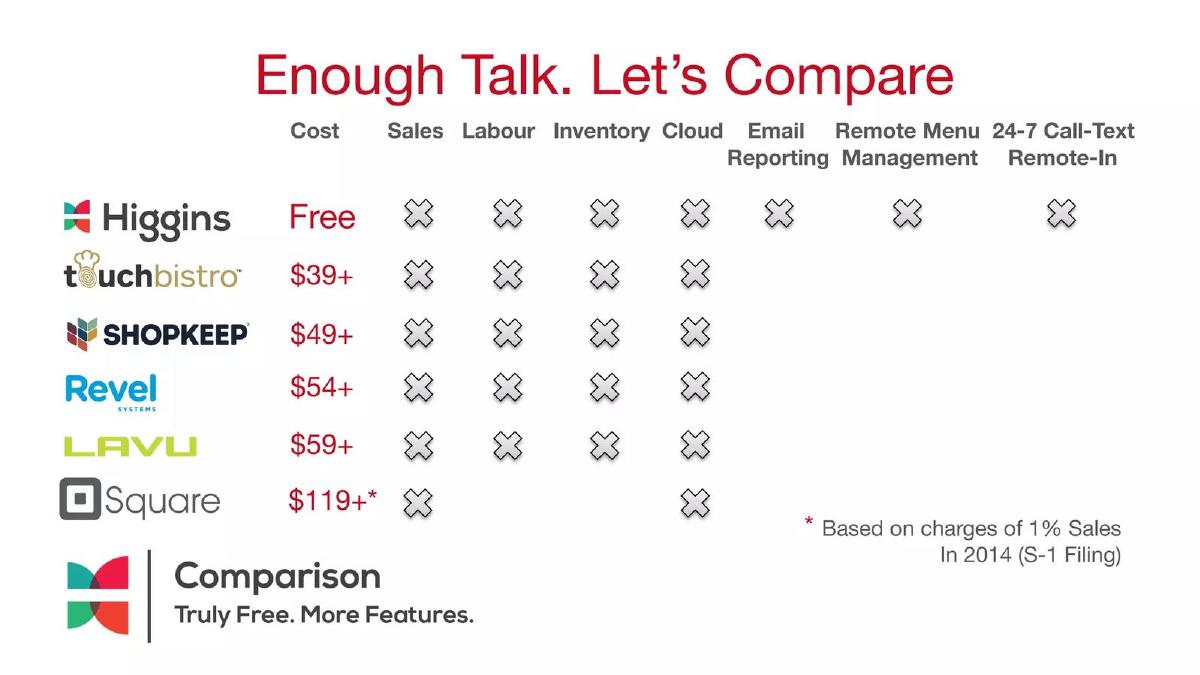
- Higgins claims a 'Truly Free' model, contrasting its $0 cost against Square's estimated $119+ monthly cost on Slide 3.
- Projected Life-Time Value (LTV) per client is stated as $35,573, with HigginsHardware contributing the largest share at $13,545 on Slide 4.
- Performance data shows $60,820,321 in sales processed through the system and 9,817,112 transactions uploaded to the cloud on Slide 5.
- The client profile is diverse, with Bistros (25%) and Cafes (21%) making up nearly half of the user base on Slide 5.
- Higgins positions its valuation against Square, projecting a $10M post-revenue valuation based on $1.3M in revenue within one year on Slide 6.
- The deck highlights a patent-pending status (USPA No. 61/947,792c) on the cover and closing slides.
- A significant portion of growth comes from replacing competitors, with 27% of new clients previously using TouchBistro on Slide 5.
Executive Summary: The Loss-Leader Strategy in Fintech
The Higgins Advisors pitch deck from 2015 presents a classic disruptive play in the fintech and Point of Sale (POS) space. By identifying a massive, $3.5 trillion market currently burdened by high costs and fragmented systems, Higgins proposes a 'free' entry point to capture market share rapidly. Their thesis is built on the idea that the POS terminal is the 'operating system' of a small business, and controlling that OS allows for the cross-selling of high-value financial services like lending and payment processing. This teardown examines the 7 slides provided to understand their valuation logic and market positioning.
Slide 1: Title and Intellectual Property
The cover slide introduces the Higgins brand with a modern, four-quadrant logo. Notably, it includes a legal footer: "© Higgins.Ai Incorporated 2015" and "Patent Pending USPA No. 61/947,792c." The inclusion of a patent number on the first slide is a tactical move to signal defensibility to investors, suggesting that their 'Higgins.Ai' approach involves proprietary technology rather than just a standard software interface.
Slide 2: The Problem and Value Proposition
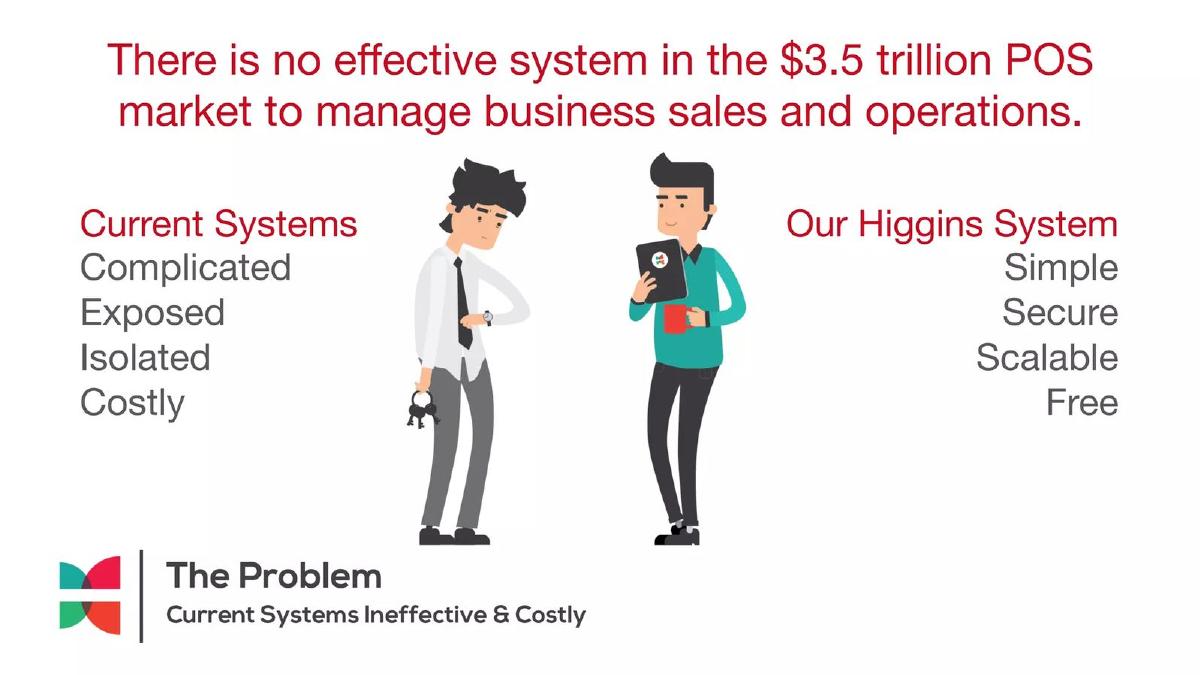
Slide 2 defines the market opportunity. It states, "There is no effective system in the $3.5 trillion POS market to manage business sales and operations." The slide uses a side-by-side comparison between "Current Systems" and the "Higgins System."
Current Systems: Complicated, Exposed, Isolated, Costly. · Higgins System: Simple, Secure, Scalable, Free.
The visual of a stressed business owner looking at his watch versus a relaxed owner using a tablet effectively communicates the emotional benefit of the product. By labeling the market at $3.5 trillion, Higgins is signaling a massive Total Addressable Market (TAM), though it does not specify if this is the total transaction volume or the software spend.
Slide 3: Competitive Feature Comparison
This slide is a standard 'check-box' comparison grid, but with a focus on pricing. It lists competitors including TouchBistro, ShopKeep, Revel, Lavu, and Square . The cost column is the most striking, showing Higgins as "Free" while competitors range from $39+ to $119+ per month. A footnote specifies that Square's $119+ cost is based on "charges of 1% Sales In 2014 (S-1 Filing)."
Higgins claims to offer features that none of the competitors provide, specifically: Email Reporting, Remote Menu Management, and 24-7 Call-Text Remote-In support. This slide attempts to neutralize the 'you get what you pay for' argument by suggesting that the free product is actually more feature-rich than the paid alternatives.
Slide 4: The Business Model and LTV
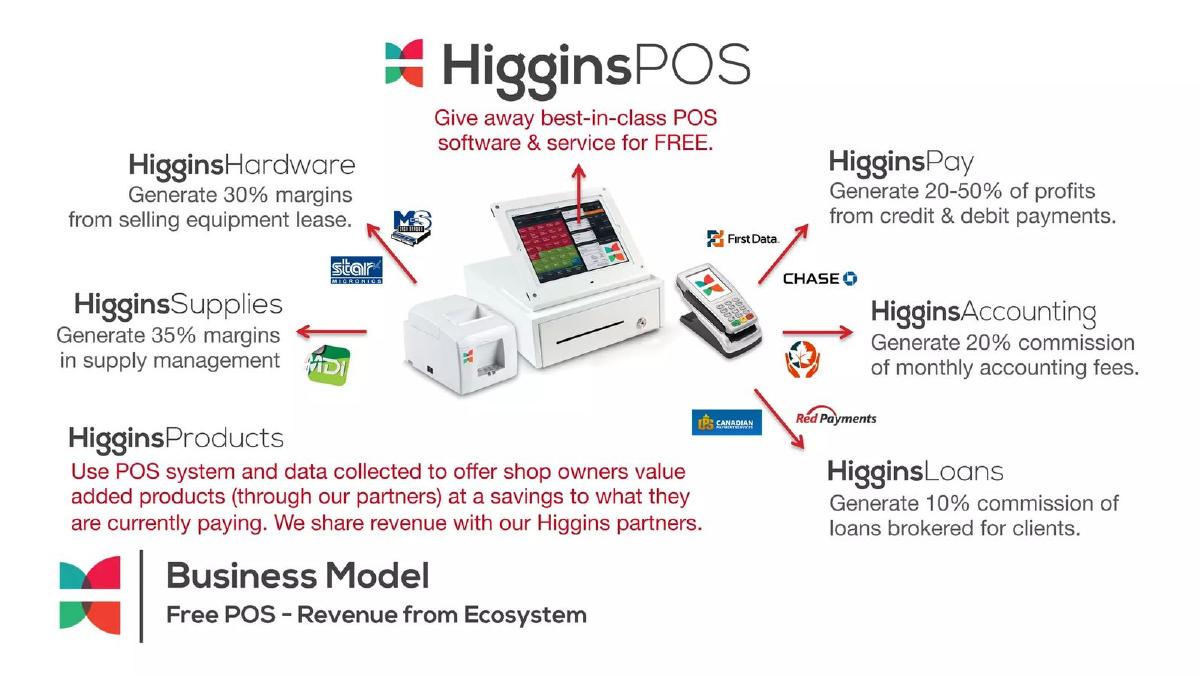
Slide 4 is the core of the financial pitch. It addresses the obvious question: how does a free product make money? The slide introduces four revenue pillars:
HigginsSupplies: $1,898 LTV · HigginsPay: $10,634 LTV · HigginsLoans: $9,494 LTV · HigginsHardware: $13,545 LTV
The total "Life-Time Value (LTV) Per Client is $35,573." A donut chart shows the revenue mix, with HigginsHardware (38%) and HigginsPay (30%) being the primary drivers. This slide is critical because it shifts the conversation from a SaaS 'subscription' model to a 'platform' model where the software is a customer acquisition tool for higher-margin services.
Slide 5: Performance and Traction
To prove that the model works, Slide 5 provides hard data. The company claims $60,820,321 in sales processed and 9,817,112 transactions uploaded to the cloud. They also boast a 99.9135% up time.
The "Systems Replaced" pie chart is particularly insightful for investors. It shows that 27% of their customers came from TouchBistro and 20% came from traditional cash registers. This suggests that Higgins is successful both at 'greenfield' sales (new businesses) and 'switch' sales (stealing customers from incumbents). The "Client Profile" chart confirms their stronghold in the hospitality sector, with 64% of their clients being Bistros, Cafes, or Bars.
Slide 6: Valuation and Market Validation
Slide 6 attempts to justify the company's valuation by comparing itself to Square. It creates a narrative that "Higgins is Square for Shops & Stores."
Square: $40M Pre-Revenue valuation (based on Seed round) with $0M revenue; $6,000M Post-Revenue valuation with $850M revenue after 4 years. · Higgins: $5M Pre-Revenue valuation with $0M revenue; $10M Post-Revenue valuation with $1.3M revenue after 1 year.
By showing a much lower entry valuation ($5M vs $40M) and a faster path to revenue, Higgins is positioning itself as a high-upside, lower-risk alternative to the early-stage Square investment.
Slide 7: Closing and Tagline
The final slide repeats the logo and the patent pending information. It adds a bold, aggressive tagline: "The First POS Register That Doesn't Suck." This reflects a 'challenger brand' mentality designed to resonate with frustrated small business owners, though it may be seen as unprofessional by some institutional investors.
What Higgins Advisors Does Well
The deck is exceptionally clear about its business model. Many 'free' software startups fail to explain how they will eventually monetize, but Higgins provides specific LTV targets for four distinct revenue streams. This transparency helps investors understand the unit economics of the 'free' strategy. Furthermore, the use of real traction metrics—$60M in processed sales—proves that the product is not just a concept but a functioning platform with market fit.
What is Missing from the Deck
The most significant omission is the Team Slide . There is no mention of who is building this technology, their background in fintech, or their previous successes. In early-stage fundraising, the team is often more important than the idea itself. Additionally, there is no 'Ask' slide . The deck mentions valuations but does not state how much capital is being raised in the current round or what the specific milestones for that capital will be. Finally, there is no Roadmap . While we see where they are, we don't see the plan for the next 18-24 months in terms of product development or geographic expansion.
Founder Takeaways: Copy the Clarity, Avoid the Omissions
Founders should emulate the way Higgins uses comparative data . Instead of just saying they are better than Square, they break down features, pricing, and valuation benchmarks. This makes the 'disruption' argument much more tangible. However, founders must ensure they include a robust team slide and a clear funding request. A pitch deck is a call to action; without a specific 'Ask,' you are simply giving a presentation rather than raising capital. Finally, the use of a 'patent pending' notice is a strong way to signal intellectual property value from the very first slide, which is a tactic worth adopting for tech-heavy startups.
Frequently asked questions
- How does Higgins make money if the POS is free?
- According to Slide 4, Higgins utilizes a multi-pronged monetization strategy. While the software is free, they generate revenue through HigginsPay (payments), HigginsLoans (financing), HigginsSupplies (consumables), and HigginsHardware (equipment). They project an LTV of $35,573 per client across these four streams, suggesting that the free software acts as a loss leader for high-margin financial and supply services.
- What is the primary competitive advantage claimed by Higgins?
- Higgins emphasizes a 'more features for less cost' approach. Slide 3 shows that Higgins includes 24-7 call/text support, remote menu management, and email reporting—features that competitors like Square, Lavu, and ShopKeep either lack or charge for. Their primary hook is being 'Truly Free' while offering a broader suite of operational tools than the market leaders.
- What stage of development is Higgins in based on this deck?
- The deck appears to be for a Seed or early Series A round. Slide 6 mentions a $5M valuation based on a Seed round with $0 revenue, and projects a $10M valuation once they reach $1.3M in revenue. Slide 5 indicates they are already operational, having processed over $60 million in sales and nearly 10 million transactions.
- Who is the target customer for Higgins?
- Slide 5 provides a 'Client Profile' breakdown. The primary targets are food and beverage establishments, specifically Bistros (25%), Cafes (21%), Takeout (18%), and Bars (15%). They also serve retail (8%), clubs (9%), and offices (4%), indicating their software is optimized for high-transaction environments with inventory and labor management needs.
- What are the biggest red flags in this pitch deck?
- The most glaring omission is the lack of a team slide. Investors fund people as much as ideas, and the absence of founder backgrounds is a major gap. Additionally, the deck lacks a clear 'Ask' slide detailing how much money they are raising and how it will be spent. The LTV figures on Slide 4 are also highly specific ($35,573) but lack the underlying assumptions (churn rate, time period) to verify their accuracy.