Hey Jane's 2021 pitch deck is a masterclass in timing and regulatory positioning. By highlighting the imminent threat to Roe v. Wade and the simultaneous FDA shift toward permanent mail-order medication, the company framed itself as a vital infrastructure play in a volatile landscape. The deck focuses on a 'Complete Care' model that combines medical, emotional, and social support, resulting in a Net Promoter Score of 91. While the deck lacks specific financial projections and a clear funding ask, it successfully leverages social proof and a massive $1.4 trillion market opportunity in women's…
Key takeaways
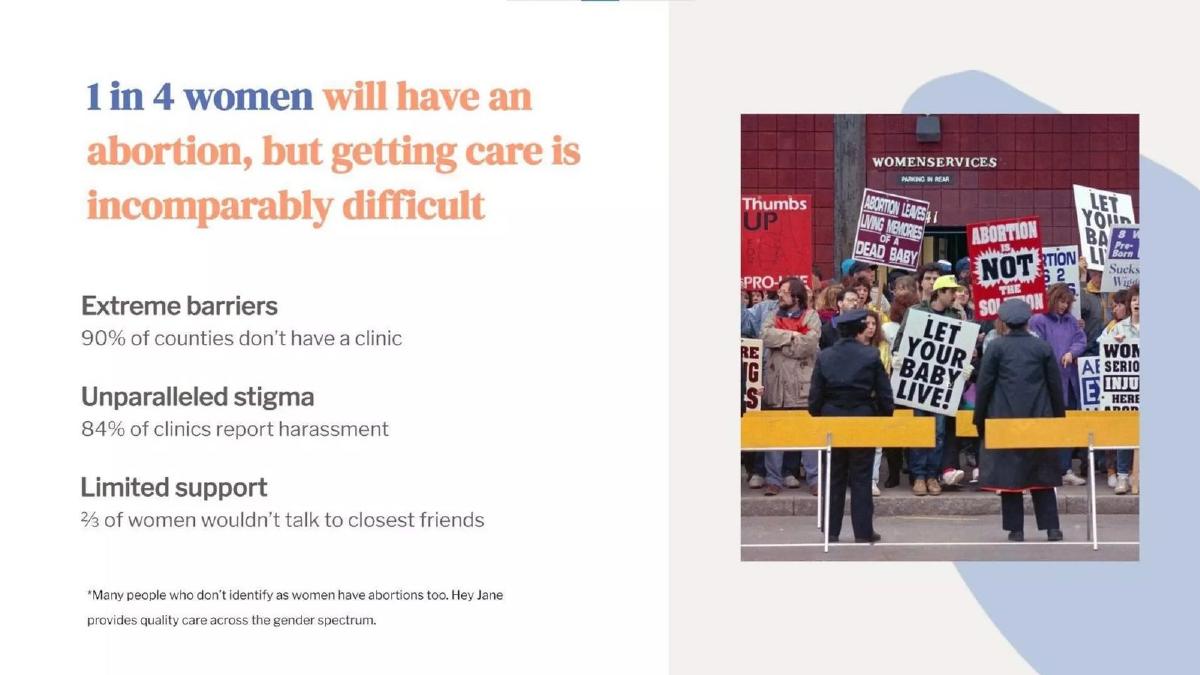
- The deck identifies that 90% of U.S. counties lack an abortion clinic, creating a massive access gap (Slide 2).
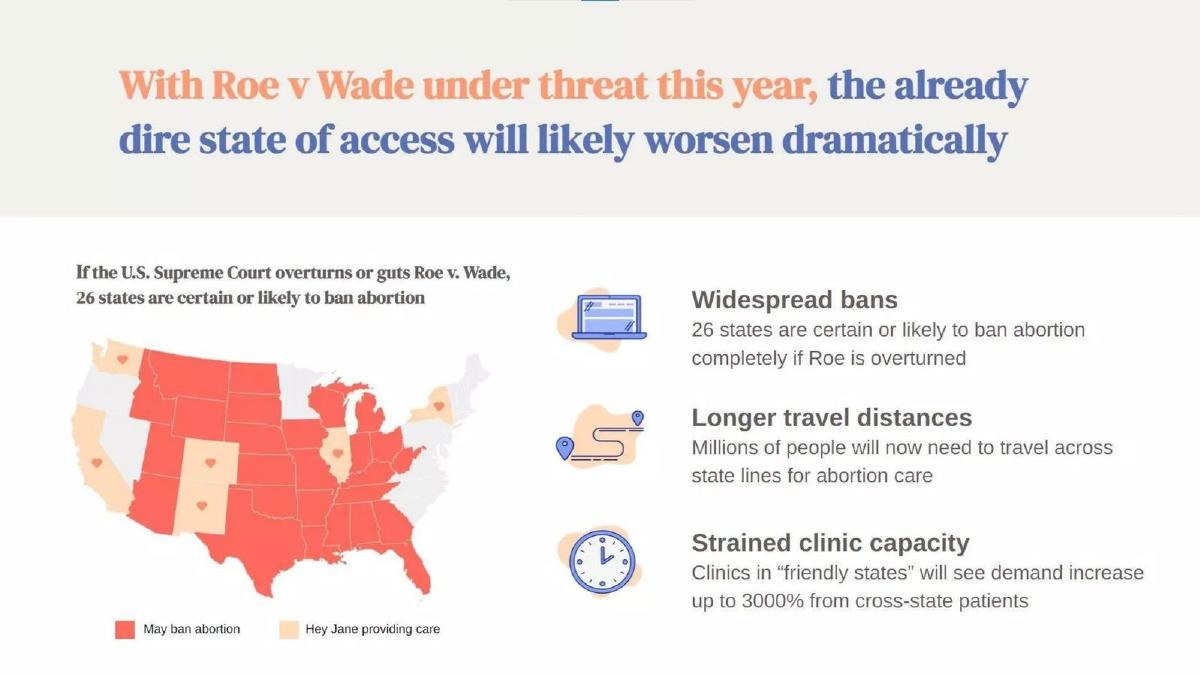
- Hey Jane positions itself against a 3000% projected increase in demand for clinics in 'friendly states' if Roe v. Wade were overturned (Slide 3).
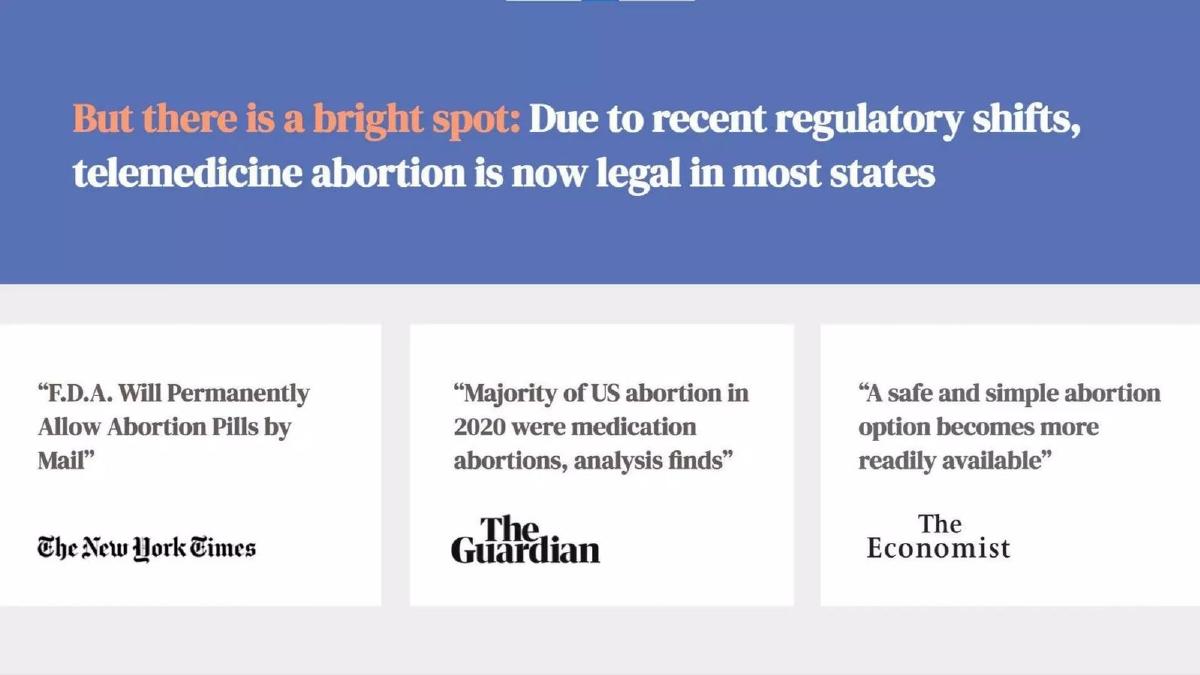
- The company highlights a critical regulatory shift: the FDA's 2021 decision to allow abortion pills by mail (Slide 5).
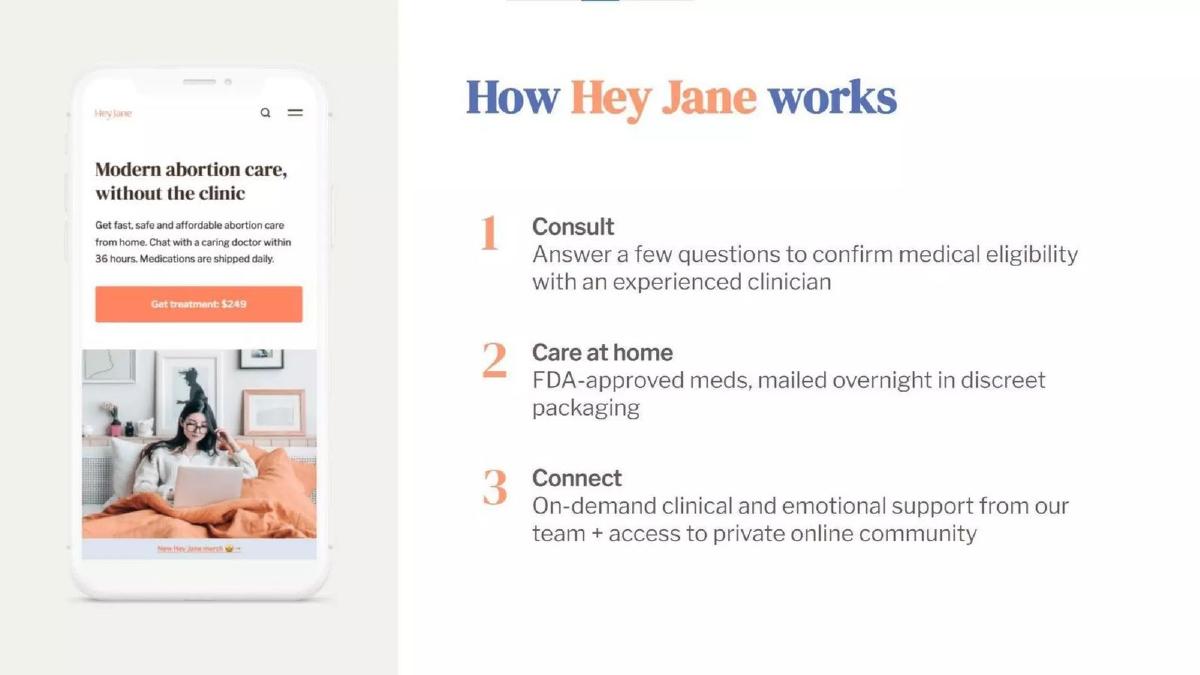
- The service is priced at $249, as shown in the mobile app mockup (Slide 6).
- Hey Jane reports a Net Promoter Score (NPS) of 91, significantly higher than the healthcare vertical average of 9 (Slide 9).
- The deck claims a $1.4 trillion total addressable market for women's healthcare spend (Slide 11).
- The leadership team includes founders with backgrounds from Harvard Business School, Uber, and Columbia University (Slide 12).
- The deck omits a specific 'Ask' slide, failing to detail how the $9.7 million would be allocated.
Executive Summary: A Timely Response to a Healthcare Crisis
Hey Jane’s 13-slide pitch deck, used to raise $9.7 million in 2021, is a study in urgency. The company describes itself as a telehealth startup utilizing a 'Complete Care' model to provide medical, emotional, and social support for patients seeking abortion care. At the time of the deck's creation, the U.S. reproductive healthcare landscape was facing unprecedented legal shifts. Hey Jane positioned itself not just as a service provider, but as a necessary infrastructure for a post-Roe v. Wade world. By focusing on the 2021 FDA ruling that allowed medication abortion via mail, the deck presents a clear regulatory 'why now' that justifies its expansion.
Slides 1-3: The Problem and the Political Climate
The deck opens with a minimalist title slide (Slide 1) featuring the tagline 'Abortion on your own terms.' This immediately establishes the brand's patient-centric tone. Slide 2 dives into the 'incomparably difficult' nature of getting care, citing that 90% of counties lack a clinic and 84% of clinics report harassment. It also touches on the social isolation of the procedure, noting that 2/3 of women wouldn't talk to their closest friends about it.
Slide 3 is perhaps the most critical for investor urgency. It maps out the potential impact of the Supreme Court overturning Roe v. Wade. It notes that 26 states are 'certain or likely' to ban abortion and predicts that clinics in 'friendly states' will see demand increase by up to 3000% from cross-state patients. This slide transforms the business from a niche telehealth service into a critical relief valve for a strained national healthcare system.
Slides 4-5: The Regulatory 'Why Now'
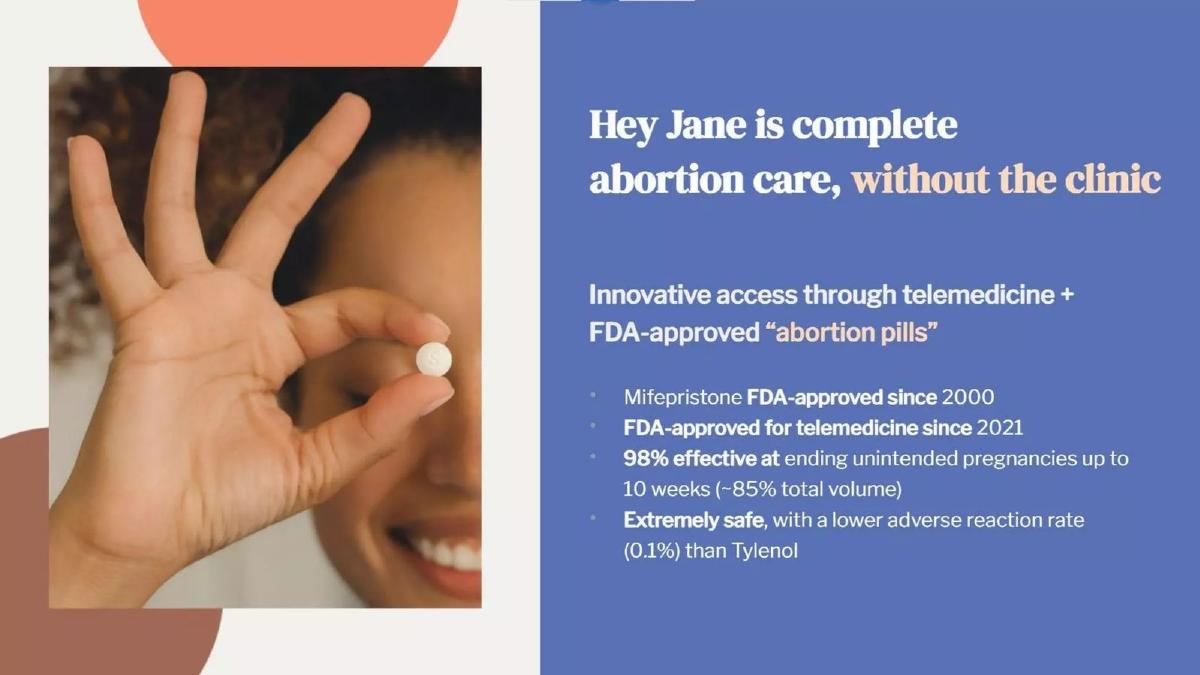
To balance the dire warnings of Slide 3, Slide 4 introduces a 'bright spot': recent regulatory shifts making telemedicine abortion legal in most states. Slide 5 provides the evidence, quoting headlines from The New York Times, The Guardian, and The Economist regarding the FDA’s decision to allow abortion pills by mail. It highlights that Mifepristone is 'extremely safe,' with a lower adverse reaction rate (0.1%) than Tylenol. By anchoring the pitch in FDA approval and clinical safety, Hey Jane de-risks the investment for those wary of the legal complexities surrounding the sector.
Slides 6-8: The Solution and the 'Complete Care' Model
Slide 6 introduces the product interface and a three-step process: Consult, Care at Home, and Connect. A mobile mockup shows a price point of $249 for treatment. Slide 7 emphasizes the 'unique' aspects of Hey Jane, specifically cross-state care and the 'first private online community for verified abortion patients.'
Slide 8 defines the 'Complete Care' model. It breaks the service down into Physical (virtual consults), Emotional (counselors), and Social (peer community). This is a strategic move to differentiate Hey Jane from 'pill mill' startups. By emphasizing the layers of support, the company positions itself as a premium, holistic healthcare provider rather than a simple pharmacy fulfillment service.
Slides 9-10: Traction and Social Proof
Slide 9 focuses on growth and trust. While the 'total patients' and 'avg monthly growth' figures are redacted as 'X' in this version of the deck, the catalogue listing confirms they had helped nearly 20,000 patients by 2021. The standout metric here is the Net Promoter Score (NPS) of 91. Comparing this to the healthcare vertical average of 9 is a powerful way to demonstrate product-market fit and patient satisfaction in a high-stress category.
Slide 10 reinforces this with patient testimonials. Quotes like 'so much more than a purchase' and 'no judgment or fear' validate the 'Complete Care' model described earlier. For investors, these testimonials prove that the emotional and social components of the business are actually resonating with the end-user.
Slides 11-13: Market Size, Team, and Conclusion
Slide 11 addresses the 'Big Vision.' It cites a $1.4 trillion women's healthcare spend. While abortion and birth control are valued at $8 billion, the slide shows five other 'locked' categories, suggesting that the Hey Jane model is a Trojan horse for a much larger telehealth platform. This is a standard venture capital requirement: showing how a specific entry point leads to a massive total addressable market (TAM).
The team slide (Slide 12) is strong. It features three co-founders: Kiki Freedman (CEO, ex-Uber/Bain), Gaby Izarra (Marketing, ex-Webflow/Autodesk), and Kate Shaw, MD (Medical, Columbia University). The inclusion of leadership from GoodRx, One Medical, and CityMD suggests the company has the operational 'muscle' to navigate the complexities of the US healthcare system. The deck concludes on Slide 13 with contact information and a repeat of the opening imagery.
What Works in This Deck
Regulatory Tailwinds: The deck perfectly captures a specific moment in time where regulatory changes (FDA mail-order approval) created a massive market opening. · NPS Comparison: Comparing an NPS of 91 against an industry average of 9 is a devastatingly effective way to show superiority in a crowded or poorly performing sector. · Holistic Branding: The 'Complete Care' framing moves the conversation away from the controversial aspects of the procedure and toward a standard of 'exceptional support' and 'inclusive care.' · Clear Problem Statement: The use of a map to show 'clinic deserts' and the 3000% demand surge creates a clear, logical need for a digital-first solution.
What Is Missing from This Deck
The Ask: There is no slide detailing how much money is being raised or how it will be spent. While we know from the catalogue that they raised $9.7M, the deck itself is silent on the terms. · Financial Projections: There are no charts showing projected revenue, burn rate, or path to profitability. The $249 price point is the only financial data point provided. · Unit Economics: The deck does not explain the cost of acquisition (CAC) or the lifetime value (LTV) of a patient, which is a significant omission for a telehealth startup. · Competitive Landscape: There is no mention of other telehealth providers or traditional clinics. The deck assumes Hey Jane is the only modern solution, which is rarely the case in venture-backed sectors.
What a Founder Should Copy
The 'Why Now' Slide: Slide 3 and 4 are excellent examples of how to use external macro-trends to create investment urgency. · Visualizing the Model: Slide 8 uses simple icons to explain a complex service model (Physical, Emotional, Social). This makes the 'secret sauce' of the business easy to digest. · Pedigree Alignment: The team slide (Slide 12) doesn't just list names; it uses recognizable logos (Uber, Bain, One Medical) to signal that the founders have 'been there, done that' in high-growth environments. · Social Proof: Mixing hard metrics (NPS) with soft metrics (testimonials) provides a balanced view of the company's impact on its users.
Frequently asked questions
- What is the primary problem Hey Jane aims to solve?
- Hey Jane addresses the 'incomparably difficult' process of obtaining abortion care in the U.S. According to Slide 2, 90% of counties lack a clinic, and 84% of existing clinics report harassment. By providing a telehealth solution, Hey Jane bypasses physical barriers, travel distances, and the social stigma that prevents 2/3 of women from discussing the procedure with friends.
- How does the 'Complete Care' model differ from standard telehealth?
- As detailed on Slide 8, the 'Complete Care' model is tripartite. It includes 'Physical' care (virtual clinical consults), 'Emotional' care (access to empathetic counselors), and 'Social' care (a private online community of peers). This holistic approach is credited with achieving an NPS of 91, far exceeding the industry average (Slide 9).
- What regulatory factors influenced the timing of this deck?
- The deck was created during a pivotal regulatory window. Slide 4 and 5 highlight that the FDA permanently allowed abortion pills by mail in 2021. Simultaneously, Slide 3 notes that 26 states were 'certain or likely' to ban abortion if Roe v. Wade were overturned, creating a surge in demand for remote, cross-state care solutions.
- What are the expansion plans for Hey Jane beyond abortion care?
- Slide 11 indicates that Hey Jane views abortion and birth control as an $8 billion entry point into a $1.4 trillion women's healthcare market. The slide shows five other 'locked' market segments with valuations ranging from $4 billion to $150 billion, suggesting a long-term strategy to apply their 'Complete Care' model to other underserved treatments.
- Is the team qualified to handle the legal and medical complexities of this sector?
- The leadership team (Slide 12) combines high-growth tech experience with medical expertise. CEO Kiki Freedman brings experience from Uber and Bain, while Head of Medical Kate Shaw, MD, provides clinical oversight from Columbia University. Other team members have backgrounds at GoodRx, One Medical, and CityMD, suggesting a strong grasp of both telehealth operations and regulated healthcare environments.