Heron’s 17-slide deck is a masterclass in using service-based validation to fund a SaaS transition. Instead of starting with a blank slate, the founders leveraged their existing consultancy, People Collective, to prove that companies would pay for compensation data and modeling. The deck highlights that they were already turning away 5x the clientele pipeline due to manual capacity constraints, creating a compelling 'why now' for automation. While the deck uses placeholders for specific revenue figures in this public version, the narrative flow from McKinsey-backed problem statements to a cle…
Key takeaways
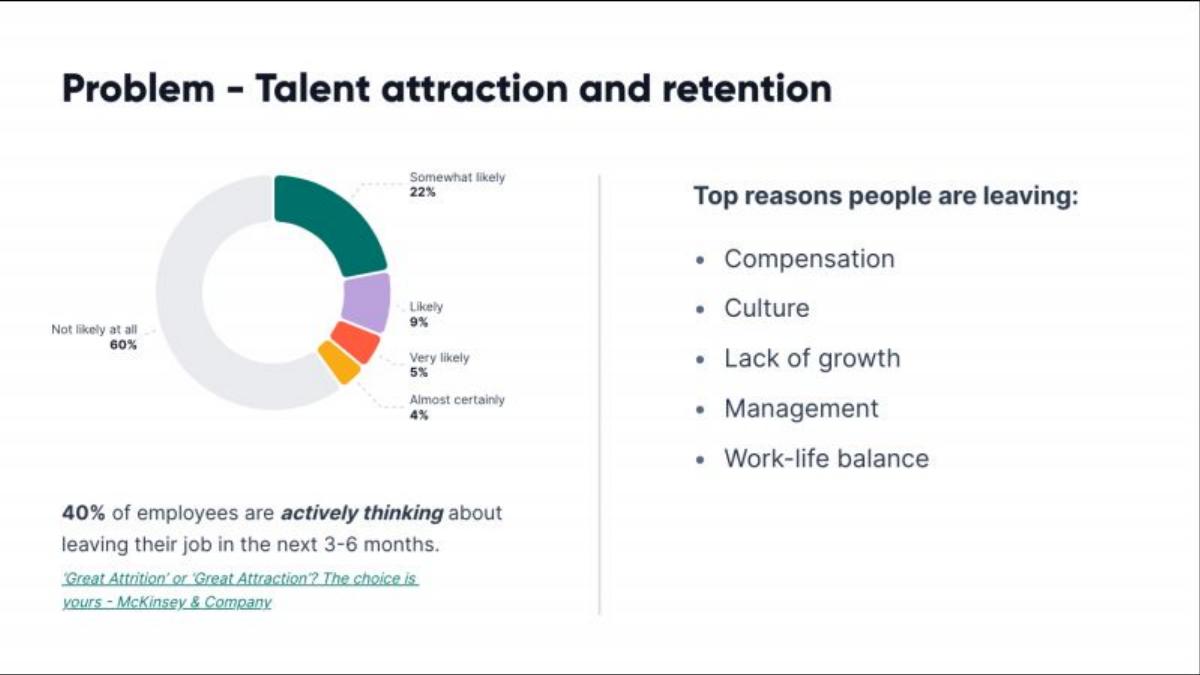
- The deck cites a McKinsey & Company study stating 40% of employees are actively thinking about leaving their jobs in the next 3-6 months (Slide 2).
- Heron identifies compensation as the top reason people leave their jobs, followed by culture and lack of growth (Slide 2).
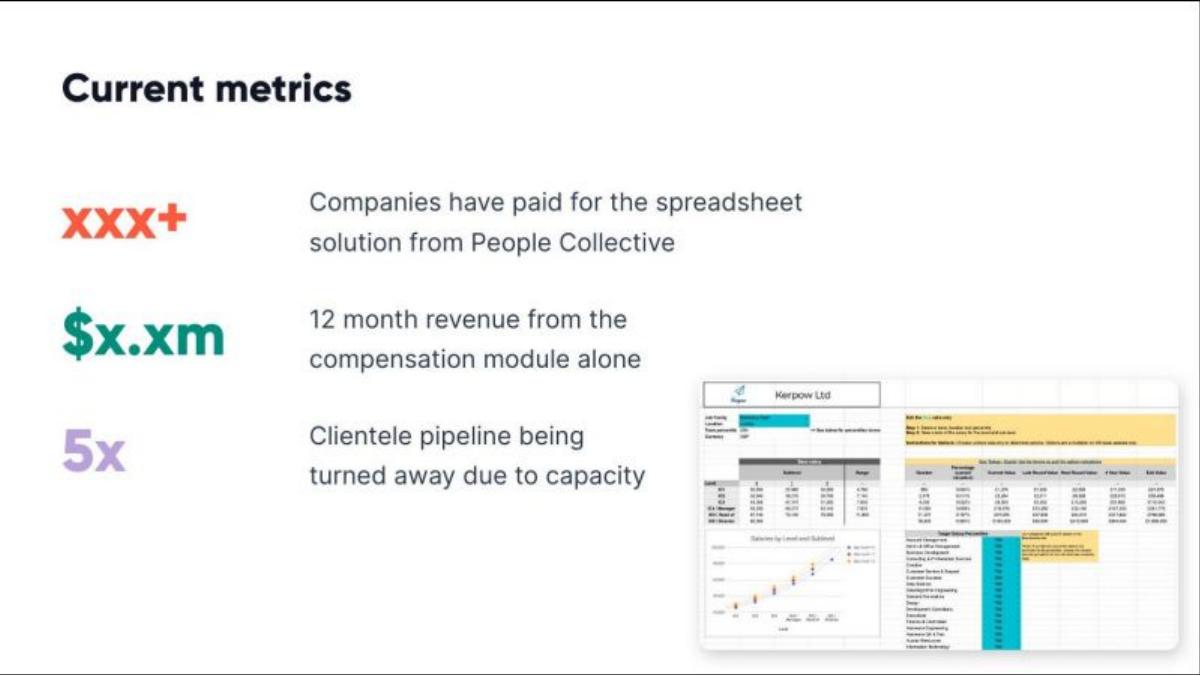
- The company proves market demand by noting that 'xxx+' companies have already paid for a spreadsheet solution from their predecessor, People Collective (Slide 5).
- A critical 'Why Now' factor is the 5x clientele pipeline currently being turned away due to manual capacity limits (Slide 5).
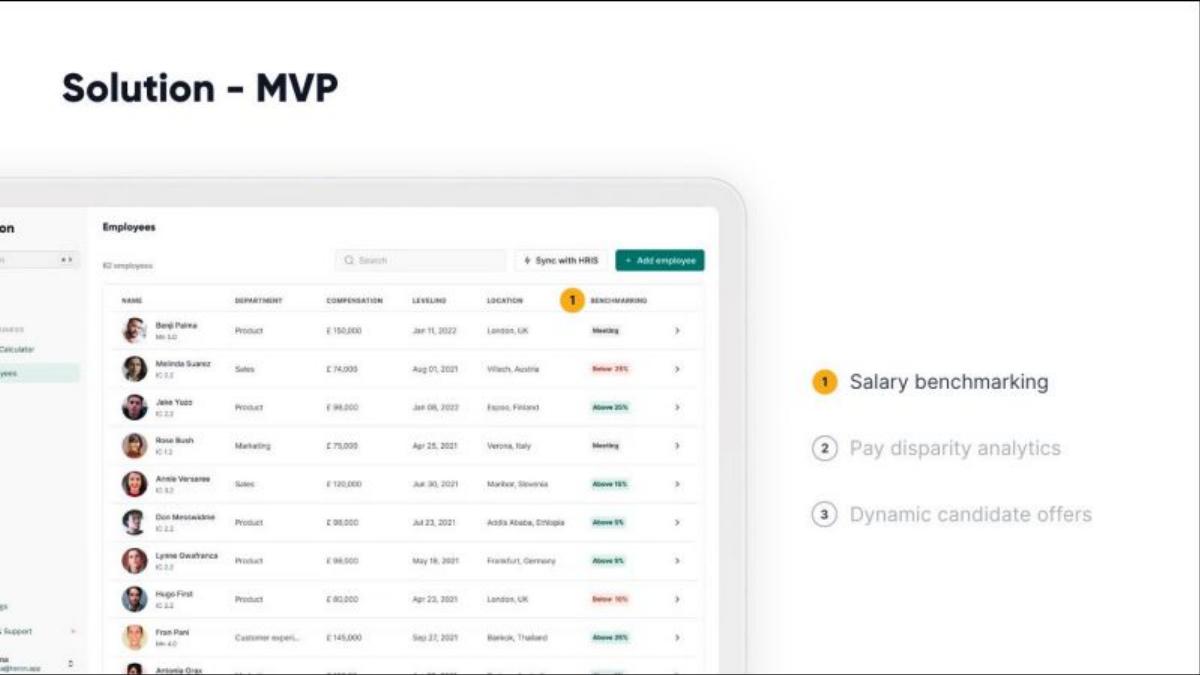
- The MVP focuses on three core pillars: salary benchmarking, pay disparity analytics, and dynamic candidate offers (Slides 6-8).
- The competitive landscape is segmented by geography, positioning Heron as the primary focus for the European market founded in 2022 (Slide 10).
- Heron targets venture-backed 10-500 person startups as their 'wedge market' before expanding to all companies with 50+ people (Slide 11).
- The team slide highlights significant hiring traction, claiming verbal agreements with 13 people out of 21 key first-year hires (Slide 14).
Executive Summary: The Service-to-SaaS Pivot
Heron’s pitch deck represents a classic and highly effective fundraising strategy: the service-to-SaaS pivot. By the time this deck was presented for their $1.2M seed round in 2020, the founders had already done the hard work of finding product-market fit through a manual consultancy called People Collective. This teardown examines how they translated that manual success into a high-growth software narrative.
Slide 1: Title and Branding
The cover slide is minimalist, focusing on the core value proposition: "Attract and Retain your workplace heroes." The branding uses a multi-color palette that feels modern and approachable, distinct from the traditional, sterile blue often associated with HR tech. The Heron logo is present but small, letting the mission lead the presentation.
Slides 2-3: The Macro and Micro Problem
Slide 2 uses external validation to set the stakes. By quoting a McKinsey & Company report stating that 40% of employees are considering leaving, Heron establishes a sense of urgency. They list compensation as the number one reason for attrition, directly linking their product to a CEO-level concern: talent retention.
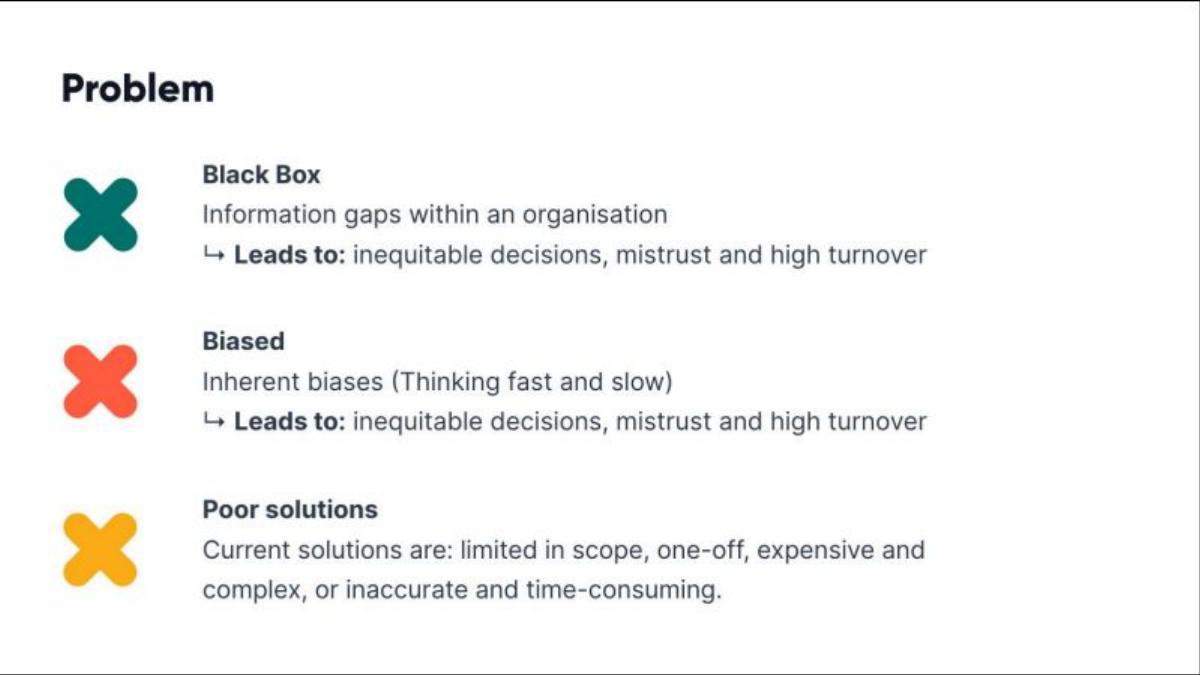
Slide 3 drills down into why this problem persists. They categorize the issues into three buckets: Black Box (information gaps), Biased (referencing the psychological concept of Thinking Fast and Slow), and Poor Solutions . They characterize existing options as "limited in scope, one-off, expensive and complex." This sets the stage for a solution that is transparent, automated, and accessible.
Slide 4: Why Now?
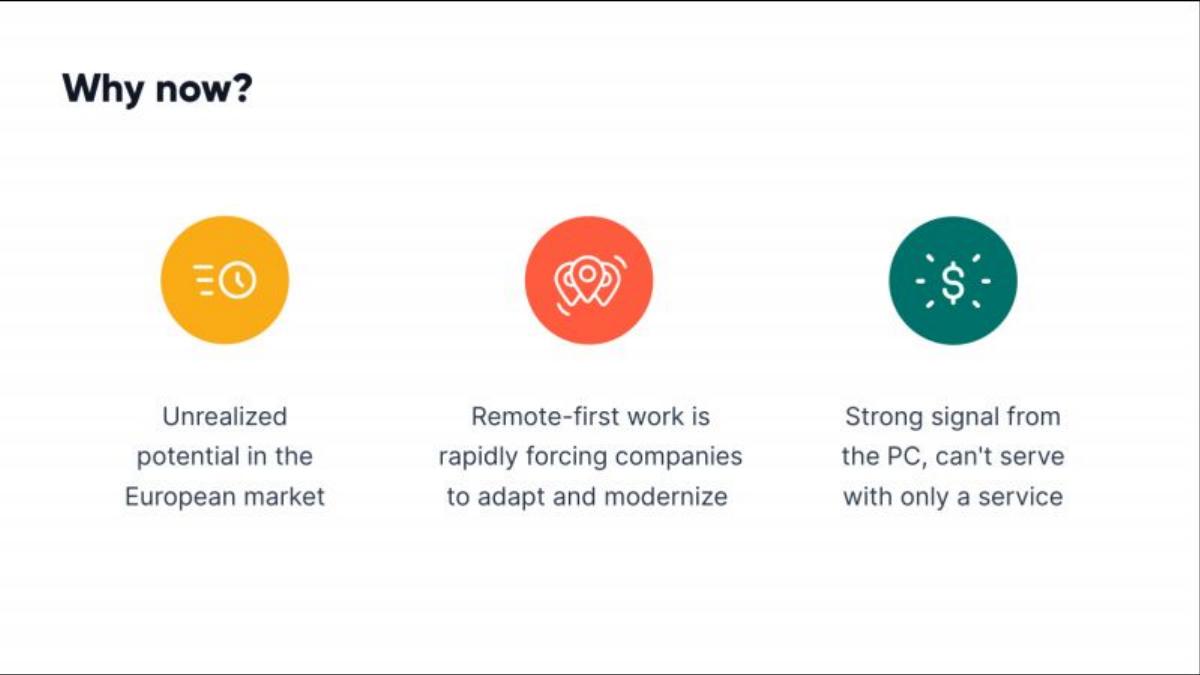
The "Why Now" slide identifies three catalysts. First, an "unrealized potential in the European market," suggesting that while US competitors exist, Europe is underserved. Second, the rise of "remote-first work," which complicates compensation across different geographies. Third, a "strong signal from the PC" (People Collective), indicating that their own service business can no longer keep up with demand.
Slide 5: Traction and Validation
This is arguably the most important slide in the deck. It proves that Heron isn't just an idea. They note that "xxx+" companies (placeholder for the actual figure) have already paid for their manual spreadsheet solution. Most importantly, they state their "clientele pipeline being turned away due to capacity" is 5x their current output. This is a powerful signal to investors that the market is pulling the product out of the founders, rather than the founders pushing it into the market.
Slides 6-8: The MVP Solution
These slides provide a clear walkthrough of the software. Slide 6 shows the employee dashboard with salary benchmarking , highlighting how individual pay compares to market percentiles (e.g., "Above 25%", "Below 10%"). Slide 7 moves into pay disparity analytics , showing a breakdown of gender split and average salary by department. Slide 8 demonstrates dynamic candidate offers , showing how the tool helps HR teams generate offer letters that balance salary, equity, and benefits. The UI shown is clean and data-heavy, reinforcing the "anti-black box" value prop.
Slide 9: Data Strategy
This slide is largely redacted in the public version, using placeholders like "First way" and "Second way." However, the structure suggests a three-pronged approach to data acquisition and utilization. In a compensation platform, the proprietary nature of the data is the primary moat, so this slide likely detailed how they aggregate and anonymize salary data from their customers to provide real-time benchmarks.
Slide 10: The Competitive Landscape
Heron uses a standard feature-comparison matrix but adds a geographic layer. They position themselves as the European focus (founded in 2022), contrasting with US competitors (founded in 2018/2019) and older UK data providers (founded in 1975). By checking all six feature boxes while competitors only check one or two, they claim a superior, all-in-one product suite.
Slide 11: Market Sizing (Wedge vs. Vision)
The market slide avoids the "trillion-dollar TAM" trap by focusing on a "Wedge market size." They target venture-backed startups with 10-500 people as their initial Serviceable Obtainable Market (SOM), valued at "$x.xb." Their grand vision expands this to all companies with over 50 employees, which they value at "$xx.xb." This shows a realistic path to scale, starting with a high-need niche.
Slides 12-13: Timeline and Social Proof
Slide 12 provides a linear history, from the founding of People Collective in 2018 to the Seed round in January 2023. It shows a rapid progression from MVP completion in February 2022 to first paying customer in April 2022. Slide 13 adds logos of recognizable brands like Disney, Patagonia, WWF, and Ecosia , though it's important to note these are likely clients of the predecessor consultancy, used here to demonstrate the team's ability to sell to major organizations.
Slide 14: The Team
The team slide is exceptionally strong. Kenna Smutz is listed as a 4th-time founder with experience at ClickUp. Matt Bradburn brings the domain expertise from People Collective and Peakon. Tamás Várkonyi adds operational depth with a Cambridge background. A unique and compelling metric included here is that they have "verbal agreements with 13 people" out of their 21 planned first-year hires, suggesting they have a talent pipeline ready to activate upon funding.
Slide 15: The Ask
The final content slide details the Pre-seed round (though the deck is for a Seed round, this may be a legacy slide or referring to the total capital stack). They specify the funding will go toward product development, team growth, and marketing . Notably, they mention SEIS/EIS terms , which are tax relief schemes for UK investors, indicating their primary target investor base at this stage.
What Heron Does Well
The deck excels at demand validation . By showing that they were literally unable to handle the amount of business coming their way through manual methods, they make the case for automation undeniable. They also do a great job of geographic positioning . By identifying as the European leader in a space where US companies are often the default, they create a clear "land grab" opportunity for investors looking for regional winners.
What is Missing
The deck is light on unit economics . While it mentions revenue from the compensation module, it doesn't detail Customer Acquisition Cost (CAC) or Lifetime Value (LTV). Given they were transitioning from a service model, investors would want to see how the margins improve as they move to pure SaaS. Additionally, the data sourcing slide is vague; in the highly competitive compensation space, explaining exactly how they get high-quality, real-time data without violating privacy or relying on stale self-reported surveys is critical.
Founder Takeaway: Copy the 'Wedge' Strategy
Founders should study Slide 11. Many decks fail because they try to be everything to everyone on day one. Heron clearly defines a wedge market (venture-backed startups) that they can dominate quickly before moving to a broader grand vision . This shows investors that you have a focused, executable plan for the first 18 months, rather than just a vague long-term dream.
Frequently asked questions
- What is Heron's core product offering?
- Heron is a total compensation management platform. According to slides 6 through 8, the product automates salary benchmarking, provides analytics on pay disparities (including gender split and average percentiles), and generates dynamic candidate offers that include both salary and equity components.
- How did the founders validate the need for this software?
- They used their existing consultancy, People Collective, as a testing ground. Slide 5 reveals that hundreds of companies had already paid for a manual spreadsheet-based version of the tool. The founders realized they had to build a SaaS platform because they were turning away five times the amount of business they could handle manually.
- Who is the target customer for Heron?
- As shown on slide 11, Heron's 'wedge' or initial go-to-market focus is venture-backed startups with 10 to 500 employees. Their 'grand vision' is to expand the Ideal Customer Profile (ICP) to all companies with more than 50 employees, significantly increasing their Serviceable Obtainable Market (SOM).
- What specific problems does Heron aim to solve in the HR space?
- Slide 3 outlines three main pain points: 'Black Box' information gaps that lead to mistrust, inherent biases in decision-making (referencing 'Thinking Fast and Slow'), and the fact that current solutions are either too expensive, one-off, or time-consuming.
- What is the background of the founding team?
- The team consists of Kenna Smutz (Product), a 4th-time founder with experience at ClickUp; Matt Bradburn (Growth), co-founder of People Collective and ex-VP People at Peakon; and Tamás Várkonyi (Ops), who holds a social psychology degree from Cambridge and experience scaling teams at Ledgy (Slide 14).