Help Lightning's pitch deck is a concise, 9-slide presentation that successfully leveraged the unique market conditions of 2020 to secure Series A funding. The company, which provides 'Merged Reality' for remote field service, focused heavily on a specific 'Pandemic Inflection' that saw usage grow by 417% in a single month. By showcasing a blue-chip customer list including Siemens, Canon, and Ricoh, alongside a team led by a serial entrepreneur with four exits, the deck establishes immediate credibility. While it lacks detailed financial projections and a competitive landscape analysis, the s…
Key takeaways
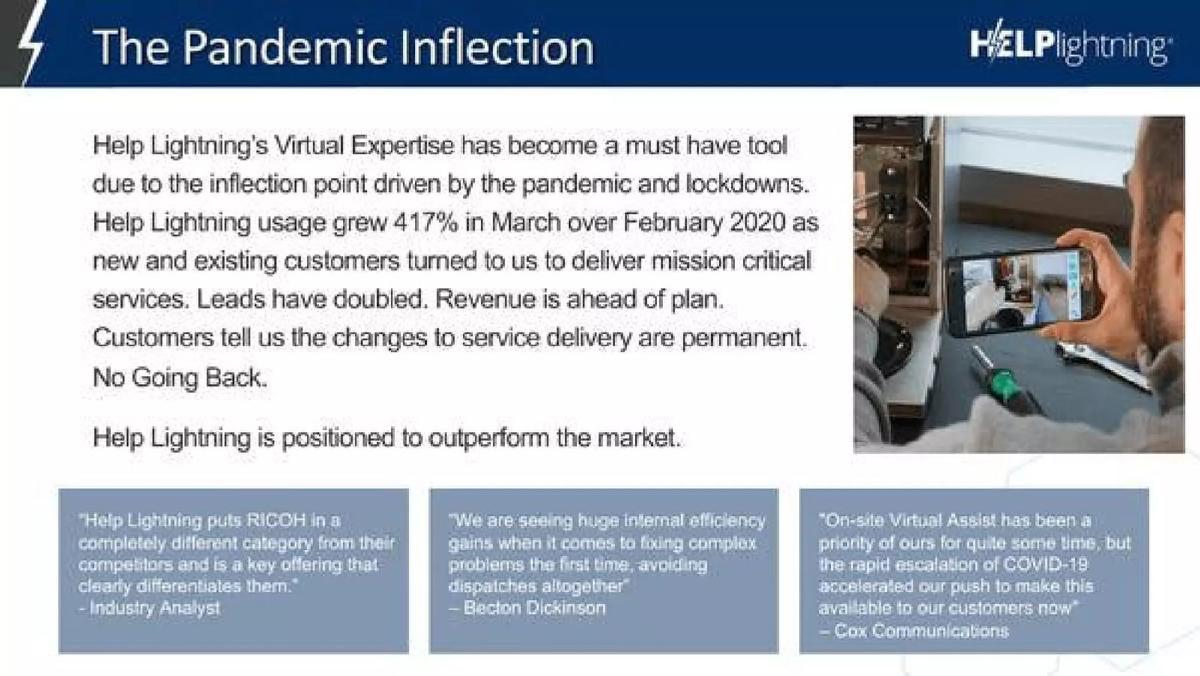
- The deck highlights a massive usage growth of 417% in March 2020 compared to February 2020 (Slide 6).
- Help Lightning reports a 111% net retention rate, indicating strong product-market fit and expansion within existing accounts (Slide 7).
- The Series A ask is explicitly stated as $8M, earmarked for sales and marketing growth (Slide 7).
- The company claims a strong intellectual property position with 5 patents across 8 countries (Slide 7).
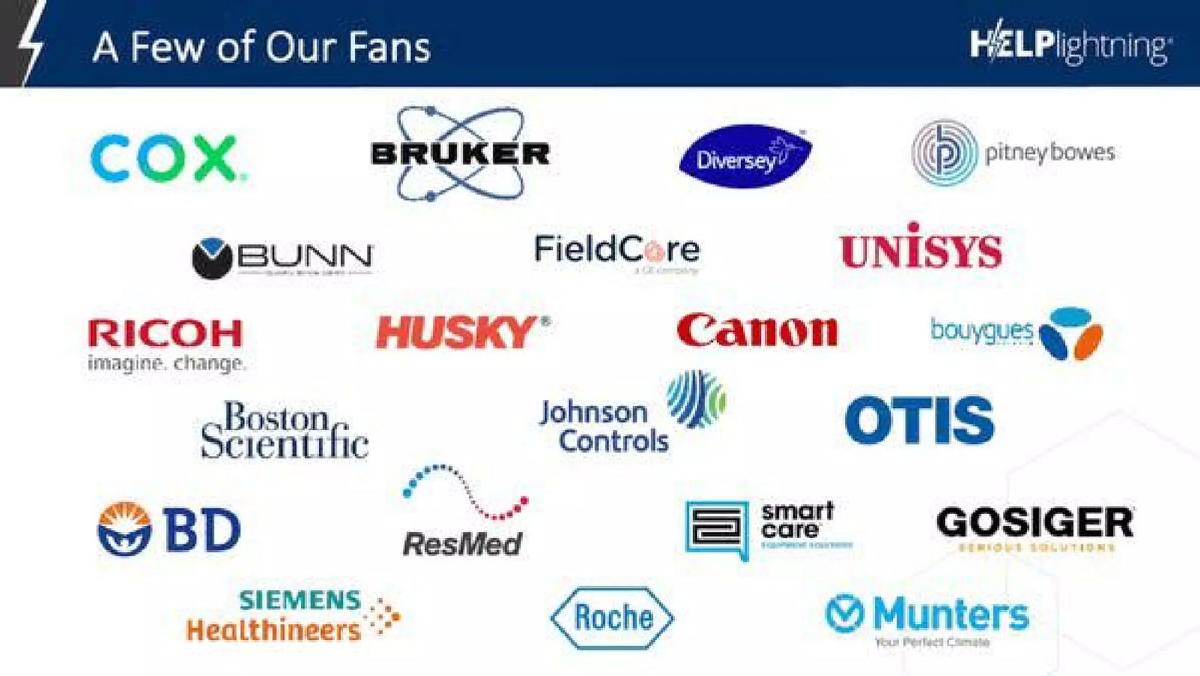
- The customer base is high-caliber, featuring logos like Siemens Healthineers, Cox, Canon, and Boston Scientific (Slide 4).
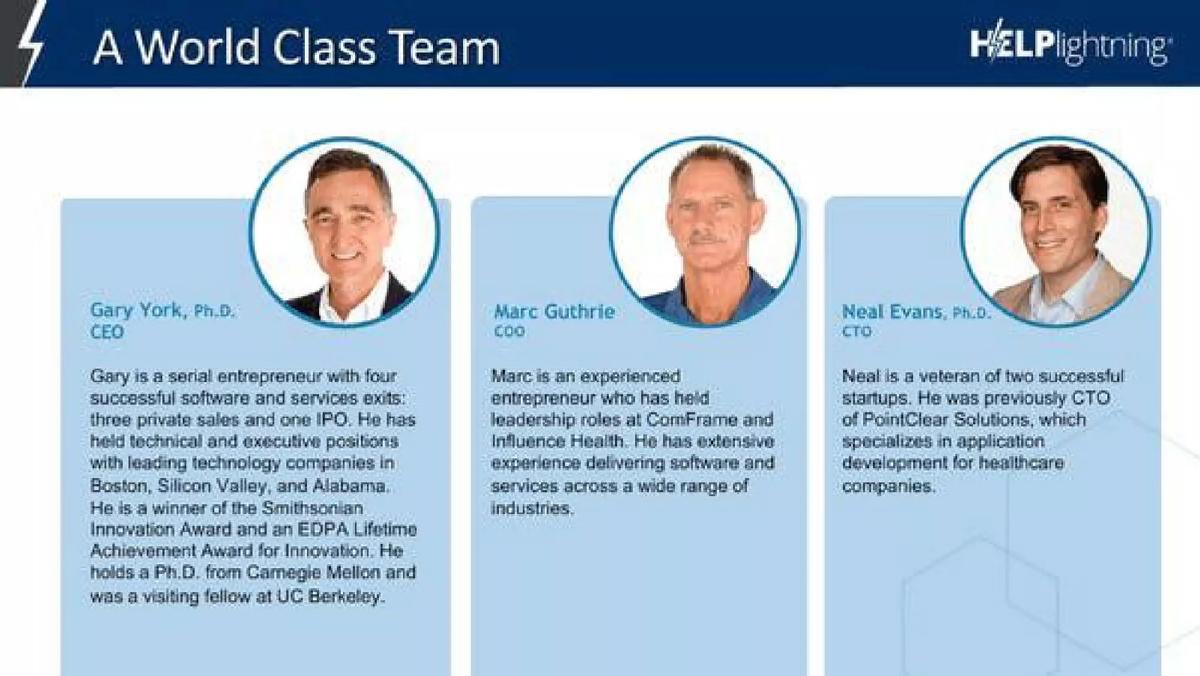
- The CEO, Gary York, Ph.D., is presented as a serial entrepreneur with four successful exits, including one IPO (Slide 5).
- The technology is described as 'Merged Reality,' blending two real-time video streams into a collaborative environment (Slide 2).
- The deck omits a traditional 'Problem' slide, choosing instead to focus on the 'Pandemic Inflection' as the primary market driver (Slide 6).
Overview of the Help Lightning Series A Deck
Help Lightning’s pitch deck is a lean, 9-slide document that focuses on momentum and market timing. Founded in 2009, the company spent years developing its 'Merged Reality' technology before hitting a massive tailwind during the 2020 global pandemic. The deck is designed to prove that their remote assistance software is no longer a 'nice-to-have' but a mission-critical tool for enterprise field services. With a heavy emphasis on blue-chip validation and explosive usage growth, the deck successfully navigated a Series A raise of $12.3 million (per catalogue facts), despite asking for $8 million on the slides.
The Vision and Product (Slides 1-2)
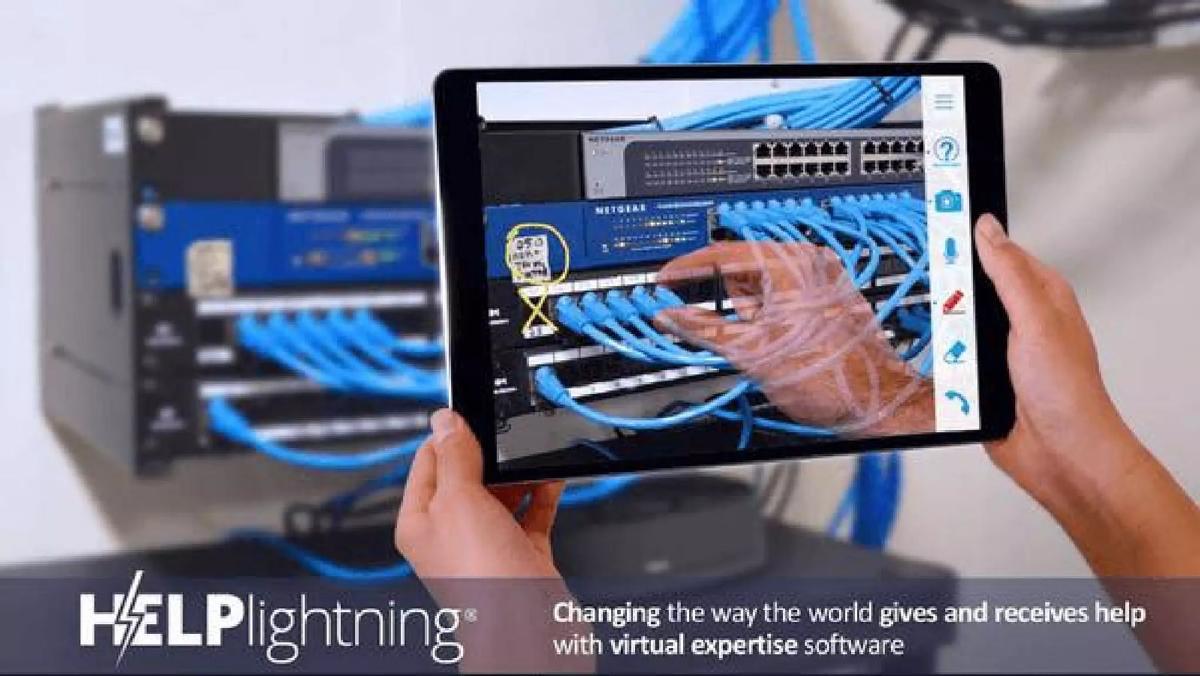
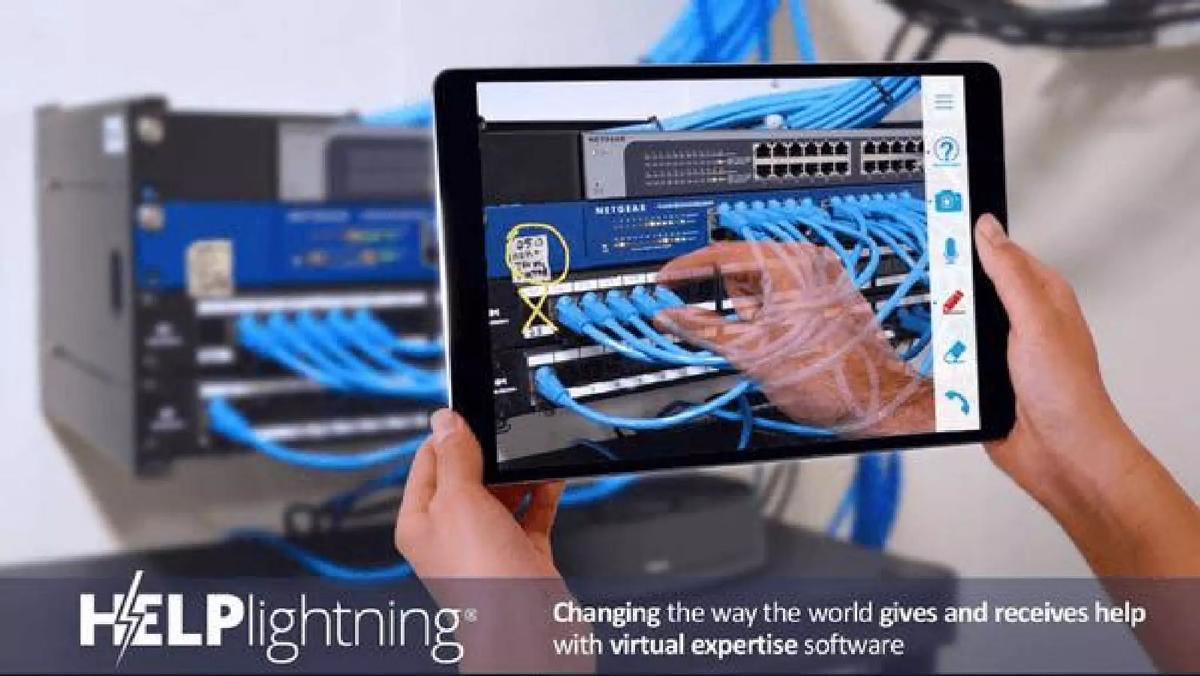
Slide 1: Title Slide The deck opens with a high-quality action shot of a technician using a tablet to inspect a server rack. The tablet screen shows a 'merged' hand reaching into the frame to point at specific cables. The tagline is 'Changing the way the world gives and receives help with virtual expertise software.' It immediately establishes the use case: remote, visual, and collaborative technical support.
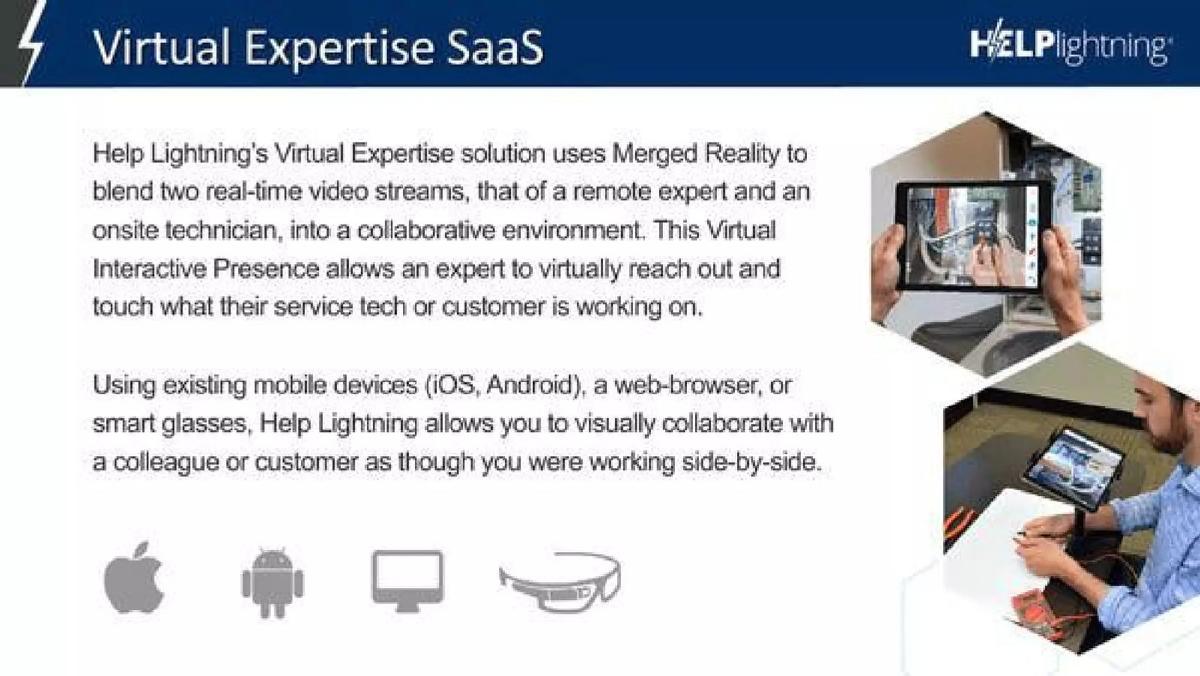
Slide 2: Virtual Expertise SaaS This slide defines the technology. It uses the term 'Merged Reality' to describe the blending of two real-time video streams. The copy explains that this 'Virtual Interactive Presence' allows an expert to 'virtually reach out and touch' what a technician is working on. It lists compatibility with iOS, Android, web browsers, and smart glasses, positioning the software as hardware-agnostic. Two inset photos show the product in use: one on a tablet and one on a desktop setup with a specialized camera arm, demonstrating versatility in both field and office environments.
Market Focus and Social Proof (Slides 3-4)
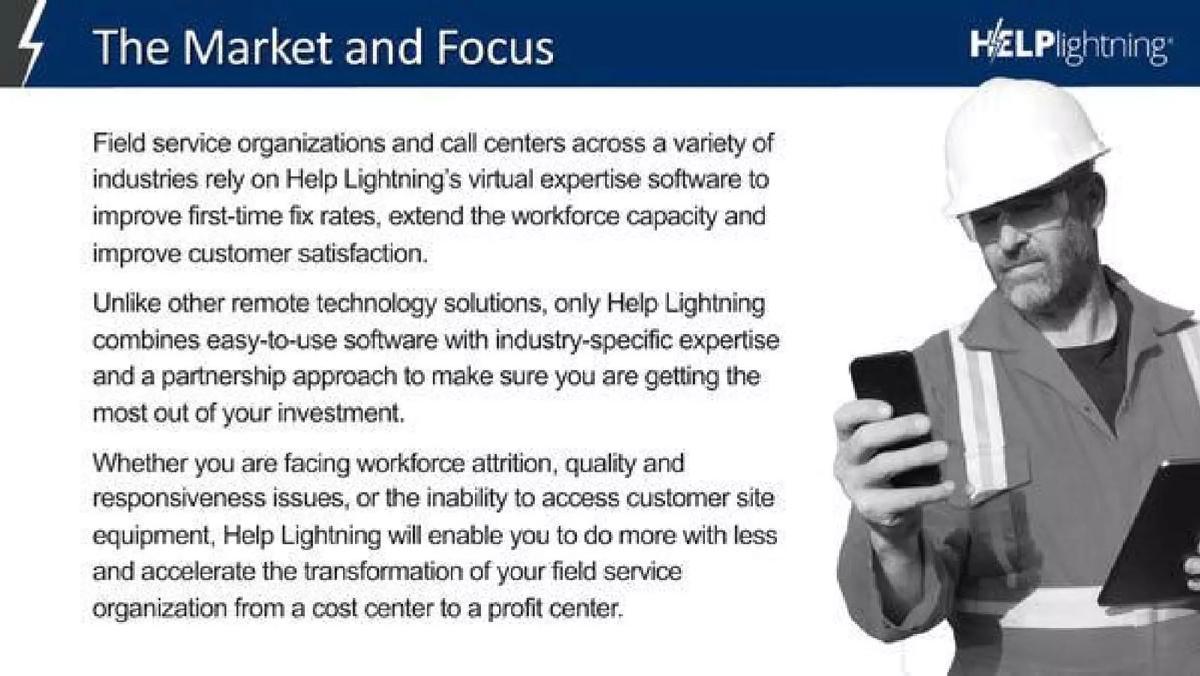
Slide 3: The Market and Focus Instead of a broad TAM/SAM/SOM slide, Help Lightning focuses on the specific value proposition for field service organizations. They cite three key outcomes: improved first-time fix rates, extended workforce capacity, and improved customer satisfaction. The slide makes a bold claim that their software helps transform field service from a 'cost center to a profit center.' It also mentions 'workforce attrition' as a pain point, suggesting the tool helps capture knowledge from aging experts before they retire.
Slide 4: A Few of Our Fans This is a classic logo wall, but the quality of the logos is exceptionally high for a Series A company. The 20 logos displayed include global giants like Siemens Healthineers, Canon, Ricoh, Boston Scientific, Roche, and Otis. The breadth of industries—ranging from healthcare (BD, ResMed) to telecommunications (Cox) and industrial equipment (Husky, Munters)—demonstrates that the 'Merged Reality' use case is horizontal and scalable across different technical domains.
The Team and the Inflection Point (Slides 5-6)
Slide 5: A World Class Team The team slide focuses on three executives. CEO Gary York, Ph.D., is the anchor, described as a serial entrepreneur with four exits, including an IPO. His academic credentials (Ph.D. from Carnegie Mellon) and awards (Smithsonian Innovation Award) add significant weight. COO Marc Guthrie and CTO Neal Evans, Ph.D., are also highlighted for their previous leadership roles and startup experience. The collective narrative is one of seasoned professionals who have 'been there, done that,' reducing execution risk in the eyes of investors.
Slide 6: The Pandemic Inflection This is arguably the most important slide in the deck. It addresses the 'Why Now?' question with startling data. It states that Help Lightning usage grew 417% in March 2020 compared to February 2020. It notes that leads have doubled and revenue is 'ahead of plan.' The slide includes three testimonials from an industry analyst, Becton Dickinson, and Cox Communications. The Cox quote is particularly telling: 'the rapid escalation of COVID-19 accelerated our push to make this available to our customers now.' This slide frames the pandemic not as a temporary boost, but as a permanent shift in service delivery.
Traction and The Ask (Slides 7-9)
Slide 7: Early Growth Stage This slide provides the 'hard' metrics. It uses icons to display three key figures: a '$2X' for ARR growth goals, '111%' for net retention, and '117%' for 2020 growth. A line graph on the right shows 'Call Volume and User Count Growth,' with both lines trending sharply upward toward the end of the timeline. The slide also mentions '5 patents in 8 countries,' highlighting their defensive moat. Finally, it states the round details: 'Series A Round - $8M for sales and marketing growth.'
Slide 8: Seeing is Believing! Recognizing that 'Merged Reality' is difficult to explain in text, this slide serves as a gateway to video demonstrations. It provides links to a 'Virtual Expertise Overview,' an 'International Support Call,' and 'Field Service Support.' A quote from Canon Solutions reinforces the market demand: 'Our customers now expect this is how we will service them.' The visual shows a remote expert at a desk using a specialized camera to project his hands into a technician's view.
Slide 9: Contact The final slide summarizes the value proposition: 'Virtual Interactive Presence supports business continuity and transforms service delivery.' It provides the CEO’s direct email address and features the company logo prominently.
What Works in This Deck
1. The 'Why Now' is Undeniable: Most decks struggle to prove urgency. Help Lightning uses the 417% usage spike (Slide 6) to show that the market moved toward them overnight. This creates a 'fear of missing out' (FOMO) for investors who see a clear inflection point.
2. Enterprise Validation: The logo wall on Slide 4 is not just a collection of startups; it is a list of Fortune 500 companies. For a Series A company, having Siemens, Roche, and Canon as 'fans' suggests that the product has passed rigorous enterprise security and procurement hurdles.
3. High-Signal Team: The CEO’s track record of four exits (Slide 5) is a massive de-risking factor. Investors at the Series A stage are looking for founders who can scale a business, and Gary York’s history provides that confidence.
4. Net Retention Metric: The 111% net retention figure on Slide 7 is a 'gold standard' SaaS metric. It proves that not only are customers staying, but they are also expanding their usage over time, which is the hallmark of a healthy B2B software business.
What is Missing from This Deck
1. Competitive Landscape: The deck completely ignores competitors. In the remote assistance space, companies like TeamViewer, Librestream, and even general tools like Zoom or FaceTime are potential threats. The deck fails to explain why Help Lightning’s 'Merged Reality' is technically superior or more defensible than a standard video call with annotations.
2. Detailed Financials: While the deck mentions '$2X ARR growth' and an '$8M' ask, it does not provide a breakdown of current ARR, burn rate, or a basic P&L. Investors would need to see the starting point of that '2X' growth to understand the scale of the business.
3. Unit Economics: There is no mention of Customer Acquisition Cost (CAC) or Lifetime Value (LTV). Given that the $8M ask is specifically for 'sales and marketing growth,' showing the efficiency of their current sales motion would have been a strong addition.
4. Product Roadmap: The deck focuses heavily on what the product does today. It lacks a vision for the next 3-5 years. Does the company plan to integrate AI for automated diagnostics? Will they move into consumer markets? The lack of a roadmap makes the vision feel somewhat static.
What a Founder Should Copy
1. Use Specific Growth Windows: If your business experienced a surge due to a specific event (like the pandemic), highlight the month-over-month growth during that window (Slide 6). It is much more impactful than an annualized average.
2. Lead with Credibility: If you have a strong team or impressive customers, put them early in the deck. Help Lightning places its logos and team in the first half of the presentation, which builds the 'trust' necessary for the investor to take the subsequent data seriously.
3. The 'Hardware-Agnostic' Play: By showing the software working on tablets, desktops, and smart glasses (Slide 2), Help Lightning avoids being pigeonholed as a 'hardware company.' Founders in the AR/VR space should follow this lead to avoid the high-risk perception associated with hardware startups.
4. Clear Use of Funds: Slide 7 explicitly states that the $8M is for 'sales and marketing growth.' Being specific about where the money goes—rather than just saying 'general corporate purposes'—shows that the founders have a clear plan for scaling the existing momentum.
Conclusion Help Lightning’s deck is a textbook example of a 'momentum deck.' It doesn't spend time educating the investor on the basics of SaaS or the general benefits of AR. Instead, it assumes the investor understands the category and focuses entirely on why Help Lightning is winning the category right now. The combination of elite enterprise logos, a veteran leadership team, and a massive, pandemic-driven usage spike makes for a compelling Series A narrative.
Frequently asked questions
- What is the core technology behind Help Lightning?
- Help Lightning utilizes what they call 'Merged Reality' or 'Virtual Interactive Presence.' As described on Slide 2, the software blends two real-time video streams—one from a remote expert and one from an onsite technician—into a single collaborative environment. This allows the expert to virtually reach out and 'touch' or annotate the equipment the technician is working on, using mobile devices, web browsers, or smart glasses.
- How did the COVID-19 pandemic impact their business metrics?
- The pandemic served as a significant catalyst for the company. According to Slide 6, usage grew by 417% in March 2020 over February 2020. Additionally, the company reported that leads doubled during this period and revenue was ahead of plan, as customers viewed the shift to remote service delivery as a permanent change rather than a temporary fix.
- What are the key financial metrics shared in the deck?
- The deck is relatively light on hard dollar figures but provides strong growth indicators on Slide 7. It notes a 111% net retention rate and a 117% growth rate for 2020. It also mentions a goal of 2x ARR growth for the year. The most specific financial figure is the $8 million Series A round target intended to fund sales and marketing.
- Who are the key members of the leadership team?
- The team is led by CEO Gary York, Ph.D., a serial entrepreneur with four exits (three private, one IPO) and a Ph.D. from Carnegie Mellon. He is supported by COO Marc Guthrie, who has leadership experience at ComFrame and Influence Health, and CTO Neal Evans, Ph.D., a veteran of two successful startups and former CTO of PointClear Solutions (Slide 5).
- What specific industries does Help Lightning target?
- While the 'Fans' slide (Slide 4) shows a broad range of sectors, the text on Slide 3 specifies a focus on field service organizations and call centers. The customer logos suggest heavy penetration in medical technology (Roche, BD, Boston Scientific), office hardware (Ricoh, Canon, Pitney Bowes), and industrial/utility services (Siemens, Cox, Otis).