Hemptown Spring’s 2019 presentation outlines a capital-intensive strategy to dominate the US hemp market through scale and genetic differentiation. By moving from 50 acres in 2018 to a projected 2,350 acres by 2020 (Slide 13), the company aims to leverage 'Soil to Oil' vertical integration. The deck highlights a significant pricing advantage for rare cannabinoids, specifically CBG isolate, which they price at $27,000/kg compared to just $7,000/kg for CBD isolate (Slide 7). While the deck provides a detailed capital structure and clear growth milestones across Oregon, Kentucky, Colorado, and C…
Key takeaways
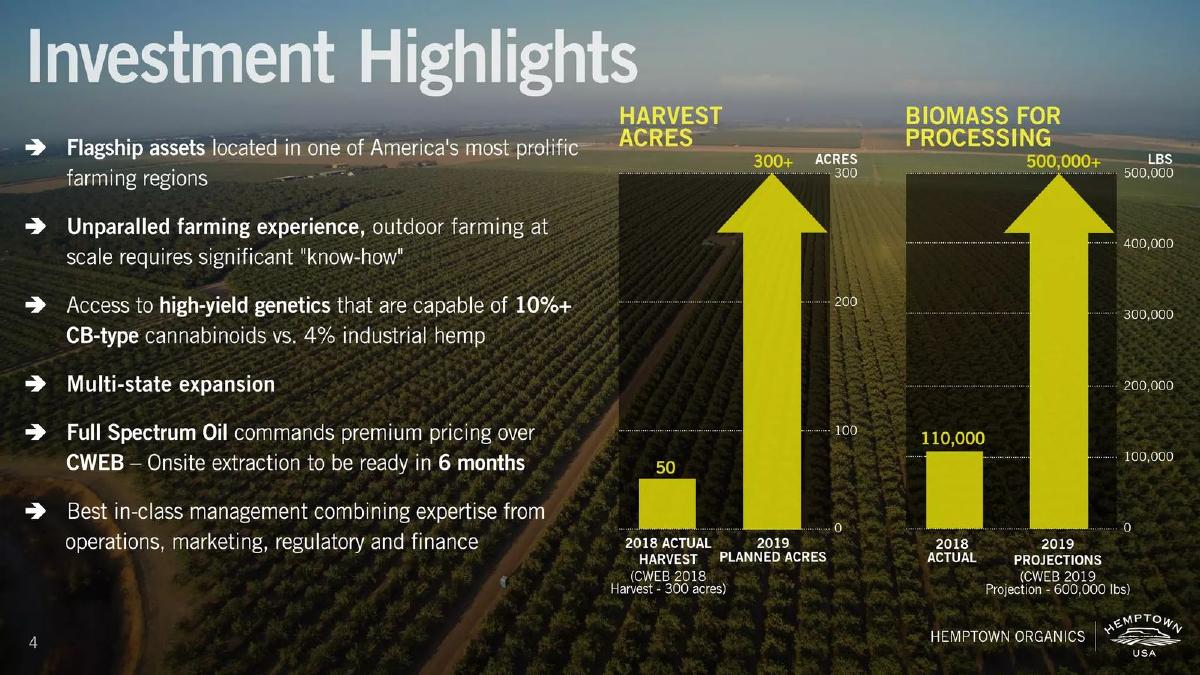
- The company planned a massive scale-up from 50 harvest acres in 2018 to 300+ planned acres in 2019 (Slide 4).
- Biomass production was projected to grow from 110,000 lbs in 2018 to over 500,000 lbs in 2019 (Slide 4).
- Hemptown claims a significant margin advantage by growing outdoor hemp at $5-$10/lb compared to indoor cannabis at $900-$1,200/lb (Slide 7).
- The revenue strategy pivots heavily toward CBG isolate, which commands a $27,000/kg price point versus $7,000/kg for CBD isolate (Slide 7).
- The company secured exclusive rights to 1 million rare CBG seeds for the 2019 season and the following four years (Slide 10).
- Growth targets include reaching 2,350 total acres by 2020 through joint ventures and contract farming in four states (Slide 13).
- The capital structure shows 53.2 million basic shares outstanding and a fully diluted count of 58.7 million shares (Slide 19).
- Vertical integration includes the launch of an in-house brand, Siskū Botanicals, to capture retail margins (Slide 16).
Executive Summary: The Industrialization of Cannabinoids
Hemptown Spring (branded as Hemptown USA) presents a 2019 investor deck that is less about a 'startup' and more about an industrial agricultural scale-up. The narrative centers on the transition from traditional industrial hemp to high-value, genetically specialized cannabinoid production. By focusing on rare cannabinoids like CBG and vertical integration through extraction and branding, the company attempts to distance itself from the commoditized CBD market of the late 2010s.
Slide 1: Title and Positioning
The cover slide establishes the core thesis: "Soil to Oil." This phrase is a direct nod to vertical integration, suggesting the company controls the entire value chain from cultivation to finished product. The subtitle "Positioned for Global Growth" and the Q1 2019 date stamp place this deck at the height of the post-Farm Bill hemp boom in the United States. The imagery of a vast outdoor hemp field reinforces the scale of their operations.
Slide 4: Investment Highlights and Production Scaling
This slide serves as the executive summary of the company's progress. It lists six key pillars: flagship assets in prolific regions, farming expertise, high-yield genetics (10%+ cannabinoids vs. 4% industrial standard), multi-state expansion, onsite extraction, and management expertise. The visual data is the most compelling part of this slide, showing a 6x increase in harvest acres (50 to 300+) and a nearly 5x increase in biomass for processing (110,000 lbs to 500,000+ lbs) between 2018 and 2019 projections. This indicates a company in a rapid execution phase.
Slide 7: Unit Economics and Revenue Drivers
Slide 7 is the most critical slide for understanding the business model. It compares the revenue potential of different hemp products against the cost of production. The "Revenue Drivers" chart shows a massive price delta between raw CBD Biomass ($29/kg) and CBG Isolate ($27,000/kg). This justifies the company's focus on rare cannabinoids. On the right, "Cost Considerations" highlights the efficiency of outdoor farming. Hemptown claims a cost of $5-$10/lb for feminized hemp, which is a fraction of the $900-$1,200/lb cost for indoor cannabis. This slide effectively argues that Hemptown has a massive structural margin advantage over indoor or greenhouse growers.
Slide 10: Genetic Competitive Advantage
Hemptown leans heavily on its IP in this slide. They claim exclusive rights to 1 million rare CBG seeds for the 2019 season and the following four years. The slide asserts that they yield 15-20% full-spectrum CBD, which they describe as "some of the world's most coveted profile." By securing these seed rights, the company positions itself as one of the top five CBG producers in the US, creating a barrier to entry for competitors who only have access to standard industrial hemp seeds.
Slide 13: Growth Strategy and Geographic Footprint
This slide outlines a roadmap to 2,350 acres by 2020. The strategy is diversified across four states: Oregon (350+ acres), Kentucky (500+ acres via joint venture), Colorado (1,500 acres via joint venture), and California (500+ acres via contract farming). Beyond farming, the strategy includes vertically integrating processing to increase margins, implementing a global distribution strategy with Fortune 500 brands, and pursuing strategic acquisitions of other farming operations and brands. The mention of "water-soluble delivery system" patents suggests they are also looking at the beverage and functional food markets.
Slide 16: Branded Consumer Goods (Siskū Botanicals)
To complete the "Soil to Oil" story, the deck introduces Siskū Botanicals, Hemptown's first in-house line of branded products. The slide emphasizes "branding elegance" and "product efficacy." This is a strategic move to capture the highest possible point in the value chain—retail. By moving from a B2B biomass supplier to a B2C brand owner, Hemptown aims to insulate itself from wholesale price fluctuations in the hemp market.
Slide 19: Capital Structure
This slide provides transparency regarding the company's equity. With 53.2 million basic shares and a fully diluted total of 58.7 million, the cap table appears relatively clean for a company of this scale. The presence of warrants at $0.10 and $0.50, along with options at $1.00, gives investors a clear picture of the price levels at which previous capital was raised and where future dilution will occur. It shows a staged valuation growth that aligns with the operational milestones mentioned earlier in the deck.
Slide 23: Contact and Closing
The final slide provides direct contact information for Damien Lowry, including a phone number and email address. The "Grow With Us" call to action is thematic, though the slide lacks a specific dollar amount for the investment 'Ask' in this specific version of the presentation.
What Works Well in This Deck
The deck excels at demonstrating scale. The jump from 50 to 2,350 acres is a clear, ambitious narrative. The comparison of unit economics on Slide 7 is particularly effective; it uses industry benchmarks to make Hemptown's outdoor farming model look like a high-margin machine. Furthermore, the focus on CBG rather than just CBD shows a sophisticated understanding of market saturation and the need for product differentiation. The inclusion of the capital structure (Slide 19) is a professional touch that many early-stage decks omit, providing immediate clarity on the share count.
What Is Missing or Could Be Improved
The most notable omission in this 8-slide selection is a detailed 'Use of Funds' or a specific 'Ask' slide. While the growth strategy is clear, the deck doesn't explicitly state how much capital is being raised or exactly how that capital will be allocated between farm expansion, extraction equipment, and brand marketing. Additionally, while 'management expertise' is mentioned as a highlight on Slide 4, the provided slides do not include the specific biographies of the leadership team. In a highly regulated and operationally complex industry like hemp, the specific track records of the founders and operators are as important as the acreage they control.
Founder Takeaways: Copy These Moves
Vertical Unit Economics: If you are in a commodity-adjacent business, use a slide like Slide 7 to show how your specific process (e.g., outdoor vs. indoor, or raw vs. refined) creates a margin cushion that competitors cannot match. · IP as a Barrier: Hemptown doesn't just say they grow hemp; they say they have exclusive rights to 1 million seeds. Founders should always highlight exclusive licenses or proprietary genetics as a primary moat. · The 'Roadmap to Scale' Visual: Slide 13's breakdown of acreage by state and year is a perfect way to show geographic diversification and a clear path to becoming a market leader. · Capital Structure Transparency: Including a basic cap table summary (Slide 19) builds immediate trust with sophisticated investors by showing you have nothing to hide regarding dilution and previous rounds.
Frequently asked questions
- What is Hemptown Spring's primary competitive advantage according to the deck?
- The deck identifies two primary advantages: genetic exclusivity and low-cost production. Slide 10 highlights exclusive rights to 1 million rare CBG seeds, positioning them as a top-five US producer. Slide 7 emphasizes their outdoor farming model, which produces hemp at $5-$10 per pound, significantly lower than greenhouse ($500-$800) or indoor ($900-$1,200) cannabis cultivation costs.
- How does the company plan to increase its profit margins?
- Hemptown utilizes a 'Soil to Oil' strategy. Slide 4 and Slide 7 explain that by implementing onsite extraction (ready within 6 months of the deck's publication) and moving from raw biomass ($29/kg) to refined products like CBG isolate ($27,000/kg), they can capture the value-add typically lost to third-party processors.
- What are the specific geographic expansion plans mentioned?
- Slide 13 details a multi-state footprint: 350+ acres in Oregon for 2019, a 500+ acre joint venture in Kentucky for 2019, and 2020 targets of 1,500 acres in Colorado (joint venture) and 500+ acres in California (contract farming), totaling 2,350 acres.
- What does the capital structure look like for Hemptown Spring?
- As of Slide 19, the company had 53.2 million basic shares outstanding. The fully diluted share count of 58.7 million includes 1.5 million warrants at $0.10, 3 million warrants at $0.50, and 1 million options at $1.00. This provides a clear view of potential dilution for new investors.
- What is the significance of CBG in their business model?
- CBG (Cannabigerol) is treated as a premium 'rare' cannabinoid. Slide 10 notes that Hemptown's genetics yield 10%+ CB-type cannabinoids compared to 4% in industrial hemp. Slide 7 shows that CBG isolate is their highest-value revenue driver, priced nearly four times higher than CBD isolate.