Hello English (CultureAlley) utilizes a high-contrast, data-driven deck to pitch a contextual language learning tool that embeds lessons into a user's daily browsing habits. The deck relies heavily on a single, powerful metric: a 103% month-over-month growth in Monthly Active Users (MAUs) between January and April 2014. By positioning itself against legacy players like Rosetta Stone, the company highlights a superior completion rate of 8% versus the industry standard of 0.6%. The presentation emphasizes gamification, using visual cues from popular mobile games to illustrate its 'Jellies' rewa…
Key takeaways
- The company claims a 103% month-over-month growth rate in Monthly Active Users (MAUs) as of April 2014 (Slide 6).
- CultureAlley reports an 8% course completion rate, which it contrasts against Rosetta Stone's 0.6% rate (Slide 3).
- The product strategy involves embedding language learning prompts directly into the Facebook news feed (Slide 1).
- The deck highlights a gamified reward system where users win 'Jellies' for correct translations (Slide 5).
- The company was part of 500 Startups Batch 8 (Slide 7).
- The advisor and investor network includes high-profile figures like Rajan Anandan (Head, Google India) and Bhupen Shah (SlingBox founder) (Slide 7).
- The core value proposition is turning passive online time into active learning opportunities (Slide 8).
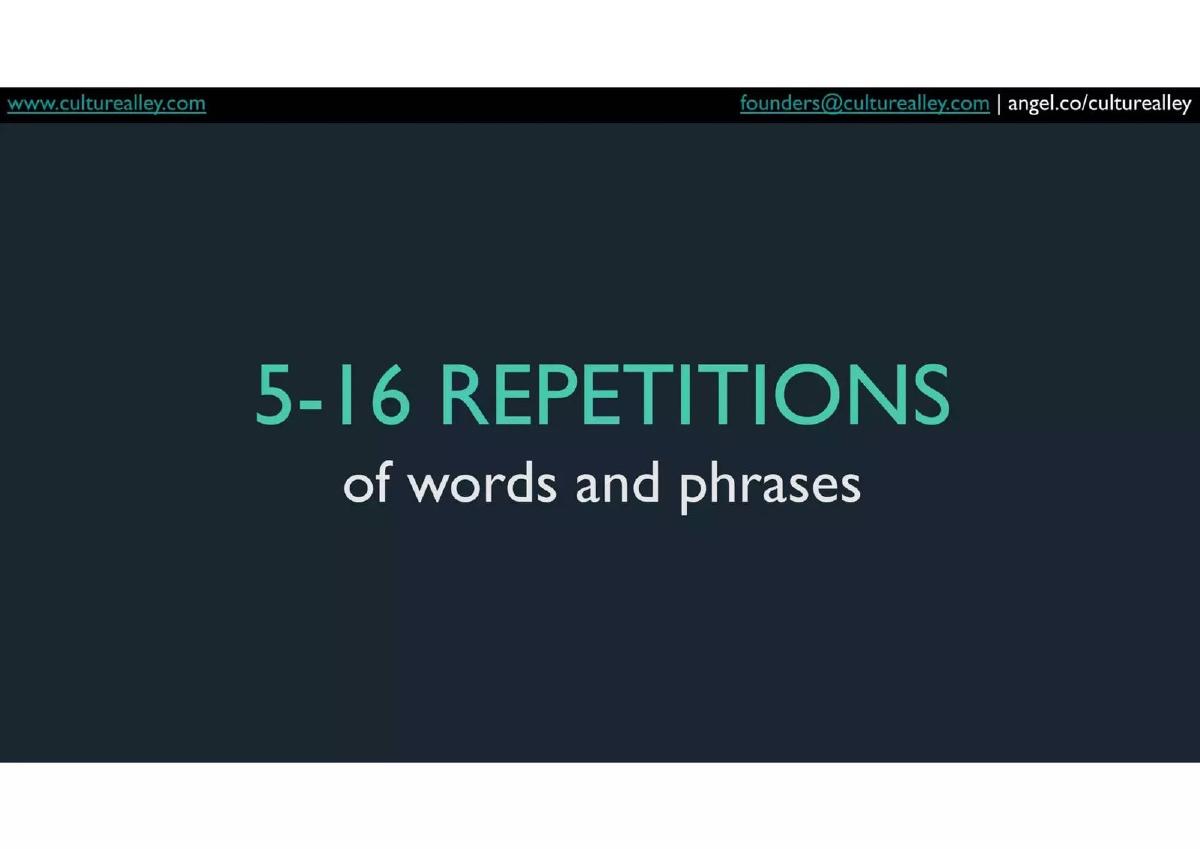
- The deck uses a '5-16 repetitions' metric to justify its pedagogical approach to word and phrase retention (Slide 2).
Slide-by-Slide Analysis
Slide 1: Title and Value Proposition
The opening slide introduces CultureAlley with a clear, punchy sub-headline: "Learn languages while browsing Facebook!" The background is a darkened screenshot of a Facebook news feed, reinforcing the contextual nature of the product. The top bar includes the company URL and a contact email for the founders, along with an AngelList link. This is a highly functional title slide that immediately explains the 'what' and 'where' of the product.
Slide 2: The Pedagogical Hook
Slide 2 presents a simple text-based claim: "5-16 REPETITIONS of words and phrases." This slide serves as the scientific justification for their product. By stating the number of repetitions required for memory retention, they set the stage for why a high-frequency environment like a social media feed is the ideal classroom. It is a minimalist slide designed to be spoken over by a founder explaining the 'why' behind the method.
Slide 3: Competitive Benchmarking
This slide uses a bar chart to compare "Course completion rates." It shows Rosetta Stone at a meager 0.6% and CultureAlley at 8%. While 8% might seem low in absolute terms for other industries, in the context of self-paced EdTech, it is presented as a 13x improvement over the market leader. The use of high-contrast teal against a dark background makes the growth look substantial, even if the Y-axis is not fully detailed beyond the two data points.
Slide 4: The Gamification Tease
Slide 4 features a single graphic: the icon for Candy Crush Saga. This is a classic 'analogy' slide. It prepares the audience for the transition from a purely educational tool to a gamified experience. By using a globally recognized symbol of digital addiction and engagement, the founders are signaling their intent to capture similar psychological triggers for language learning.
Slide 5: Product Interface and Mechanics
This slide provides a mock-up of the user experience. It shows a Facebook post where the word "friends" is highlighted. A pop-up asks the user to translate the word, offering three choices: "PADRES," "AMIGOS," and "HERMANOS." To the right, a gamified element shows "12 JELLIES WON" inside a glass jar. This slide effectively connects the Facebook integration mentioned on Slide 1 with the gamification hinted at on Slide 4. It demonstrates a low-friction, high-reward loop.
Slide 6: Traction and Growth
This is the 'money slide.' It shows a line graph of Monthly Active Users (MAUs) from January 2014 to April 2014. The headline figure is "103% MoM growth of MAUs." The graph shows a clear hockey-stick trajectory, ending just under the 30,000 MAU mark. This provides the necessary proof that the product mechanics shown in previous slides are successfully attracting and retaining users.
Slide 7: Social Proof and Advisors
Instead of a traditional team slide, this slide focuses on "heavy hitters." It features Rajan Anandan (Google India), Bhupen Shah (SlingBox), and Prem Jain (Cisco/Insieme). The inclusion of logos for Google, Microsoft, SlingBox, and Cisco, along with the 500 Startups Batch 8 badge, is intended to build immediate credibility. It suggests that while the product is early, it is backed by individuals who understand scale and exits (citing $380M and $860M exits for the advisors' previous companies).
Slide 8: The Vision Statement
The final slide in this set returns to the core mission: "Every time you go online you have an opportunity to learn a new language." It reinforces the idea of turning 'dead time' into 'productive time.' Like the first slide, it uses the Facebook feed as a backdrop, creating a bookend effect for the presentation.
What Works Well
The 'Aha' Moment: The deck does an excellent job of showing, not just telling. Slide 5 is the strongest in the deck because it explains the entire product loop in a single image. An investor can immediately understand how the product works without needing a demo.
Aggressive Benchmarking: By picking a fight with Rosetta Stone on Slide 3, the company positions itself as a disruptor to a well-known but 'boring' incumbent. The 13x difference in completion rates is a compelling hook for any investor interested in the EdTech space.
Traction Timing: Showing a 103% MoM growth rate is the best way to justify a seed or Series A round. The deck focuses on the most recent four months of data, which suggests the company is pitching at the exact moment of their breakout.
What Is Missing
Founding Team: While the advisors are impressive, the actual founders are nowhere to be seen in these slides. Investors fund founders, not just advisors. The lack of a slide detailing the CEO, CTO, and their specific backgrounds is a significant omission.
Business Model: There is no mention of how CultureAlley intends to make money. Is it a freemium model? Is it ad-supported? Do they sell 'Jellies'? Without a revenue slide, the 30,000 MAUs are just a cost center.
Market Size (TAM): The deck assumes the investor knows the language learning market is big. However, a standard pitch deck should quantify the Total Addressable Market to show the potential for a billion-dollar outcome.
The Ask: There is no slide indicating how much money is being raised or what the milestones for the next 18 months will be. This makes the deck feel more like a product showcase than a formal investment proposal.
Founder Takeaways
Lead with Traction: If you have a 100%+ growth rate, make it the centerpiece of your deck. CultureAlley uses Slide 6 to validate everything they claimed in the first five slides. · Use Familiar Analogies: Using the Candy Crush icon (Slide 4) is a shorthand way to explain complex engagement mechanics. It saves time and aligns the investor's expectations with successful precedents. · Focus on One Platform First: By focusing almost exclusively on Facebook integration, the deck feels focused. Founders often make the mistake of saying they will be "everywhere," but CultureAlley shows they are winning in one specific, high-traffic environment first. · Highlight Completion, Not Just Downloads: In EdTech, downloads are a vanity metric. Completion rates (Slide 3) are a value metric. Always pitch the metric that proves your product actually works.
Frequently asked questions
- What is the primary product of CultureAlley/Hello English?
- Based on Slide 1 and Slide 5, the product is a browser-based or integrated tool that allows users to learn languages while browsing social media. It identifies specific words in a user's feed (e.g., 'friends') and prompts them to select the correct translation (e.g., 'amigos') in exchange for digital rewards called 'Jellies'.
- How does the company justify its efficacy compared to traditional methods?
- The deck uses a direct comparison on Slide 3, showing an 8% completion rate for CultureAlley versus 0.6% for Rosetta Stone. It also cites a requirement of 5-16 repetitions for word retention on Slide 2, implying that its high-frequency, low-friction social media integration facilitates this repetition better than standalone software.
- What does the traction look like for the company?
- Slide 6 shows a steep growth curve for Monthly Active Users (MAUs) from January 2014 to April 2014. The chart indicates that the user base grew from near zero to approximately 27,000 MAUs in four months, representing a 103% month-over-month growth rate.
- Who are the key people involved in the project?
- Slide 7 lists several high-profile advisors and investors rather than the operational founders. These include Rajan Anandan (Head of Google India), Bhupen Shah (Founder of SlingBox), Prem Jain (Advisor to Cisco CEO), and Sasha Mirchandani. The slide also notes their participation in 500 Startups Batch 8.
- What is the business model mentioned in the deck?
- The provided slides do not explicitly state a business model, pricing strategy, or revenue figures. The deck focuses entirely on user growth, engagement metrics, and the product's gamified mechanics. There is no mention of subscription fees, ad revenue, or B2B licensing in these eight slides.