Hello Heart used this 10-slide deck to secure $70M in Series D funding in 2022. The presentation is notable for its restraint, eschewing complex technical diagrams for high-impact clinical data and clear financial ROI. The company addresses the #1 cause of death globally by targeting the B2B2C market, specifically self-insured employers. The deck's strength lies in its third-party validation: a peer-reviewed study in JAMA Network Open involving over 28,000 participants and a cost-savings certification from the Validation Institute. By demonstrating a $1,865 reduction in medical costs per part…
Key takeaways
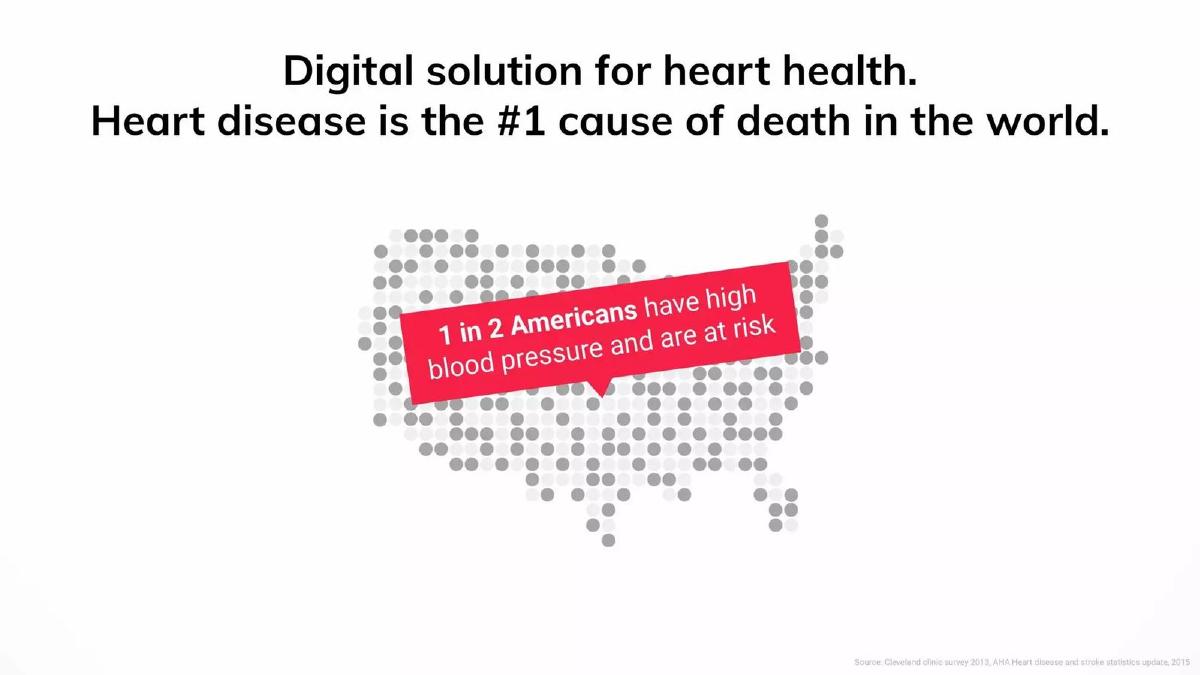
- The deck leads with a massive TAM, citing that 1 in 2 Americans have high blood pressure (Slide 2).
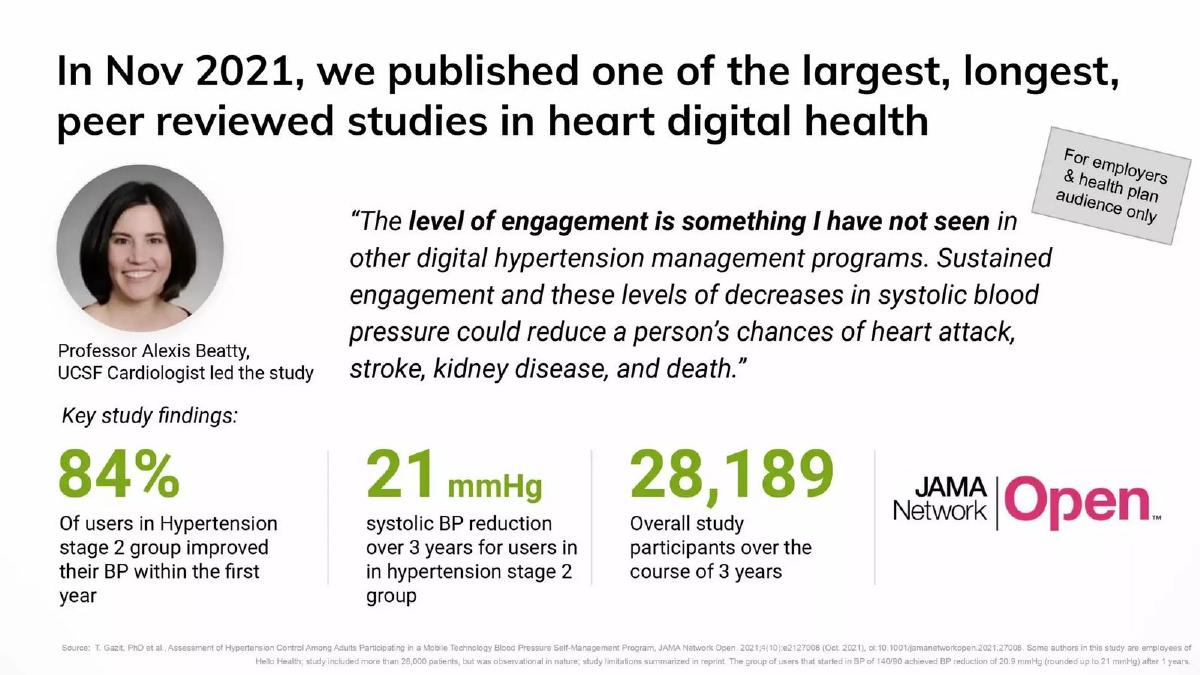
- Clinical efficacy is the core value proposition, highlighted by an 84% improvement in blood pressure for Stage 2 hypertension users (Slide 5).
- The company utilizes a peer-reviewed study of 28,189 participants to de-risk the investment (Slide 5).
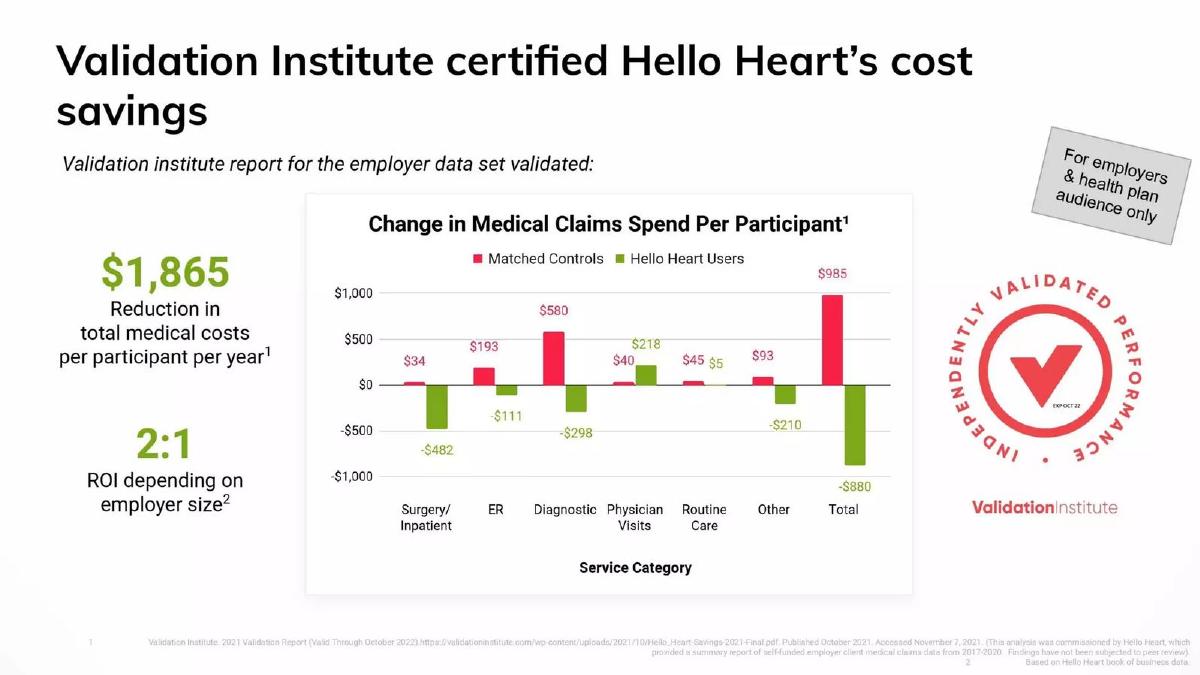
- Financial ROI is quantified as a $1,865 reduction in total medical costs per participant per year (Slide 6).
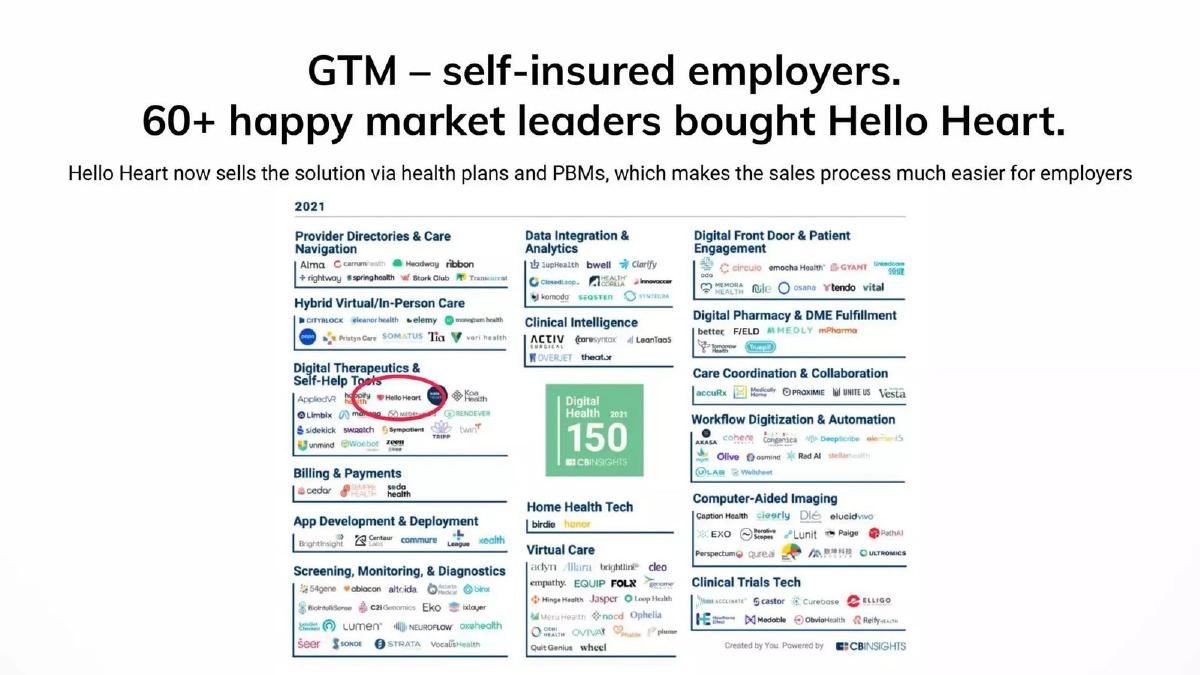
- The Go-To-Market strategy focuses on self-insured employers, health plans, and PBMs (Slide 4).
- Revenue momentum is shown through an ARR growth chart indicating 3x growth in 2019 and 2020, followed by 2x in 2021 (Slide 7).
- The leadership team is presented as a robust group of 11 executives, signaling a mature, late-stage organization (Slide 9).
- Investor social proof includes heavyweights like Khosla Ventures and IVP, alongside successful founders like Noam Bardin of Waze (Slide 10).
The Series D Narrative: From Wellness App to Clinical Necessity
Hello Heart’s Q1 2022 overview deck is a masterclass in late-stage fundraising. At the Series D level, investors are no longer looking for 'vibes' or unproven theories; they want to see a machine that converts capital into predictable health outcomes and financial returns. This 10-slide deck succeeds by focusing almost exclusively on evidence. By the time an investor reaches the final slide, the company has presented a peer-reviewed study, a certified ROI report, and a list of 60+ enterprise clients. The narrative is simple: Heart disease is expensive, our app fixes it, and we have the data to prove it.
Slide 1: Title and Product Visualization
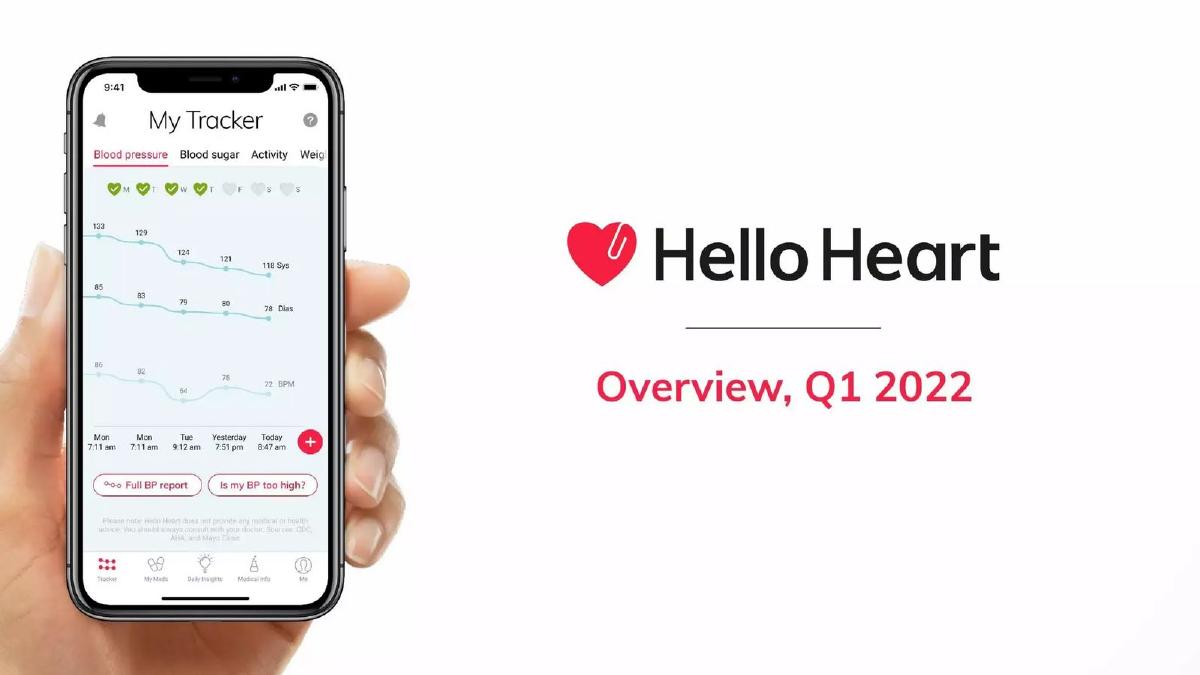
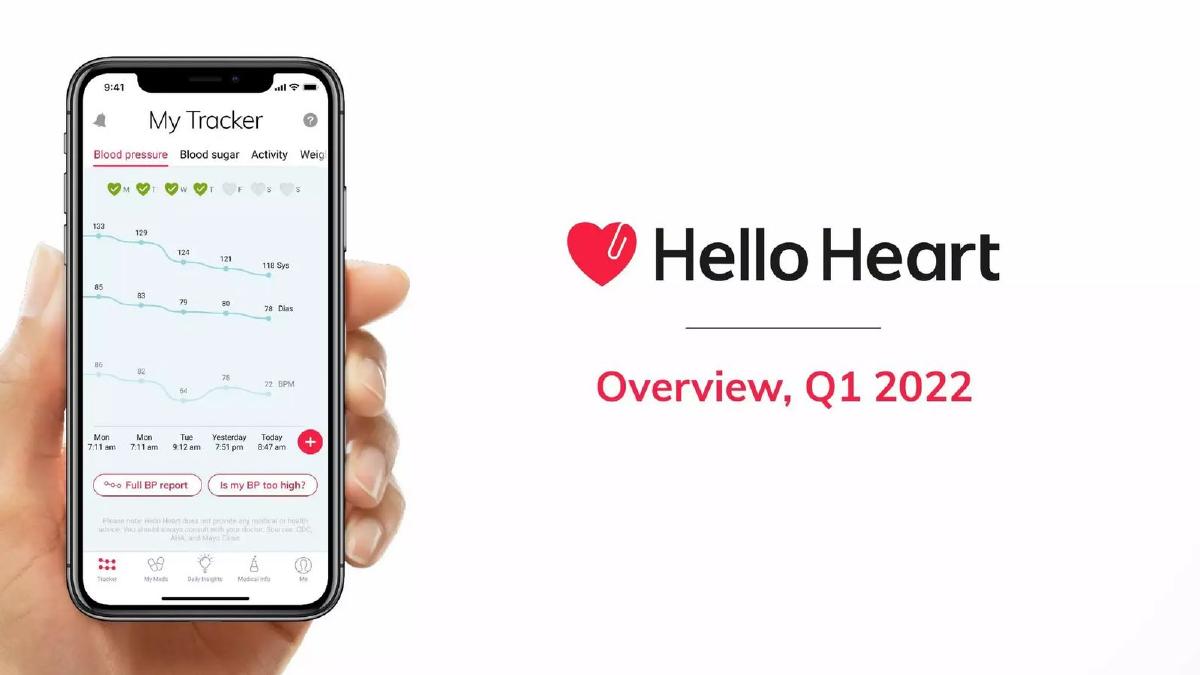
The deck opens with a clean title slide featuring the Hello Heart logo and a high-resolution mockup of the app on an iPhone. The screen shown is 'My Tracker,' displaying a clear downward trend in systolic and diastolic blood pressure over a week. This immediately establishes the product as a data-driven tracking tool. The sub-header 'Overview, Q1 2022' signals that this is a timely snapshot of the business during its $70M Series D push.
Slide 2: The Macro Problem
Hello Heart frames the problem with two staggering statistics. First, it notes that 'Heart disease is the #1 cause of death in the world.' Second, it localizes the crisis to the US market with a map graphic stating that '1 in 2 Americans have high blood pressure and are at risk.' This slide establishes a massive Total Addressable Market (TAM) without needing a complex spreadsheet. If half the population is a potential user, the scale of the opportunity is self-evident.
Slide 3: The Digital Solution
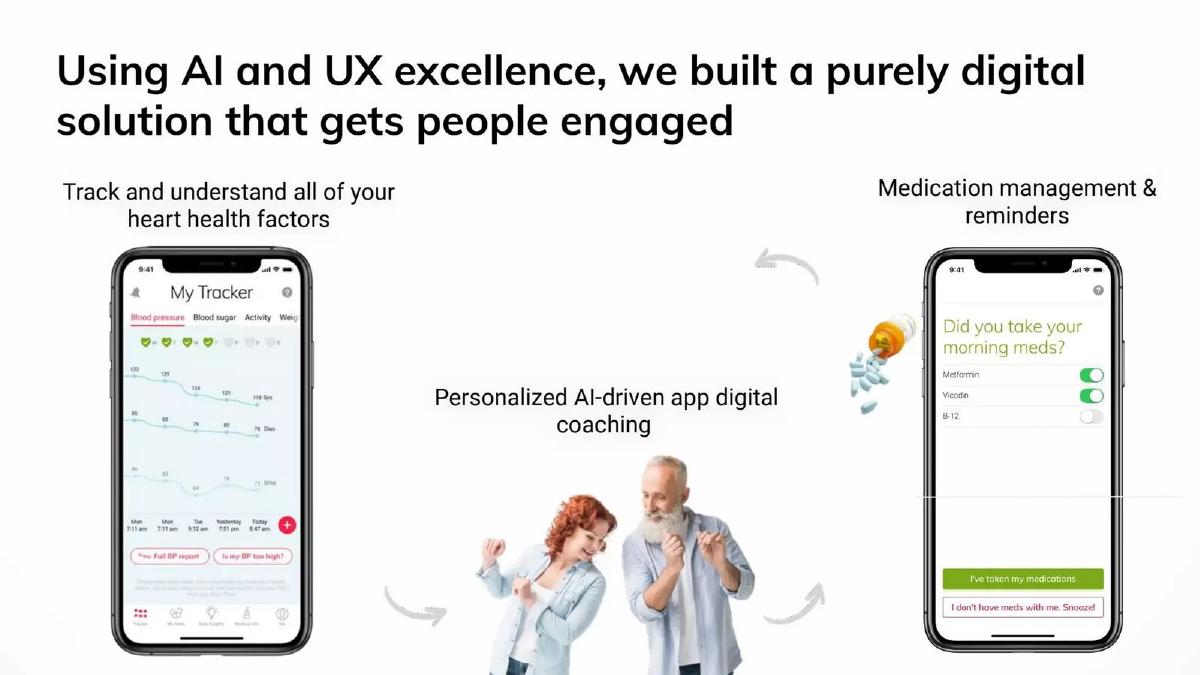
This slide defines the product as a 'purely digital solution' that leverages 'AI and UX excellence.' It highlights three core pillars: tracking heart health factors, personalized AI-driven digital coaching, and medication management/reminders. By emphasizing that the solution is 'purely digital,' Hello Heart signals high gross margins—there are no expensive human coaches or physical clinics mentioned here, which is a key differentiator in the crowded telehealth space.
Slide 4: Go-To-Market and Enterprise Traction
Slide 4 identifies the primary customer: self-insured employers. It claims that '60+ happy market leaders bought Hello Heart.' The slide includes a 2021 CB Insights 'Digital Health 150' graphic, where Hello Heart is circled in the 'Digital Therapeutics & Self-Help Tools' category. This provides immediate industry validation. The text also notes a strategic shift: selling via health plans and PBMs (Pharmacy Benefit Managers), which 'makes the sales process much easier for employers.' This indicates a maturing sales motion that leverages existing healthcare infrastructure.
Slide 5: Clinical Validation (The 'Killer' Slide)
This is arguably the most important slide in the deck. It cites a peer-reviewed study published in JAMA Network Open in November 2021. The numbers are massive: 28,189 participants over three years. The key findings are highlighted in large green text: 84% of Stage 2 hypertension users improved their blood pressure in the first year, and there was a 21 mmHg reduction in systolic blood pressure over three years. A quote from Professor Alexis Beatty, a UCSF Cardiologist, adds medical authority, stating the engagement levels are unlike anything seen in other programs. For a healthcare investor, this slide removes the 'does it work?' risk entirely.
Slide 6: Financial ROI and Cost Savings
While Slide 5 proves the health benefit, Slide 6 proves the economic benefit. Hello Heart presents a report from the Validation Institute showing a $1,865 reduction in total medical costs per participant per year. A bar chart compares 'Matched Controls' (red) to 'Hello Heart Users' (green) across categories like Surgery, ER, and Diagnostic visits. In every category, Hello Heart users cost the employer less. The slide concludes with a '2:1 ROI depending on employer size,' turning the software into a 'no-brainer' financial investment for HR departments.
Slide 7: Revenue Momentum
The deck shows a 'Committed accumulated Annual Recurring Revenue (ARR)' graph from Jan 2019 to Jan 2022. While the Y-axis lacks specific dollar amounts (a common practice in shared decks), it shows clear growth multiples: 3x from 2019-2020, 3x from 2020-2021, and 2x into 2022. The graph ends at a point labeled '+60 clients.' This visualizes the 'hockey stick' growth that VCs require for a Series D valuation.
Slide 8: The AI Competitive Advantage
Slide 8 attempts to explain the 'moat.' It uses a network diagram to show how their AI categorizes users into groups like 'Hooked,' 'Loyal,' 'Influenced,' and 'Not Engaged.' The message is that their AI isn't just a buzzword; it's a tool for sustaining engagement by tailoring the experience to different user personas. This addresses the common 'churn' problem in digital health apps.
Slide 9: The Leadership Team
The team slide features 11 executives, led by CEO Maayan Cohen. The sheer size of the leadership team—including a Chief Growth Officer, CTO & CISO, CRO, and CFO—indicates a company that has moved past the 'scrappy startup' phase and has built a professional corporate structure. The inclusion of an 'SVP of People' and 'Head of Product Marketing' suggests the company is focused on scaling its workforce and brand.
Slide 10: Investor Social Proof
The final slide lists the 'Backers.' It features headshots of prominent figures like Vinod Khosla (Khosla Ventures) and Somesh Dash (IVP). By listing the successful companies these investors have backed (DoorDash, Zoom, Waze, Lyra), Hello Heart associates itself with the 'unicorn' class of startups. This slide tells the investor: 'The smartest people in the room have already done the due diligence and placed their bets.'
What Hello Heart Does Exceptionally Well
The brilliance of this deck is its third-party reliance . Hello Heart doesn't ask you to take their word for it. They cite JAMA for clinical results, the Validation Institute for financial results, and CB Insights for market positioning. For a Series D, this is exactly the right strategy. They have successfully shifted the conversation from 'what we hope to do' to 'what we have already proven to do at scale.'
Furthermore, the focus on a single, quantifiable metric (21 mmHg reduction) is a psychological anchor. It is easy to remember, easy to repeat in a partner meeting, and serves as a proxy for the entire product's efficacy. Most healthcare decks get bogged down in the 'how' (the science); Hello Heart focuses on the 'what' (the result).
What is Missing from the Hello Heart Deck
As an 'Overview' deck for a $70M round, there are notable omissions that would likely be covered in a full data room but are absent here:
The Ask: There is no slide stating how much they are raising or what the valuation expectations are. · Use of Funds: There is no breakdown of how the $70M will be spent (e.g., R&D vs. Sales expansion). · Unit Economics: While they show ARR growth, they don't show the cost to acquire those 60+ clients (CAC) or the lifetime value (LTV) of those contracts. · Competition: The deck ignores competitors like Livongo (acquired by Teladoc) or Omada Health. In a Series D, investors want to know why you are winning against specific incumbents. · Detailed Financials: There are no P&L summaries or burn rate mentions.
Founder's Guide: What to Copy
1. Use 'Validation Logos': If you have been featured in a major publication, certified by an industry body, or published in a journal, make those logos larger than your own. Hello Heart uses the JAMA and Validation Institute logos to build immediate trust.
2. Quantify the Pain in Dollars: Don't just say your product 'saves money.' Show exactly where those savings come from (ER visits, surgeries, etc.) as seen on Slide 6. This allows your champion at a target company to justify the purchase to their CFO.
3. The 'Power of One' Metric: Find the one number that proves your product works and put it in a giant font. For Hello Heart, it's '21 mmHg.' For a fintech, it might be '% increase in yield.' For a dev tool, it might be 'hours saved per sprint.' Anchor your deck around that number.
4. Show the 'Scaling' Team: Once you hit Series B and beyond, your team slide should look like Slide 9. It shouldn't just be three co-founders; it should show a functional organization with specialized leaders in Growth, People, and Strategy. This proves you are ready to manage a much larger capital infusion.
Frequently asked questions
- What is the primary business model of Hello Heart?
- Hello Heart operates on a B2B2C SaaS model. According to the catalogue facts and Slide 4, they sell their digital heart health solution to self-insured employers, health plans, and Pharmacy Benefit Managers (PBMs). This allows them to reach a large user base (employees) while the employer or insurer pays the subscription fees to reduce overall medical claims spend.
- How does Hello Heart prove its solution actually works?
- The company relies on extreme clinical validation. Slide 5 cites a peer-reviewed study published in JAMA Network Open. The study followed 28,189 participants over three years and showed that 84% of users in the Hypertension Stage 2 group improved their blood pressure within the first year, with an average systolic reduction of 21 mmHg.
- What is the financial incentive for an employer to buy this software?
- Slide 6 provides a specific cost-savings breakdown certified by the Validation Institute. It shows a $1,865 reduction in total medical costs per participant per year compared to matched controls. The primary savings come from reduced surgery/inpatient costs ($482 reduction) and ER visits ($111 reduction), resulting in a 2:1 ROI.
- Who are the key investors backing Hello Heart?
- As shown on Slide 10, the company is backed by prominent venture firms and individual tech leaders. Notable investors include Vinod Khosla (Khosla Ventures), Somesh Dash (IVP), and Sara Deshpande (Maven Ventures). Individual backers include Noam Bardin (former CEO of Waze) and Eric Roza (former CEO of Datalogix).
- What is missing from this pitch deck?
- This is a late-stage 'Overview' deck, so it lacks several early-stage staples. There is no slide detailing the specific 'ask' (amount being raised), no detailed 5-year financial projections, and no granular unit economics (CAC/LTV). It also omits a direct competitor comparison, choosing instead to focus on its own clinical superiority and market leadership.