Clinical Evidence Slides: Real Pitch Deck Examples
How health startups present clinical evidence in a pitch deck: who ran the study, how many patients, what changed, and where it was published.
Clinical Evidence Slides: Real Pitch Deck Examples
Seven slides from health startups, shown in full, compare how companies present clinical proof, and how much an investor could check from the slide alone.
TL;DR
A clinical evidence slide should answer four questions: who ran the study, on how many patients, what changed compared with what, and where the results were published. Hello Heart and Carrum Health answer nearly all four, naming the journal, the size of the study and the result. Astek names its pilot site and sample size. Heal gives strong-sounding percentages with no source. Emocha counts studies without saying what they found. Béa cites evidence for a general medical method, not for its own product. Put the study design and source on the slide, even in small print.
Clinical evidence slides from real pitch decks
Each example shows the exact stored slide above its analysis and links to the full teardown. Study results are as reported on the slides; we have not checked the underlying studies. Stage and year are given only where the slide states them.
Hello Heart traction slide — slide 5
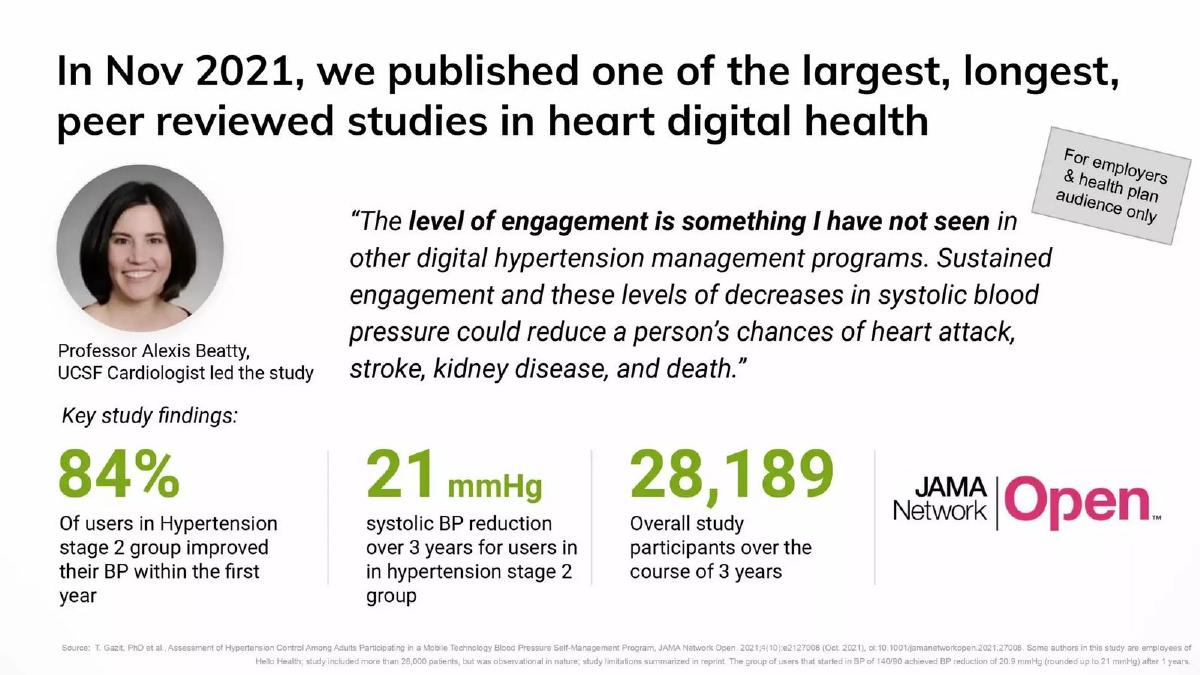
Digital program for managing blood pressure, sold to employers and health plans. The slide refers to a study published in November 2021; stage is not stated.
Hello Heart deck, slide 5. Exact stored slide matched to this analysis.
Our analysis: This slide answers almost every question: a named journal, a named lead investigator, the study length, the number of participants and specific results for a defined group. The small-print citation lets an investor look it up.
Evidence and limitation: The headline figures apply to the stage 2 hypertension subgroup, not all 28,189 participants, and there is no comparison group on the slide. If your study is observational or has company-employed authors, say so in the footnote, as a careful investor will check.
What a founder can adapt: Lead with the publication date and journal, name who led the study, then give two or three findings with the patient group each applies to.
Supporting analysis
What the deck claims: "In Nov 2021, we published one of the largest, longest, peer reviewed studies in heart digital health". A photo and quote from Professor Alexis Beatty, the UCSF cardiologist who led the study, and three findings: 84% of users in the stage 2 hypertension group improved their blood pressure within the first year; a 21 mmHg systolic reduction over 3 years for that group; and 28,189 participants over 3 years. The JAMA Network Open logo sits beside them, with a small-print citation at the bottom.
Presentation choice: This slide answers almost every question: a named journal, a named lead investigator, the study length, the number of participants and specific results for a defined group. The small-print citation lets an investor look it up.
When it does not fit: The headline figures apply to the stage 2 hypertension subgroup, not all 28,189 participants, and there is no comparison group on the slide. If your study is observational or has company-employed authors, say so in the footnote, as a careful investor will check.
Surgery benefits for employers. The source line cites a March 2021 publication; stage is not stated.
Carrum Health deck, slide 6. Exact stored slide matched to this analysis.
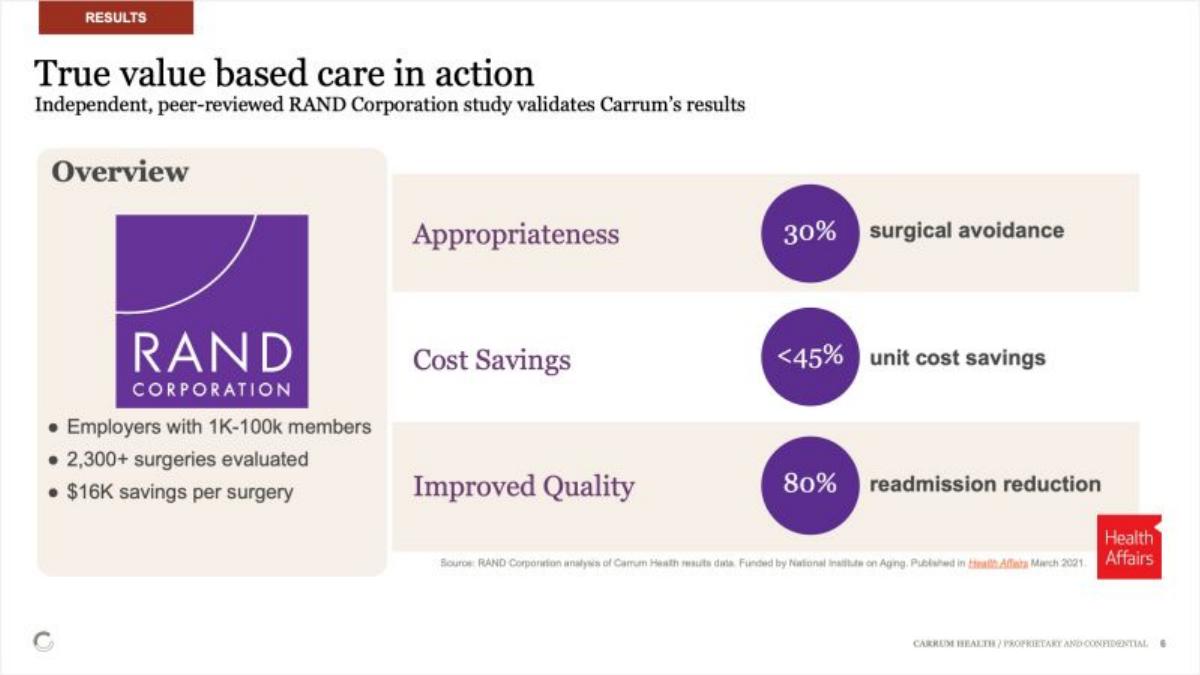
Our analysis: An independent evaluator, a sample size, clinical and cost outcomes side by side, and a full source line. For a buyer that pays for surgery, the pairing of quality and savings is the whole case.
Evidence and limitation: "<45%" reads as "up to", which is hard to interpret. State the average saving and the comparison (what the same surgeries cost elsewhere).
What a founder can adapt: If an outside organisation has evaluated your results, put its name in the headline and the full source at the bottom.
Supporting analysis
What the deck claims: "True value based care in action — Independent, peer-reviewed RAND Corporation study validates Carrum's results". The overview lists employers with 1K–100k members, 2,300+ surgeries evaluated and $16K savings per surgery. Three results: 30% surgical avoidance, under 45% unit cost savings, and 80% readmission reduction. The source line credits a RAND analysis of Carrum Health results data, funded by the National Institute on Aging and published in Health Affairs in March 2021.
Presentation choice: An independent evaluator, a sample size, clinical and cost outcomes side by side, and a full source line. For a buyer that pays for surgery, the pairing of quality and savings is the whole case.
When it does not fit: "<45%" reads as "up to", which is hard to interpret. State the average saving and the comparison (what the same surgeries cost elsewhere).
Rapid infection testing. Stage and year are not stated on this slide.
Astek Diagnostics deck, slide 4. Exact stored slide matched to this analysis.
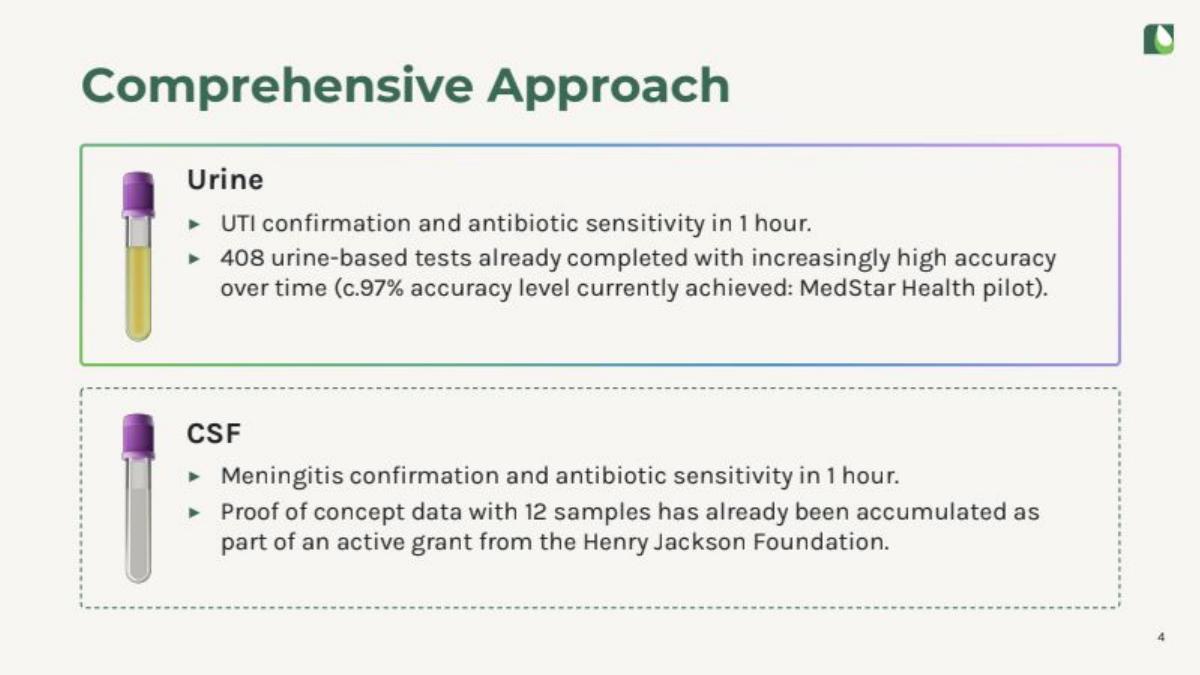
Our analysis: It separates a more advanced use (408 tests, a named hospital pilot) from an early one (12 samples), and is honest about the difference by using a solid and a dashed box.
Evidence and limitation: "Accuracy" on its own is ambiguous for a diagnostic. Report sensitivity and specificity against the reference test, and say whether 97% is the latest batch or all 408 tests.
What a founder can adapt: Show each use at its real stage of evidence, with the site and sample size, and make the difference visible.
Supporting analysis
What the deck claims: "Comprehensive Approach" in two boxes. Urine: infection confirmation and antibiotic sensitivity in 1 hour; "408 urine-based tests already completed with increasingly high accuracy over time (c.97% accuracy level currently achieved: MedStar Health pilot)". Cerebrospinal fluid: proof-of-concept data "with 12 samples" gathered under a grant from the Henry Jackson Foundation.
Presentation choice: It separates a more advanced use (408 tests, a named hospital pilot) from an early one (12 samples), and is honest about the difference by using a solid and a dashed box.
When it does not fit: "Accuracy" on its own is ambiguous for a diagnostic. Report sensitivity and specificity against the reference test, and say whether 97% is the latest batch or all 408 tests.
Video-based medication adherence. Stage and year are not stated on the slide.
emocha Health deck, slide 2. Exact stored slide matched to this analysis.
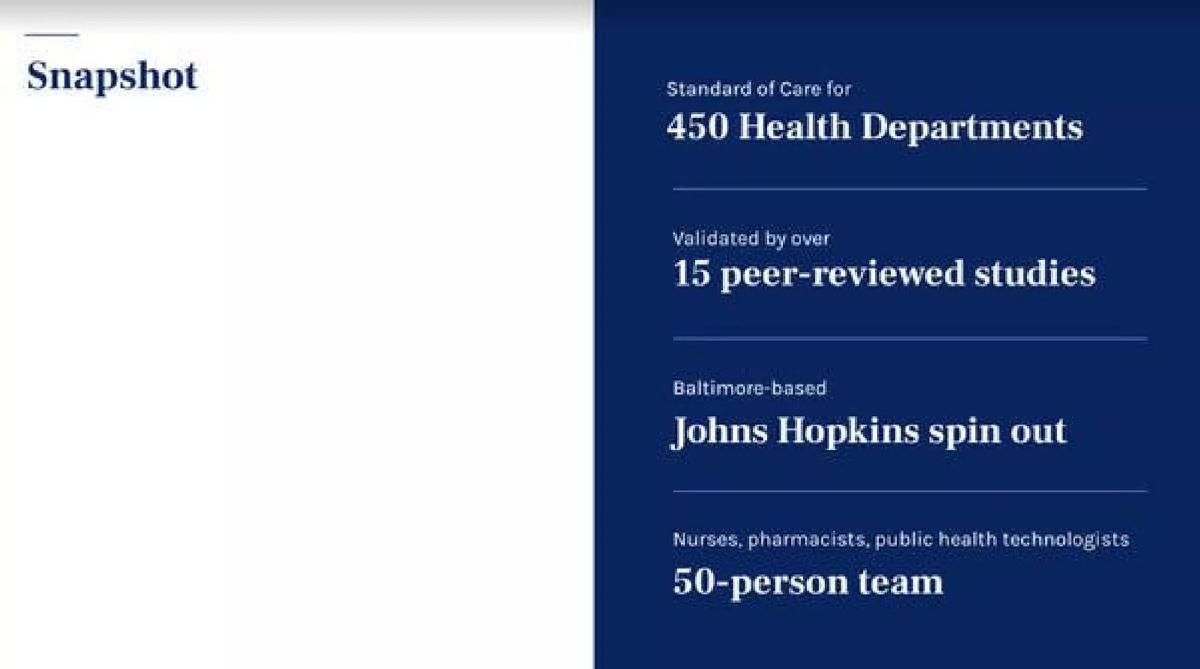
Our analysis: As an opening snapshot, it signals quickly that the evidence base is deep and academic, and pairs it with adoption (450 health departments).
Evidence and limitation: Fifteen studies with no finding tells an investor nothing about the effect. Add one number, such as the adherence rate against in-person observation, with its source.
What a founder can adapt: A count of studies works on an overview slide if a later slide shows the main result.
Supporting analysis
What the deck claims: "Snapshot": standard of care for 450 health departments; "validated by over 15 peer-reviewed studies"; a Johns Hopkins spin-out based in Baltimore; a 50-person team of nurses, pharmacists and public health technologists.
Presentation choice: As an opening snapshot, it signals quickly that the evidence base is deep and academic, and pairs it with adoption (450 health departments).
When it does not fit: Fifteen studies with no finding tells an investor nothing about the effect. Add one number, such as the adherence rate against in-person observation, with its source.
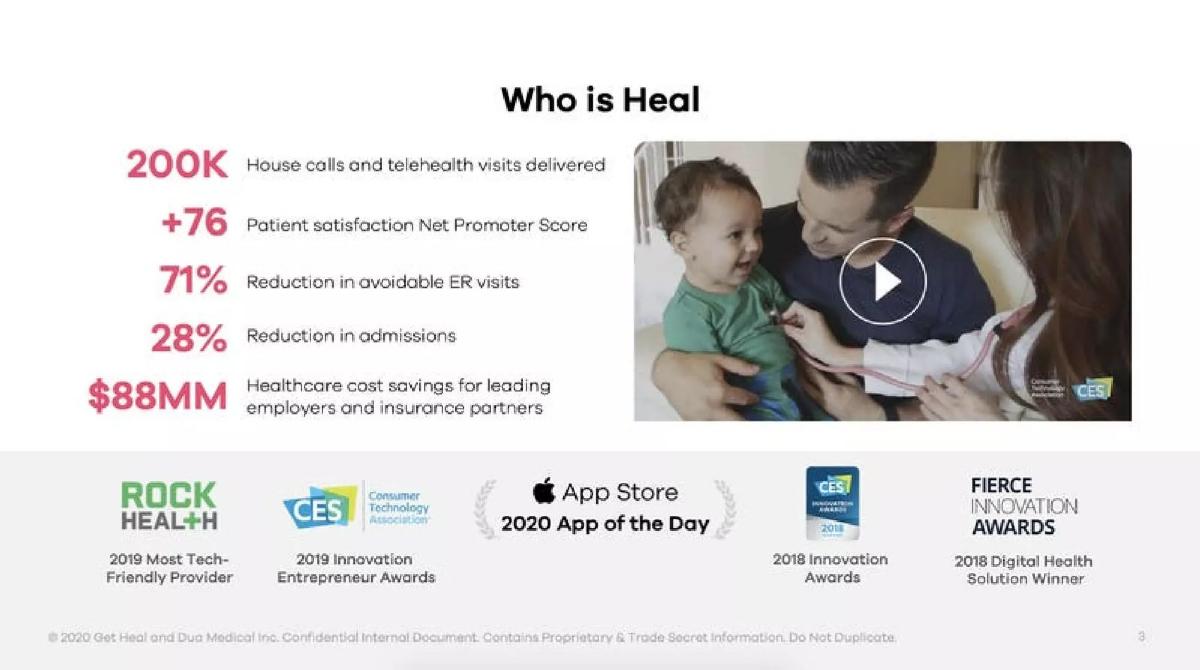
House calls and telehealth. The slide footer is dated 2020; stage is not stated.
Heal deck, slide 3. Exact stored slide matched to this analysis.
Our analysis: Strong outcome figures sit next to scale (200K visits) and savings, which is what a payer wants to see.
Evidence and limitation: None of the three outcome figures has a source, comparison group or period on the slide, and consumer awards are not clinical evidence. Add who measured it and against what.
What a founder can adapt: Put outcomes next to the number of patients or visits they come from.
Supporting analysis
What the deck claims: "Who is Heal": 200K house calls and telehealth visits delivered; +76 patient Net Promoter Score; 71% reduction in avoidable ER visits; 28% reduction in admissions; $88MM healthcare cost savings for leading employers and insurance partners. A row of awards follows (CES, App Store App of the Day and others).
Presentation choice: Strong outcome figures sit next to scale (200K visits) and savings, which is what a payer wants to see.
When it does not fit: None of the three outcome figures has a source, comparison group or period on the slide, and consumer awards are not clinical evidence. Add who measured it and against what.
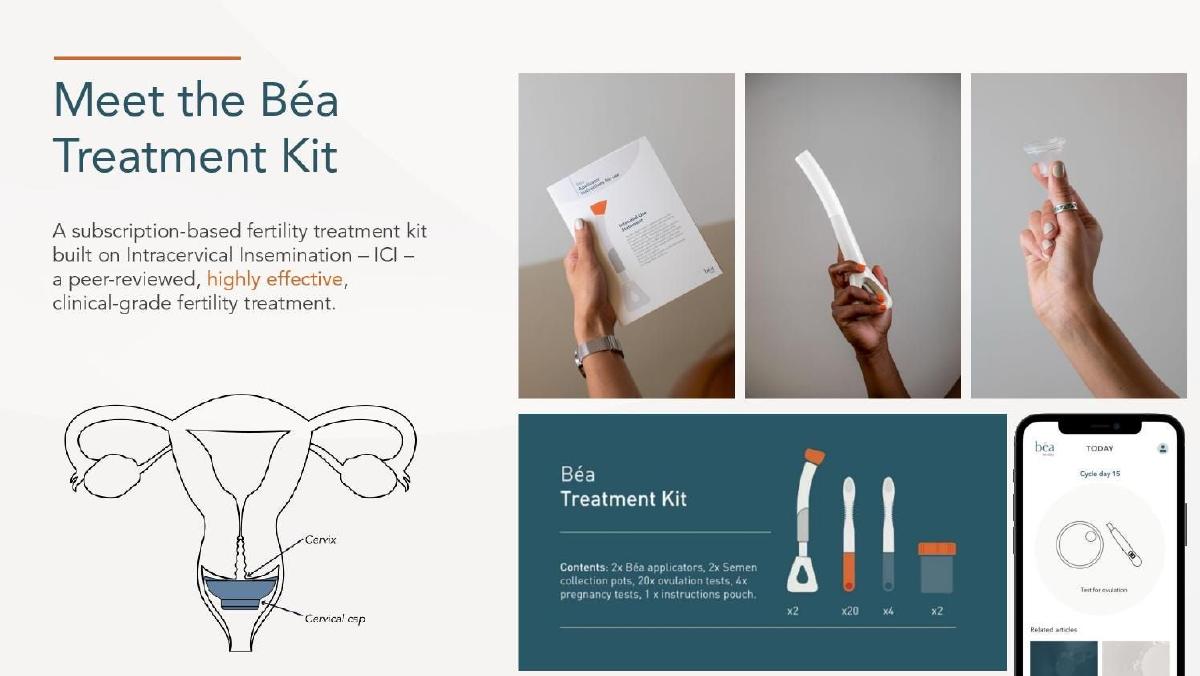
At-home fertility treatment kit. Stage and year are not stated on the slide.
Béa Fertility deck, slide 4. Exact stored slide matched to this analysis.
Our analysis: Building on a known clinical method lowers the perceived risk, and the product photos make the kit concrete.
Evidence and limitation: The evidence described belongs to ICI in general, not to the Béa kit, and no study or success rate is given. Cite the source for the method and add any pregnancy rate from Béa's own users.
What a founder can adapt: Treat this as a slide to improve on. If your product delivers an established treatment, cite the evidence for that treatment and then show your own early results.
Supporting analysis
What the deck claims: "Meet the Béa Treatment Kit": a subscription-based fertility treatment kit built on intracervical insemination (ICI), described as "a peer-reviewed, highly effective, clinical-grade fertility treatment", with product photos, a diagram and an app screen.
Presentation choice: Building on a known clinical method lowers the perceived risk, and the product photos make the kit concrete.
When it does not fit: The evidence described belongs to ICI in general, not to the Béa kit, and no study or success rate is given. Cite the source for the method and add any pregnancy rate from Béa's own users.
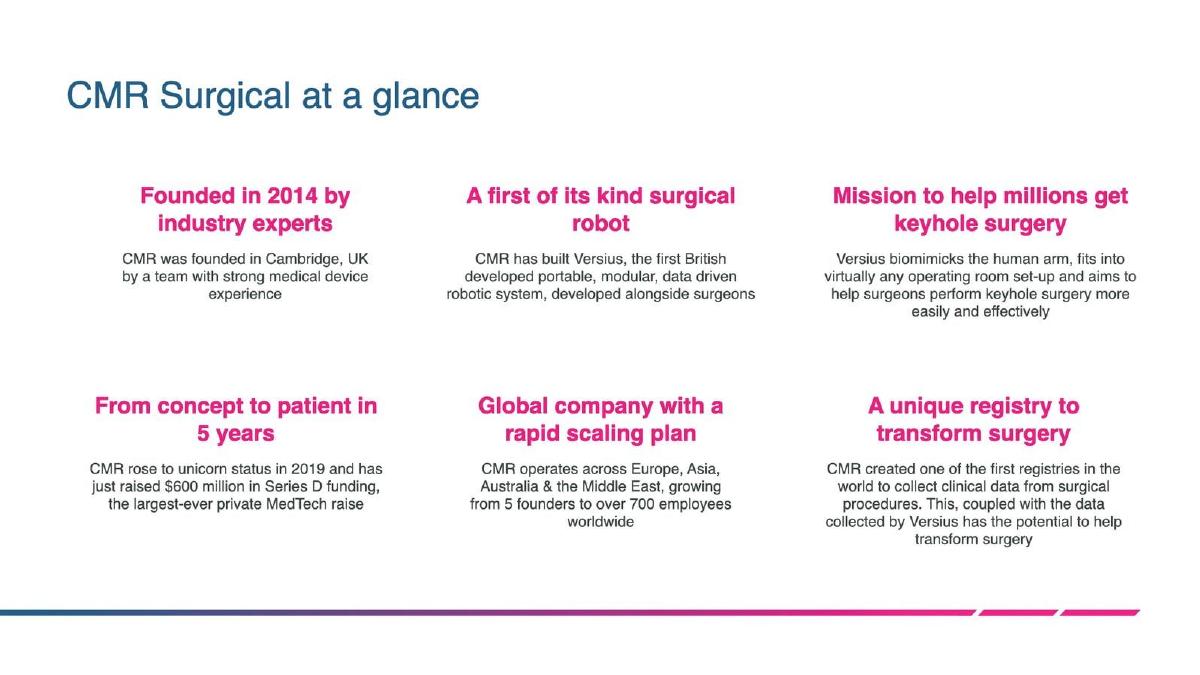
Surgical robotics (Versius). The slide says CMR was founded in 2014 and reached unicorn status in 2019.
CMR Surgical deck, slide 2. Exact stored slide matched to this analysis.
Our analysis: A registry is a real clinical-evidence asset for a device company: it builds data from every procedure over time.
Evidence and limitation: The slide says the registry exists but not how many procedures it holds or what it has shown. Add the number of cases recorded and one outcome, such as complication rate.
What a founder can adapt: If you collect clinical data by design, say so and say how much you have.
Supporting analysis
What the deck claims: "CMR Surgical at a glance" in six blocks, including "from concept to patient in 5 years" and "a unique registry to transform surgery": CMR says it created one of the first registries to collect clinical data from surgical procedures, which, with data from Versius, could help transform surgery.
Presentation choice: A registry is a real clinical-evidence asset for a device company: it builds data from every procedure over time.
When it does not fit: The slide says the registry exists but not how many procedures it holds or what it has shown. Add the number of cases recorded and one outcome, such as complication rate.
The four questions a clinical evidence slide should answer.
Example
Who ran it
How many
What changed
Where published
Hello Heart
Named UCSF cardiologist
28,189 participants
Yes, for a subgroup
JAMA Network Open
Carrum Health
RAND (independent)
2,300+ surgeries
Yes: three outcomes
Health Affairs
Astek Diagnostics
MedStar Health pilot
408 tests; 12 samples
"c.97% accuracy"
Not stated
emocha Health
Not stated
15+ studies
Not stated
"Peer-reviewed"
Heal
Not stated
200K visits (scale)
Yes, unsourced
Not stated
Béa Fertility
About the method, not the kit
Not stated
Not stated
"Peer-reviewed"
CMR Surgical
Own registry
Not stated
Not stated
Not stated
Key Takeaways
Name the study and the journal. Hello Heart cites JAMA Network Open and names the cardiologist who led the study; Carrum cites a RAND Corporation analysis published in Health Affairs.
Give the sample size next to the result. Carrum's "2,300+ surgeries evaluated" and Astek's "408 urine-based tests" let an investor judge how much weight a figure can bear.
Independent beats in-house. Carrum leads with "independent, peer-reviewed"; results the company measured itself need to say so.
Say what the figures are compared with. Heal's "71% reduction in avoidable ER visits" has no comparison group, period or source on the slide.
Evidence must be about your product. Béa calls intracervical insemination "peer-reviewed" and "highly effective"; that is evidence for the method, not for the Béa kit.
Build your clinical evidence slide
If you can't fill a line, say what stage the evidence is at instead.
Who. Who ran the study: you, a hospital partner or an independent group?
Design and size. What kind of study was it, on how many patients, over what period?
Result. What changed, for which group, compared with what?
Source. Where is it published or submitted? If not published, say so.
Copyable framework: [Study type] led by [who] with [n] patients over [period]: [result] vs [comparison] in [group]. Published in [journal, date] / submitted / internal data.
After: Pilot at [hospital], [n] patients, [months]: [outcome] fell from [x]% to [y]% vs usual care. Internal analysis; submitted to [journal], [month year].
What improved: Our illustrative rewrite, not any company's text. It adds who, how many, the comparison and the publication status; bracketed values are placeholders.
How this differs from a general traction slide
For most startups, traction means customers and revenue. For companies that diagnose or treat patients, investors also ask whether it works clinically, because buyers, payers and regulators will ask the same. This page covers that proof. How health startups get paid is covered in the healthcare reimbursement guide; the drug-development pipeline is covered in the biotech pipeline guide.
Common mistakes
No source. Outcome percentages without a study behind them are discounted.
Counting studies, not results. Give at least one finding.
Borrowed evidence. Evidence for a general method is not evidence for your product.
Subgroup as headline. Say which patients a figure applies to.
Awards as proof. Industry awards are not clinical evidence.
Diagnostic checklist
The slide says who ran the study.
Sample size and period sit next to each result.
Each result names its comparison.
The publication or its status is stated.
The evidence is about your product.
Stage of evidence is clear for each use.
Frequently asked questions
How we chose these examples
Corpus: published pitch deck teardowns on StartupFundraising.com. Founder-uploaded private decks are excluded.
Selection (2026-09-24): we searched extracted text of slides 2–6 for clinical study, peer-reviewed, accuracy, sensitivity and outcome-reduction language, excluded drug-pipeline and public-company disclosure slides (covered or out of scope), and excluded companies already used in the healthcare guides. Nine candidates were inspected; seven were selected. Aurion Biotech and Certis Oncology were not used: their slides are investment highlights and a preclinical model description rather than clinical evidence.
Overlap check: the healthcare reimbursement guide covers how health startups get paid; the biotech pipeline guide covers drug-development stages; the healthcare team guide covers who leads care. None covers presenting clinical evidence.
Review: all seven stored slide images were inspected on 2026-09-24 and matched to company, deck and slide number (editorial model review). No person has yet completed an editorial review of this page.
Study results are the companies' own descriptions; we have not reviewed the underlying studies. We make no claim that any slide caused a fundraising outcome.