How social and climate startups show impact in a pitch deck: dated outcome figures, attribution to the company, and the link to revenue.
Impact Slide: Real Pitch Deck Examples
Ten impact and sustainability slides, shown in full, compare how social, climate and health startups show the good they do, and whether an investor could check it and connect it to the business.
TL;DR
An impact slide should show a measured result the company itself caused, dated, with the unit counted, and say how that result grows as revenue grows. The strongest example below (ComBio) charts avoided emissions year by year and adds outside certification. The weakest borrow impact that isn't theirs: Ellis lists famous immigrant founders who never used its product. In between sit slides with real numbers but no method (Change Heroes' "1000% more money") and slides that map to the UN Sustainable Development Goals without a single figure (Global Water First). Everphone shows the link to revenue most directly: a cited figure of 58 kg of CO2 saved per refurbished device, and a customer that keeps rented devices longer, which the company says raises its profit. HelloBello separates what it does today from a goal of CO2 neutrality by 2023. MiTerro states 2030 targets, which are forecasts. AgBiome ticks 12 of the 17 UN goals without a figure. Count something, date it, and show why it rises with sales.
Impact slides from real pitch decks
Each example shows the exact stored slide above its analysis and links to the full teardown. Impact figures are the companies' own claims and have not been verified. Stage and year are given only where the slide states them.
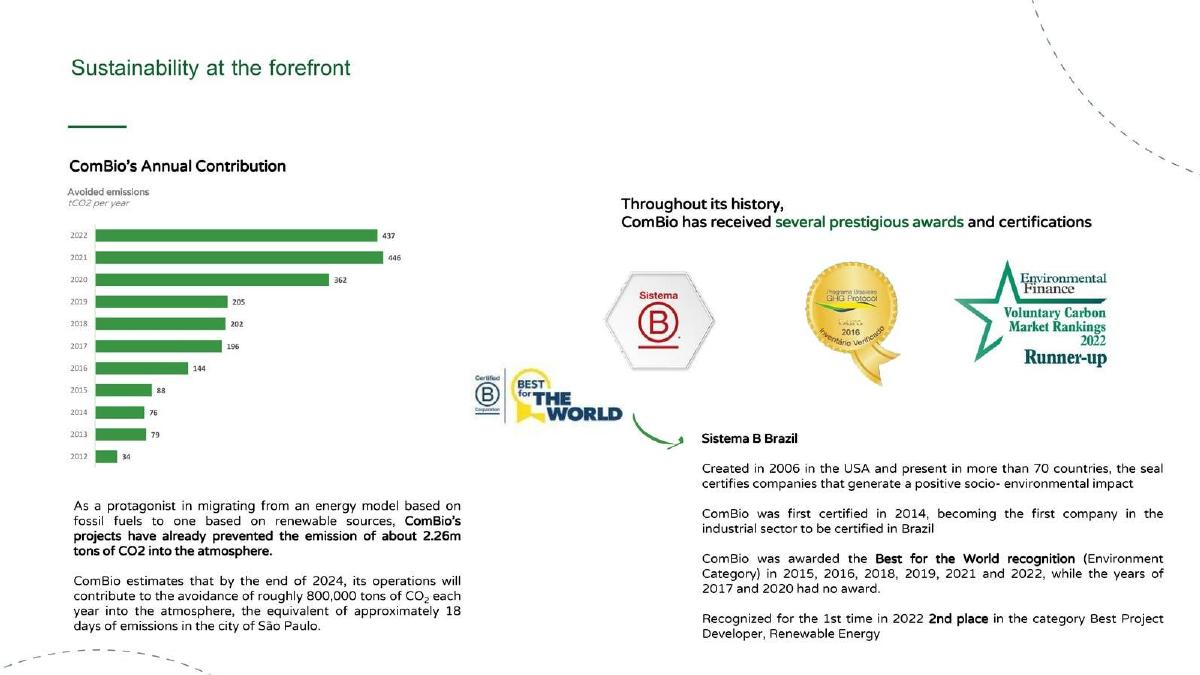
ComBio impact slide — slide 6
Renewable industrial energy in Brazil. The slide refers to results through 2022 and an estimate to the end of 2024; stage is not stated.
ComBio deck, slide 6. Exact stored slide matched to this analysis.
Our analysis: This is the most checkable slide here: a unit (tons of CO2), a yearly series, a cumulative total, a forward estimate labelled as an estimate, and third-party certification.
Evidence and limitation: The slide doesn't say how avoided emissions are calculated (against what baseline fuel) or link the figure to revenue. Add the method in a footnote and one line such as tons avoided per unit of revenue.
What a founder can adapt: Chart your impact metric by year, give the total, label forecasts clearly, and add any outside certification.
Supporting analysis
What the deck claims: "Sustainability at the forefront". A bar chart of avoided emissions per year; text saying ComBio's projects "have already prevented the emission of about 2.26m tons of CO2" and estimating about 800,000 tons of CO2 avoided each year by the end of 2024. The right side shows B Corp certification (first certified in 2014, described as the first industrial company certified in Brazil), Best for the World recognitions and a 2022 carbon-market ranking.
Presentation choice: This is the most checkable slide here: a unit (tons of CO2), a yearly series, a cumulative total, a forward estimate labelled as an estimate, and third-party certification.
When it does not fit: The slide doesn't say how avoided emissions are calculated (against what baseline fuel) or link the figure to revenue. Add the method in a footnote and one line such as tons avoided per unit of revenue.
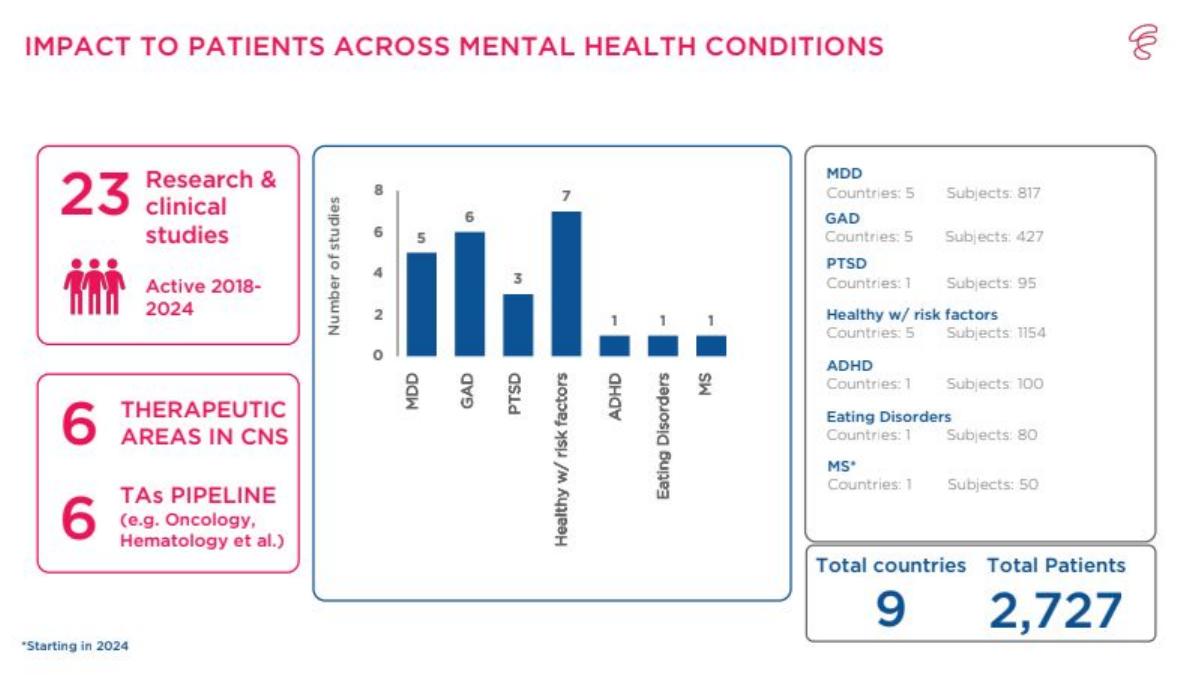
Digital mental-health therapeutics. Stage is not stated; the slide shows studies active 2018–2024.
Feel Therapeutics deck, slide 6. Exact stored slide matched to this analysis.
Our analysis: For a health company, reach in clinical studies is a concrete and countable form of impact, broken down by condition.
Evidence and limitation: Patients enrolled is reach, not outcome. The slide says nothing about whether symptoms improved. Add the main result of one study.
What a founder can adapt: If your impact is clinical, count studies, patients and conditions, and date the period.
Supporting analysis
What the deck claims: "Impact to patients across mental health conditions": 23 research and clinical studies active 2018–2024, 6 therapeutic areas in the central nervous system and 6 more in the pipeline. A chart counts studies by condition (depression, anxiety, PTSD and others) with countries and subjects for each, totalling 9 countries and 2,727 patients.
Presentation choice: For a health company, reach in clinical studies is a concrete and countable form of impact, broken down by condition.
When it does not fit: Patients enrolled is reach, not outcome. The slide says nothing about whether symptoms improved. Add the main result of one study.
Agricultural funding platform in Indonesia. The slide covers 2018 to 2019; stage is not stated.
Fundnesia deck, slide 4. Exact stored slide matched to this analysis.
Our analysis: Three counted measures, dated periods and a visible trend. The numbers are small, but they are specific.
Evidence and limitation: The footnote doesn't explain the method, and 2019 mixes actual and possibly planned figures without saying which. Mark forecasts and say what changed for each farmer, such as income.
What a founder can adapt: Use a simple table of two or three impact measures across dated periods.
Supporting analysis
What the deck claims: "Social Impact" as a table across S1-2018, S2-2018 and 2019: small farmers reached (6, 15, 28 people), agricultural product raised (100 kg, 300 kg, 1,000 kg) and program funding (20M, 60M, 200M IDR). A footnote reads "The Impact base on change and calculate".
Presentation choice: Three counted measures, dated periods and a visible trend. The numbers are small, but they are specific.
When it does not fit: The footnote doesn't explain the method, and 2019 mixes actual and possibly planned figures without saying which. Mark forecasts and say what changed for each farmer, such as income.
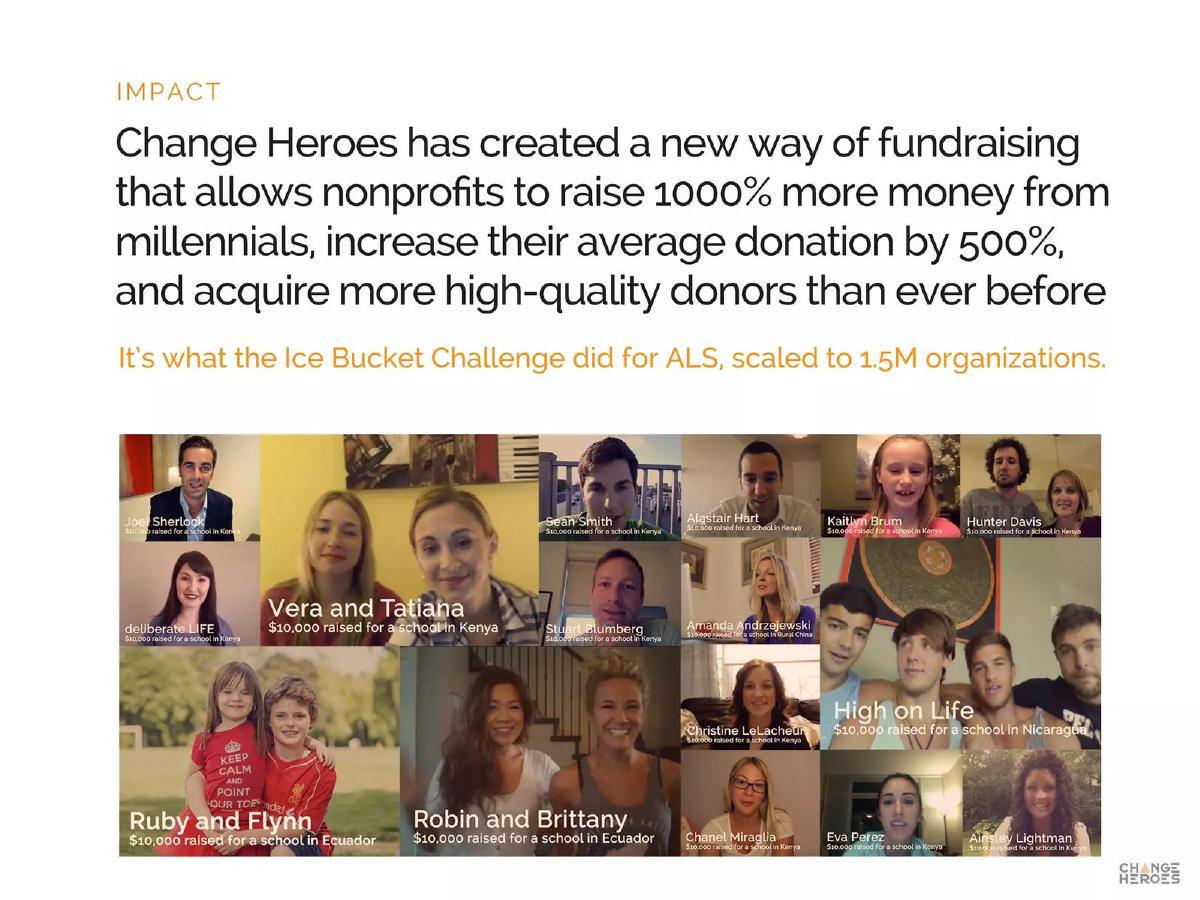
Fundraising platform for nonprofits. Stage and year are not stated on the slide.
Change Heroes deck, slide 3. Exact stored slide matched to this analysis.
Our analysis: Named people and dollar amounts make the impact human and concrete. The customer impact (more money raised) is also the reason nonprofits would pay.
Evidence and limitation: The 1000% and 500% figures have no base, sample or period, and 1.5M organizations is a market size, not a result. Replace them with totals raised to date and the number of campaigns.
What a founder can adapt: Show real people with the amount they achieved, and make the impact the same thing customers buy.
Supporting analysis
What the deck claims: "Impact": the company says nonprofits can "raise 1000% more money from millennials, increase their average donation by 500%, and acquire more high-quality donors than ever before", compares itself to what the Ice Bucket Challenge did for ALS "scaled to 1.5M organizations", and shows photos of fundraisers with amounts raised (for example $10,000 raised for a school).
Presentation choice: Named people and dollar amounts make the impact human and concrete. The customer impact (more money raised) is also the reason nonprofits would pay.
When it does not fit: The 1000% and 500% figures have no base, sample or period, and 1.5M organizations is a market size, not a result. Replace them with totals raised to date and the number of campaigns.
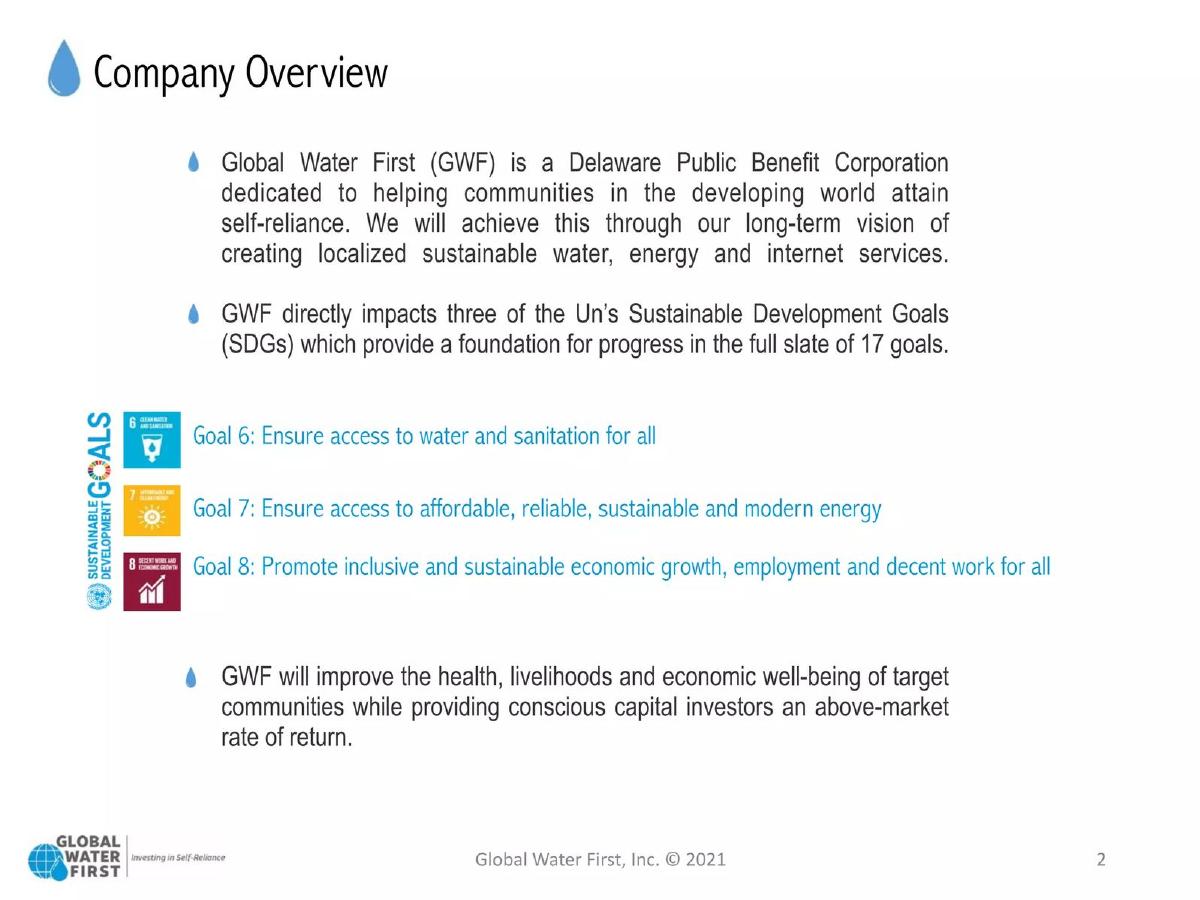
Water, energy and internet services in developing communities. The slide footer is dated 2021; stage is not stated.
Global Water First deck, slide 2. Exact stored slide matched to this analysis.
Our analysis: Stating the legal form (a public benefit corporation) and naming specific goals tells impact investors which frameworks the company reports against.
Evidence and limitation: There is no number at all: no communities, people, litres or kilowatt-hours. The promise of above-market returns needs evidence. Add one measured outcome per goal.
What a founder can adapt: If you report against a framework, name it and the specific goals, as here.
Supporting analysis
What the deck claims: "Company Overview": a Delaware Public Benefit Corporation helping communities in the developing world "attain self-reliance"; it maps to UN Sustainable Development Goals 6 (water and sanitation), 7 (energy) and 8 (economic growth), and promises investors "an above-market rate of return".
Presentation choice: Stating the legal form (a public benefit corporation) and naming specific goals tells impact investors which frameworks the company reports against.
When it does not fit: There is no number at all: no communities, people, litres or kilowatt-hours. The promise of above-market returns needs evidence. Add one measured outcome per goal.
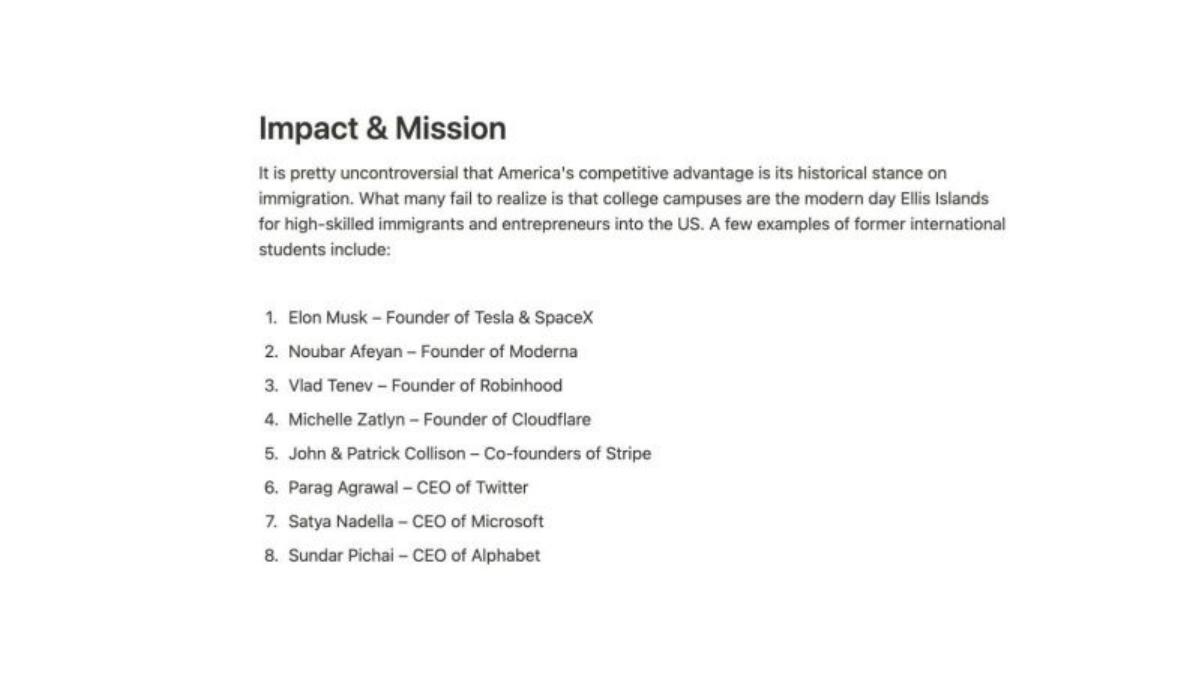
Support for international students. Stage and year are not stated on the slide.
Ellis deck, slide 2. Exact stored slide matched to this analysis.
Our analysis: The list makes the mission memorable and shows why the student group matters.
Evidence and limitation: None of the people listed used Ellis. This is the size of the opportunity, not the company's impact. Rename it a mission slide, or add students served and outcomes such as visas secured or jobs started.
What a founder can adapt: Treat this as a slide to improve on. A well-known example can open the argument, as long as the slide then shows your own results.
Supporting analysis
What the deck claims: "Impact & Mission": argues that college campuses are "the modern day Ellis Islands" for high-skilled immigrants and lists eight former international students who became founders or CEOs, including Elon Musk, the Collison brothers and Satya Nadella.
Presentation choice: The list makes the mission memorable and shows why the student group matters.
When it does not fit: None of the people listed used Ellis. This is the size of the opportunity, not the company's impact. Rename it a mission slide, or add students served and outcomes such as visas secured or jobs started.
Rental and lifecycle management of company smartphones, including refurbishment and resale.
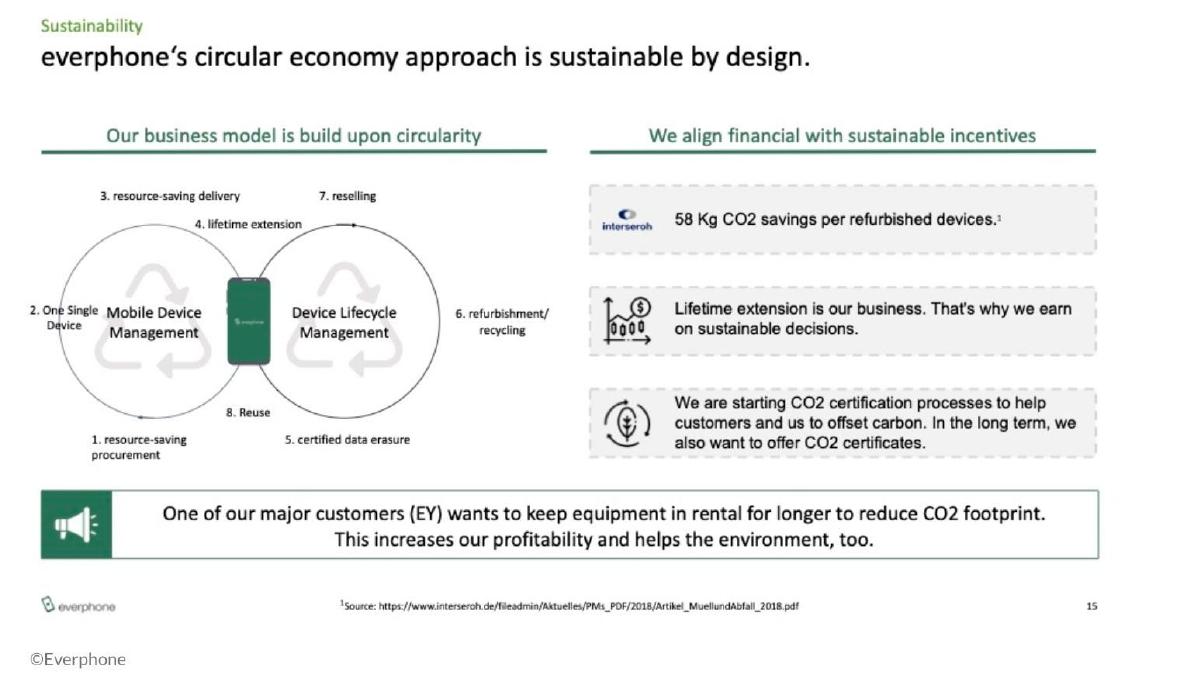
Everphone deck, slide 15. Exact stored slide matched to this analysis.
Our analysis: It links impact to revenue: longer rentals are both less waste and more profit, shown with a named customer. The per-device CO2 figure is cited.
Evidence and limitation: No count of refurbished devices, so the total CO2 saved can't be worked out. The 58 kg figure is a general one from an outside source, not measured on Everphone's own devices.
What a founder can adapt: Say how your impact grows with revenue, and give one customer example.
Supporting analysis
What the deck claims: "Sustainability": "everphone's circular economy approach is sustainable by design." A circular diagram (resource-saving procurement, single device, delivery, lifetime extension, certified data erasure, refurbishment/recycling, reselling, reuse). Right side: "58 Kg CO2 savings per refurbished devices" with a footnote to an Interseroh document; "Lifetime extension is our business. That's why we earn on sustainable decisions."; CO2 certification processes being started. Callout: one major customer (EY) "wants to keep equipment in rental for longer to reduce CO2 footprint. This increases our profitability and helps the environment, too."
Presentation choice: It links impact to revenue: longer rentals are both less waste and more profit, shown with a named customer. The per-device CO2 figure is cited.
When it does not fit: No count of refurbished devices, so the total CO2 saved can't be worked out. The 58 kg figure is a general one from an outside source, not measured on Everphone's own devices.
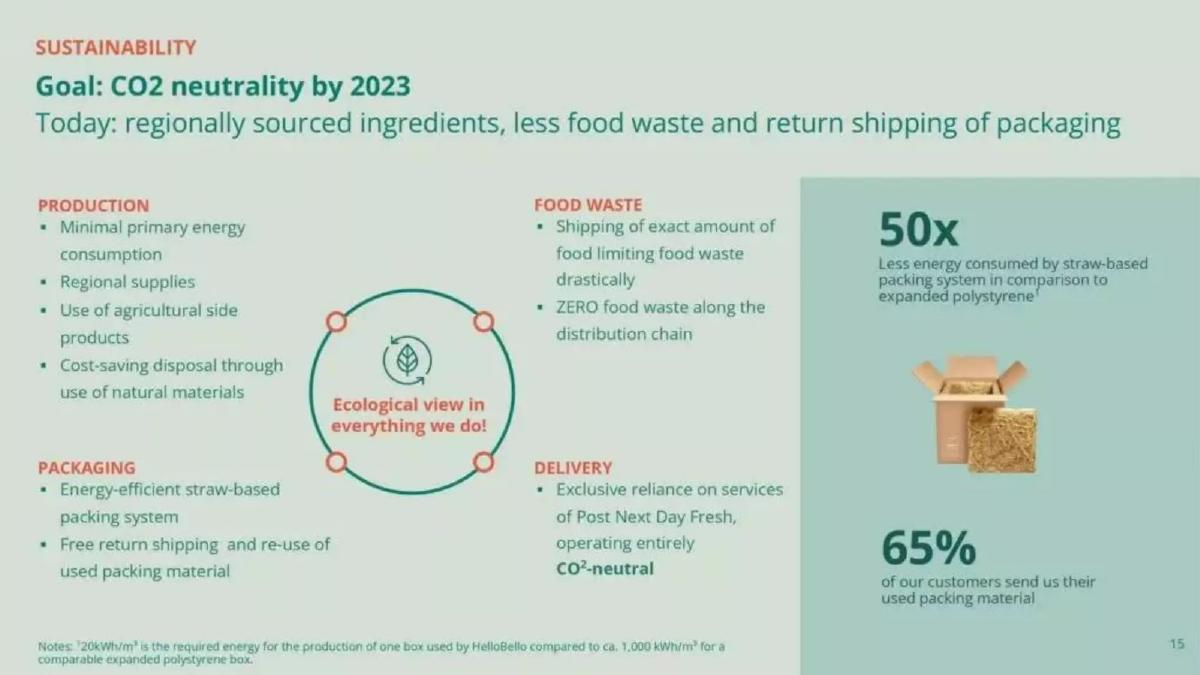
HelloBello deck, slide 15. Exact stored slide matched to this analysis.
Our analysis: It separates a goal from current practice, and the 50x figure has a stated basis.
Evidence and limitation: The 65% return rate has no period or count, and there is no current CO2 figure to measure progress toward the 2023 goal.
What a founder can adapt: Label goals as goals, list what you do today, and footnote how each figure was calculated.
Supporting analysis
What the deck claims: "Sustainability. Goal: CO2 neutrality by 2023. Today: regionally sourced ingredients, less food waste and return shipping of packaging." Four areas (production, food waste, packaging, delivery). "50x" less energy for straw-based packaging than expanded polystyrene (footnote: about 20 kWh per cubic metre against about 1,000); "65% of our customers send us their used packing material"; delivery by a carrier described as "operating entirely CO2-neutral".
Presentation choice: It separates a goal from current practice, and the 50x figure has a stated basis.
When it does not fit: The 65% return rate has no period or count, and there is no current CO2 figure to measure progress toward the 2023 goal.
Packaging and materials made from agricultural waste.
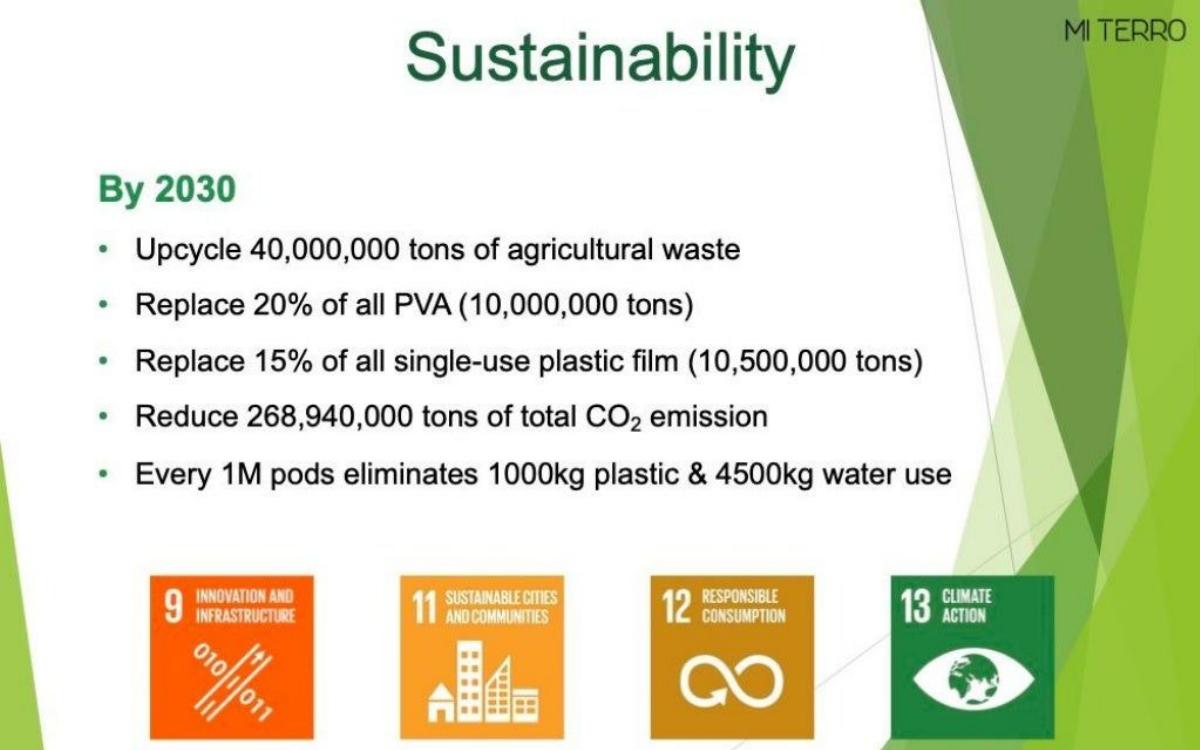
MiTerro deck, slide 7. Exact stored slide matched to this analysis.
Our analysis: The per-unit figure lets a reader turn a sales plan into an impact plan, and the four UN goals fit the product.
Evidence and limitation: Every tonnage is a 2030 target (a forecast), with no current result and no method. Add what you have achieved so far.
What a founder can adapt: State impact per unit sold so investors can check it against your revenue forecast.
Supporting analysis
What the deck claims: "Sustainability. By 2030": upcycle 40,000,000 tons of agricultural waste; replace 20% of all PVA (10,000,000 tons); replace 15% of single-use plastic film (10,500,000 tons); reduce 268,940,000 tons of total CO2 emission; "Every 1M pods eliminates 1000kg plastic & 4500kg water use." Four UN goals shown (9, 11, 12, 13).
Presentation choice: The per-unit figure lets a reader turn a sales plan into an impact plan, and the four UN goals fit the product.
When it does not fit: Every tonnage is a 2030 target (a forecast), with no current result and no method. Add what you have achieved so far.
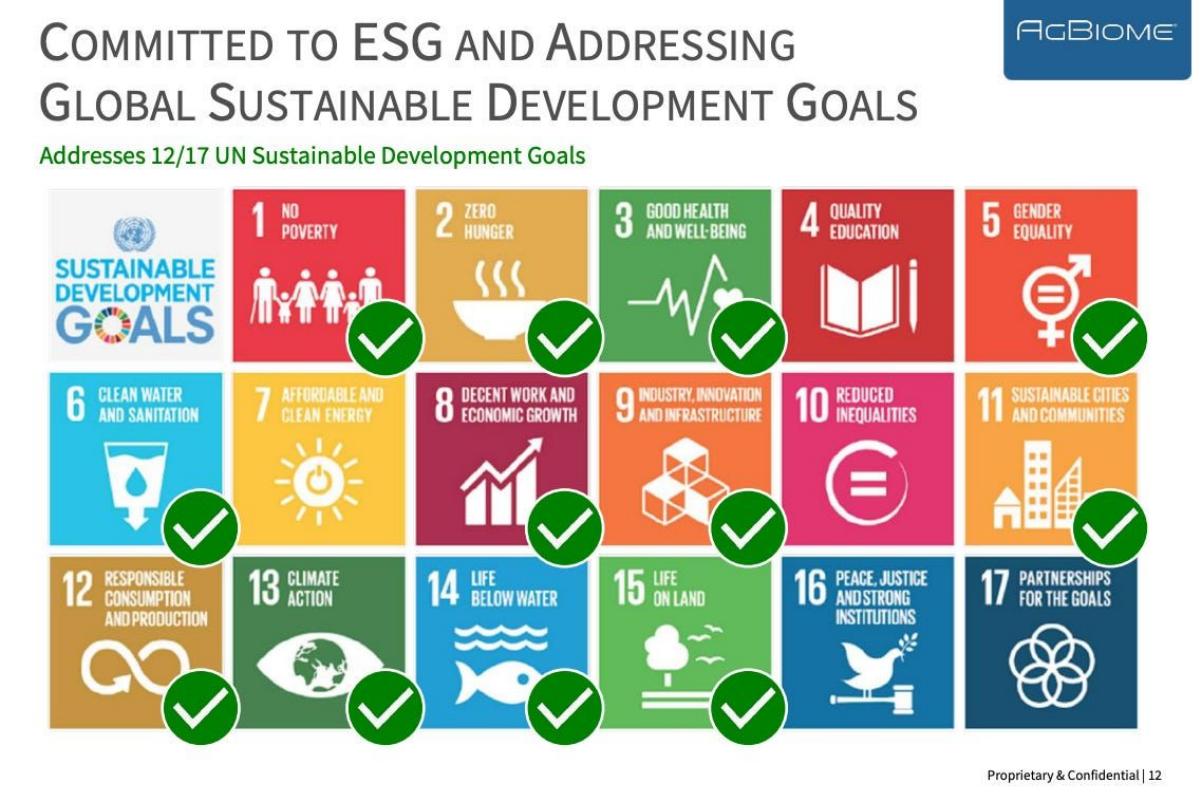
AgBiome deck, slide 12. Exact stored slide matched to this analysis.
Our analysis: A contrast example: it shows how ticking many goals without figures weakens the claim.
Evidence and limitation: No figures for any goal, and several (quality education, gender equality) have no obvious link to crop protection.
What a founder can adapt: Pick the one to three goals your product most directly affects and add a figure for each.
Supporting analysis
What the deck claims: "Committed to ESG and addressing global sustainable development goals. Addresses 12/17 UN Sustainable Development Goals." The full 17-goal grid with 12 ticked, including no poverty, zero hunger, quality education, gender equality, clean water, decent work, innovation, sustainable cities, responsible consumption, climate action, life below water and life on land.
Presentation choice: A contrast example: it shows how ticking many goals without figures weakens the claim.
When it does not fit: No figures for any goal, and several (quality education, gender equality) have no obvious link to crop protection.
Check your slide against the column that matters most to your investors: measured, dated, caused by you, linked to revenue.
Example
Measured
Dated
Caused by the company
Linked to revenue
ComBio
Yes: tons of CO2
Yes: yearly series
Yes, plus certification
Not stated
Feel Therapeutics
Reach: studies and patients
Yes: 2018–2024
Yes
Not stated
Fundnesia
Yes: farmers, kg, funding
Yes: half-years
Yes, method unclear
Implied by funding
Change Heroes
Percentages without base
No
Claimed
Yes: more money is the product
Global Water First
No figures
No
Framework only
Asserted return
Ellis
No
No
No: borrowed examples
No
Everphone
Per device (cited outside figure)
No
Yes, totals not given
Yes: longer rentals raise profit
HelloBello
Yes: energy (with basis), return rate
Goal dated 2023
Yes
Not stated
MiTerro
Targets only
2030 targets
Planned
Per unit (1M pods)
AgBiome
No figures
No
Framework only (12 goals)
No
Key Takeaways
Date every impact figure. ComBio charts avoided emissions per year and gives a cumulative total (about 2.26 million tons of CO2); Fundnesia uses half-year columns.
Only claim outcomes you caused. Ellis's list of Elon Musk, the Collison brothers and others shows a problem worth solving, not Ellis's impact.
Percentages need a base and a method. Change Heroes' "1000% more money from millennials" and "average donation by 500%" give neither.
Goal mapping is not measurement. Global Water First names three UN goals but no people served, litres delivered or cost per person.
Cite outside figures. Everphone footnotes its 58 kg of CO2 per refurbished device to a recycling company's source document.
Separate today from goals and forecasts. HelloBello labels CO2 neutrality by 2023 as a goal and lists current practices below it; MiTerro's 2030 tonnages are targets, not results.
Ticking more UN goals does not make impact more credible. AgBiome claims 12 of 17 with no figures.
Small, honest numbers are fine at an early stage. Fundnesia reports 28 farmers reached in 2019. Investors would rather see that than an unexplained large figure.
Build your impact slide
Answer each prompt with a number where you can.
Unit. What do you count: people served, tons avoided, income gained, patients treated?
Series. What was it in each period so far, and what is the total?
Method. How is it measured, and against what baseline?
Link. How does the impact grow when revenue grows?
Copyable framework: [Company] has [outcome] for [n unit] since [year] ([method, baseline]). Each [unit of sale] delivers [impact per unit], so impact grows with revenue. [Certification or framework, if any].
Illustrative example 1 — written by us
Before: We change lives and support the UN Sustainable Development Goals.
After: Since [year], [n] households have gained access to clean water through our [product] ([method]). Each [installation] we sell serves about [x] people, so reach grows with sales. We report against SDG 6.
What improved: Our illustrative rewrite, not any company's text. It adds a counted unit, a start date, a method and a link to sales; bracketed values are placeholders.
When a deck needs a separate impact slide
Include one when impact is part of why customers buy or why certain investors (impact funds, climate funds, foundations) would back you. For most other companies, a line on the solution or traction slide is enough.
Investors will read the slide in two ways: is the impact real and measured, and does it grow with revenue or compete with it? A slide that answers only the first question looks like a charity pitch.
Linking impact to revenue
The question that separates an investor-ready impact slide from a charity pitch is whether impact grows with the business or competes with it. Everphone, which rents and refurbishes company phones, answers it most directly. Its slide says the business model "is build upon circularity" (the slide's wording) and that "Lifetime extension is our business. That's why we earn on sustainable decisions." It then gives a customer example: one of its major customers, EY, "wants to keep equipment in rental for longer to reduce CO2 footprint. This increases our profitability and helps the environment, too." Whether that holds across all customers isn't shown, but the slide makes the argument an impact investor and a financial investor both want to hear: each extra month of rental is both more revenue and less waste.
MiTerro, which makes packaging from agricultural waste, makes the link per unit instead: "Every 1M pods eliminates 1000kg plastic & 4500kg water use." That lets a reader convert a sales forecast into an impact forecast. It is the company's claim with no method shown, but the structure is right. If you can state impact per unit sold, investors can check it against your revenue plan.
Today, goals and forecasts
Sustainability slides often mix what a company already does with what it hopes to do. HelloBello, a dog food company, separates them clearly: the headline is "Goal: CO2 neutrality by 2023", and the line beneath starts with "Today:" before listing regionally sourced ingredients, less food waste and return shipping of packaging. Two figures sit on the right: packaging that uses "50x" less energy than expanded polystyrene, with a footnote giving the basis (about 20 kWh per cubic metre against about 1,000 for a comparable polystyrene box), and "65% of our customers send us their used packing material". The first has a stated method; the second is the company's claim without a period or count.
MiTerro's slide is entirely forward-looking: "By 2030" it aims to upcycle 40 million tons of agricultural waste, replace 20% of all PVA and 15% of single-use plastic film, and reduce total CO2 emissions by 268,940,000 tons. These are targets, not results, and they are very large for a company at the stage the deck describes. A reader will want to know what the company has achieved so far. If your slide is mostly forecasts, label them and add one current figure, even a small one.
Citing your sources
Impact figures are easy to inflate and hard to check, so a source matters even more than on a market slide. Everphone's 58 kg of CO2 per refurbished device carries a footnote to a document from Interseroh, a recycling and environmental services company. A reader can follow it. HelloBello's footnote explains how its 50x energy figure was calculated. ComBio, earlier in this guide, adds outside certification. Most other impact slides in our corpus give no source at all.
If your figure comes from your own measurement, say how you measured it: what you counted, over what period, and against what baseline. If it comes from an industry study, cite the study and say whether the per-unit figure applies to your product or to the category in general.
UN goal grids
Mapping a company to the UN Sustainable Development Goals is common in impact decks, and it is useful to funds that report against them. But a tick on a goal is a claim, not a result. AgBiome, which develops biological crop protection products, shows the full 17-goal grid under the heading "Committed to ESG and addressing global sustainable development goals" and ticks 12, including quality education, gender equality and life below water. No figures support any of them, and it is hard to see how a crop protection company addresses twelve goals directly.
Fewer goals with evidence is more credible than many goals without. MiTerro names four (industry and innovation, sustainable cities, responsible consumption, climate action), which fit its product. Global Water First, earlier in this guide, names three. Pick the one to three goals your product most directly affects, and put a number next to each.
Questions investors usually ask
Expect questions such as: How is this figure measured, and who checked it? What is the baseline? How much of the impact would happen without you? Does impact per unit stay the same as you grow, or fall? Is any of it a forecast? Have answers ready, and remove any figure you can't explain in one sentence.
Common mistakes
Borrowed impact. Famous examples show the problem, not your results.
Percentages with no base. Say compared with what, for how many, over what period.
Goals without figures. Naming a UN goal is not measurement.
Reach presented as outcome. People enrolled is not people helped.
Unlabelled forecasts. Separate actual and projected figures.
Diagnostic checklist
Every impact figure has a unit and a date.
The measurement method or baseline is stated.
Only outcomes the company caused are claimed.
Forecasts are labelled as forecasts.
The slide says how impact grows with revenue.
Any certification or framework is named specifically.
Frequently asked questions
How we chose these examples
Corpus: published pitch deck teardowns on StartupFundraising.com. Founder-uploaded private decks are excluded.
Selection (2026-09-24): we searched extracted text of slides 2–6 for slides titled impact, social impact, sustainability or similar, and for UN Sustainable Development Goal and emissions language, where a stored slide image exists. Six were selected in v1. Nesta was excluded as a foundation, not a startup; Terraformation and Mattereum slides were excluded because they discuss the size of the climate problem, not company impact; Richpanel, Symend and Surge Ventures were excluded because "impact" there means business effect, not social or environmental impact.
Overlap check: no existing guide covers impact slides. The pre-revenue traction guide covers early proof of demand, not social or environmental outcomes.
Review (v1): the first six stored slide images were inspected on 2026-09-24 and matched to company, deck and slide number (editorial model review). No person has yet completed an editorial review of this page.
Update (2026-10-01): we added Everphone slide 15, HelloBello slide 15, MiTerro slide 7 and AgBiome slide 12, read from images made from the original deck files. Not used: Fisker, Genius Group, Kroger/Albertsons, Impact Silver and Canadian Overseas Petroleum (publicly listed companies), Mi Terro's other deck version (same slide as MiTerro), EcoVadis, HowGood, Normative and Utopi (their product is sustainability software, so the slides describe the product), and Cedar Fair and Lara Exploration ("sustainability" there means financial sustainability).
Review (v2): the four new slide images were inspected on 2026-10-01 and matched to company, deck and slide number (AI editorial model review). No person has yet completed an editorial review of this page.
Impact figures, certifications and rankings are the companies' own claims and have not been independently verified. We make no claim that any slide caused a fundraising outcome.