Mi Terro is an advanced materials company targeting the $128.8 billion global single-use plastic industry by upcycling agricultural waste into degradable packaging. The 2022 Seed deck, which secured $1.5M led by Astanor, relies heavily on technical problem-solving and large-scale environmental impact projections. While the deck provided for this teardown is a condensed 8-slide version of a 15-slide original, it clearly identifies Polyvinyl Alcohol (PVA) as a primary target, noting that 75% of PVA currently stays in waterways and soil. The company positions itself as a B2B supplier with a dive…
Key takeaways
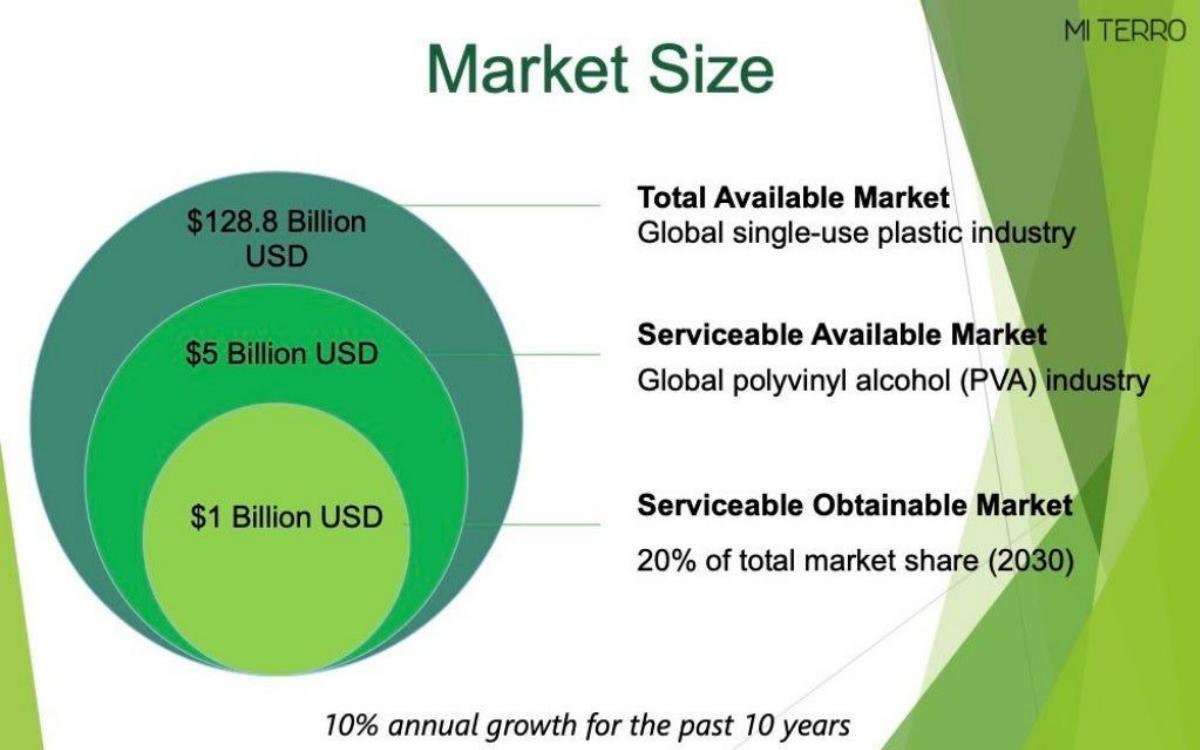
- The company targets the $128.8 billion global single-use plastic industry, specifically focusing on the $5 billion PVA market (Slide 4).
- Mi Terro claims that 75% of current PVA used in 20 billion dishwasher and laundry pods in the US remains in waterways and soil (Slide 3).
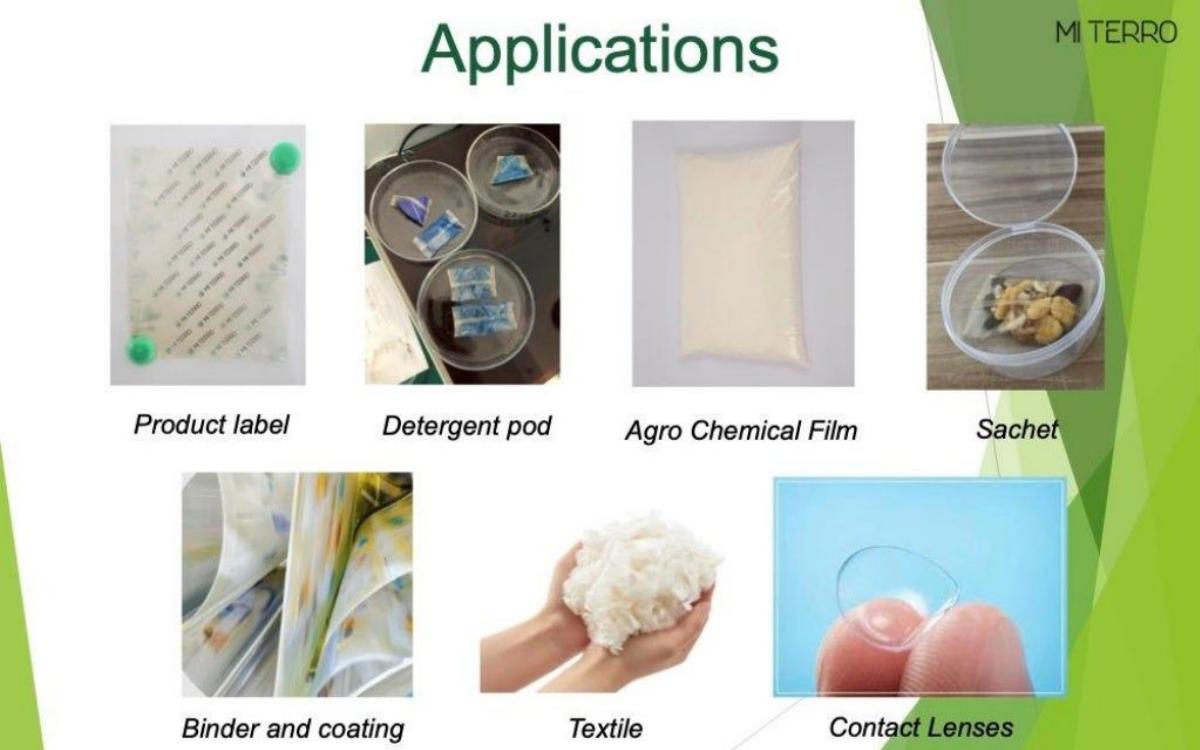
- The technology is presented as versatile, with applications ranging from detergent pods and agrochemical film to textiles and contact lenses (Slide 5).
- The deck lists high-profile potential clients and partners including Google, ABInBev, Budweiser, Unilever, and P&G (Slide 6).
- Sustainability goals for 2030 include upcycling 40,000,000 tons of agricultural waste and replacing 20% of all PVA (Slide 7).
- The company estimates that every 1 million pods produced eliminates 1,000kg of plastic and 4,500kg of water use (Slide 7).
- The Serviceable Obtainable Market is defined as $1 billion, representing a 20% market share by 2030 (Slide 4).
- The deck highlights a 10% annual growth rate for the target market over the past decade (Slide 4).
Mi Terro: A Seed Stage Deep-Dive into Biomass Engineering
Mi Terro represents a growing cohort of "Deep Tech" sustainability startups that focus on material science to solve the plastic crisis. This teardown examines their 2022 Seed deck, which helped secure $1.5M in funding. The deck is structured to move from a specific environmental pollutant (PVA) to a broad industrial solution, leveraging the massive scale of agricultural waste as a feedstock.
Slide 1: Cover Slide
The cover slide is minimalist, featuring the company name and the tagline: "Cutting-Edge Engineering Biomass Waste to End Microplastic." This immediately establishes the company's two-sided value proposition: waste management (biomass) and environmental protection (ending microplastics). The branding is clean, utilizing a green and white color palette that reinforces the sustainability theme.
Slide 2: Contents
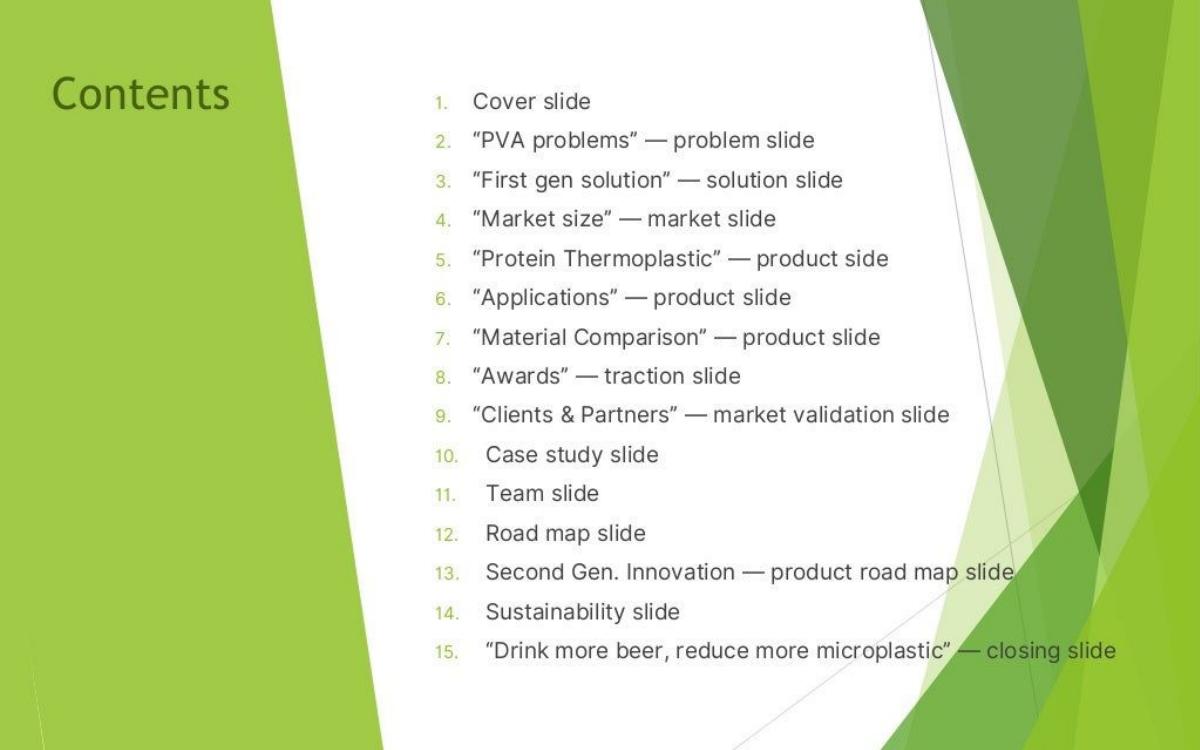
Slide 2 provides a roadmap for the presentation. It lists 15 distinct sections, including "PVA problems," "Protein Thermoplastic," "Material Comparison," and a "Road map slide." Crucially, the deck provided for this teardown is an excerpt containing only 8 of these 15 slides. The missing slides include the Team slide, the Case Study, and the Second Gen Innovation slide. For a founder, a Table of Contents is often unnecessary in a short deck, but in a technical deep-dive, it helps investors navigate complex material science topics.
Slide 3: PVA Problems
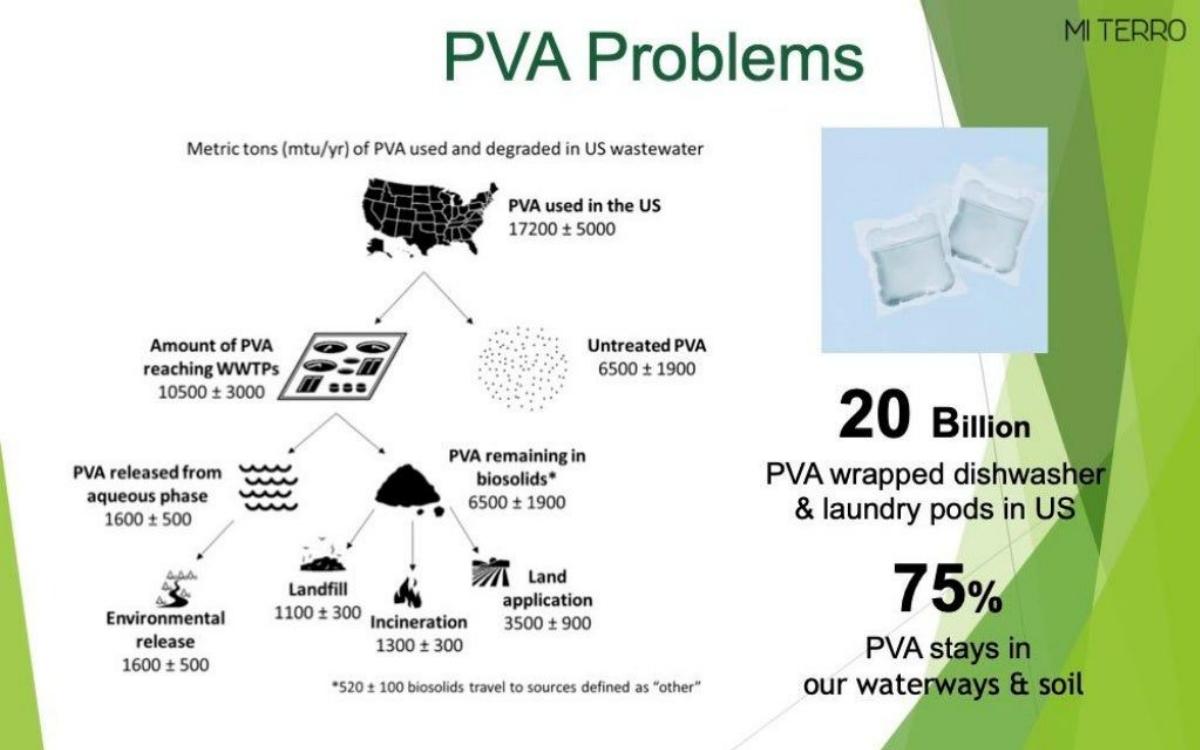
This is the core "Problem" slide. It focuses specifically on Polyvinyl Alcohol (PVA), the material used to wrap laundry and dishwasher pods. The slide uses a flow chart to track the lifecycle of PVA in the US. Key figures include:
17,200 ± 5,000 metric tons of PVA used in the US annually. · 20 Billion PVA wrapped dishwasher & laundry pods used in the US. · 75% of PVA stays in our waterways & soil.
By quantifying the failure of "water-soluble" plastics to actually biodegrade, Mi Terro creates an urgent need for their alternative. The use of error margins (±) suggests a level of scientific rigor often missing from pitch decks.
Slide 4: Market Size
Mi Terro uses the standard TAM/SAM/SOM concentric circle model to illustrate their opportunity:
Total Available Market: $128.8 Billion USD (Global single-use plastic industry). · Serviceable Available Market: $5 Billion USD (Global polyvinyl alcohol industry). · Serviceable Obtainable Market: $1 Billion USD (Targeting 20% market share by 2030).
The slide also notes a 10% annual growth rate for the past 10 years, indicating a tailwind in the sector. The SOM of $1 billion is ambitious but grounded in a specific percentage of a defined sub-sector (PVA).
Slide 5: Applications
This slide demonstrates the versatility of the material. Rather than just being a "pod company," Mi Terro shows six distinct use cases with photographic evidence:
Product labels · Detergent pods · Agro Chemical Film · Sachets · Binder and coating · Textiles · Contact Lenses
This variety is intended to de-risk the investment by showing that if one market (like detergent pods) fails to adopt the material, there are multiple other billion-dollar verticals available.
Slide 6: Clients & Partners
This is a "Logo Slide" intended to provide market validation. It features major global conglomerates: ABInBev, Budweiser, Unilever, P&G, Google, Mitsui Bussan Packaging, Kuraray, Monosol, Harada, and Asahi. The deck does not specify the nature of these relationships (e.g., whether they are paid pilots, LOIs, or research partnerships). However, for a Seed stage company, having these names associated with the technology is a significant signal of interest from the world's largest plastic users.
Slide 7: Sustainability
The final content slide in this excerpt focuses on ESG (Environmental, Social, and Governance) metrics. It sets specific targets for 2030:
Upcycle 40,000,000 tons of agricultural waste. · Replace 20% of all PVA (10,000,000 tons). · Reduce 268,940,000 tons of total CO2 emission. · Every 1M pods eliminates 1000kg plastic & 4500kg water use .
The slide also references UN Sustainable Development Goals 9, 11, 12, and 13. This is particularly important for attracting impact-focused VCs like Astanor, who eventually led the round.
Slide 8: Closing
The final slide is a promotional graphic for the pitch deck library source. The actual closing slide of the Mi Terro deck (mentioned in the Table of Contents as "Drink more beer, reduce more microplastic") is not included in this excerpt.
What Mi Terro Does Well
Specific Problem Targeting: Instead of attacking "plastic" as a whole, which is too broad, Mi Terro identifies a specific, misunderstood pollutant (PVA). By proving that PVA doesn't actually disappear, they create a niche where they can be the dominant alternative.
Quantified Impact: The use of specific tonnage and CO2 reduction figures (Slide 7) appeals to the data-driven requirements of modern ESG investors. They aren't just selling "green packaging"; they are selling a measurable reduction in carbon and waste.
Visual Proof: Slide 5 (Applications) uses actual photos of the material in different forms. For a material science company, showing that the product exists in a lab-verified form is essential for moving past the "science project" phase in an investor's mind.
What is Missing from the Deck
The Team: As an excerpt, the most glaring omission is the team slide. In Seed stage investing, the founders' technical pedigree (PhD in materials science, chemistry, etc.) is often more important than the current traction. The Table of Contents indicates a team slide exists, but its absence here makes it impossible to evaluate the execution risk.
Unit Economics: There is no mention of the cost per unit compared to traditional PVA. In the B2B packaging world, sustainability is a secondary concern to price and performance. If the biomass-based film costs 5x more than PVA, the "Serviceable Obtainable Market" of $1 billion is unlikely to be realized.
The Ask: The deck does not state how much money is being raised or how the funds will be allocated. While the catalogue facts state they raised $1.5M, a pitch deck should ideally outline the milestones that the specific funding round will enable (e.g., "Building a pilot production facility").
Founder Takeaways
Use a Table of Contents for Long Decks: If your deck exceeds 12 slides or covers complex scientific territory, a contents slide (Slide 2) helps investors pace themselves and revisit specific technical sections during due diligence.
Leverage Industry Standard Frameworks: The TAM/SAM/SOM slide (Slide 4) is a textbook example of how to present market size. It starts with a massive headline number to show the ceiling, then narrows down to a realistic, defensible target (20% of the PVA market).
Connect to Global Goals: If you are in the sustainability space, explicitly linking your metrics to the UN Sustainable Development Goals (Slide 7) makes your company more "discoverable" for impact funds that have specific mandates to invest in those categories.
Focus on the 'Invisible' Problem: Most people think laundry pods dissolve completely. By highlighting the 75% persistence rate (Slide 3), Mi Terro educates the investor on a problem they didn't know existed, which immediately makes the solution more valuable.
Frequently asked questions
- What specific problem is Mi Terro solving?
- Mi Terro targets the environmental impact of Polyvinyl Alcohol (PVA). According to slide 3, 20 billion PVA-wrapped pods are used in the US annually, but 75% of that material persists in soil and water rather than fully degrading. They solve this by engineering agricultural biomass waste into a truly degradable alternative.
- Who are Mi Terro's primary customers?
- The company operates a B2B model, targeting large-scale consumer goods and industrial firms. Slide 6 displays logos for major global brands including Unilever, P&G, ABInBev, and Budweiser, suggesting these companies are either current clients, pilot partners, or primary targets for their packaging materials.
- How large is the market opportunity for biomass-based packaging?
- Mi Terro defines the Total Available Market (TAM) as the $128.8 billion global single-use plastic industry. Their more immediate Serviceable Available Market (SAM) is the $5 billion global PVA industry. They aim to capture $1 billion of this, or 20% market share, by 2030 (Slide 4).
- What are the environmental benefits of the Mi Terro solution?
- Beyond being ocean-degradable, the process upcycles agricultural waste. Slide 7 notes that by 2030, they aim to reduce 268,940,000 tons of CO2 emissions. Additionally, every 1 million pods produced saves 4,500kg of water compared to traditional manufacturing methods.
- What is missing from this pitch deck?
- This specific 8-slide version is an excerpt. It lacks a team slide (essential for Seed stage), a detailed product roadmap, unit economics, and a specific funding ask. While the table of contents on slide 2 mentions these sections, they are not included in the provided visual materials.