Good City Foundation’s deck positions the organization as a central orchestrator for urban digitalization in emerging markets, specifically targeting Asia and Africa. Utilizing what they call a 'Double-Funnel' model, the foundation bridges the gap between high-level international agendas and specific local development projects. The deck highlights a three-pronged ecosystem: the Future City Summit for networking, the Good City Foundation for digital platform governance, and Rainmaker Ventures for startup investment. While the deck boasts impressive historical milestones—including 35 city partn…
Key takeaways
- The primary goal is the digitalization of 100 emerging cities by the year 2030 (Slide 1).
- The foundation addresses 'Wicked Digital Governance Challenges' such as inconsistent urban dynamics and weak technology awareness in city governments (Slide 2).
- A 'Double-Funnel' model is used to align international agendas with local stakeholder demand and specific startup procurement (Slide 3).
- The organization has already identified interest from specific cities in Indonesia, the Philippines, and Vietnam (Slide 4).
- The 'PPP by Youth' program serves as the primary mechanism for identifying master planning pain points with local governments (Slide 5).
- Rainmaker Ventures acts as the investment arm, providing access to seed capital and incubator networks like Cyberport and InvestHK (Slide 6).
- Milestones since 2016 include 5 annual meets, 7 development programs, and 35 city partners across Asia and Africa (Slide 7).
- The deck offers three entry points for funders: summit sponsorship, platform membership, or startup investment partnership (Slide 8).
The Vision: Digitalisation For All
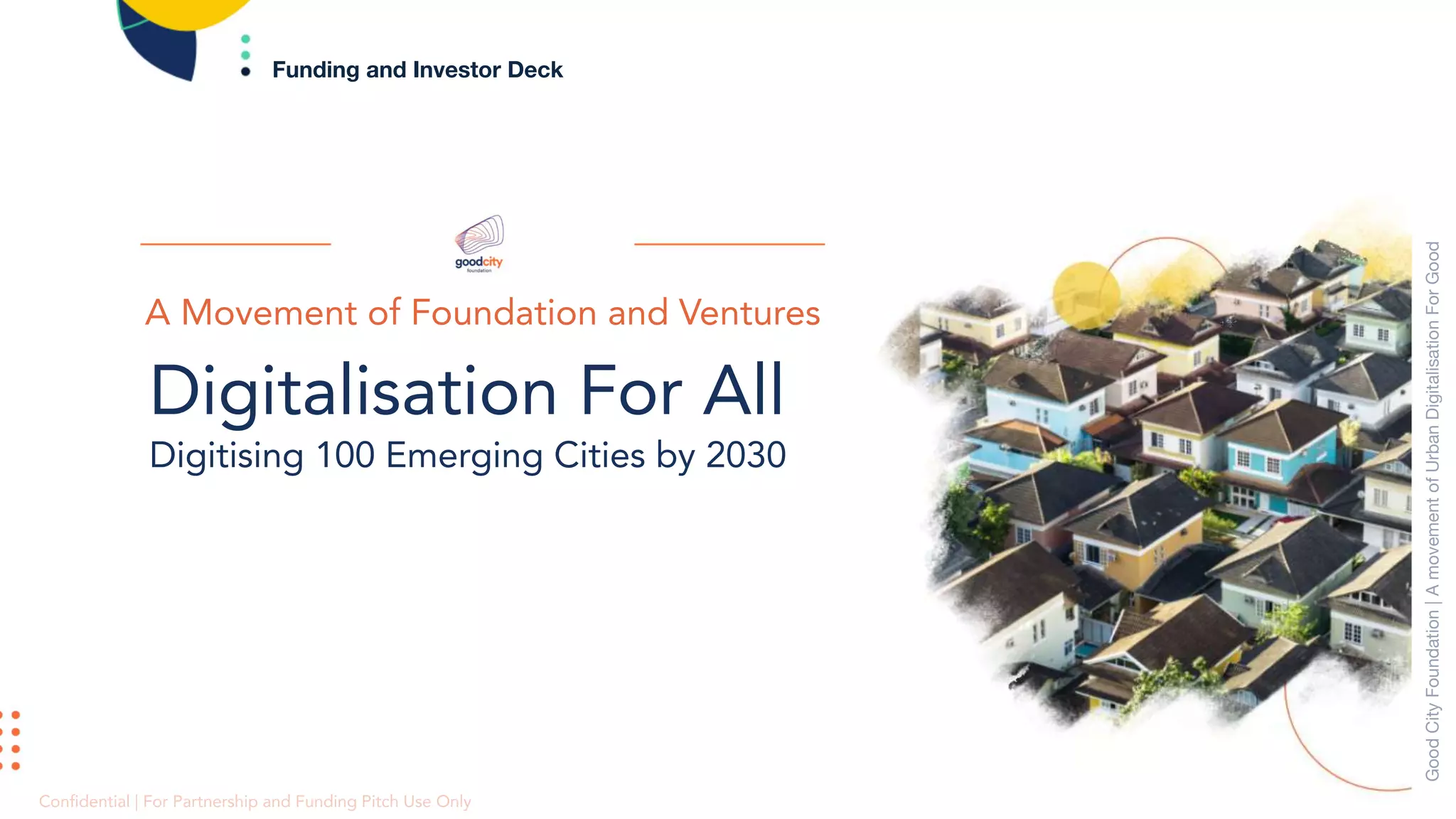
The Good City Foundation deck opens with a bold, time-bound mission: 'Digitising 100 Emerging Cities by 2030.' This title slide (Slide 1) immediately establishes the scale of the ambition and the specific niche—emerging cities. By branding themselves as a 'Movement of Foundation and Ventures,' they signal a hybrid structure that combines social impact with private sector investment mechanisms.
Defining the 'Wicked' Problem
Slide 2, titled 'The Wicked Digital Governance Challenges and Opportunities,' uses a classic problem-solution format. The foundation identifies three core friction points: inconsistent urban dynamics in master planning, weak technology awareness in city governments, and a lack of sustainable financing models for local private sector partnerships. Their proposed solutions involve data-driven benchmarking, human capital investment through digital media, and a 'hyper-collaborative' venture building model linked to ESG (Environmental, Social, and Governance) standards.
The Double-Funnel Strategy
Slide 3 introduces the 'All Weather Development Strategy,' visualized as a 'Double-Funnel' model. This is the most complex slide in the deck, attempting to show how the organization operates across four levels: Network, Development, Investment, and Specific Portfolios. The top funnel represents the aggregation of international agendas and capacity building, while the bottom funnel focuses on identifying specific startups and projects for procurement and financing. The 'interface' between these two funnels is where regional stakeholder interest is aligned with local demand mapping. This slide effectively communicates that the foundation acts as a bridge between high-level policy and on-the-ground execution.
Product and Traction: The Urbanetics Map
Slide 4 provides a glimpse into the actual tools being deployed. It features the 'Urbanetics Map,' a dashboard for assessing land use, operational costs, and revenue. More importantly, it shows a 'City Benchmarking' tool that scores cities on a radar chart across five indicators (Alpha 1 through 5). The slide lists specific 'Interested Cities' in Indonesia, the Philippines, and Vietnam, providing concrete evidence of regional traction. This moves the deck from abstract theory to tangible application.
The Human Element: PPP by Youth
Slide 5 and Slide 6 detail the 'Ecosystem As A Movement.' Slide 5 focuses on the 'PPP by Youth' program, showcasing a diverse group of advisors and participants, including mayors, councilors, and academics. The three-step process—Identify, Identify Pain Points, and Provide Insights—frames the foundation as a consultancy-led movement. Slide 6 introduces 'Rainmaker Ventures,' the investment arm. It lists notable partners like Cyberport, Garuda Fund, InvestHK, and Beyond Ventures, suggesting a strong institutional network in Hong Kong and Southeast Asia. This section is vital for investors as it explains how the 'Foundation' side of the business feeds the 'Venture' side.
Quantifiable Milestones
Slide 7 is the 'traction' slide, listing milestones since 2016. The figures are impressive: 5 annual meets, 7 development programs in 6 cities, 50+ signed partnerships, and a network of over 2,000 alumni. The most significant metric for potential partners is the '35 City Partners in Asia and Africa' and the '60,000+ Annual Digital Footprint.' These numbers suggest that the foundation has successfully moved past the pilot phase and has a functional, scalable network.
The Ask: Three Funding Schemes
The final slide (Slide 8) departs from the traditional venture capital 'ask' for a specific dollar amount at a specific valuation. Instead, it offers three distinct 'Funding Schemes.' This approach is tailored for a hybrid organization. It allows institutional donors to sponsor events, corporate entities to pay for platform access, and VCs or family offices to co-invest in startups. While this provides flexibility, it may leave a pure-play VC wondering where the primary exit opportunity lies.
What Works in This Deck
Clear Geographic Focus: By naming specific cities in Southeast Asia, the foundation demonstrates that they are not just theorizing about emerging markets but are actively engaged in them.
Structural Sophistication: The 'Double-Funnel' model (Slide 3) is a sophisticated way to explain a complex business that involves both non-profit and for-profit activities. It shows that the founders have thought deeply about how to align disparate stakeholders.
Network Effect: The inclusion of logos like InvestHK and Cyberport (Slide 6) and the mention of 35 city partners (Slide 7) build significant credibility. In the world of urban tech and government relations, the strength of the network is often the primary moat.
What is Missing
Unit Economics and Revenue Model: While the deck mentions 'Sustainable Financing' and 'Corporate Users,' it does not explain how the foundation actually makes money on a day-to-day basis. Are there SaaS fees for the Urbanetics Map? What is the carry structure for Rainmaker Ventures? These details are absent.
The Team Slide: Although Slide 5 shows several faces associated with the 'PPP by Youth' program, there is no dedicated 'Team' slide highlighting the core leadership, their backgrounds, or their previous successes in urban planning or venture capital. This is a major omission for an organization that relies so heavily on trust and expertise.
Specific Capital Requirements: The 'Funding Schemes' on Slide 8 are categories, not targets. A professional investor would want to see how much capital is needed for the next 18-24 months and exactly how that capital will be allocated between the foundation and the venture arm.
Founder's Playbook: What to Copy
The Benchmarking Approach: If you are building a B2G (Business to Government) or impact-focused startup, creating a 'benchmarking' or 'rating' system (as seen on Slide 4) is a powerful way to create a 'fear of missing out' among stakeholders. No city wants to be the one with the lowest score in 'Urban Governance Wisdom.'
Visualizing the Ecosystem: The way this deck visualizes the flow from 'International Agenda' to 'Specific Startup Procurement' is excellent. Founders in complex industries (like healthcare or energy) should copy this method of showing how their company fits into a larger, multi-layered ecosystem.
Hybrid Funding: For social entrepreneurs, the three-tiered funding approach on Slide 8 is a great template. It acknowledges that different types of capital (grants, sponsorships, and equity) have different requirements and offers a way to accommodate all of them without diluting the core mission.
Frequently asked questions
- What is the core business model of Good City Foundation?
- It is a hybrid model described as a 'Movement of Foundation and Ventures.' It operates at three levels: a Network Level (Future City Summit), a Development Level (Good City Foundation digital platform), and an Investment Level (Rainmaker Ventures). This allows them to generate impact through non-profit capacity building while capturing value through venture capital investments in urban tech startups.
- Which geographic regions does the foundation target?
- The deck specifically lists cities in Southeast Asia, including Denpasar, Bandung, and Surabaya in Indonesia; Manila in the Philippines; and Hue City and Da Nang in Vietnam. Slide 7 also notes that they have 35 city partners spanning both Asia and Africa, with operation offices in Bangkok, Denpasar, and Jakarta.
- How does the foundation interact with local governments?
- They use a 'Public Private Partnership (PPP) by Youth' strategy. This involves identifying potential emerging cities and working directly with local government officials—such as mayors and councilors—to identify master planning pain points and provide tech governance insights through their bottom-up development programs.
- What kind of technology or product does the foundation offer?
- Slide 4 showcases an 'Urbanetics Map' and a city benchmarking dashboard. These tools provide data-driven city evaluation, credit ratings for urban governance, and comparison metrics across categories like geographical equity policies, public health governance, and digital finance inclusiveness.
- What are the specific funding opportunities mentioned?
- Unlike a standard startup deck, there is no single 'ask.' Instead, Slide 8 outlines three schemes: 1) Institutional partnership and sponsorship for the Future City Summit, 2) Corporate membership and funding for the digitalization platform, and 3) Becoming an investment partner for impactful urban tech startup investing via Rainmaker Ventures.