Lenda’s pitch deck is an exercise in extreme brevity, utilizing just 10 slides to communicate a value proposition centered on efficiency and cost reduction in the mortgage industry. The deck leans heavily on three core pillars: a $1.2 trillion market size, a team with over 10 years of domain expertise, and an early traction milestone of $10 million in loans funded. By highlighting a 65% cost reduction compared to traditional lenders and a process that is 3x faster, Lenda positions itself as the digital-first alternative to a notoriously slow and paper-heavy industry. While the deck lacks a sp…
Key takeaways
- The deck identifies a massive $1.2T market size as a primary hook on slide 2.
- Founder Jason van den Brand is highlighted for having 10+ years of domain expertise and founding 3 companies on slide 9.
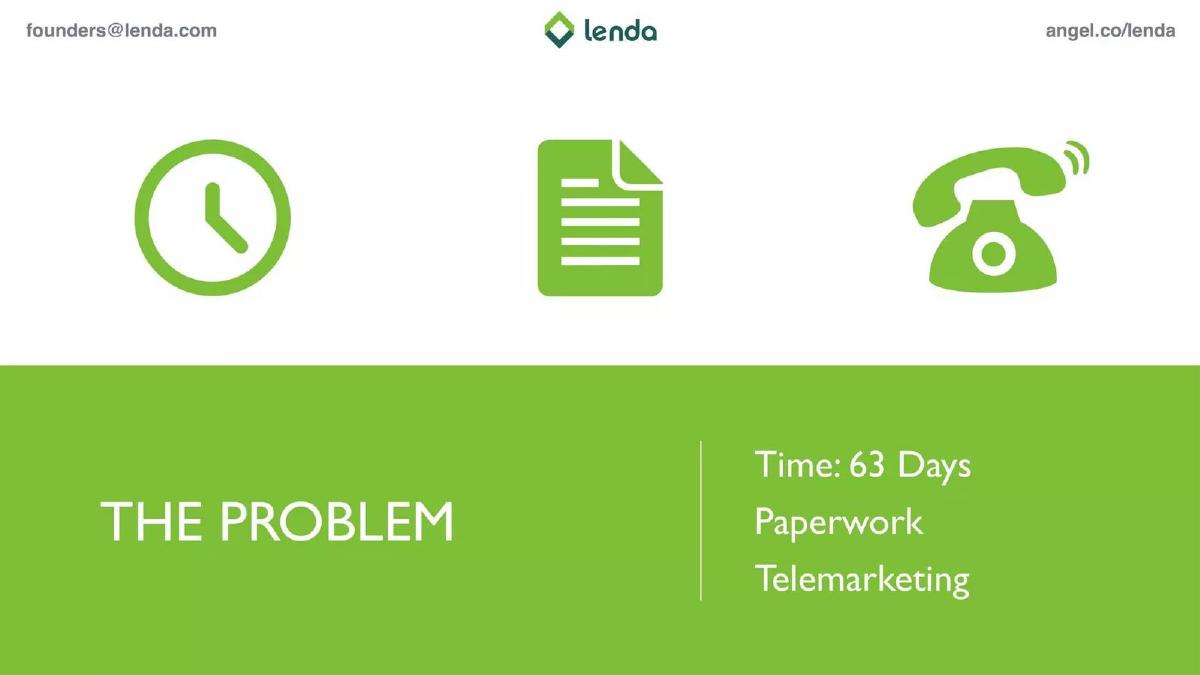
- The problem is quantified as a 63-day closing time involving heavy paperwork and telemarketing on slide 5.
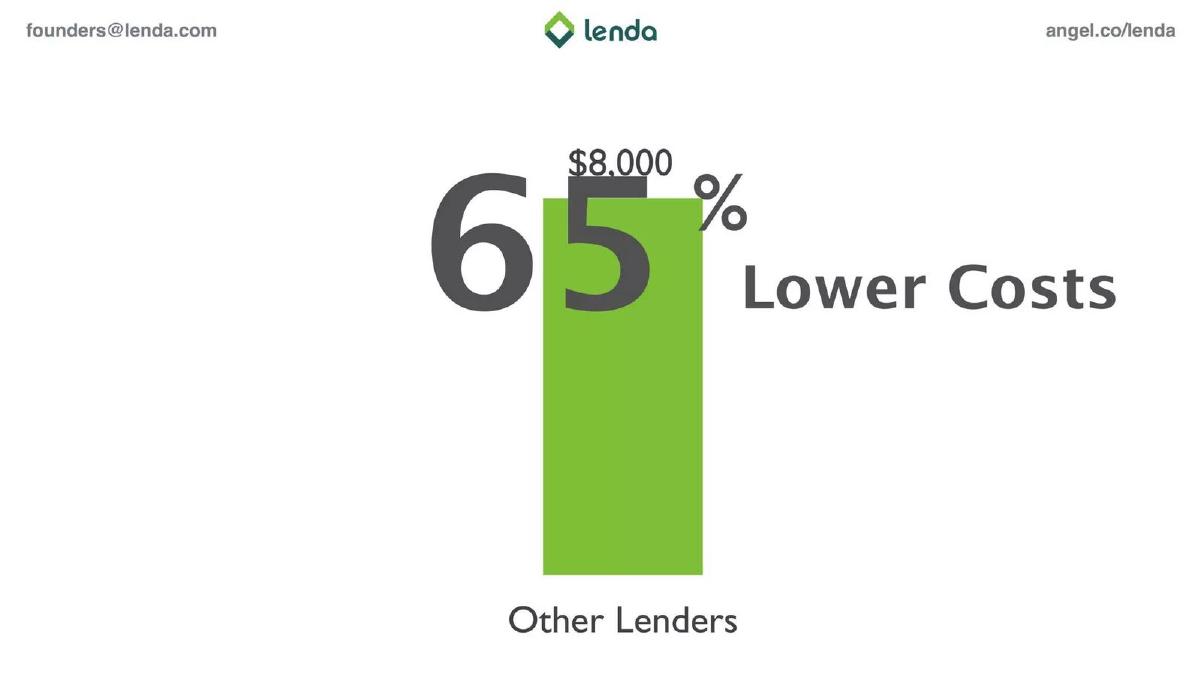
- Lenda claims a 65% lower cost structure compared to 'Other Lenders' on slide 6.
- The solution is defined by digital paperwork, the absence of telemarketing, and being 3x faster on slide 7.
- Early traction is demonstrated by $10M in loans already funded as shown on slide 8.
- The deck completely omits a slide detailing the specific funding amount requested or the intended use of funds.
- A product UI mockup on slide 10 shows a 'No Fees' rate option with a 4.125% interest rate.
The Minimalist Path to a $10.7M Series A
Lenda's pitch deck is a striking example of the 'less is more' philosophy in startup fundraising. In an industry as complex and regulated as mortgage lending, one might expect a 30-slide deck filled with legal disclosures and intricate flowcharts. Instead, Lenda presents a 10-slide narrative that focuses on the sheer scale of the opportunity and the inefficiency of the status quo. Founded in 2011 and based in San Francisco, Lenda used this deck to bridge the gap between early traction and a significant Series A round.
Slides 1-3: The Hook and the Credentials
Slide 1: Title Slide The deck opens with the Lenda logo and the tagline: 'Home loans online, from rate quote to close.' It is a clear, functional summary of the business. There are no distractions, just a promise of a digital-end-to-end experience.
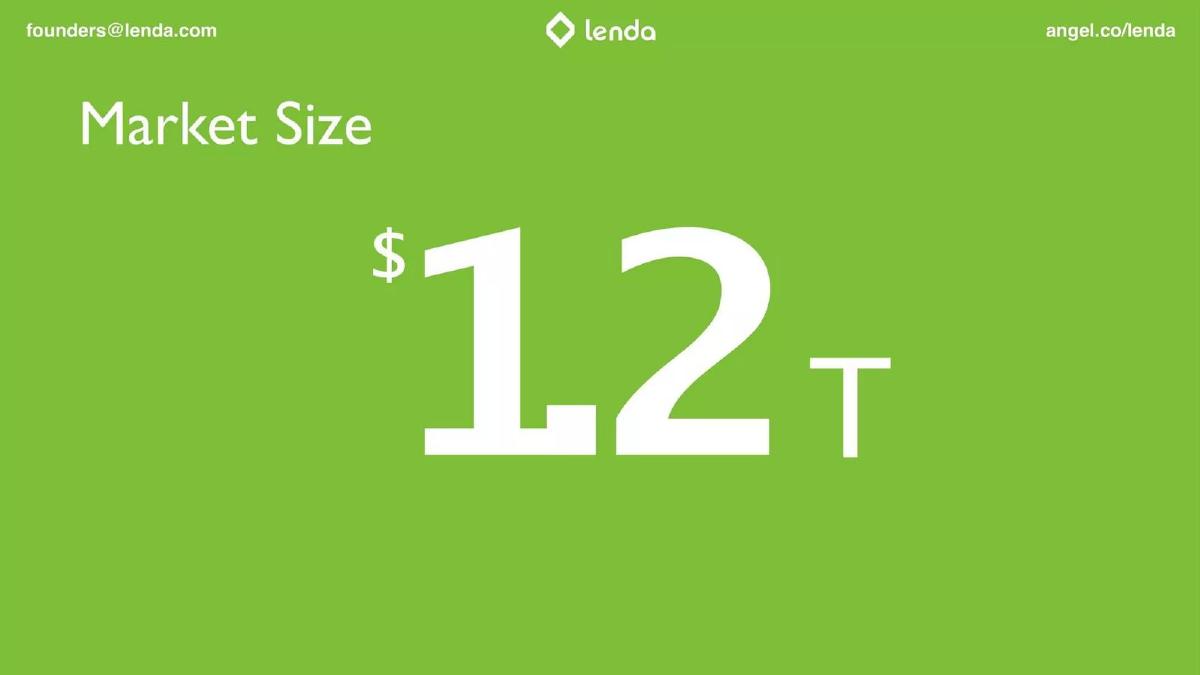
Slide 2: Market Size Lenda immediately goes for the 'big number' strategy. Slide 2 features a massive '$1.2T' in white text against a green background. By starting with the market size, the founders are signaling that even a tiny fraction of market share represents a massive business. This sets the stakes for the rest of the presentation.
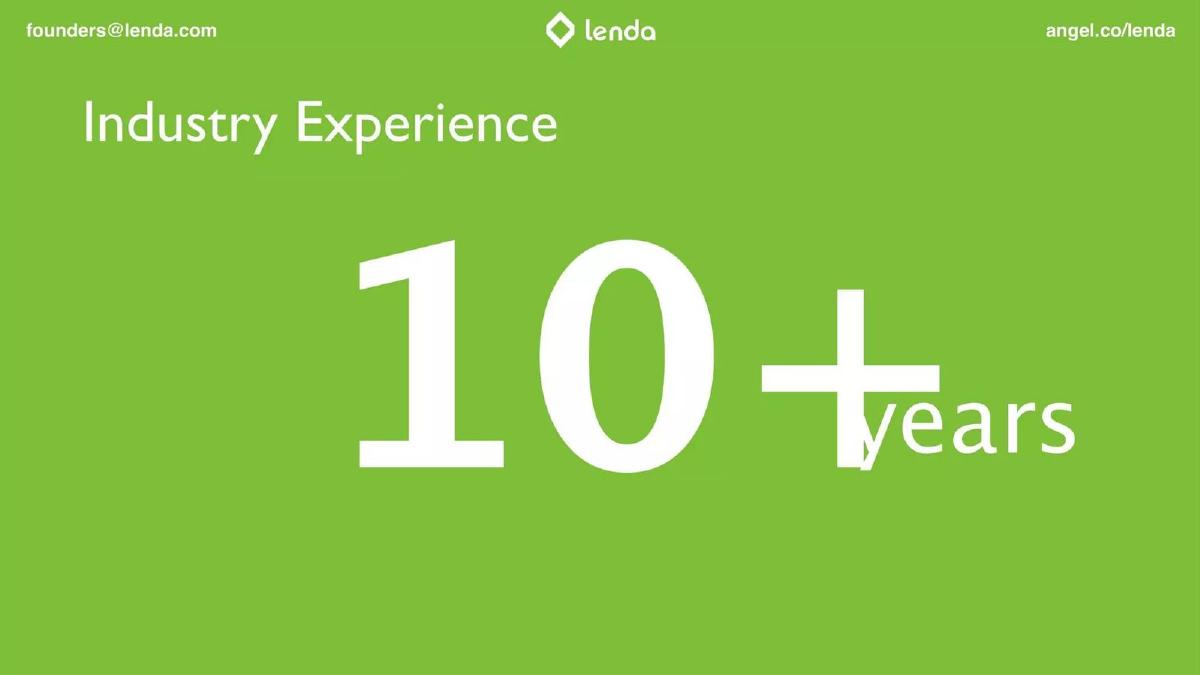
Slide 3: Industry Experience Before explaining the product, Lenda sells the team's credibility. Slide 3 displays '10+ years' of industry experience. In fintech, and specifically in lending, investors are often wary of 'tech-first' founders who don't understand the regulatory and capital markets nuances of the industry. This slide aims to neutralize that concern early.
Slides 4-5: The Emotional and Functional Problem
Slide 4: The Emotional Hook Slide 4 is a blurred image of a suburban home with the overlay '#GETTINGAMORTGAGESUCKS'. This is a rare use of a hashtag in a professional pitch deck, but it serves to humanize the problem. It identifies with the customer's frustration, moving the conversation from abstract finance to a relatable human experience.
Slide 5: The Functional Problem Slide 5 quantifies the 'suck.' It lists three specific pain points: 'Time: 63 Days', 'Paperwork', and 'Telemarketing'. By putting a specific number (63 days) on the board, Lenda gives the investors a benchmark to measure their solution against. The icons for a clock, a document, and a ringing telephone reinforce these points visually.
Slides 6-7: The Economic and Technical Solution
Slide 6: Lower Costs This is arguably the most important slide for a Series A investor. It claims '65% Lower Costs' compared to 'Other Lenders'. It includes a figure of '$8,000', presumably representing the savings passed to the consumer or the reduction in origination costs. The bar chart is simple but effective in showing the delta between Lenda and the incumbents.
Slide 7: The Solution Slide 7 mirrors the problem slide. The solution is 'Digital Paperwork', 'No Telemarketing', and being '3x Faster'. The icons show a hand signing a tablet and a 'no' symbol over a telephone. This slide promises to solve every specific pain point mentioned on Slide 5, creating a satisfying narrative arc.
Slides 8-10: Traction, Team, and Product
Slide 8: Loans Funded Traction is the ultimate de-risking mechanism. Slide 8 shows '$10M' in loans funded. While $10M is a small fraction of the $1.2T market mentioned earlier, it proves that the platform works, the licenses are in place, and customers are willing to trust a startup with their largest financial transaction.
Slide 9: The Team The team slide provides faces and backgrounds for the '10+ years' claim made earlier. Jason van den Brand (CEO) is noted for founding 3 companies. The technical team (Elijah and Dave Schaaf) and marketing lead (Chris Hiestand) are shown, with Dave Schaaf bringing 'big bank' credibility from JPMorgan. This slide balances entrepreneurial grit with corporate experience.
Slide 10: Product Summary The final slide shows a MacBook Air running the Lenda interface. The UI displays 'Rate Options' with a '4.125%' rate and '$0.00 Closing Costs'. To the right, the deck summarizes its three biggest hits: '10Y industry experience', '$1.2T market size', and '$10M loans funded'. It is a summary slide that leaves the most impressive metrics in the investor's mind as the presentation ends.
What Works in the Lenda Deck
Extreme Clarity: The deck is incredibly easy to read. Each slide has one job and one primary metric. This is ideal for a partner meeting where the goal is to spark a conversation rather than provide a comprehensive data room.
Quantified Pain: By citing the '63 Days' to close a traditional mortgage, Lenda makes the problem tangible. It is much easier to sell a solution when the problem is measured in days and dollars rather than vague adjectives like 'slow' or 'expensive'.
Credibility First: Leading with industry experience (Slide 3) is a smart move for a mortgage startup. It tells investors that the founders aren't just building an app; they understand the plumbing of the financial system.
What is Missing from the Lenda Deck
The Ask: There is no slide indicating how much money Lenda is raising or what they plan to do with it. While this information is often handled in the verbal pitch, its absence in the deck makes the document feel incomplete as a standalone piece.
Business Model: The deck explains how they save money (65% lower costs), but it doesn't explicitly state how Lenda makes money. Do they sell the loans? Do they keep the servicing rights? Do they charge a technology fee? These are critical questions for a Series A round.
Competitive Landscape: Aside from a generic 'Other Lenders' reference on Slide 6, there is no mention of other digital mortgage players like Rocket Mortgage (Quicken Loans) or Better.com. Investors would want to know how Lenda differentiates itself from other tech-enabled competitors.
Unit Economics: While the deck mentions $10M in loans funded, it doesn't provide the Customer Acquisition Cost (CAC) or the Lifetime Value (LTV) of a customer. In a high-CAC industry like mortgage lending, these numbers are vital for proving the scalability of the business.
What a Founder Should Copy
The 'Rule of Three': Lenda consistently uses groups of three to explain their points (3 problems on slide 5, 3 solutions on slide 7, 3 summary metrics on slide 10). This is a classic rhetorical device that makes information more memorable.
Visual Consistency: The use of the brand's green and white color palette throughout the deck creates a professional, cohesive feel. The icons are simple and consistent in style, which prevents the deck from looking cluttered.
The Summary Slide: Ending with a 'greatest hits' slide (Slide 10) that combines a product shot with the three most compelling reasons to invest is a powerful way to close a pitch. It ensures that the final image left on the screen during the Q&A session reinforces the core thesis of the investment.
Final Thoughts Lenda's deck is a high-conviction document. It doesn't hide behind walls of text or complex charts. Instead, it bets that the combination of a massive market, a broken status quo, and a qualified team is enough to win over investors. While it leaves many technical and financial questions unanswered, as a tool for securing a second meeting and establishing a clear narrative, it is highly effective. The successful $10.7M raise suggests that for Lenda, this minimalist approach was exactly what the market ordered.
Frequently asked questions
- How much did Lenda raise with this deck?
- According to the catalogue facts from pitchdeckhunt.com, Lenda raised a total of $10,700,000. The deck itself does not specify the amount being raised or the terms of the round, which is common in decks designed for stage presentations rather than as standalone reading materials.
- What is Lenda's core value proposition?
- Lenda's value proposition centers on speed and cost. As stated on slide 7, the platform offers a process that is 3x faster than traditional methods by using digital paperwork and eliminating telemarketing. Slide 6 further emphasizes this by claiming 65% lower costs than other lenders, specifically citing an $8,000 figure.
- Who are the key team members mentioned?
- Slide 9 introduces four key team members: Jason van den Brand (CEO & Founder), Elijah (CTO & Full-stack developer), Chris Hiestand (Digital Marketing & Financial Advisory), and Dave Schaaf (Backend Developer with experience at Cisco and JPMorgan). The CEO's 10+ years of domain expertise is a recurring theme.
- What specific problem in the mortgage industry does Lenda address?
- Slide 5 identifies the problem as a 63-day average time to close, excessive paperwork, and annoying telemarketing. Slide 4 uses the hashtag #GETTINGAMORTGAGESUCKS to tap into the emotional frustration consumers feel with the traditional home loan process.
- Is there a business model or revenue slide in the deck?
- No. The deck is notably missing a business model slide, financial projections, or a breakdown of how the company generates revenue. It focuses almost entirely on the market opportunity, the team's ability to execute, and the efficiency of the product compared to incumbents.