Suki’s 17-slide Series D deck, used to secure $70M in 2024, is a highly polished example of a growth-stage narrative. Rather than dwelling on technical AI architectures, the deck focuses heavily on the economic and human costs of physician burnout. By quantifying value through three distinct lenses—Efficiency, Revenue, and Satisfaction—Suki provides a compelling case for a 9X ROI. The deck successfully differentiates between its 'Assistant' (the end-user tool) and its 'Platform' (the developer-facing API), signaling a transition from a single-point solution to a broad infrastructure play. Whi…
Key takeaways
- The deck identifies a $4.6B yearly cost associated with physician burnout on slide 3.
- Suki claims to deliver a 72% reduction in documentation time for clinicians on slide 15.
- The product is positioned as more than a scribe, offering 'Problem based charting' and 'Medical calculators' on slide 9.
- Integration is a core value prop, with slide 9 listing Epic, athenahealth, Oracle Cerner, and Meditech as partners.
- The company quantifies revenue growth at up to $57K incremental annual revenue per user on slide 15.
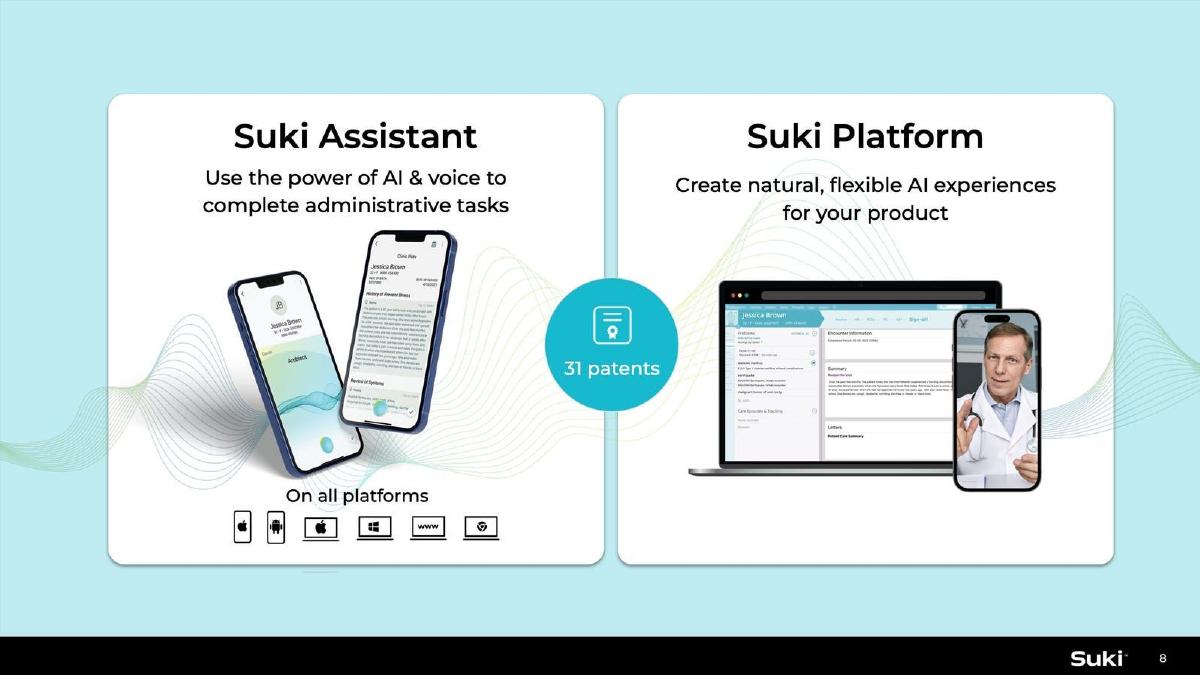
- Suki uses a two-pronged business model: the Suki Assistant for clinicians and the Suki Platform for tech companies (slide 8).
- Third-party validation is provided via a KLAS spotlight report mentioned on slide 16.
- The deck emphasizes 'Responsible AI' and 'EHR integration' as its primary competitive differentiators on slide 13.
Introduction and Vision
Slide 1: Title Slide
The deck opens with a clean, minimalist title slide featuring the Suki logo and the tagline "Suki Hears You." The imagery of a clinician interacting with a patient reinforces the company's focus on the human element of healthcare, rather than just the technology. The copyright date of 2024 confirms this is a current, high-growth stage presentation.
Slide 2: The Vision
Slide 2 establishes the high-level objective: "Our vision is to make healthcare tech invisible and assistive." This is a strategic positioning move. By calling the tech "invisible," Suki promises to remove friction rather than adding another software interface for doctors to manage.
The Problem and Market Dynamics
Slide 3: The State of Healthcare
This is the primary 'Problem' slide, and it is data-heavy. It cites four critical pain points: 50%+ of doctors experience burnout, a $4.6B yearly cost of burnout, 1 out of 3 patients avoiding care due to long waits, and 50%+ of hospitals operating at a financial loss. By linking clinician burnout to hospital financial health, Suki makes a case that their solution is a 'must-have' for the C-suite, not just a 'nice-to-have' for doctors.
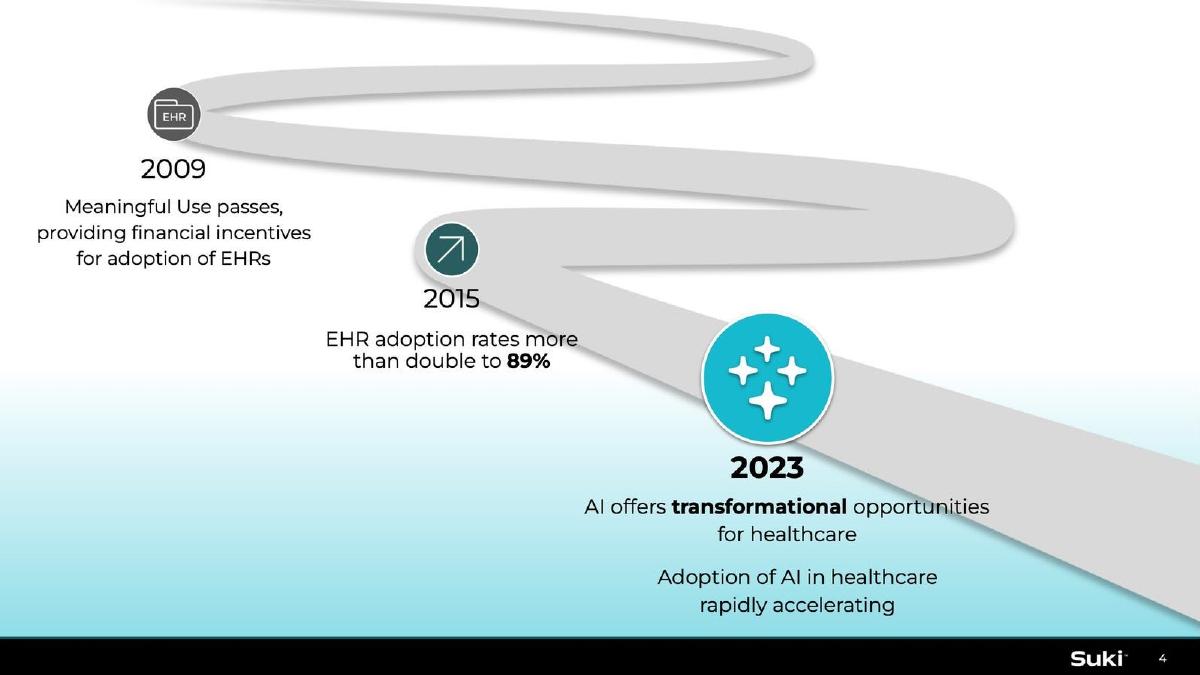
Slide 4: Market Acceleration
Slide 4 notes that the adoption of AI in healthcare is "rapidly accelerating." This slide serves to create urgency (FOMO) for investors, suggesting that the window for capturing this market is open now. It transitions the narrative from a general healthcare crisis to a specific technological opportunity.
The Solution: Assistant and Platform
Slide 5 & 6: The AI Assistant
Slide 5 introduces the "AI Assistant for clinicians." Slide 6 (though text-only in the summary) details the capabilities. The focus here is on the assistant's role in transcribing and summarizing interactions, which directly addresses the burnout mentioned on slide 3.
Slide 7: Democratizing Access
Slide 7 uses a collage of diverse healthcare professionals under the header "Democratize access to AI." This reinforces the scale of the mission—Suki isn't just for elite specialists; it is intended for the entire clinical workforce.
Slide 8 & 9: Product Depth and Integrations
Slide 8 introduces the dual-product strategy: Suki Assistant and Suki Platform. This is a critical slide for a Series D round because it shows multiple revenue streams and a transition toward becoming a platform company. Slide 9 provides a deep dive into the Assistant's "skills," which include gathering data, assessing and planning, and executing actions like medical coding. Crucially, this slide displays the logos of Epic, athenahealth, Oracle Cerner, and Meditech, proving that Suki has solved the difficult problem of EHR integration.
Slide 10: Clinical Settings
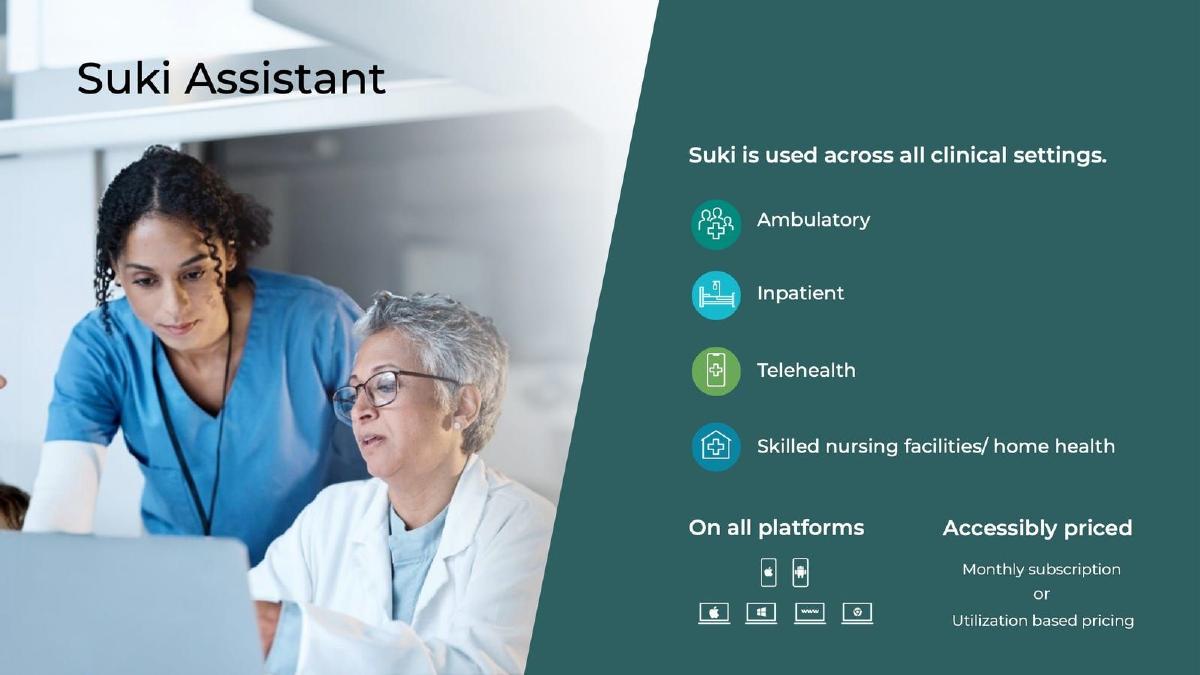
Slide 10 states that Suki is used "across all clinical settings." This indicates that the TAM (Total Addressable Market) is not limited to primary care but extends to hospitals, specialty clinics, and ambulatory centers.
The Platform Strategy
Slide 11 & 12: The B2B Infrastructure Play
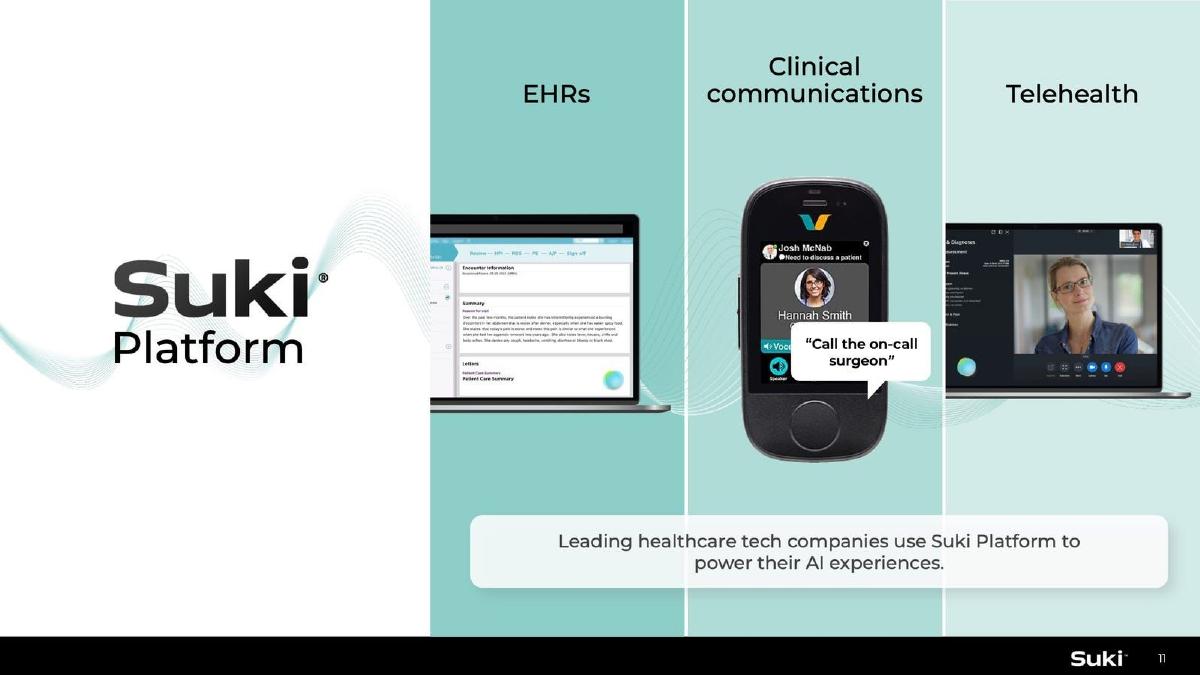
Slide 11 highlights that "Leading healthcare tech companies use Suki Platform to power their AI experiences." This is a classic 'Intel Inside' strategy. Slide 12 emphasizes that this platform requires "minimal development effort," making it an attractive partnership for other health-tech firms that don't want to build their own proprietary LLM layers for healthcare.
Differentiation and Results
Slide 13: The Suki Difference
This slide addresses competition. It lists four pillars: Responsible AI, Works everywhere, More than an ambient scribe, and Reinvents EHR integration. By positioning themselves as "more than a scribe," they are attempting to move up the value chain from simple transcription to clinical decision support and administrative automation.
Slide 14 & 15: The Proof and ROI
Slide 14 introduces the metrics, and Slide 15 delivers the 'knockout' punch: a 9X ROI. The metrics are categorized into Efficiency (72% documentation time reduction), Revenue ($57K incremental annual revenue per user), and Satisfaction (100% recommendation). The $57K figure is particularly powerful as it shows the product pays for itself many times over by increasing patient throughput and coding accuracy.
Slide 16: Third-Party Validation
Slide 16 references a "KLAS spotlight report." In the healthcare industry, KLAS is a highly respected independent research firm. Including this provides a level of objective validation that internal metrics cannot match.
Slide 17: Closing
The deck closes by returning to the theme of "Democratize access to AI," showing the product in use on mobile devices, emphasizing portability and ease of use.
What Works in the Suki Deck
Quantified Pain Points: Suki does not just say doctors are tired; they cite the $4.6B cost of that fatigue. This allows them to frame their solution as a financial recovery tool for hospitals.
Dual-Track Growth: The distinction between the Assistant and the Platform is brilliant for a Series D deck. It shows that the company has a high-margin SaaS product for users and a high-scale API product for the broader industry.
Integration as a Moat: By prominently featuring Epic and Oracle Cerner logos, Suki signals to investors that they have cleared the highest technical and regulatory hurdles in healthcare tech. In this industry, integration is often a bigger barrier to entry than the AI itself.
ROI Clarity: Slide 15 is the strongest slide in the deck. It breaks down the value proposition into three clear buckets that appeal to three different stakeholders: the doctor (Efficiency), the CFO (Revenue), and the HR department (Satisfaction).
What is Missing from the Suki Deck
Team Slide: The provided slides do not include a team overview. For a $70M round, investors would typically want to see the pedigree of the engineering and clinical leadership, especially in a field as sensitive as AI healthcare.
The Ask: There is no slide detailing how the $70M will be spent. While this may have been handled in a separate document or a verbal presentation, a standard pitch deck usually includes a 'Use of Funds' slide to show how the capital will accelerate growth.
Unit Economics: While the deck shows ROI for the customer , it does not show the unit economics for Suki . There is no mention of Customer Acquisition Cost (CAC), Lifetime Value (LTV), or gross margins, which are standard requirements for growth-stage investors.
Competitive Landscape: Slide 13 touches on differentiation, but there is no traditional 'competitor grid.' Given the crowded nature of the AI scribe market (with players like Nuance/Microsoft), a more direct comparison might have been expected.
Lessons for Founders
Move Beyond the 'Feature' Label: Suki successfully avoids being labeled as just a 'scribe tool.' They do this by showing 'Medical calculators' and 'Platform' capabilities. Founders should always look for ways to show their product is a platform, not just a feature.
Use Industry-Standard Validation: If your industry has an equivalent to KLAS (like Gartner for enterprise software or clinical trials for biotech), use it. Third-party validation is worth ten times more than a founder's internal dashboard.
Focus on 'Hard' ROI: Satisfaction scores are nice, but 'incremental annual revenue per user' wins rounds. If your software helps your customer make more money, put that number in bold on its own slide.
Design for the User, Sell to the Buyer: The deck shows the product being used by doctors (the users) but focuses its data on hospital losses and revenue gains (the buyers). A successful healthcare deck must speak both languages simultaneously.
Frequently asked questions
- What is the primary problem Suki aims to solve?
- Suki targets physician burnout and administrative inefficiency. According to slide 3, over 50% of doctors experience burnout, costing the industry $4.6B annually. The deck positions Suki as an 'invisible and assistive' layer that reduces the time doctors spend on documentation, allowing them to focus on patient care.
- How does Suki differentiate itself from other AI medical scribes?
- On slide 13, Suki explicitly states it is 'More than an ambient scribe.' It differentiates through its 'Suki Platform,' which allows other healthcare tech companies to build their own AI experiences using Suki's infrastructure, and its deep integration with major Electronic Health Records (EHR) systems.
- What are the specific ROI metrics mentioned in the deck?
- Slide 15 outlines a 9X ROI based on three pillars: Efficiency (72% reduction in documentation time), Revenue (up to $57K incremental annual revenue per user), and Satisfaction (100% peer recommendation rate). It also notes a 15% reduction in staff support time for intake.
- Which EHR systems does Suki integrate with?
- As shown on slide 9, Suki is integrated with all major Electronic Health Record systems, specifically naming Epic, athenahealth, Oracle Cerner, and Meditech. This integration is presented as a key technical hurdle the company has already cleared.
- What is the 'Suki Platform' versus the 'Suki Assistant'?
- Slide 8 distinguishes the two: the Suki Assistant is the direct-to-clinician AI tool for tasks like charting and coding. The Suki Platform is a B2B offering that allows other healthcare technology companies to power their own AI capabilities with 'minimal development effort,' as described on slide 12.