The Stytch Series B deck is a concise, 14-slide presentation that successfully transitioned the company from a 'passwordless' tool to 'user infrastructure for modern applications.' By leading with a high-pedigree team (ex-Plaid) and a roster of top-tier existing investors like Benchmark and Thrive, the founders established immediate credibility. The narrative focuses heavily on the friction of existing authentication flows, citing that 1/3 of online purchases are abandoned due to forgotten passwords. Rather than selling just security, Stytch sells engineering efficiency and revenue recovery.…
Key takeaways
- The deck positions the product as 'User infrastructure' rather than just an authentication tool on slide 1.
- Founders leverage their Plaid background to signal expertise in developer-first API infrastructure on slide 2.
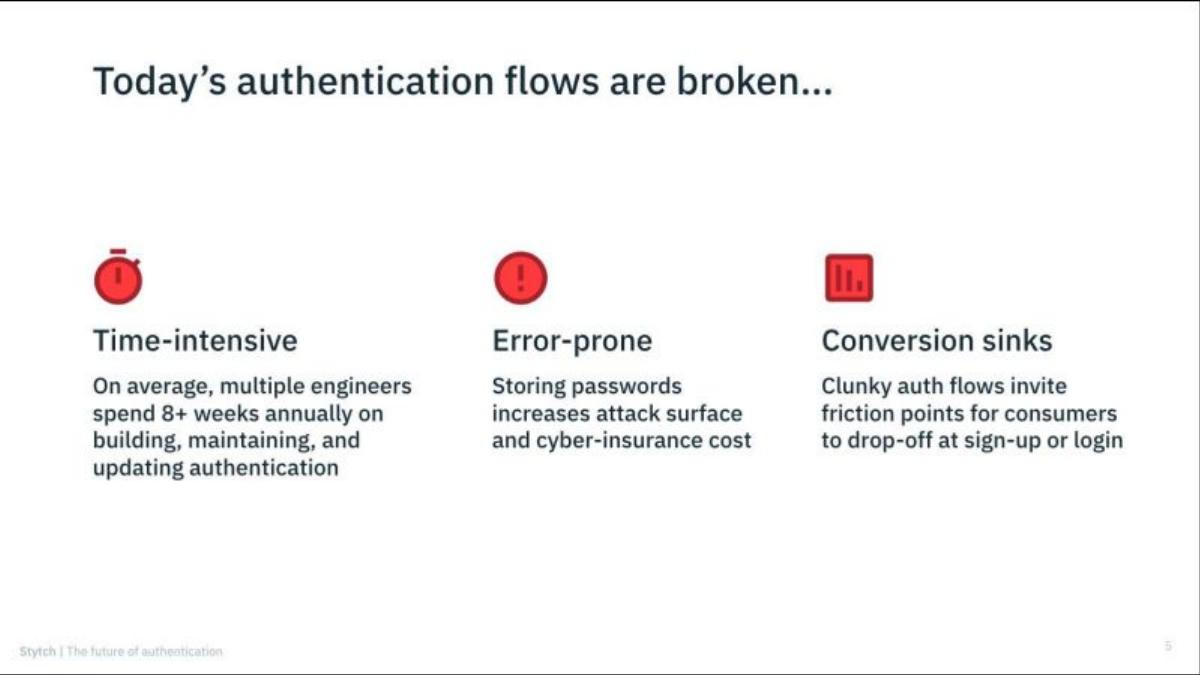
- Stytch quantifies the engineering burden, noting that engineers spend 8+ weeks annually on authentication maintenance on slide 5.
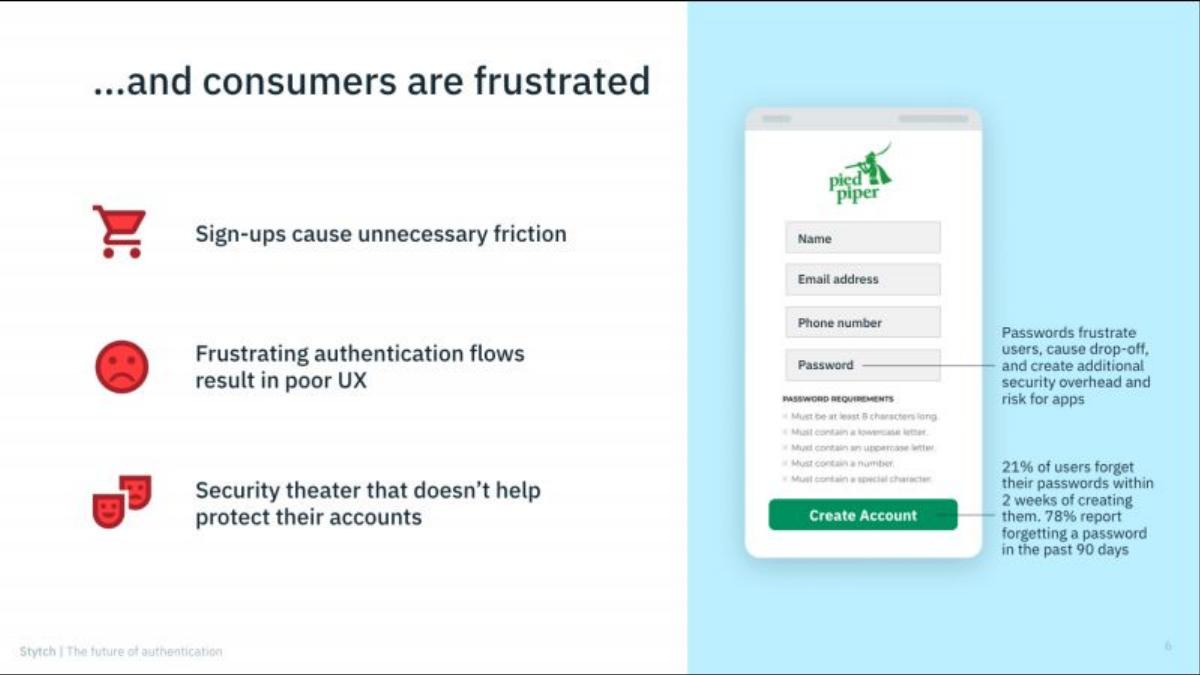
- The presentation uses a 'Pied Piper' mock-up to illustrate how 21% of users forget passwords within two weeks on slide 6.
- A critical business metric is highlighted on slide 7: 75% of users who initiate a password reset abandon the interaction.
- The deck maps the evolution of authentication from 1990s passwords to 2020s passwordless flows on slide 9.
- Product flexibility is demonstrated through a side-by-side of prebuilt UI flows and direct API code snippets on slide 11.
- The roadmap on slide 13 includes then-emerging trends like 'Login with Ethereum' to signal forward-thinking capabilities.
The Strategic Simplicity of the Stytch Series B
The Stytch Series B deck is a study in narrative momentum. At 14 slides, it is remarkably lean for a $90M raise. It operates on the assumption that the investors (Coatue, Benchmark, etc.) are already familiar with the 'API-ification' of the tech stack—a trend pioneered by companies like Stripe and Plaid. By positioning themselves as the 'Plaid for Auth,' the founders bypass the need for basic market education and move straight into the specific frictions of the status quo.
Slide 1: The Vision Statement
The title slide sets a broad stage: "User infrastructure for modern applications." This is a deliberate choice of words. Stytch is not calling itself a 'passwordless plugin' or a 'security tool.' By using the term 'infrastructure,' they are claiming a permanent, foundational spot in the developer's budget. The date, February 2022, marks this as a post-Series A expansion deck.
Slide 2: The Founding Story and Investor Pedigree
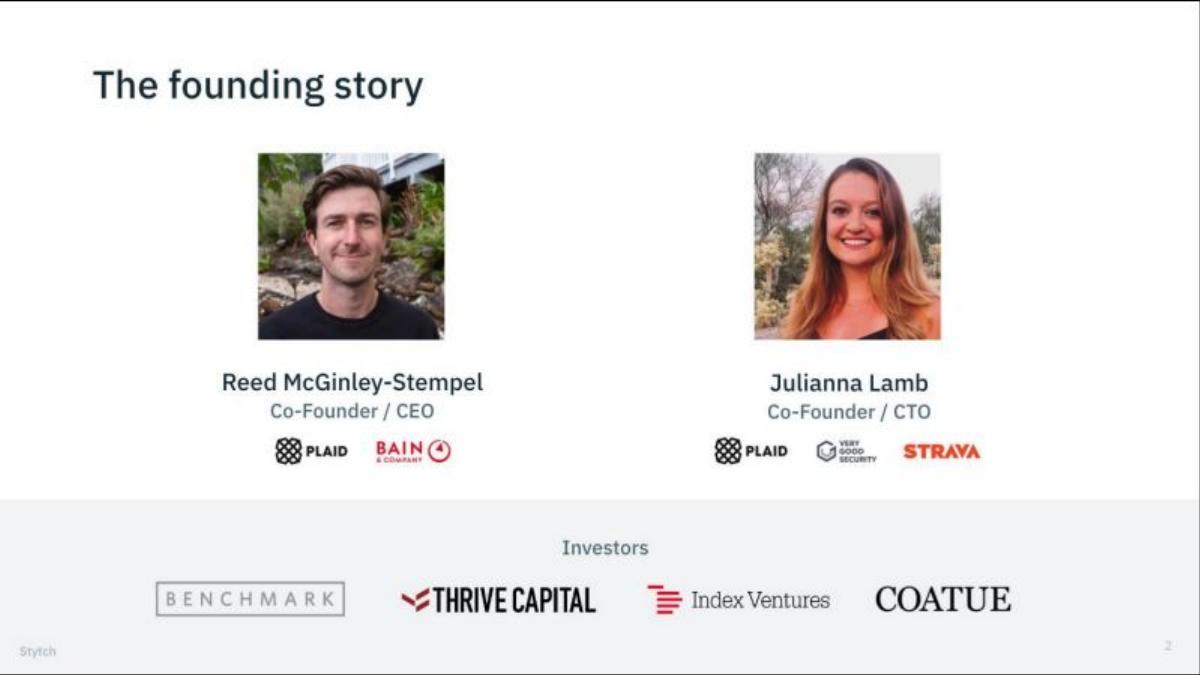
Slide 2 is perhaps the most important slide for a Series B. It features founders Reed McGinley-Stempel (CEO) and Julianna Lamb (CTO). Under their names, the logos for Plaid are prominent. This signals to investors that the team has already built and scaled a successful developer-first API company. The bottom of the slide lists Benchmark, Thrive Capital, Index Ventures, and Coatue . This is a 'social proof' slide; it tells the reader that the smartest money in Silicon Valley has already done the due diligence and placed their bets.
Slide 3-4: The Agenda and Transition
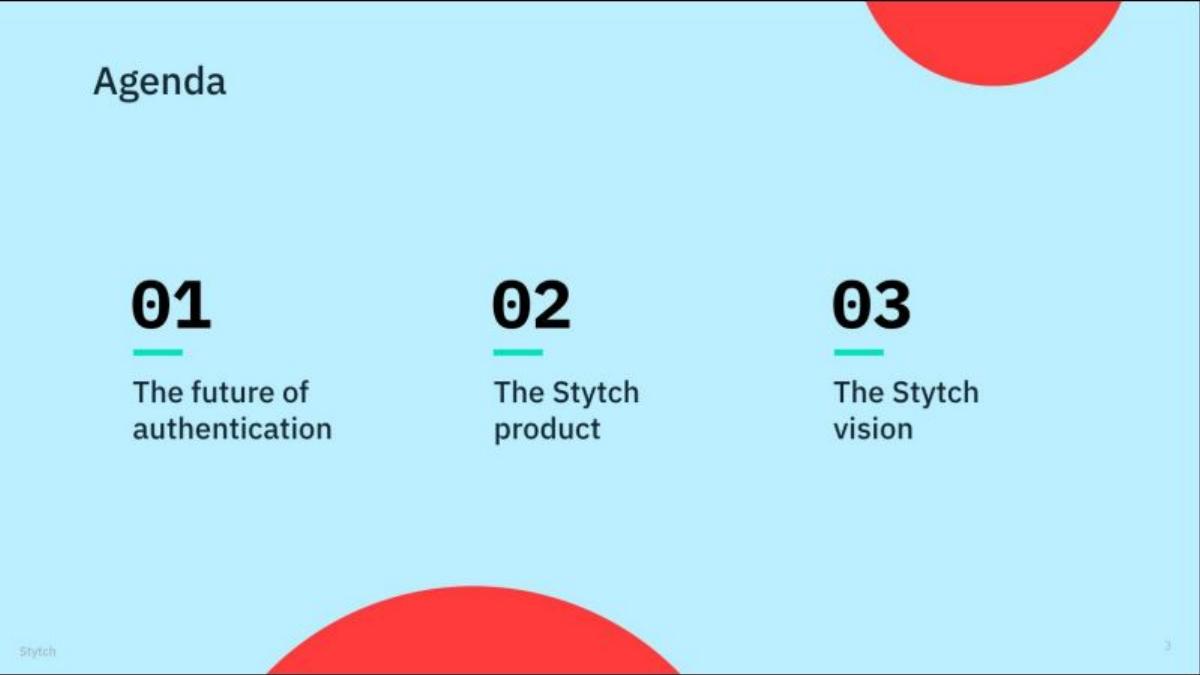
The deck is organized into three sections: The future of authentication, The Stytch product, and The Stytch vision. This structure moves from the macro (market shift) to the micro (how we build) to the future (where we are going).
Slides 5-8: Quantifying the Friction
Section 01 focuses on why the current state of the world is 'broken.' Slide 5 highlights that engineers spend "8+ weeks annually" on building and maintaining auth. This is a direct appeal to the cost of engineering talent. Slide 6 and 7 use a fictional app ('Pied Piper') to show the consumer side of the problem. The deck claims "21% of users forget their passwords within 2 weeks" and "1/3 of online purchases are abandoned at checkout" because of password issues. These are 'revenue-unlock' metrics, which are much more compelling to VCs than 'security-improvement' metrics. Slide 8 hammers this home by noting that IT teams spend 5 hours per week on password issues alone.
Slide 9: The Inevitability of Passwordless
Slide 9 provides a historical timeline. It categorizes the 1990s as the era of Passwords, the 2000s as Password Simplifiers (LastPass), the 2010s as 2FA (Authy), and the 2020s as Passwordless . By showing logos like Slack, Cash App, and Revolut in the 'Passwordless' column, Stytch is arguing that the market leaders have already moved in this direction, and the rest of the world is about to follow.
Slides 10-12: The Product Breadth
Section 02 introduces the product. Slide 11 is a 'Developer Experience' (DX) slide. It shows "Prebuilt Sign-up and Login Flows" alongside a "Direct API for Full Customization." This demonstrates that Stytch serves both the 'low-code' market and the 'high-control' enterprise market. Slide 12 lists the full suite: Email magic links, SMS passcodes, WhatsApp passcodes, OAuth, WebAuthn, and Session Management. This slide is meant to show that Stytch is a complete replacement for legacy systems like Auth0.
Slide 13: The 2022 Roadmap
The final content slide, 'Coming in 2022,' includes Native biometrics, Login with Ethereum, Push authentication, and PIN creation. The inclusion of Ethereum login is a classic 2021-2022 fundraising tactic, signaling that the company is ready for the 'Web3' wave, even if its core business remains traditional B2B SaaS.
What Makes This Deck Work?
1. Revenue-Centric Problem Definition: Stytch doesn't just say passwords are insecure. They say passwords cost you 33% of your revenue at checkout. This turns a 'security' expense into a 'growth' investment.
2. Pedigree and Momentum: By putting the Plaid logos and the existing top-tier investors on slide 2, the founders create a sense of 'inevitable success.' It suggests that this team knows the playbook for API infrastructure.
3. Visual Simplicity: The deck uses a clean, high-contrast design with minimal text. It is designed to be spoken over, not read as a document. This is typical for high-stakes Series B rounds where the relationship with the partner is already established.
What Is Missing?
1. Financials and Traction: There are no slides showing ARR (Annual Recurring Revenue), NRR (Net Revenue Retention), or even a logo cloud of current customers. While this information was certainly in the data room, its absence from the pitch deck suggests the round was driven by 'vision and team' rather than just hitting specific revenue milestones.
2. Competitive Landscape: There is no mention of Okta, Auth0, or Clerk. Stytch ignores the competition entirely, choosing instead to frame the 'enemy' as the concept of the password itself.
3. The Ask: There is no slide stating how much they are raising or what the funds will be used for. In a competitive Series B, the 'ask' is often negotiated based on the valuation the lead investor offers, rather than a fixed number set by the founder.
What Other Founders Should Copy
The 'Hidden Cost' Slide: Slide 7 is a masterpiece. If you are building a tool that replaces a legacy process, find the exact point where that process causes a user to quit. Quantify the abandonment. If you can prove your tool saves 75% of users from quitting, you don't need to sell features; you are selling found money.
The Evolution Timeline: Slide 9 is a great way to show 'Market Pull.' By showing that the most successful companies in the world are already doing what you enable, you prove that you aren't creating a new behavior, but rather democratizing an elite one.
Final Verdict
The Stytch deck is a 'prestige' deck. It relies heavily on the founders' backgrounds and the high-quality logos of their existing cap table. It succeeds because it frames a technical problem (authentication) as a business problem (conversion and engineering cost). For founders without a 'Plaid' background, this deck would likely need more traction data to be successful, but the narrative structure—Problem, Revenue Impact, Market Shift, Product Breadth—is a gold standard for infrastructure startups.
Frequently asked questions
- How much did Stytch raise with this deck?
- According to the catalogue listing, Stytch raised $90M in a Series B round in 2021. The round was led by Coatue, with participation from Benchmark, Thrive Capital, and Index Ventures.
- What is the primary problem Stytch solves according to the deck?
- The deck identifies three core problems on slide 5: authentication is time-intensive for engineers (8+ weeks/year), error-prone (increasing attack surfaces), and a 'conversion sink' where clunky flows cause users to drop off during sign-up or login.
- Does the deck include financial metrics or revenue growth?
- No. This specific 14-slide version of the deck contains zero revenue figures, customer counts, or growth percentages. It focuses entirely on the problem space, the team's pedigree, and the product's technical breadth.
- How does Stytch justify the move to passwordless?
- Stytch uses consumer behavior data on slide 7, stating that 1/3 of checkout abandonments are due to forgotten passwords and 75% of users who start a 'forgot password' flow never finish the transaction.
- What is the 'Stytch Vision' mentioned in the agenda?
- While the agenda on slide 3 lists 'The Stytch vision' as section 03, the deck concludes after section 02 (The Stytch product). The vision is implied through the roadmap on slide 13, which includes biometrics and Web3 logins.