This teardown analyzes Monzo's 2017 Series B investment memo, which successfully secured £19.5 million. The deck stands out by ditching traditional slides for a narrative-driven memo that balances 'magical' user experience with hard metrics like zero acquisition costs and a banking license. While its international goals were over-ambitious, the pitch masterfully de-risked execution by showcasing a team that bridged Silicon Valley innovation with City of London regulatory credibility.
Key takeaways
- Sell a Two-Act Story: Present a tangible product for today that serves as the foundation for a massive vision for tomorrow.
- Weaponize Your Early Adopters: Build a passionate community to serve as a marketing engine and proof of product-market fit.
- Lead with 'Magic,' Follow with Metrics: Hook investors with the emotional product experience, then back it up with hard data.
- Articulate Your 'Unfair Advantage': Identify your moat, such as proprietary tech infrastructure or hard-to-get regulatory licenses.
- Build the 'Why This Team?' Slide: Curate your team to show a blend of disruptive tech talent and deep industry expertise.
The Moment in Time: The Neobank Land Grab of 2017
To understand why this deck worked, you have to transport yourself back to early 2017. The dust from the 2008 financial crisis hadn't fully settled, and public trust in legacy banks was still at a low. The iPhone was a decade old, and consumers were now conditioned to expect slick, instant, mobile-first experiences for everything—except their finances. In the UK, the regulatory environment was becoming uniquely favorable. The Prudential Regulation Authority (PRA) and Financial Conduct Authority (FCA) had streamlined the process for new banking licenses, intending to foster competition. The upcoming Payment Services Directive 2 (PSD2) promised to blow the doors open with Open Banking.
This was the primordial soup from which the challenger banks emerged. Monzo, then still operating on a prepaid card program, was racing against rivals like Starling Bank, Revolut, and Germany's N26 to capture the hearts, minds, and wallets of a generation fed up with clunky apps, opaque fees, and terrible customer service. This £19.5 million Series B round, led by Thrive Capital, wasn't just about funding; it was a crucial war chest to transition from a popular fintech app to a fully-licensed, deposit-holding UK bank, and to do it before competitors cornered the market. This deck was Monzo's declaration of intent to win that race.
A Page-by-Page Analysis of Monzo's Investment Memo
This document is structured as an 'Investment Overview' memo rather than a traditional ten-slide deck. This format allows for greater detail and is often preferred by more sophisticated, thesis-driven investors like Thrive. It reads like a compelling narrative, building a case brick by brick.
The Hook: A Vision for 1 Billion People
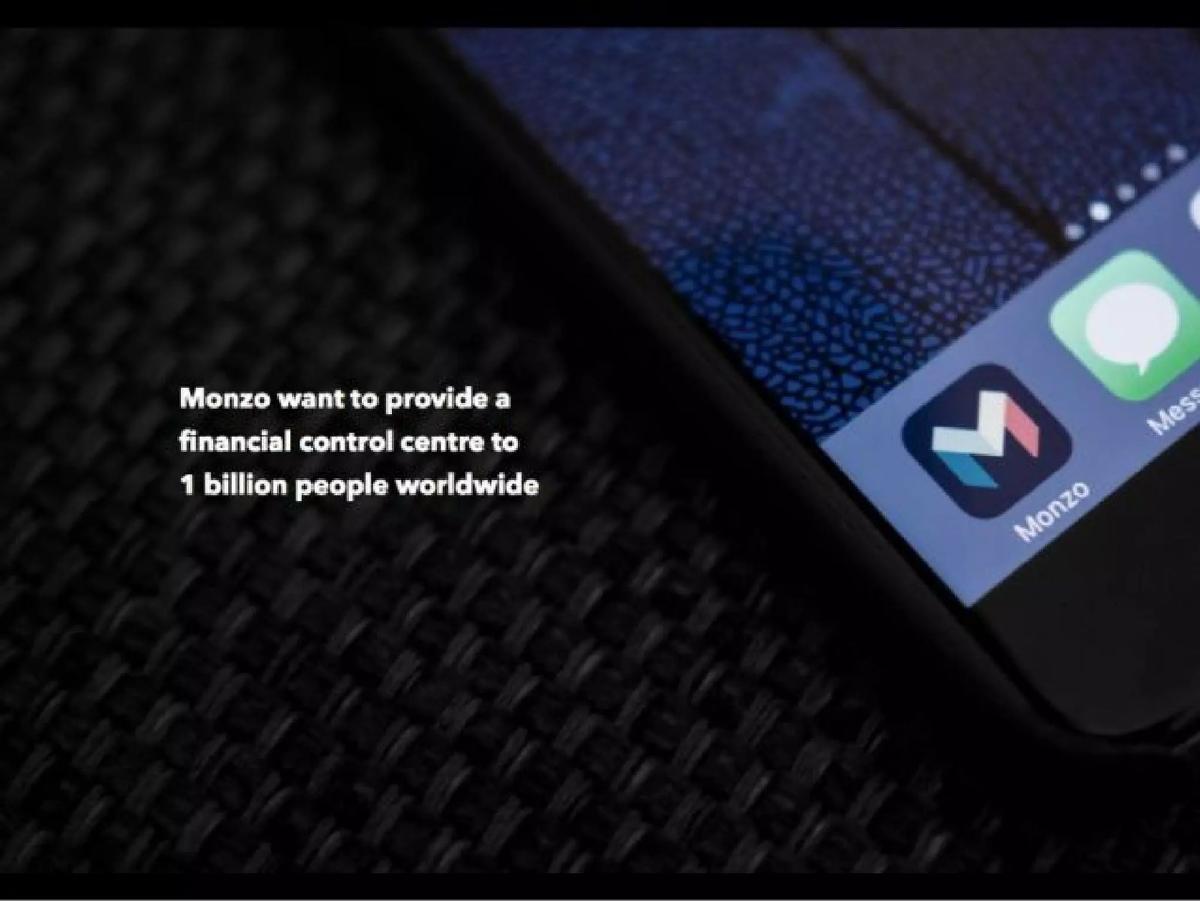
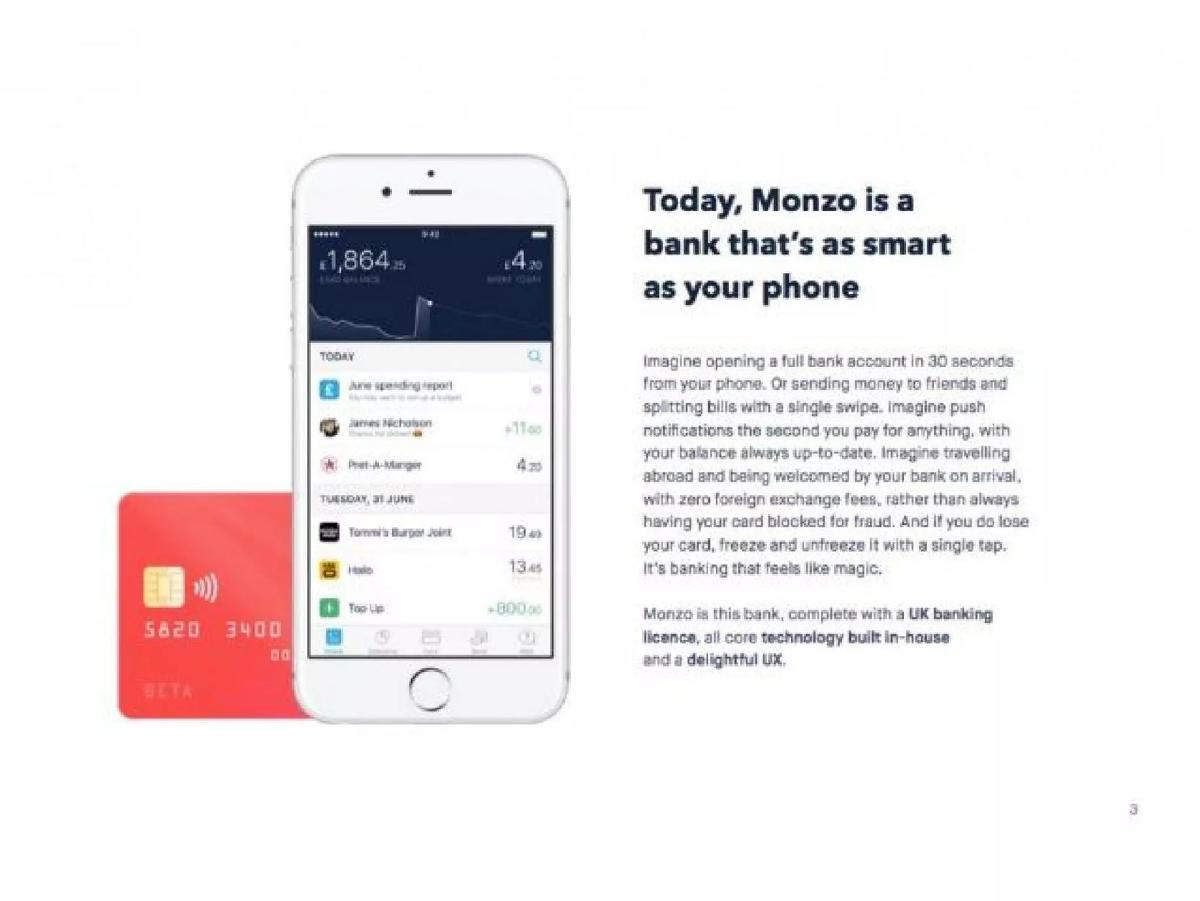
The deck opens with an audacious, almost Jobs-ian, statement of purpose: "Monzo want to provide a financial control centre to 1 billion people worldwide." This is immediately followed by a more grounded, present-day mission: "Today, Monzo is a bank that’s as smart as your phone."
This one-two punch is brilliant. It establishes a venture-scale ambition (the 1B user goal) that justifies a massive valuation down the line, while simultaneously rooting the company in a product that exists and delivers value right now. It tells an investor they are buying into both a tangible reality and a world-changing dream.
The Problem & Solution: 'Banking That Feels Like Magic'
Monzo cleverly avoids a standard 'Problem' slide lamenting how bad traditional banks are. They assume the investor knows this pain intimately. Instead, they define the problem by illustrating its magical antithesis. The deck paints a vivid picture: "Imagine opening a full bank account in 30 seconds... Imagine push notifications the second you pay for anything... Imagine travelling abroad and being welcomed by your bank... It's banking that feels like magic."
This is masterclass storytelling. It sells the emotional benefit, not just the features. By articulating a solution that feels intuitive and delightful, it implicitly frames the entire legacy banking sector as archaic and broken without ever having to say it directly. The solution is presented as a solved problem, a piece of the future that has already arrived.
Traction: Irrefutable Proof of Desire
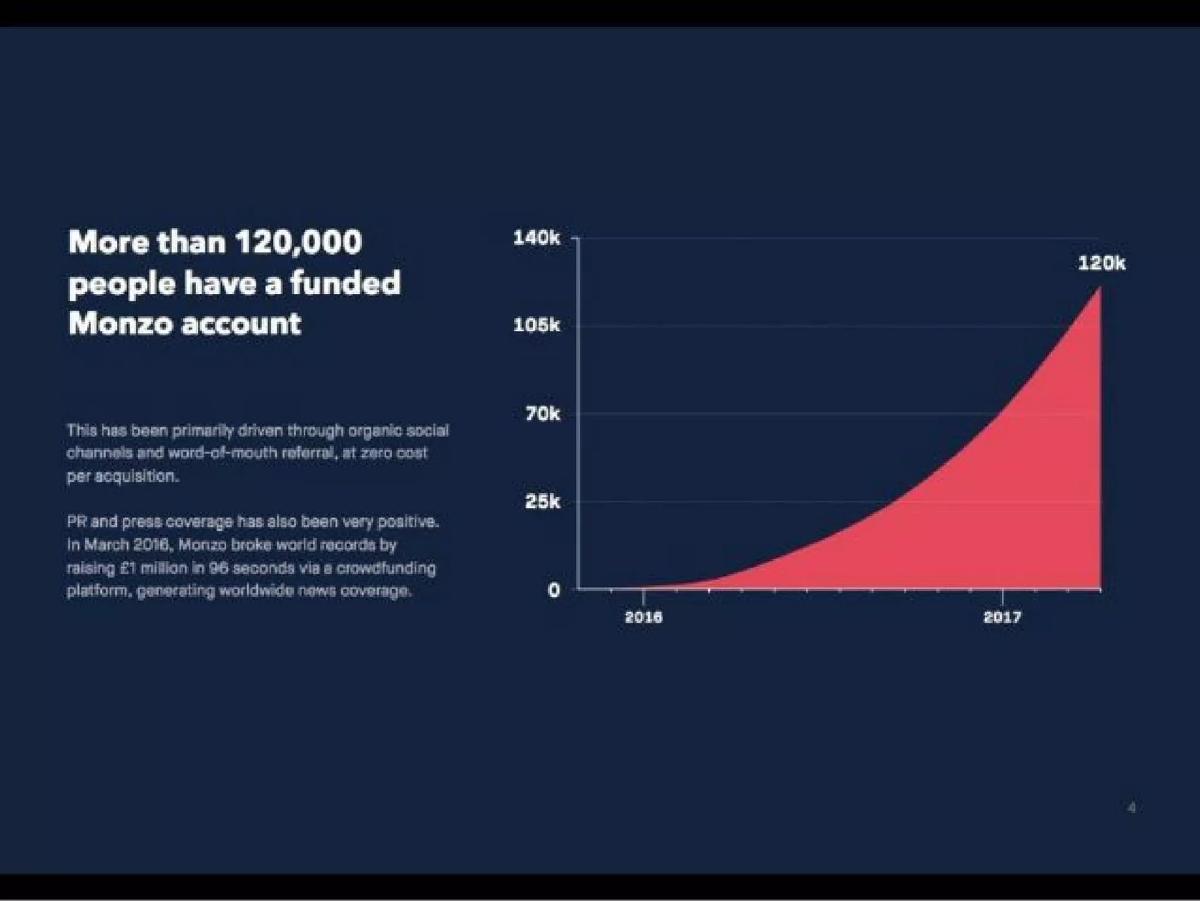
This is where the deck shifts from narrative to hard evidence. The headline number— "More than 120,000 people have a funded Monzo account" —is the anchor. In 2017, for a pre-launch bank, this was an astonishing figure. But the supporting details are even more compelling:
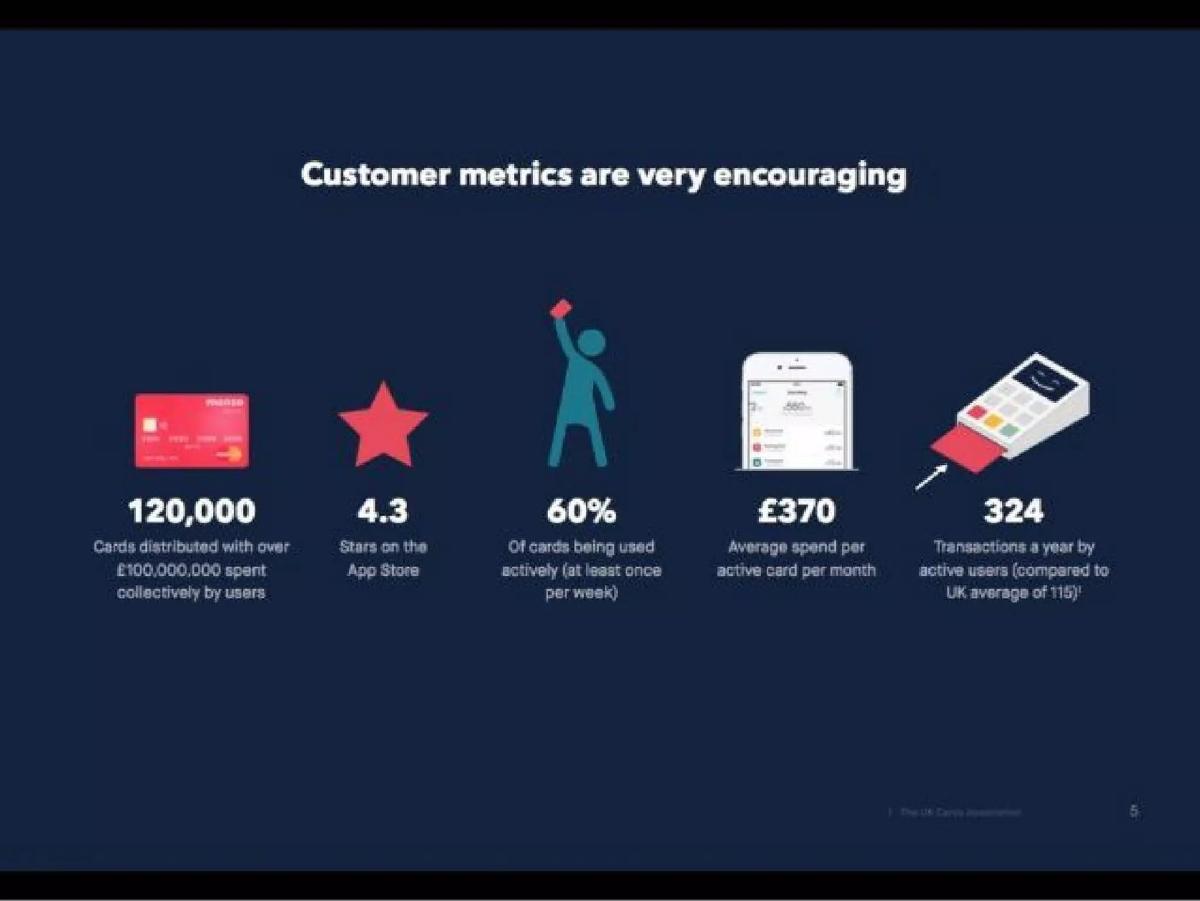
Zero Cost Per Acquisition: Growth was purely organic and word-of-mouth. This is the holy grail for any B2C startup, signaling intense product-market fit and the potential for explosive, capital-efficient growth. · World-Record Crowdfund: The "£1 million in 96 seconds" stat is iconic. It serves a triple purpose: it proves demand, showcases the team's marketing savvy, and demonstrates the existence of a fanatical community that investors could tap into. · Stellar Engagement Metrics: The deck highlights a 4.3 App Store rating and, most importantly, that Monzo users were transacting 325 times per year compared to the UK average of 115. This wasn't just a novelty app people downloaded and forgot; it was becoming a primary financial tool for its users, indicating a path to replacing their legacy bank entirely.
The Future Vision & Business Model: The Marketplace Bank
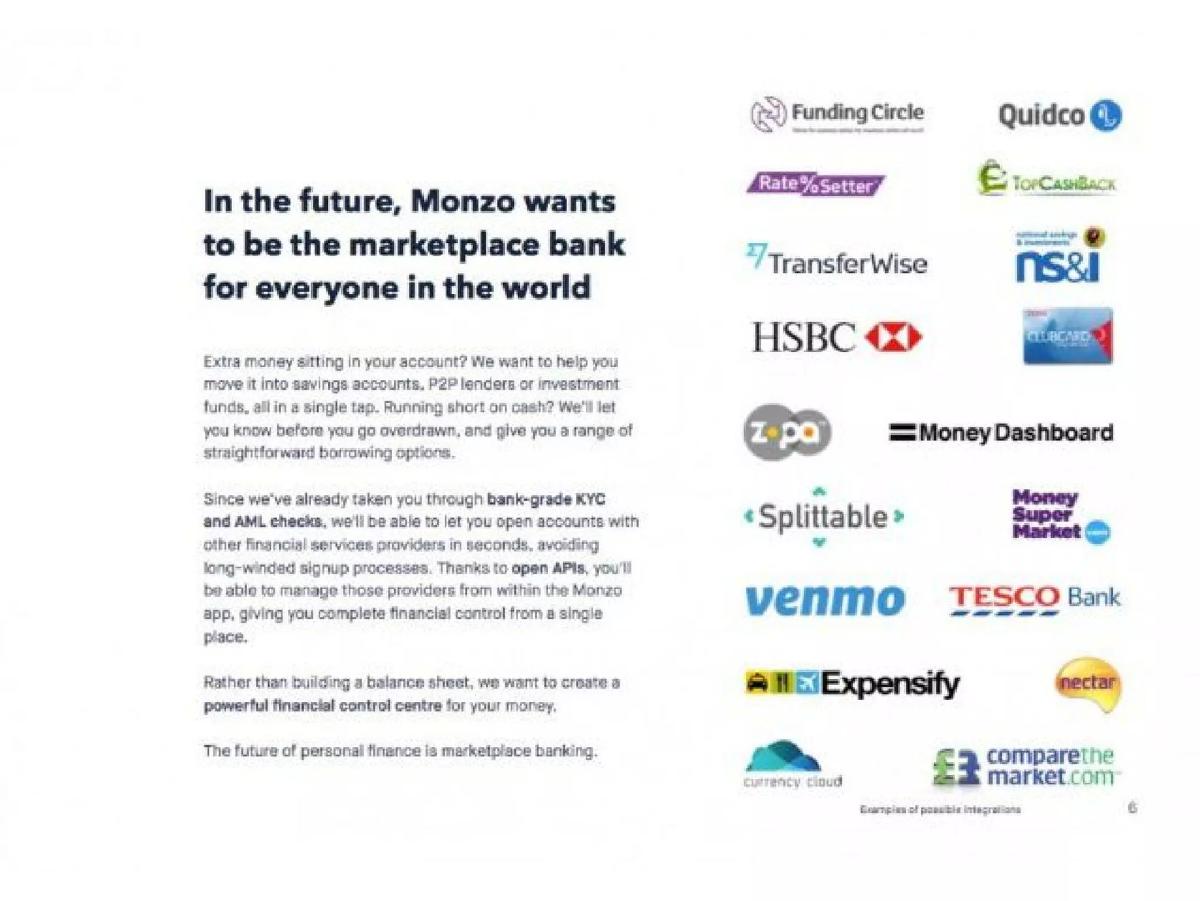
After proving demand for the current product, Monzo unveils the grand plan. This is the core of the VC pitch. They state, "In the future, Monzo wants to be the marketplace bank for everyone in the world." They explicitly state they do not want to be a traditional balance sheet bank. Instead, they aim to be the "powerful financial control centre," the interface through which users access a universe of other financial products (savings accounts, loans, investments).
Short-term: Net Interest Margin. Once they have a banking license and current accounts, they will make money 'the old-fashioned way' by lending out a portion of customer deposits. This provides a clear, understandable path to initial revenue. · Long-term: Marketplace Fees. The real prize is revenue from profit-sharing and affiliate fees on third-party products. This is a high-margin, scalable, low-capital model that looks much more like a tech company than a bank, which is exactly what VCs want to see.
This slide, with logos of potential partners like Transferwise and Funding Circle, sells a future where Monzo owns the customer relationship—the most valuable asset—and clips the ticket on every financial decision a user makes.
The Moat, Part 1: Proprietary Technology
Monzo dedicates significant space to their technology, making it clear this is a core differentiator. The key claim: "We've built 95% of our bank software in-house." They detail their stack (Go microservices, Kafka, Cassandra, AWS) to signal to technically-savvy investors that this is not a shallow 'fintech' skin on top of a legacy core banking system. This is a fundamental rebuild of banking infrastructure from first principles.
The payoff is speed and flexibility: "Rolling out new functionality is a matter of hours and days, rather than weeks and months." They also flex their data science capabilities, citing an 85% reduction in fraud losses via machine learning and plans to build sophisticated credit models. This positions Monzo as a data company that happens to be a bank, a much more attractive proposition than the reverse.
The Moat, Part 2: The Banking License & Community
Technology is one moat; regulation is another. The deck proudly announces, "We received a UK banking licence in August 2016!" For any investor, this is a massive de-risking event. It represents years of work, significant capital, and a huge barrier to entry for any would-be competitor. It was the key that unlocked the entire business model of taking deposits and lending.
Layered on top is the community moat. With 269k Twitter followers and nearly 30k forum posts, Monzo had built a self-sustaining marketing and product feedback engine. The community felt a sense of ownership, turning users into evangelists. This wasn't just a user base; it was a movement.
The Team: The Perfect Blend for an Audacious Goal
For a mission as ambitious as building a bank from scratch, the team is paramount. Monzo’s team slide is a masterclass in demonstrating founder-market fit. It showcases a perfect blend of talent:
Startup DNA: CEO Tom Blomfield was a co-founder of GoCardless, and CTO Jonas Huckestein was a YC alum. They knew how to build and scale tech products. · Banking Heavyweights: The Deputy CEO, COO, CFO, and Chief Risk Officer all had decades of experience at major institutions like Lloyds, NatWest, and ABN AMRO. They knew the regulatory landscape and operational complexities of banking inside and out. · Investor Credibility: The board included Eileen Burbidge of Passion Capital, one of the most respected fintech investors in Europe. Her presence was a powerful stamp of approval.
This slide sends a single, crucial message: This is the team that can bridge the worlds of Silicon Valley and the City of London. They have the technical chops to build the future and the industry credibility to navigate the present.
The Ask & Use of Funds: Going Global
While the deck doesn't state a specific amount, the 'Additional capital' section clearly articulates the growth plan. The funds will be used to launch the full current account in the UK and then fuel international expansion into Europe, the US, and Asia. The plan acknowledges the different strategies required for each market (passporting in Europe, sponsor banks in the US/Asia). It paints a picture of a company ready to deploy capital for aggressive, planet-scale growth.
What Worked and Why Investors Said Yes
"Monzo combined a magical product that users loved with a credible plan to build a massive, highly defensible business. It was a rare blend of bottom-up obsession and top-down strategic vision."
The Narrative Sizzle and Steak: The deck served both. The 'magic' of the product and the world-changing vision was the sizzle. The hard traction metrics, proprietary tech stack, and banking license were the steak. Investors got a story they could fall in love with, backed by evidence they could model. · Product-Market Fit as a Bludgeon: The user growth, engagement, and zero CPA were not just talking points; they were undeniable proof that Monzo had created something people desperately wanted. The risk was no longer 'Will people use this?' but 'Can they execute the next phase?' · De-Risking the Execution: The deck systematically de-risked the execution question. Technical risk? Mitigated by the in-house stack and brilliant engineering team. Regulatory risk? Mitigated by the banking license and experienced C-suite. Market risk? Mitigated by the insane organic traction. · A VC-Friendly Business Model: Pitching a future as a low-capital, high-margin marketplace was music to VCs' ears. It showed a path to tech-like multiples, not bank-like multiples. The initial NIM model was just the bridge to get there.
What Was Weak or Missing?
Hyper-Optimistic Internationalization: The slide on expanding to the US and Asia is incredibly thin. It glosses over the monumental regulatory, cultural, and competitive challenges in those markets. Suggesting a US launch could happen in '6 months' via a sponsor bank was, in hindsight, wildly optimistic. · Lack of Competitive Analysis: The deck largely ignores the competition. Starling Bank was arguably ahead on the technical front of launching a current account, and Revolut was scaling users across Europe at a blistering pace. The deck positions Monzo in a vacuum, which is a confident but risky move. · Ambiguity on Path to Profitability: While the dual-revenue model is clear, the deck lacks financial projections or a timeline for when the marketplace would take over or when the company as a whole might break even. This is understandable for a growth-stage pitch but leaves a major question unanswered.
5 Lessons for Founders Raising Today
Sell a Two-Act Story: Present a tangible, valuable product for today (Act I) that serves as the foundation for a massive, scalable vision for tomorrow (Act II). Monzo's 'delightful bank' today enables the 'financial control center' of tomorrow. · Weaponize Your Early Adopters: Don't just acquire users; build a community. Monzo proved that a passionate community is a marketing engine, a product lab, and a source of capital. The 96-second crowdfund was the ultimate proof point. · Lead with 'Magic,' Follow with Metrics: Hook investors with the emotional, 'magical' experience of your product. Then, immediately back it up with a wall of undeniable, non-vanity metrics that prove it's real and people care. · Articulate Your 'Unfair Advantage': A great team and a cool product aren't enough. You need a moat. Monzo had two: a proprietary tech stack that incumbents couldn't replicate and a regulatory license that startups couldn't easily obtain. What is your unique, defensible advantage? · Build the 'Why This Team?' Slide: Don't just list logos and titles. Curate your team slide to answer why your specific combination of people is uniquely qualified to solve this specific, hard problem. Monzo's blend of tech disruptors and banking veterans was their perfect answer.
Epilogue: Monzo Now vs. The Deck's Promise
The deck promised a financial control center for one billion people, monetized primarily through a marketplace. The reality is more nuanced. Monzo has been incredibly successful in its home market, now serving over 9 million UK customers. They flawlessly executed the transition to a full current account and delivered on the promise of a superior banking experience.
However, the grander vision has been tempered by reality. The one billion user goal is nowhere in sight, and the aggressive international expansion was scaled back significantly after a difficult and costly attempt to enter the US market. The primary revenue drivers today are the 'boring' parts of the business model: net interest margin from lending (overdrafts, loans) and subscription fees (Monzo Plus/Premium), not the grand marketplace vision. While some marketplace features exist, they are not the core of the business.
In a sense, Monzo succeeded at Act I so profoundly that it became the whole show. They built a better bank, and it turns out that being a really good, profitable bank is a great business, even if it's not the world-eating financial super-app they originally pitched. They achieved profitability in 2023, a landmark for the entire neobanking sector, validating the core thesis even if the exact path strayed from the original map. The deck sold a dream of a marketplace; the company delivered the reality of a damn good bank.
Frequently asked questions
- Why was this an 'Investment Overview' memo and not a traditional slide deck?
- This format is often used for later-stage rounds (like a Series B) with more sophisticated investors. It allows for a deeper, more nuanced narrative than bullet points on a slide. It respects the investor's intelligence by providing detail on technology, regulation, and strategy, functioning as a pre-read to frame a more strategic conversation.
- Didn't competitors like Revolut have more users? Why did Monzo get so much attention?
- While Revolut focused on rapid, multi-country user acquisition with a focus on FX and crypto, Monzo's strategy was one of depth over breadth. They focused solely on the UK market, building a fanatical community and pursuing a full banking license from day one. Investors were betting on Monzo's strategy of owning the primary banking relationship in a major market, which they believed was ultimately more valuable and defensible than Revolut's more scattered, feature-led approach at the time.
- How important was the UK banking license, really?
- It was arguably the single most important strategic asset mentioned in the deck. Without it, Monzo would have remained a prepaid card program, reliant on a partner bank's infrastructure and unable to take deposits or lend. The license unlocked the entire business model, created a massive regulatory moat, and signaled to the market that Monzo was a serious, long-term player, not just another fintech app.
- The deck mentions a 1 billion user goal. Was that realistic or just founder hubris?
- It was a classic VC pitch number—an audacious, top-down goal meant to signal the scale of the ambition. While not realistic in the medium term (as evidenced by their current 9M+ user base), it served its purpose in the pitch. It framed the opportunity as a global platform, not just a niche UK bank, justifying a tech-like valuation and attracting investors looking for 100x outcomes.
- What's the biggest difference between Monzo's pitch and how they actually make money today?
- The pitch heavily emphasized a long-term future where high-margin marketplace fees would be the main revenue source. The reality is that Monzo became profitable primarily through traditional banking revenue streams: Net Interest Margin (the spread between what they pay on deposits and earn on loans/overdrafts) and, increasingly, subscription fees for premium accounts. The 'marketplace' remains a component, but not the dominant engine the deck envisioned.