MoonRise (formerly Womencycles.com) presents a compelling case for a creator-led platform targeting the $400B chronic health market. The deck excels at demonstrating early traction, citing a 2.2x payback on the first purchase and an 80% renewal rate after the initial 12-week program. By positioning themselves as a 'MasterClass for health,' they differentiate from hardware-focused or general coaching competitors. The supply side is already active with 25 onboarded practitioners and a gross margin of 78% after payouts. While the deck leans heavily on 'natural healing' and 'alternative medicine'…
Key takeaways
- The company reports a 78%+ gross margin after practitioner payouts on slide 4.
- Initial product traction is anchored by a $349 price point for a 12-week program as shown on slide 5.
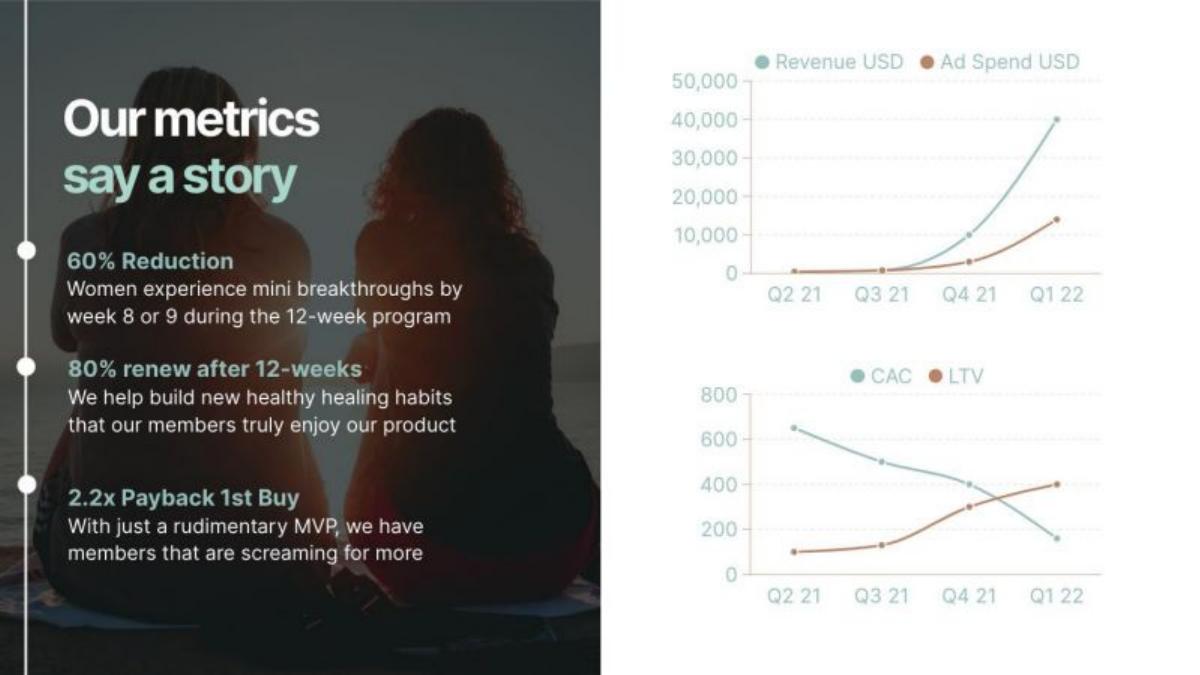
- Unit economics are a highlight, with slide 6 claiming a 2.2x payback on the first purchase and a declining CAC trend.
- Retention is high for a wellness product, with slide 6 stating that 80% of members renew after the initial 12-week period.
- The platform has already onboarded 25 certified practitioners to provide video content and one-on-one chat support (slide 4).
- The total addressable market is framed as a 15B$ opportunity within a broader 100B$ online health education market (slide 10).
- The team features founders with relevant exits, including one sold to Classpass in 2019 (slide 12).
- The deck concludes with a specific financial ask: 2M EUR in exchange for 20% dilution on slide 14.
Executive Summary: The Creator Economy Meets FemTech
MoonRise enters the market at the intersection of two massive trends: the creator economy and the underserved women's health sector. By rebranding from Womencycles.com, the company signals a broader ambition beyond menstrual health, targeting chronic conditions that affect 180 million women across major Western markets. The deck is a masterclass in showing, not just telling, that a B2C wellness platform can have SaaS-like margins and sustainable unit economics.
Slide 1: Title and Rebranding
The cover slide introduces MoonRise Health and clearly notes the transition from their previous identity, Womencycles.com . The imagery is bright and aspirational, featuring a woman in the target age demographic (45+), which aligns with the 'willing and able' customer profile mentioned later in the deck. It establishes the round as a Seed Investment Round.
Slide 2: The $400B Opportunity
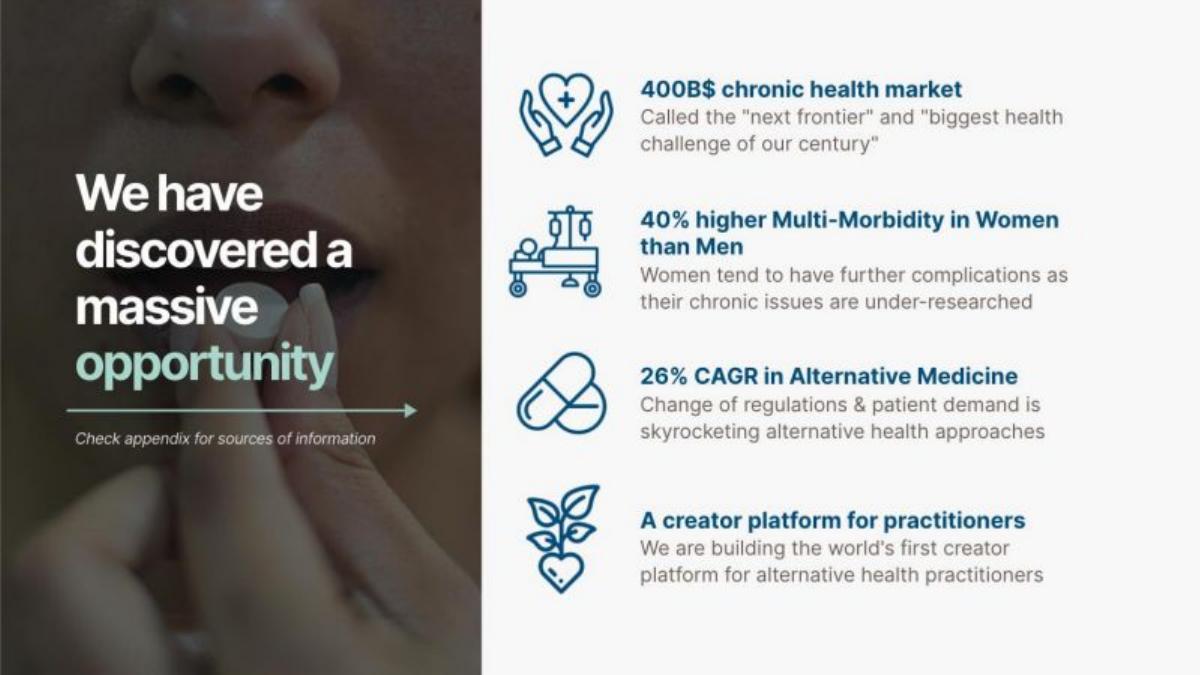
MoonRise frames the problem through the lens of a 400B$ chronic health market . They highlight three key pillars: a 40% higher multi-morbidity rate in women than men, a 26% CAGR in alternative medicine, and their solution—a creator platform for practitioners. This slide does a good job of connecting macro-economic trends (regulation changes and patient demand) to their specific business model.
Slide 3: The Pain Point
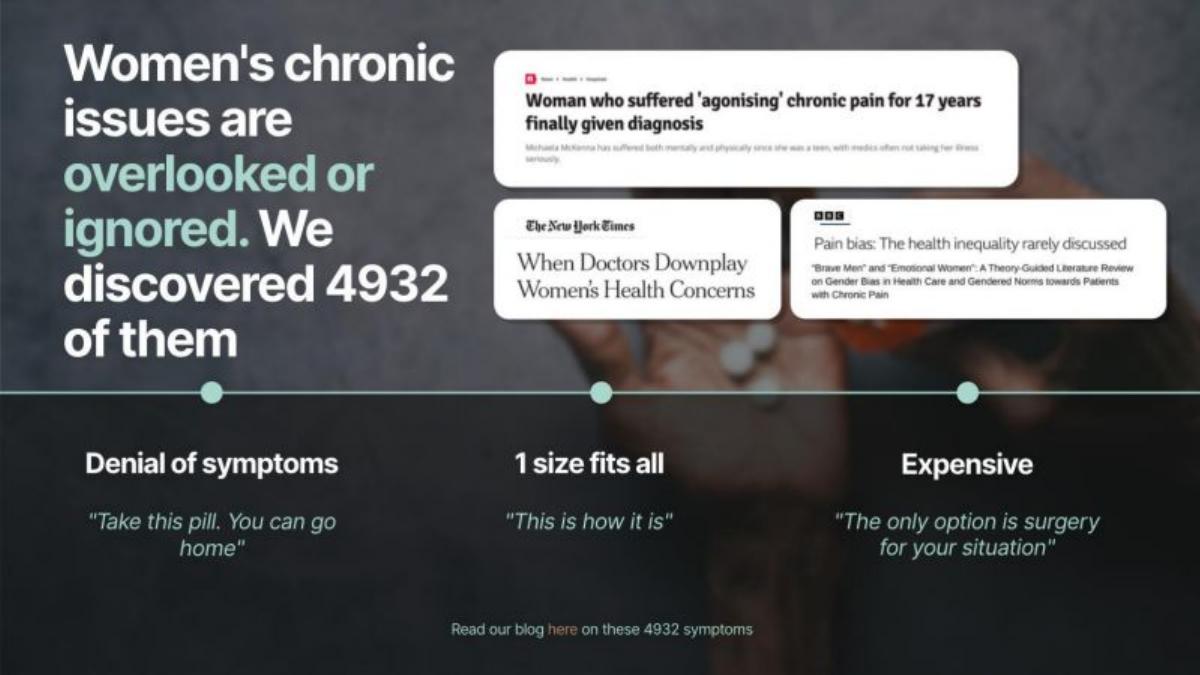
This slide uses social proof via headlines from the New York Times and BBC to validate the claim that women's chronic issues are overlooked. The most striking figure here is the claim that they have discovered 4932 symptoms that are currently ignored. They categorize the current failure of the medical system into three buckets: denial of symptoms, one-size-fits-all solutions, and expensive surgery as the only option.
Slide 4: The Platform Mechanics
MoonRise defines itself as an evidence-based health and healing platform . They provide the tools for certified practitioners to digitize their knowledge through pre-recorded video. Key metrics revealed here include 25 practitioners onboarded and a 78%+ gross margin after payouts . This high margin is a critical data point for a Seed stage company, suggesting the platform is highly scalable without linear cost increases.
Slide 5: The Product Experience
The deck gets specific about the first product: a $349 12-week program focusing on pelvic issues (incontinence, prolapse, pelvic pain). The product is delivered through three channels: personalized programs, follow-along videos, and a one-on-one chat. The inclusion of a WhatsApp-style chat screenshot suggests a high-touch, community-driven approach to healing.
Slide 6: Traction and Unit Economics
This is arguably the strongest slide in the deck. It shows two charts: revenue vs. ad spend and CAC vs. LTV. Revenue is shown growing sharply from Q2 21 to Q1 22, reaching approximately $40,000 while ad spend stays significantly lower (around $15,000). The CAC is trending down (from ~$650 to ~$180) while LTV is trending up (reaching ~$400). They claim a 2.2x payback on the first buy and an 80% renewal rate , which are exceptional metrics for a B2C health app.
Slide 7: Social Proof and NPS
Rather than standard quotes, MoonRise presents 'Love Stories.' They report an NPS of 50 . The slide includes a survey result showing that 30.8% of their users have suffered from symptoms for more than 5 years, emphasizing the 'chronic' nature of the problem they are solving. Video testimonials and Facebook group screenshots add a layer of authenticity to the claims.
Slide 8: Future Pipeline
The company outlines its roadmap for 2022, targeting symptoms like Diastasis-Recti, Thyroid Challenges, Menopausal Symptoms, and PCOS . They aim to onboard 100 practitioners and reach 200+ symptoms within 18 months. They also mention a transition from manual to AI-personalization , which is a common pitch for scaling a service-heavy business into a tech-heavy one.
Slide 9: The Billion Dollar Path
MoonRise identifies four value drivers to build a 1B$ business : cross-selling, a MasterClass-style influencer model, localization into EU languages, and creator-led growth hacking. This slide is intended to show investors that the founders are thinking about the long-term scale and network effects, not just a single-product success.
Slide 10: Market Expansion
The TAM (Total Addressable Market) is broken down into a 15B$ core market (180 million women, 20% of whom can afford out-of-pocket expenses). They also point to adjacent markets: a 100B$ online health education market, 60B$ for the digitalization of naturopathy, and 70B$ for DTC natural supplements. They note their current LTV is $395 .
Slide 11: Competitive Landscape
The competitive matrix places MoonRise in the top-right quadrant (Personalised + Coaching). They name competitors like Belly Rebuild, Block Therapy, Kindbody, Natalist, Parsley Health, and Elvie . The slide argues that most competitors are either not personalized or lack the coaching element that drives MoonRise's high retention.
Slide 12: The Team
The team slide is strong on relevant experience. Filippa Odevall is a founder of Nordic's largest yoga network in schools and a published author. Mahesh Kumar is a co-founder of FitnessCollection, which was sold to Classpass in 2019 . The presence of institutional investors like Angellnvest, Auxxo, and Calm/Storm VC on the right side of the slide provides immediate credibility for a Seed round.
Slide 13: Why Now?
The 'Why Now' slide focuses on the aging demographic (Women 45+) who have the 'money, time, and drive' to solve chronic issues. They also cite the cultural shift toward 'detabooing' women's health issues, driven by media like the BBC and Netflix.
Slide 14: The Ask
The deck concludes with a clear, unambiguous ask: Raising 2M EUR for 20% Dilution . They summarize their five key strengths: market size, scalable creator platform, 2.2x payback, expansion room, and a proven team. This level of transparency regarding valuation and dilution is rare in public decks but very helpful for filtering the right investors.
Slide 15: Appendix
The final slide lists what is available in the appendix: financial snapshots, unit economics, cash needs, and long-term vision. It invites deeper due diligence for interested parties.
What MoonRise Does Well
The MoonRise deck is exceptionally disciplined regarding unit economics. By showing the CAC/LTV crossover on slide 6, they answer the most important question for any B2C platform: can you acquire customers profitably? Most wellness decks focus on the 'mission' and 'vibe,' but MoonRise leads with the math. The 78% gross margin is another standout figure that justifies their 'platform' rather than 'service' categorization.
Furthermore, the team slide is excellent. Having a founder with a previous exit to a major player like Classpass significantly reduces the perceived execution risk for Seed investors. They also do a great job of defining their 'wedge'—pelvic health—before showing a clear path to expansion into broader categories like thyroid and menopause.
What is Missing from the MoonRise Deck
While the deck is strong, it is light on regulatory and clinical validation . In the healthcare space, 'alternative medicine' and 'natural healing' can be red flags for certain VCs due to the risk of medical liability or FTC/FDA crackdowns on health claims. While they mention 'evidence-based' credentials, they don't detail the specific clinical protocols or studies that back their 12-week programs.
The deck also omits a detailed use of funds breakdown. While they ask for 2M EUR, they don't specify how much will go to R&D (the AI personalization mentioned), marketing, or practitioner recruitment. Investors usually want to see a rough percentage split to understand the company's immediate priorities.
Founder Takeaways: What to Copy
Be transparent with your ask: Stating '2M EUR for 20% Dilution' sets a clear frame for the conversation and saves time for both the founder and the investor. · Show the unit economics trend: Don't just show a snapshot of CAC. Show that it is trending down while LTV is trending up. This proves you are learning how to optimize your marketing. · Use a 'Wedge' strategy: MoonRise doesn't try to solve every women's health issue at once. They start with pelvic issues, prove the model, and then show the 'symptom pipeline' for expansion. · Leverage the Creator Economy: If your business involves experts, frame it as a 'creator platform.' This suggests higher scalability and better margins than a traditional clinic or coaching business. · Social Proof beyond quotes: Using screenshots of Facebook groups and survey data about how long users have suffered makes the problem feel more urgent and the solution more community-validated.
Frequently asked questions
- What is the core business model of MoonRise?
- MoonRise operates as a B2C creator platform for alternative health practitioners. They onboard certified experts who create pre-recorded video content and provide digital support. The company earns revenue through high-ticket programs, such as their initial $349 12-week course, maintaining a 78% gross margin after paying out the creators. This model blends content-led education with personalized coaching and community elements.
- How does MoonRise handle the 'evidence-based' aspect of alternative medicine?
- Slide 4 explicitly states they only onboard practitioners with internationally or nationally recognized credentials. They use a 'weighted model' to qualify practitioners based on science and social proof. This is a strategic move to distance the platform from unverified wellness claims and build trust with a demographic that the deck claims has been 'let down by the medical system.'
- What are the primary growth drivers identified in the deck?
- The company identifies four value drivers on slide 9: cross-selling into more symptoms (like PCOS and Menopause), adopting a 'MasterClass' model with high-profile influencers, localizing content for EU countries, and leveraging creator referrals for growth hacking. They aim to expand from their initial focus on pelvic issues to over 200 symptoms within 18 months.
- What does the competitive landscape look like for MoonRise?
- According to the quadrant on slide 11, MoonRise positions itself in the 'Personalised' and 'Coaching' category. They distinguish themselves from hardware-focused companies like Elvie, general health platforms like Parsley Health, and non-personalized content creators like Block Therapy. Their claim is that most women's health companies lack the combination of personalization and coaching.
- What is the specific investment ask and valuation?
- On slide 14, MoonRise explicitly asks for 2M EUR. They offer 20% dilution in exchange for this capital. This implies a post-money valuation of 10M EUR. The funds are intended to help them scale their creator network and expand their symptom pipeline, moving from manual processes to AI-driven personalization.