Winnie’s 16-slide seed deck is a masterclass in demonstrating product-market fit through organic growth and supply-side engagement. By 2018, the company had already reached a 'data inflection point,' scaling to over 2 million users and 75,000 licensed child care providers. The deck highlights a significant market opportunity, noting that 90% of new parents are millennials and child care represents an $80 billion annual spend in the US. While the deck is light on specific financial projections and a formal 'ask,' it compensates with a high-pedigree team (ex-Google, Twitter, and Postmates) and…
Key takeaways
- The platform reached a 'data inflection point' where user growth began to accelerate exponentially relative to content creation (Slide 11).
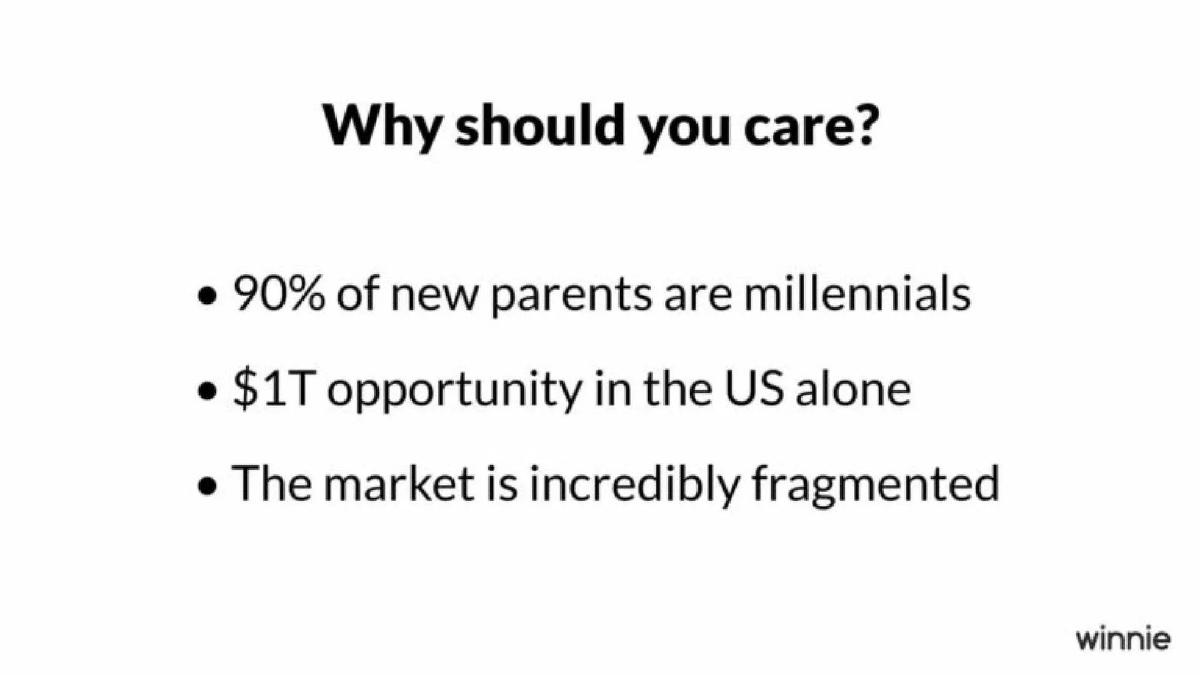
- Winnie identified a $1 trillion total opportunity in the US market, driven by the fact that 90% of new parents are millennials (Slide 6).
- The supply side is highly engaged, with 75,000 providers having claimed and updated their pages on the platform (Slide 12).
- Product efficacy is high, with the deck claiming that 90% of people searching on Winnie went to a place they found (Slide 12).
- The company built a comprehensive directory of all daycares and preschools in California, New York, Texas, and Illinois (Slide 10).
- The annual US spend on child care and education is cited at $80 billion, with $63 billion specifically for full/part-time care and babysitting (Slide 14).
- The founding team has significant product and engineering experience from major tech firms including Google, Twitter, Postmates, and Quora (Slide 15).
- The deck omits a specific fundraising 'ask' slide, focusing instead on the traction and market scale (Slides 1-16).
The Winnie Pitch Deck: A Data-First Approach to the Parenting Market
Winnie’s 2018 seed deck is a focused, 16-slide presentation that prioritizes traction and market size over complex financial modeling. At the time of this raise, the company had already established a significant footprint in the US, leveraging a massive directory of child care providers to attract a millennial parent demographic. The deck is characterized by clean design, high-level metrics, and a strong emphasis on the 'why now'—the shift of the $1 trillion parenting market to mobile-first millennial consumers.
Slides 1-4: The Product Experience
Slide 1 is a wordless title slide featuring a whimsical, illustrated scene of families, children, and local landmarks. It sets a friendly, consumer-centric tone without the need for a tagline.
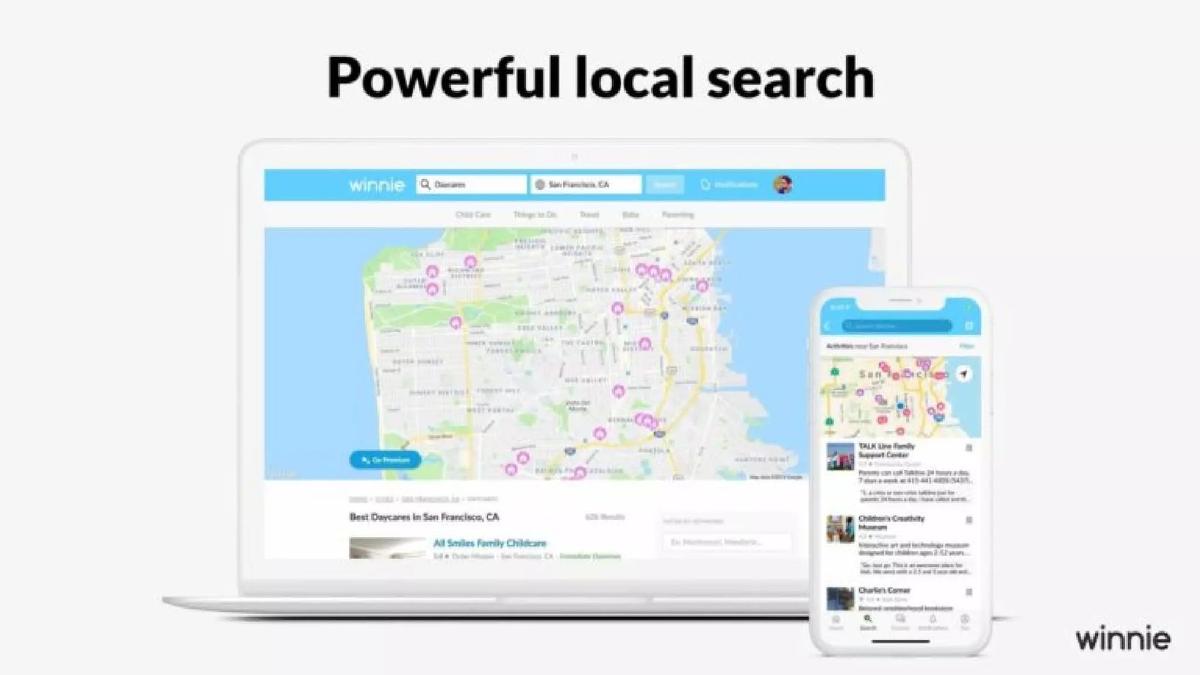
Slide 2 introduces 'Powerful local search.' It shows the interface on both desktop and mobile, highlighting a map of San Francisco populated with child care pins. This slide establishes the core utility of the platform: finding local services.
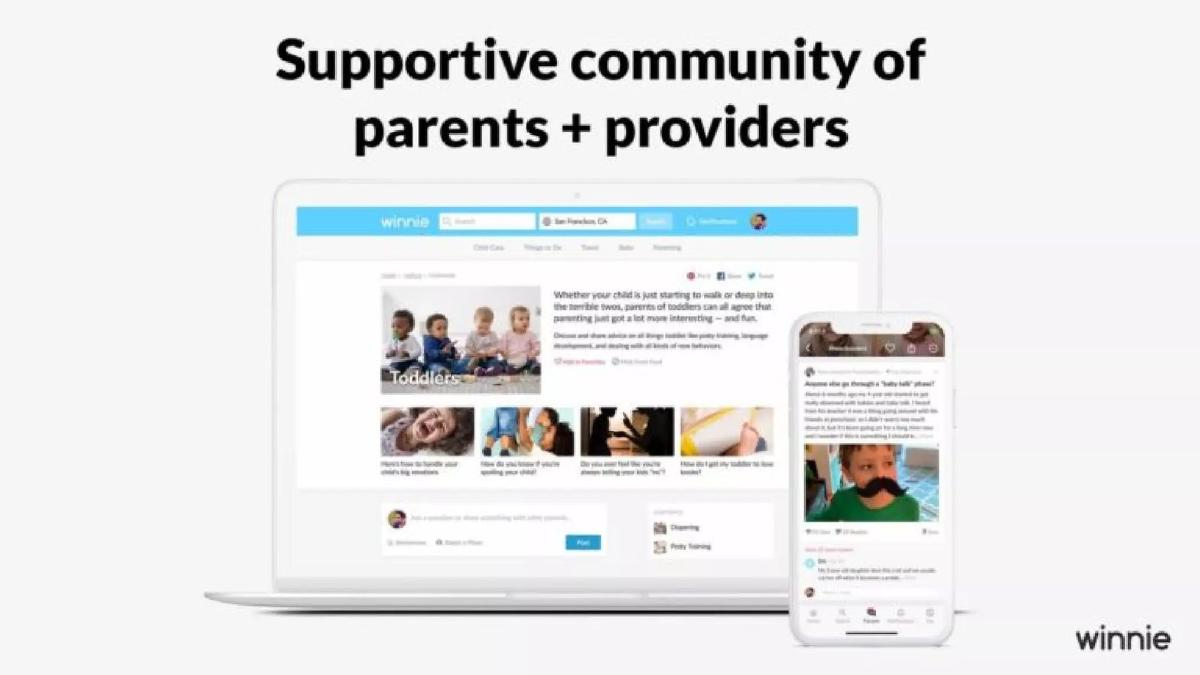
Slide 3 moves into the social layer with 'Supportive community of parents + providers.' The screenshots show forum-style discussions and advice columns, indicating that Winnie is more than just a directory; it is a destination for engagement and peer-to-peer support.
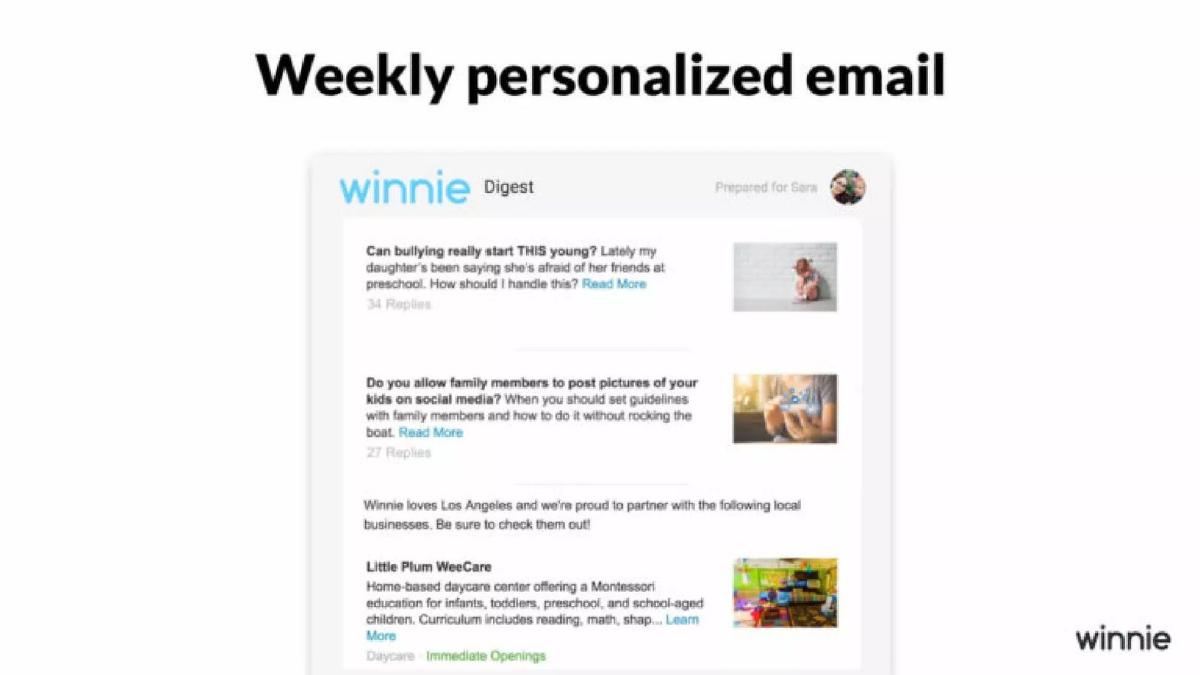
Slide 4 highlights the 'Weekly personalized email.' This suggests a retention strategy, showing how Winnie stays top-of-mind for users through a 'Digest' that includes community questions and local business spotlights like 'Little Plum WeeCare.'
Slides 5-8: The Market Opportunity
Slide 5 is a simple transition slide with the text 'Millennial parents are here.' It signals a demographic shift that the following slides quantify.
Slide 6 asks 'Why should you care?' and provides three critical data points: 90% of new parents are millennials, there is a $1T opportunity in the US, and the market is 'incredibly fragmented.' This slide effectively frames the problem as a massive, underserved market ripe for consolidation.
Slide 7 defines 'What is Winnie?' It describes the platform as an app, website, and community. It lists a major traction milestone: 2M+ moms and dads in over 10K US cities. The right side of the slide is a 'logo wall' of press mentions, including The New York Times, TechCrunch, and Forbes, which serves as third-party validation.
Slide 8 is a bold statement of intent: 'Winnie is poised to become an essential, trusted tool for this generation of millennial parents and caregivers.' It serves as an emotional hook before diving back into hard data.
Slides 9-12: Traction and Proprietary Data
Slide 9 focuses on the supply side, noting 'Over 75k licensed child care providers.' The screenshots show a detailed provider profile for 'Pacific Heights Prep,' including age ranges, price, hours, and photos. This demonstrates the depth of data Winnie collects.
Slide 10 claims 'We’ve built a massive platform.' It details a comprehensive directory for California, New York, Texas, and Illinois, featuring 200k posts and 150k venues. Crucially, it mentions 'Proprietary data parents can’t find anywhere else,' which is a key competitive moat.
Slide 11 presents a growth chart showing 'Users' vs. 'Content.' It marks a 'Data inflection point' where user growth begins to climb steeply. This is the most important slide for a Seed investor, as it proves the platform's organic scalability.
Slide 12 provides two powerful conversion metrics: 75k providers have claimed their pages, and 90% of people searching Winnie 'went to a place they found.' This proves that the platform isn't just a directory—it's a high-intent lead generator.
Slides 13-16: Social Proof, Market Size, and Team
Slide 13 features four testimonials under the heading 'Parents love Winnie.' The quotes emphasize the platform's role in finding daycare and connecting with other parents, reinforcing the community value mentioned earlier.
Slide 14 breaks down the 'really big business.' It cites a $80B annual spend in the US for Child Care & Education. It further segments this into $63B for full/part-time care and $17B for summer camps and activities. A bar chart shows that Child Care & Education accounts for 16% of household spend, second only to housing and food.
Slide 15 introduces the founders, Sara Mauskopf and Anne Halsall. Their resumes are impressive, featuring 'Product leadership at Postmates, Twitter, YouTube, Google' and 'Software design & engineering at Quora, Postmates, Google.' The slide uses large logos from these companies to emphasize their high-growth tech pedigree.
Slide 16 is the closing slide with a 'Thank you' and a call to action to visit the website or download the app. Notably, there is no slide detailing the specific amount of capital being raised or the planned use of funds.
What Works in the Winnie Deck
The Data Inflection Point: Slide 11 is the strongest slide in the deck. By showing that user growth is accelerating faster than content creation, Winnie demonstrates a network effect or an SEO advantage that makes future growth more efficient. It moves the conversation from 'we have an app' to 'we have a growth engine.'
Supply-Side Engagement: In marketplaces, the supply side is often the hardest to move. Slide 12, showing that 75,000 providers have 'claimed' their pages, is a massive signal of market acceptance. It suggests that providers view Winnie as a necessary business tool, not just another directory.
Clear Market Segmentation: Slide 14 does an excellent job of taking a vague '$1T opportunity' and narrowing it down to a specific, actionable $80B annual spend. By showing that child care is 16% of a family's budget, they prove the 'essential' nature of the service.
What is Missing from the Winnie Deck
The Ask: There is no slide stating how much money the company is raising or what the milestones for the next 18-24 months are. While this information is often handled in person, its absence in the deck leaves the 'next steps' for an investor unclear.
Business Model/Monetization: The deck mentions that the app is 'available for free' (Slide 7) but does not explicitly detail how the company makes money. Whether through lead generation fees from providers, premium subscriptions for parents (hinted at by a 'Go Premium' button on Slide 2), or advertising, the path to revenue is left to the imagination.
Unit Economics: There is no mention of Customer Acquisition Cost (CAC) or Lifetime Value (LTV). While the deck claims organic growth, investors at the Seed stage typically want to see the underlying math of how a single user or provider contributes to the bottom line.
What a Founder Should Copy
The 'Why Now' Framing: Winnie successfully frames their business as a response to a demographic shift (Millennials becoming parents). Founders should always look for a macro trend that makes their specific solution inevitable.
Visualizing Data Depth: Instead of just saying they have a lot of data, Slide 9 shows exactly what that data looks like—prices, hours, potty training requirements. This makes the 'proprietary data' claim tangible and believable.
Pedigree Alignment: The team slide (Slide 15) doesn't just list titles; it uses logos to create an immediate visual association with some of the most successful product-led companies in the world. If you have a strong background, make it impossible to miss.
Frequently asked questions
- How much did Winnie raise with this deck?
- According to the catalogue facts, Winnie raised $4 million in a Seed round in 2018 using this presentation.
- What is Winnie's primary value proposition for parents?
- As shown on slides 2, 3, and 4, Winnie provides a three-pronged solution: powerful local search for child care, a supportive community forum for parents and providers, and a weekly personalized email digest.
- How does Winnie acquire users?
- Slide 11 indicates that the platform attracts users organically. The chart shows a 'data inflection point' where the volume of proprietary data and content began to drive a surge in the user base, reaching over 2 million parents.
- What is the scale of Winnie's database?
- Slide 10 states that Winnie has 150,000 child care and activity venues, 200,000 posts and reviews, and a comprehensive directory of daycares and preschools across four major US states.
- Who are the founders of Winnie?
- The founders are Sara Mauskopf (CEO) and Anne Halsall (CPO). Mauskopf has a CS degree from MIT and product leadership experience at Postmates, Twitter, and Google. Halsall has a background in software design and engineering at Quora, Postmates, and Google (Slide 15).