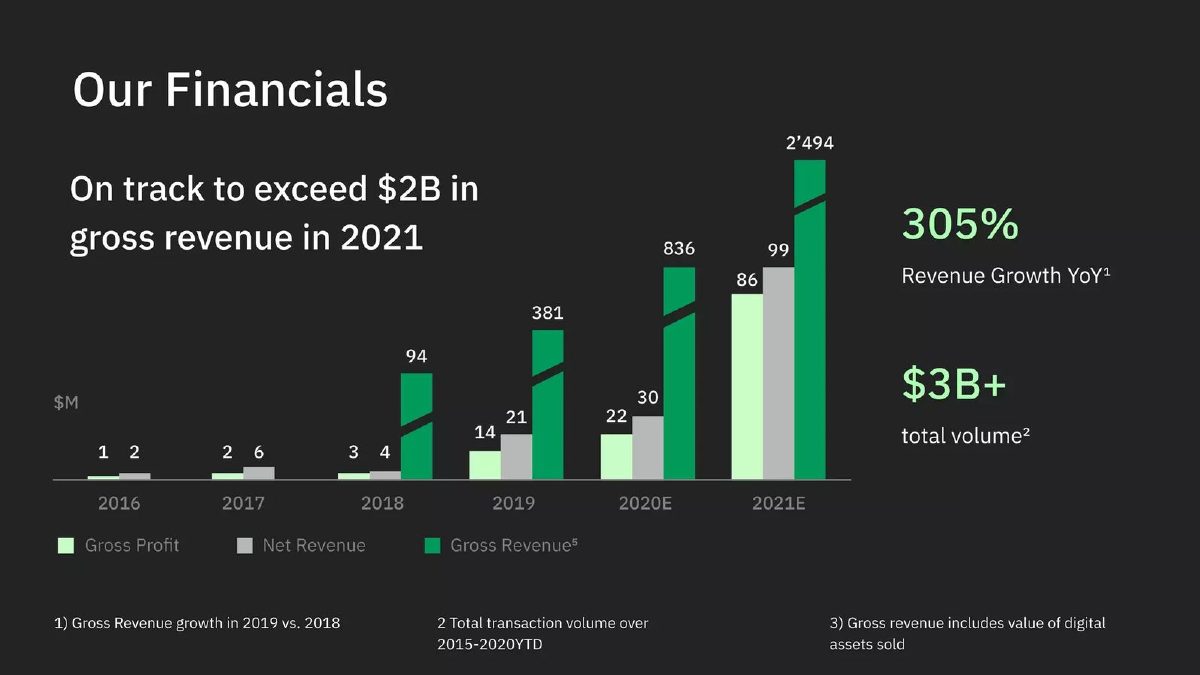
Wirex’s investor deck, produced for a 2020 Crowdcube campaign, presents a company that has moved well beyond the 'startup' phase into a high-growth scale-up. With 3.1 million users and £315m in revenue over the 12 months preceding June 2020, the company demonstrates significant market traction. The deck leans heavily on its 'dual functionality'—the ability to spend both crypto and fiat via a single card—and its proprietary WXT utility token, which had a $31m market cap at the time of the deck's creation. While the deck excels at showcasing scale and regulatory milestones, such as obtaining a…
Key takeaways
- The company reported 3.1 million total users and a 164% year-over-year revenue growth for the period of July 2019 to June 2020 (Slide 6).
- Wirex achieved £315m in revenue over a 12-month period and processed over $3bn in transaction volume (Slide 6).
- The business model is diversified across four main streams: Card Revenues, Exchange Fees, Membership Fees, and Blockchain fees (Slide 5).
- Wirex launched its own utility token, WXT, in 2019, which reached a market capitalization of $31m by August 2020 (Slide 3).
- Expansion into the United States was a primary 2020 goal, supported by a money transmission license from the State of Georgia (Slide 4).
- The leadership team features significant institutional experience from firms like Morgan Stanley, Barclays, and Credit Suisse (Slide 7).
- The deck highlights a specific demographic breakdown of the team, noting a 42-54-4 gender balance (Male-Female-Non-Disclosed) (Slide 6).
Executive Summary: A Scale-Up Narrative
The Wirex investor deck is a masterclass in showcasing traction to a retail investor audience. Unlike early-stage decks that must sell a vision of what could be, Wirex uses this presentation to document what is. By lead-lining the deck with massive figures—3.1 million users and over £300m in revenue—the company shifts the conversation from risk to momentum. The deck was specifically tailored for the Crowdcube platform, which influences its visual-heavy, jargon-light approach.
Slide 1: Title and Crowdfunding Context
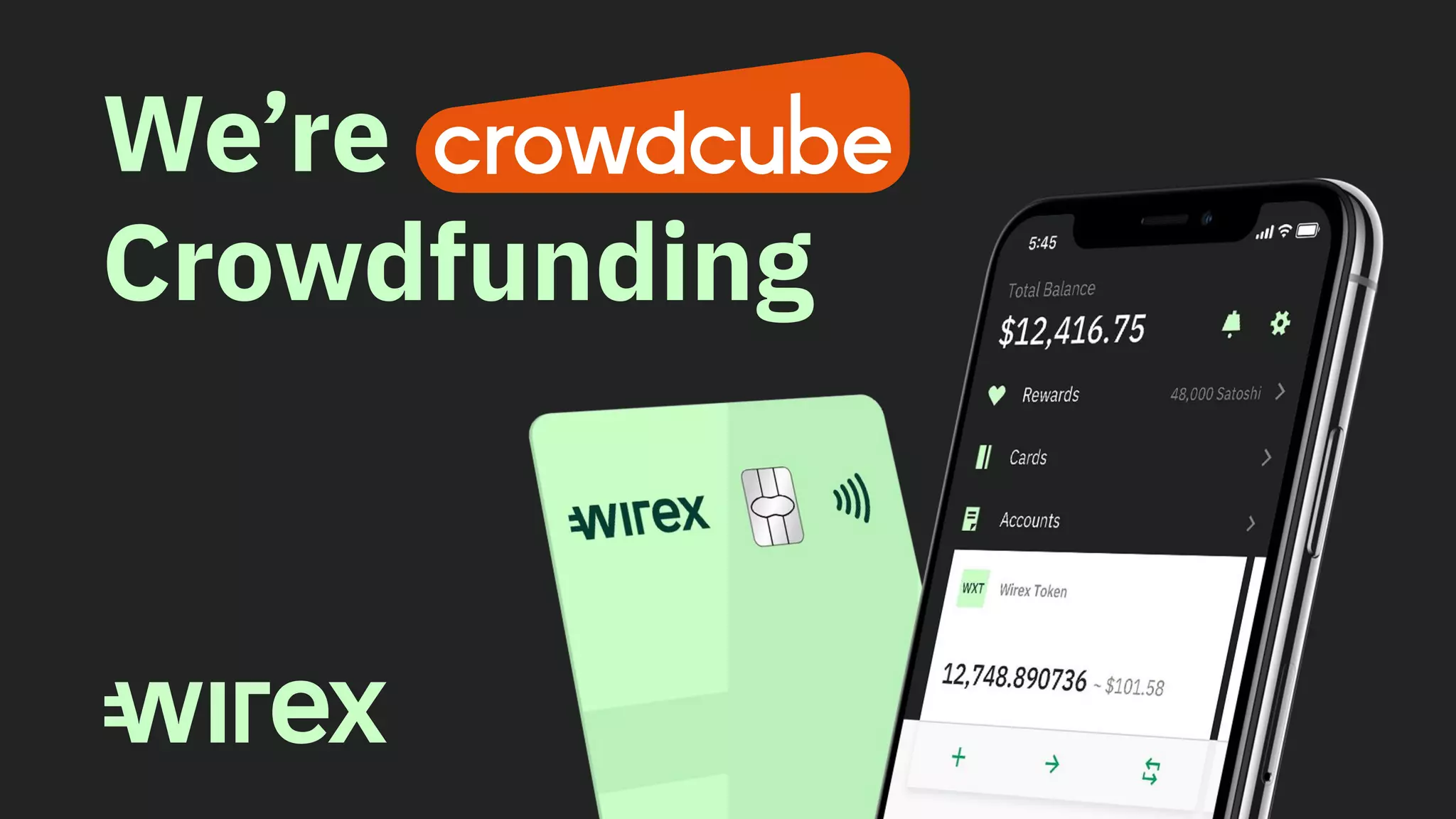
The opening slide is functional and branded. It explicitly states, "We're Crowdcube Crowdfunding," signaling that this is not a private VC deck but a document intended for public solicitation. The visuals feature the Wirex mobile interface showing a balance of $12,416.75 and a physical mint-green debit card. This immediately establishes the product: a bridge between digital balances and physical spending.
Slide 2: Defining the Category
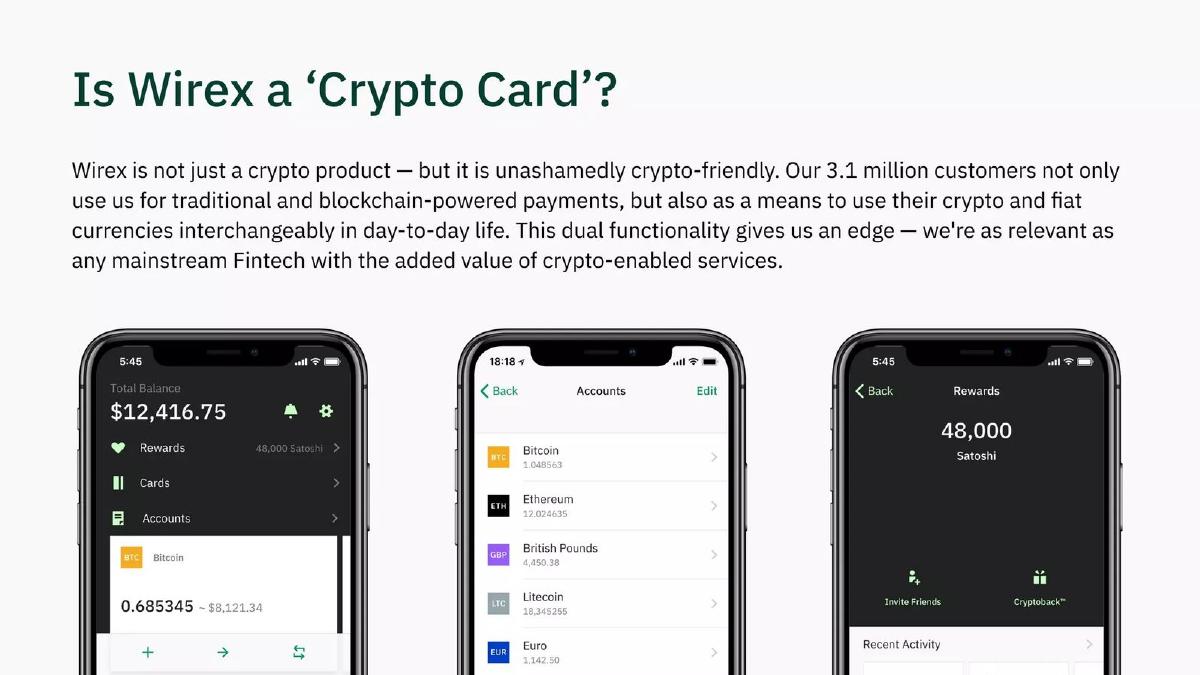
Slide 2 addresses a common misconception by asking, "Is Wirex a 'Crypto Card'?" The text clarifies that while the product is "unashamedly crypto-friendly," it functions as a mainstream Fintech tool. The slide emphasizes "dual functionality," allowing users to switch between crypto and fiat. The inclusion of three app screens showing Bitcoin, Ethereum, British Pounds, and Euros reinforces the multi-currency nature of the platform. This slide is critical for regulatory and marketing positioning, moving Wirex away from being a niche crypto tool into a broader "daily life" financial app.
Slide 3: The WXT Utility Token
This slide introduces WXT, Wirex’s proprietary cryptocurrency launched in 2019. It lists a market capitalization of $31m as of August 17, 2020, citing CoinMarketCap. The slide explains the token's utility: providing discounts and "enhanced Cryptoback™ rewards." For investors, this represents a secondary layer of value and a mechanism for user lock-in. The mention of "additional exciting rewards" planned for the end of 2020 serves as a roadmap teaser.
Slide 4: The American Expansion
Expansion is a key growth lever in any pitch. Slide 4 focuses entirely on the US market. It highlights the acquisition of a money transmission license from the State of Georgia in July 2020. By including a Yahoo Finance headline and the official seal of the Georgia Department of Banking and Finance, Wirex builds regulatory credibility. The slide positions the USA as the "world's biggest crypto-friendly market," justifying the capital intensive nature of the expansion.
Slide 5: The Revenue Model
Slide 5 outlines a "Diversified & Profitable Business Model." It breaks revenue into four categories: Card Revenues , Exchange Fees , Membership Fees , and Blockchain . This is a vital slide for investors because it demonstrates that the company isn't reliant solely on volatile trading fees. The use of real app screenshots to illustrate these revenue points (e.g., an exchange screen showing 1 BTC to LTC conversion) makes the abstract business model feel tangible.
Slide 6: The Traction 'Wall'
This is the most impactful slide in the deck. It presents eight key metrics divided into "Company" and "Team." The company metrics are staggering for a crowdfunding round: 3.1m total users , £315m in LTM revenue , $3bn+ in transaction volume , and 164% YoY revenue growth . The bottom half of the slide focuses on ESG and diversity metrics, noting a 42-54-4 gender balance and 19 different nationalities. This suggests a mature corporate culture ready for public scrutiny.
Slide 7: The Leadership Team
The final slide in this set introduces the "Global Team." It highlights the two co-founders and co-CEOs, Pavel Matveev and Dmitry Lazarichev, who bring 15+ and 20+ years of experience respectively. The pedigree of the broader team is emphasized through logos of former employers, including Morgan Stanley, Barclays, Credit Suisse, BNP Paribas, and Deutsche Bank . The presence of dedicated Managing Directors for the USA and Japan further supports the global expansion narrative mentioned in Slide 4.
What Works in the Wirex Deck
The deck excels at social proof and regulatory validation . By citing specific licenses and high-profile former employers, Wirex mitigates the "trust deficit" often associated with cryptocurrency startups. The clarity of the revenue model (Slide 5) is also a highlight; many fintech decks are vague about how they actually make money, but Wirex explicitly lists four distinct streams. Finally, the growth metrics on Slide 6 are presented with such scale that they make the investment opportunity feel like a late-stage entry rather than a speculative bet.
What is Missing
Unit Economics: While the deck shows massive top-line revenue (£315m), it does not disclose Customer Acquisition Cost (CAC) or Lifetime Value (LTV). For a consumer fintech, these are the metrics that determine long-term sustainability. · Competitive Analysis: There is no mention of competitors like Revolut, Crypto.com, or Coinbase Card. Acknowledging the competitive landscape and explaining why Wirex’s "dual functionality" is superior would have strengthened the case. · Use of Funds: The deck mentions expansion but does not provide a breakdown of how the crowdfunding capital will be allocated (e.g., % to marketing, % to R&D, % to regulatory capital). · Financial Projections: The deck looks backward at 2019-2020 performance but provides no forward-looking statements or targets for 2021-2022.
Founder Takeaways
Founders should study how Wirex visualizes their product . Instead of using generic stock photos, they use high-fidelity mockups of their own app to explain complex concepts like exchange fees and token utility. This makes the product feel "real" and ready to use. Additionally, the diversity and inclusion metrics on Slide 6 are a modern touch that many institutional and retail investors now look for; including these alongside financial metrics shows a holistic approach to company building. Finally, if you have regulatory wins (like the Georgia license), give them their own slide—they are one of the strongest moats a fintech company can possess.
Frequently asked questions
- What is the primary value proposition of Wirex according to the deck?
- Wirex positions itself as more than just a 'crypto card.' Its core value proposition is 'dual functionality,' allowing 3.1 million customers to use traditional fiat and blockchain-powered payments interchangeably in daily life. This is delivered through a mobile app and a physical debit card that supports multiple currencies, aiming to make crypto as spendable as cash.
- How does Wirex generate revenue?
- The company utilizes a four-pillar revenue model: Card Revenues (likely interchange and issuance), Exchange Fees (from converting between currencies), Membership Fees (tiered rewards and discounts), and Blockchain fees (associated with on-chain transactions). This diversified approach is intended to prevent over-exposure to any single market fluctuation as the company scales globally.
- What is the role of the WXT token in the Wirex ecosystem?
- WXT is a utility token launched in 2019. It provides Wirex customers with tangible benefits, including fee discounts and 'enhanced Cryptoback rewards.' At the time of the deck, the token had a $31m market cap. It serves as a loyalty and incentive layer to increase user retention and platform activity.
- What were Wirex's expansion plans at the time of this deck?
- The deck focuses heavily on the United States as the 'world's biggest crypto-friendly market.' Wirex secured a money transmission license in Georgia in July 2020 to facilitate this launch. Additionally, the team slide indicates a global footprint with Managing Directors specifically assigned to the USA and Japan markets.
- Does the deck provide a clear 'Ask' or valuation?
- No. Because this deck was designed for a Crowdcube campaign, the specific investment terms, valuation, and total funding target are omitted from these slides. Those details are typically hosted on the crowdfunding platform's primary listing page rather than embedded in the pitch deck itself.