International Expansion Slide: 8 Real Pitch Deck Examples
How to show which country comes next in a pitch deck, why you chose it, what must be true before you enter and what entry costs.
International Expansion Slide: Which Country Next, Why, and What Must Be True First
Many decks end the go-to-market story with a map of countries still to come. The eight real slides below range from a list of target countries to slides that name a licence already granted, grade each market by how far talks have gone, or put a budget figure on entering one market. Read together, they show five different things an expansion slide can say, and how rarely one slide says more than two.
TL;DR
An expansion slide is most useful when it separates five things: which countries you intend to enter, when, why each one was chosen, which entry requirements (licence, partner, distribution, payment access) are already met versus still to do, and what entry costs. Most slides here give the first two. Mwabu names seven countries and the result it wants to repeat. StudentFinance gives a dated rollout and, on the previous slide, dated regulatory approvals. Superscript says regulation and carrier partnerships are "in place" without naming them. Wirex pairs a US launch plan with one dated state licence. Hervé grades markets by status (operating, under NDA or in development, initial discussions). Pimentae makes its EU entry depend on first proving UK distribution. Only two slides cost the move: Direct Dairy budgets "€150K per country" twice over, and Wrykr sets "a launch budget per geographical region of £50,000" plus £5,000 a month after it. Both figures are planned spending, not spending that happened. An announced expansion on a slide is a plan, not a launch.
Expansion slides from real pitch decks
Ordered from a country list to slides with dated evidence and status per market. Each example shows the exact stored slide above its analysis and links to the full teardown. Text is quoted as shown. We describe only what each deck shows; we make no claim about whether any expansion happened.
Mwabu go to market slide — slide 14
Education technology company based in Zambia (tablet-based curriculum). The slide sits between a product slide and a competitor slide.
Mwabu deck, slide 14. Exact stored slide matched to this analysis.
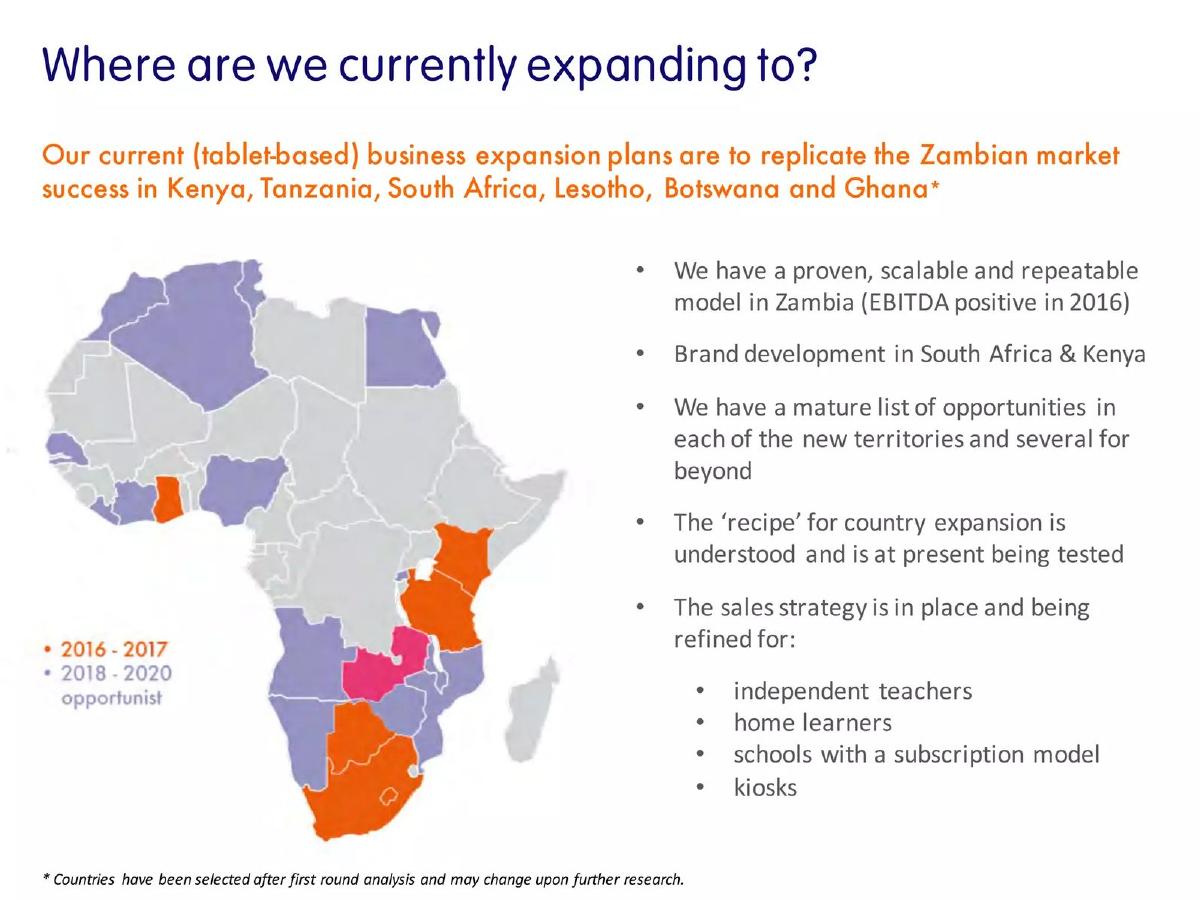
Our analysis: It states a basis for expansion (a result in the home market) and honestly marks the country list as provisional.
Evidence and limitation: The selection criteria behind "first round analysis" aren't shown, and "EBITDA positive" has no figure. The slide describes a recipe "being tested" without saying what result would confirm it.
What a founder can adapt: Keep the home-market basis and the honesty, then add one reason per country and what must be in place before each launch.
Supporting analysis
What the deck claims: "Where are we currently expanding to?" "Our current (tablet-based) business expansion plans are to replicate the Zambian market success in Kenya, Tanzania, South Africa, Lesotho, Botswana and Ghana*." Bullets: "proven, scalable and repeatable model in Zambia (EBITDA positive in 2016)"; "Brand development in South Africa & Kenya"; "a mature list of opportunities in each of the new territories"; "The 'recipe' for country expansion is understood and is at present being tested". The map legend reads "2016 - 2017" and "2018 - 2020 opportunist". Footnote: "Countries have been selected after first round analysis and may change upon further research."
Presentation choice: It states a basis for expansion (a result in the home market) and honestly marks the country list as provisional.
When it does not fit: The selection criteria behind "first round analysis" aren't shown, and "EBITDA positive" has no figure. The slide describes a recipe "being tested" without saying what result would confirm it.
European income-share education financing company. Both slides are labelled "Expansion".
StudentFinance deck, slide 12. Exact stored slide matched to this analysis.StudentFinance deck, slide 13. Exact stored slide matched to this analysis.
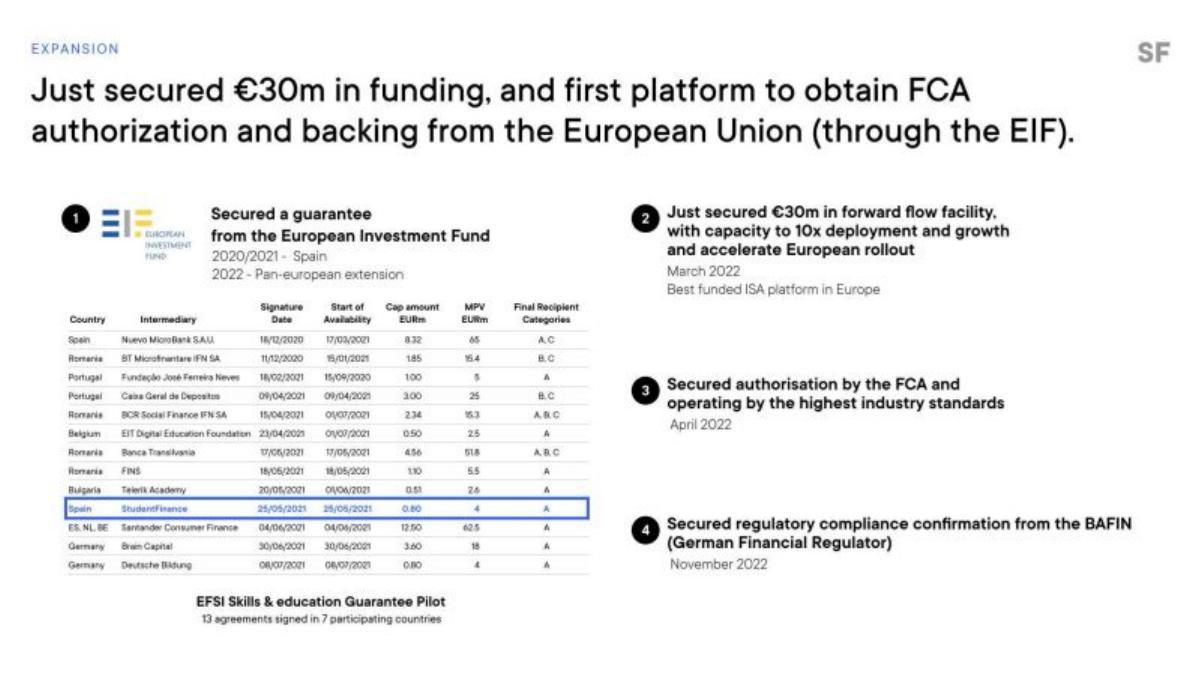
Our analysis: The dated approvals on slide 12 are entry evidence for specific markets (the UK and Germany), placed right before the dated rollout. Read together, an investor can see which parts of the plan already have a regulator's approval.
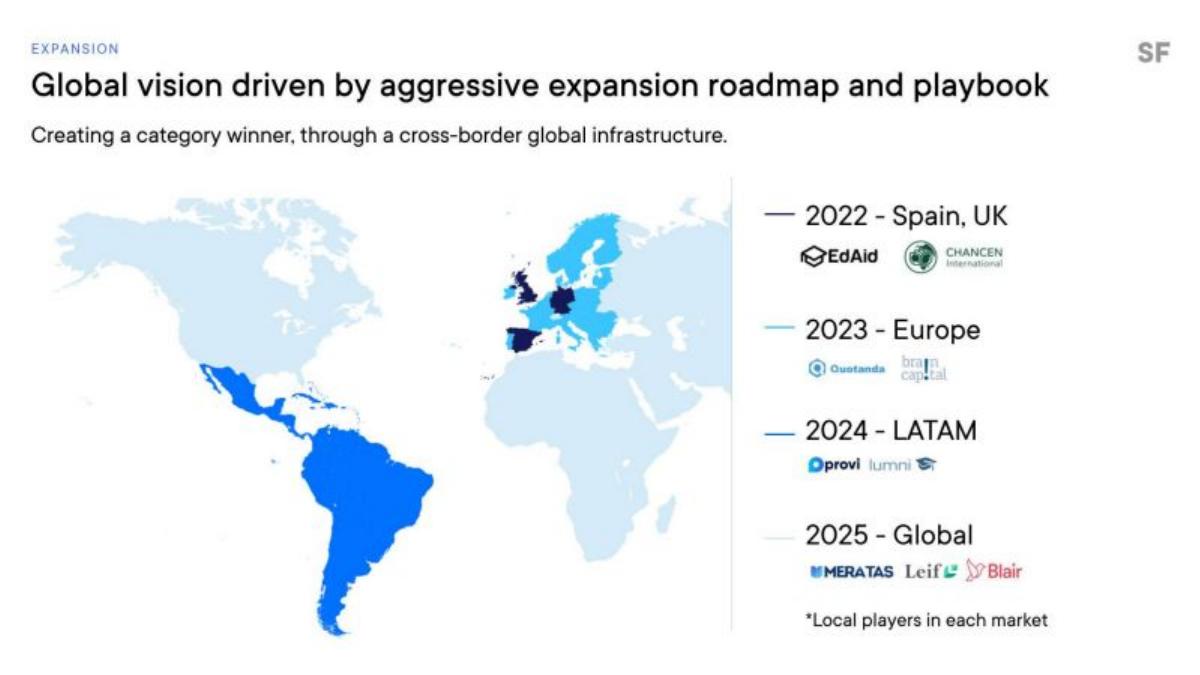
Evidence and limitation: Slide 13 gives no reason for the order (why LATAM in 2024), and the logos are local players, not stated partners. The map shades Germany with Spain and the UK although the 2022 legend names only Spain and the UK.
What a founder can adapt: Put the evidence next to the plan: for each market in the rollout, name the licence or approval and its date, or say it is still needed.
Supporting analysis
What the deck claims: Slide 12: "Just secured €30m in funding, and first platform to obtain FCA authorization and backing from the European Union (through the EIF)." An EIF guarantee ("2020/2021 - Spain", "2022 - Pan-european extension") with a table row for StudentFinance, Spain, signed 25/05/2021, €0.80m cap; "€30m in forward flow facility" (March 2022); "Secured authorisation by the FCA" (April 2022); "Secured regulatory compliance confirmation from the BAFIN" (November 2022). Slide 13: "Global vision driven by aggressive expansion roadmap and playbook": "2022 - Spain, UK", "2023 - Europe", "2024 - LATAM", "2025 - Global", with logos marked "*Local players in each market".
Presentation choice: The dated approvals on slide 12 are entry evidence for specific markets (the UK and Germany), placed right before the dated rollout. Read together, an investor can see which parts of the plan already have a regulator's approval.
When it does not fit: Slide 13 gives no reason for the order (why LATAM in 2024), and the logos are local players, not stated partners. The map shades Germany with Spain and the UK although the 2022 legend names only Spain and the UK.
Superscript deck, slide 24. Exact stored slide matched to this analysis.
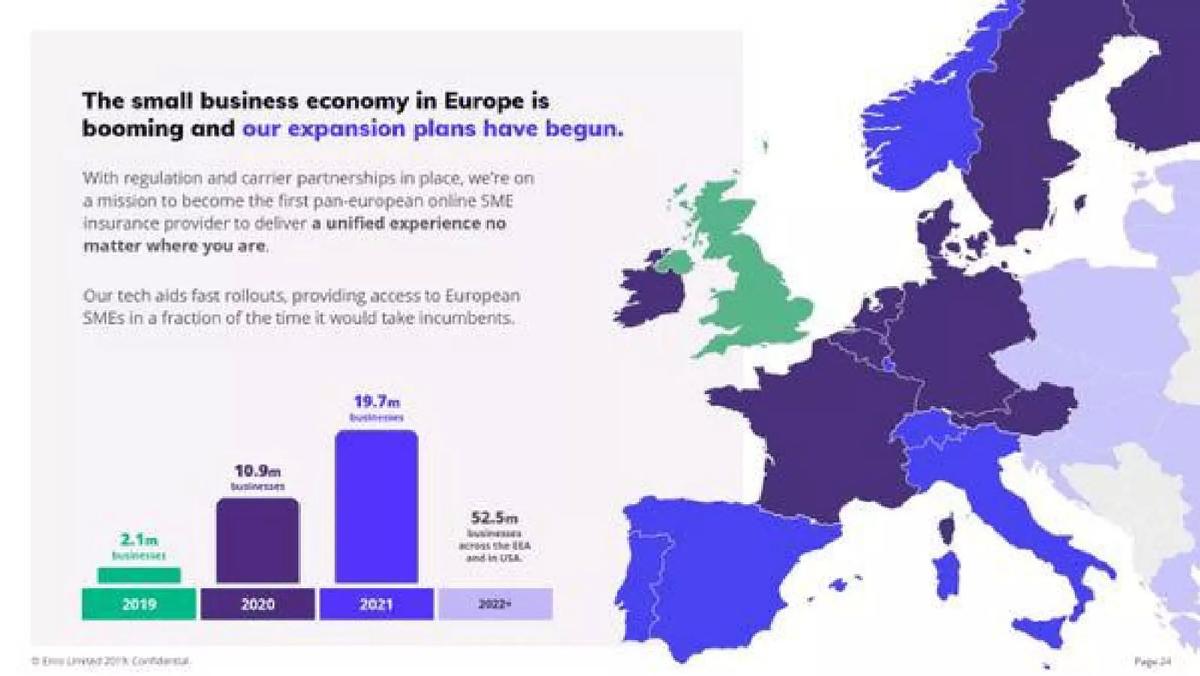
Our analysis: It names the two entry requirements that matter for insurance (regulation and carriers) and claims both are met.
Evidence and limitation: "In place" is the company's statement; the slide names no regulator, permission, carrier or country, so it establishes nothing beyond the claim. The bars count addressable businesses, not customers, and don't say which countries each year adds.
What a founder can adapt: Name the regulatory permission and at least one carrier per market, with dates, so the claim can be checked.
Supporting analysis
What the deck claims: "The small business economy in Europe is booming and our expansion plans have begun." "With regulation and carrier partnerships in place, we're on a mission to become the first pan-european online SME insurance provider." "Our tech aids fast rollouts." Bars: 2.1m businesses (2019), 10.9m (2020), 19.7m (2021), 52.5m "businesses across the EEA and in USA" (2022+), over a map of Europe.
Presentation choice: It names the two entry requirements that matter for insurance (regulation and carriers) and claims both are met.
When it does not fit: "In place" is the company's statement; the slide names no regulator, permission, carrier or country, so it establishes nothing beyond the claim. The bars count addressable businesses, not customers, and don't say which countries each year adds.
Crypto payments app and card company. The previous slide is a world map with a "Launch 2020" category.
Wirex deck, slide 10. Exact stored slide matched to this analysis.
Our analysis: It separates the plan ("plans to launch") from a dated, checkable fact (one licence, one state, one month) and gives a reason for the market ("biggest crypto-friendly market").
Evidence and limitation: One state licence is not permission across the US; the slide does not say how many states it needs or has applied for. Read "launch in the USA" as a plan.
What a founder can adapt: Name the first licence precisely, then say how many more are needed and when.
Supporting analysis
What the deck claims: "America, meet Wirex". "Wirex plans to launch in the USA and join the world's biggest crypto-friendly market in 2020." "In July 2020, Wirex received its first money transmission license from the State of Georgia." A Yahoo Finance headline reports the same licence.
Presentation choice: It separates the plan ("plans to launch") from a dated, checkable fact (one licence, one state, one month) and gives a reason for the market ("biggest crypto-friendly market").
When it does not fit: One state licence is not permission across the US; the slide does not say how many states it needs or has applied for. Read "launch in the USA" as a plan.
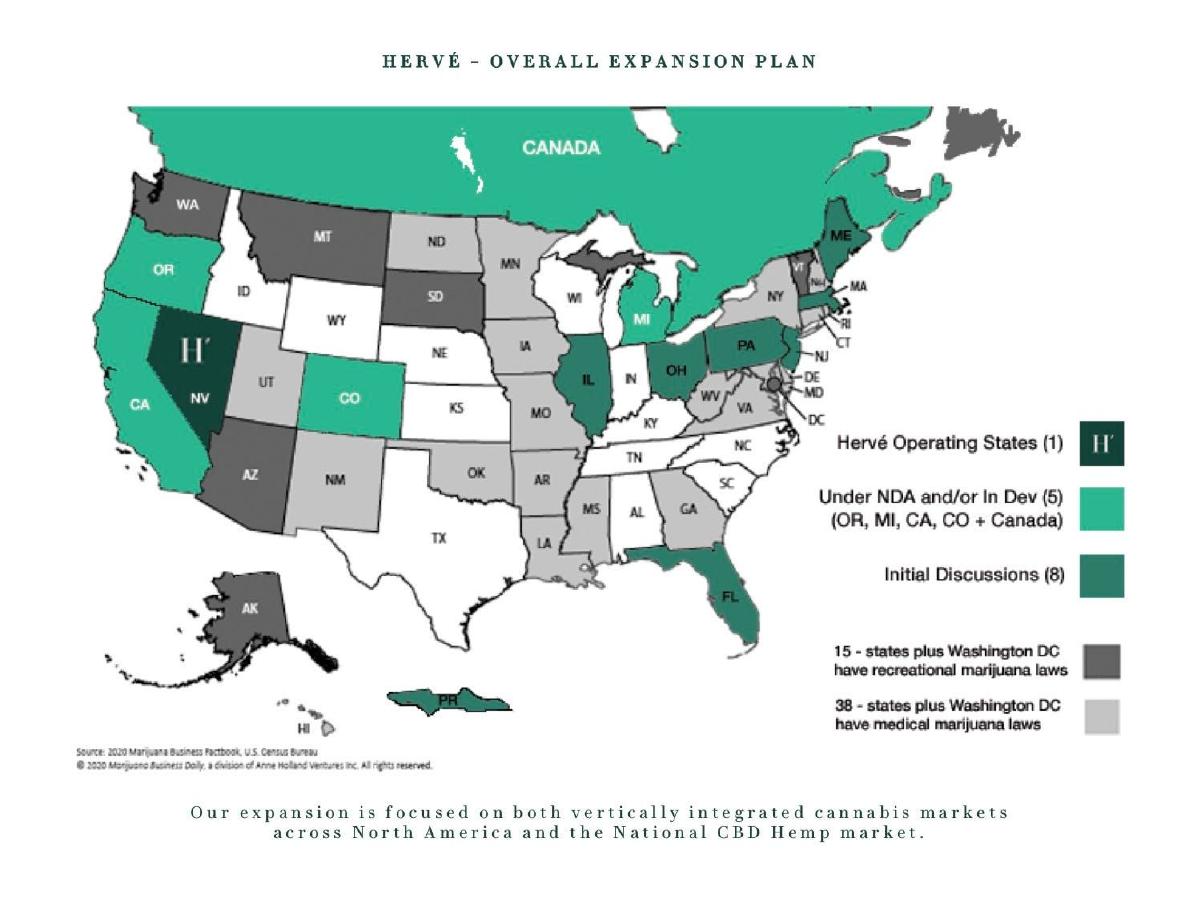
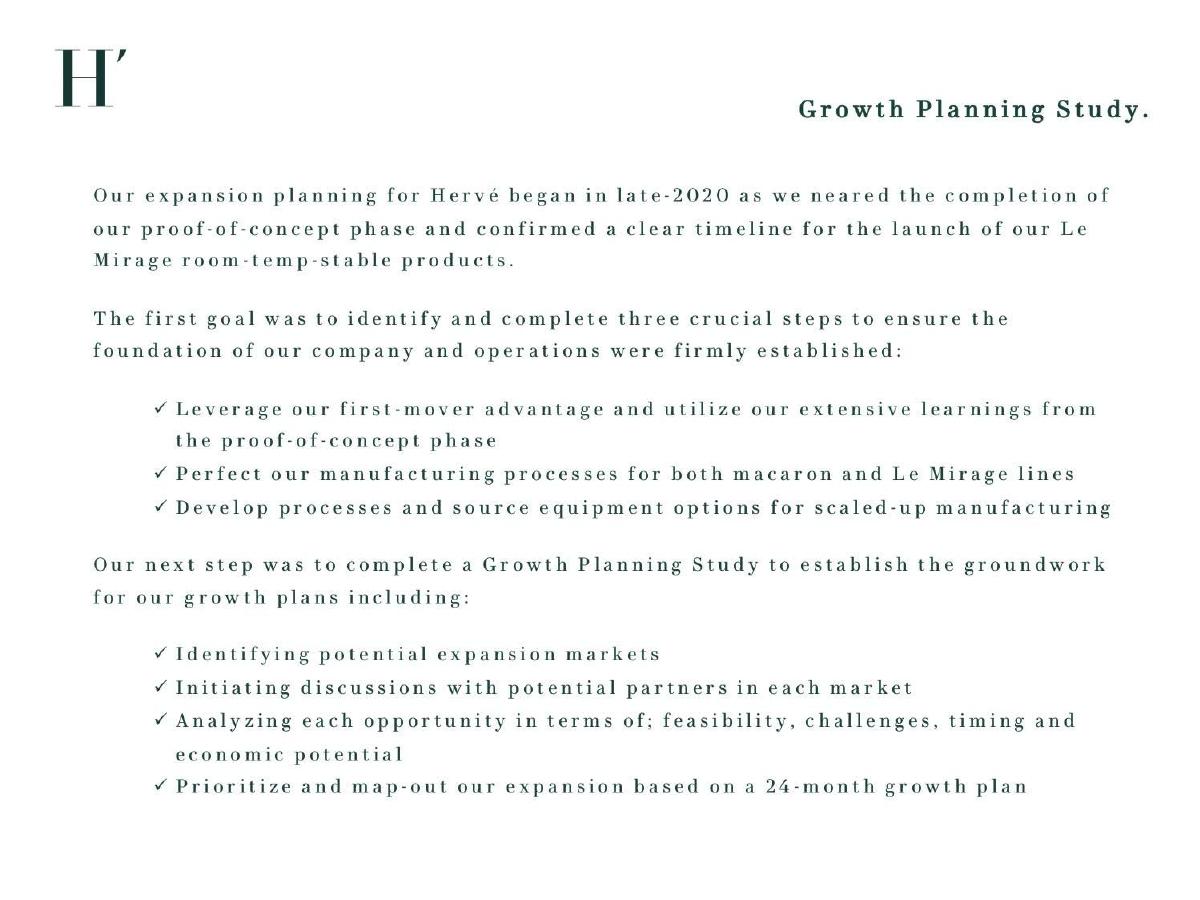
Hervé deck, slide 23. Exact stored slide matched to this analysis.Hervé deck, slide 24. Exact stored slide matched to this analysis.
Our analysis: It is the only example that grades each market by how far entry has progressed, and it overlays the legal condition (state cannabis law) that decides where entry is possible at all. The next slide states the criteria used.
Evidence and limitation: "Under NDA and/or In Dev" merges two different stages, and the criteria on slide 24 are named but not scored for any market. Partners are not named.
What a founder can adapt: Show each target market's status (operating, signed, in negotiation, early talks) and the condition that makes entry possible.
Supporting analysis
What the deck claims: Slide 23, "Hervé - Overall Expansion Plan": a map with "Hervé Operating States (1)", "Under NDA and/or In Dev (5) (OR, MI, CA, CO + Canada)", "Initial Discussions (8)", and shading for states with recreational or medical marijuana laws. Slide 24, "Growth Planning Study": steps including "Identifying potential expansion markets", "Initiating discussions with potential partners in each market", "Analyzing each opportunity in terms of; feasibility, challenges, timing and economic potential" and "Prioritize and map-out our expansion based on a 24-month growth plan".
Presentation choice: It is the only example that grades each market by how far entry has progressed, and it overlays the legal condition (state cannabis law) that decides where entry is possible at all. The next slide states the criteria used.
When it does not fit: "Under NDA and/or In Dev" merges two different stages, and the criteria on slide 24 are named but not scored for any market. Partners are not named.
UK spirits brand (tequila cocktails) raising a pre-seed round; the slide sits between a sustainability slide and the ask.
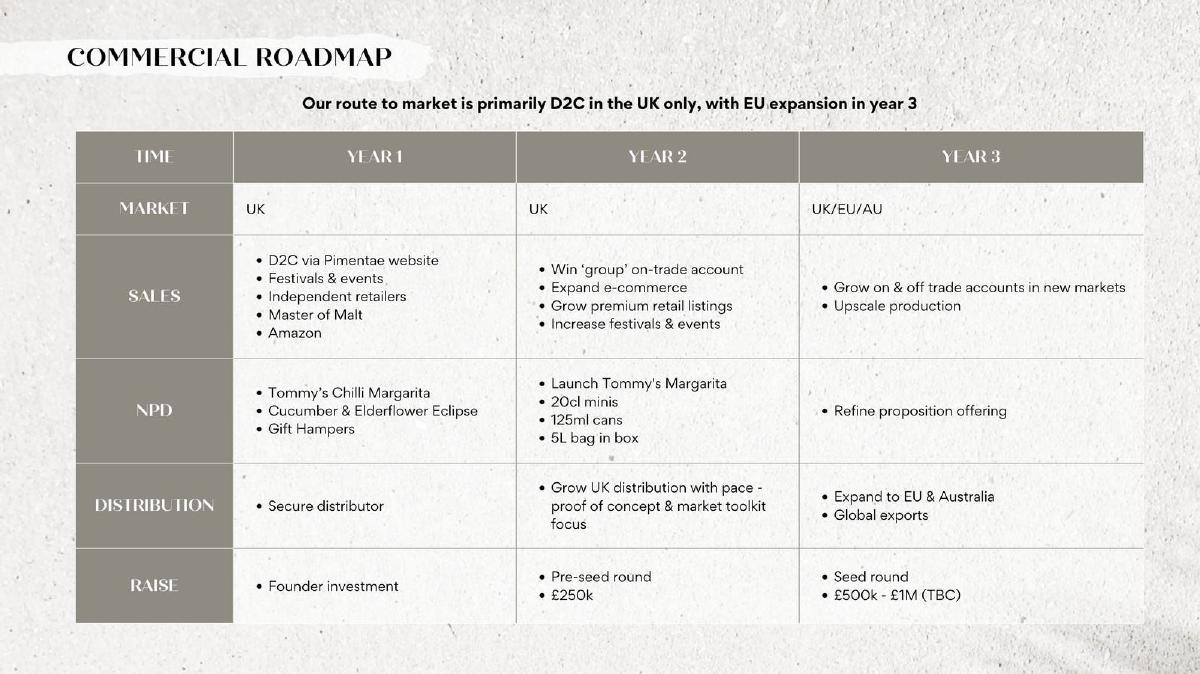
Pimentae deck, slide 17. Exact stored slide matched to this analysis.
Our analysis: It keeps the company in one market until distribution is proven, and ties the expansion year to a later funding round.
Evidence and limitation: No threshold is given, and there is no reason for choosing the EU and Australia over other markets.
What a founder can adapt: Say what "proof of concept" means as a number (accounts, monthly sales, repeat rate) so an investor knows when year 3 is earned.
Supporting analysis
What the deck claims: "Commercial Roadmap": "Our route to market is primarily D2C in the UK only, with EU expansion in year 3." Market row: Year 1 UK, Year 2 UK, Year 3 UK/EU/AU. Distribution row: Year 1 "Secure distributor"; Year 2 "Grow UK distribution with pace - proof of concept & market toolkit focus"; Year 3 "Expand to EU & Australia", "Global exports". Raise row: founder investment, pre-seed £250k, seed £500k–£1M (TBC).
Presentation choice: It keeps the company in one market until distribution is proven, and ties the expansion year to a later funding round.
When it does not fit: No threshold is given, and there is no reason for choosing the EU and Australia over other markets.
Direct Dairy Holding go to market slide — slide 31
Dutch dairy-automation company (on-farm milk processing), deck dated May 2019. The slide sits after a current-stage slide and before a slide on possible investment rounds.
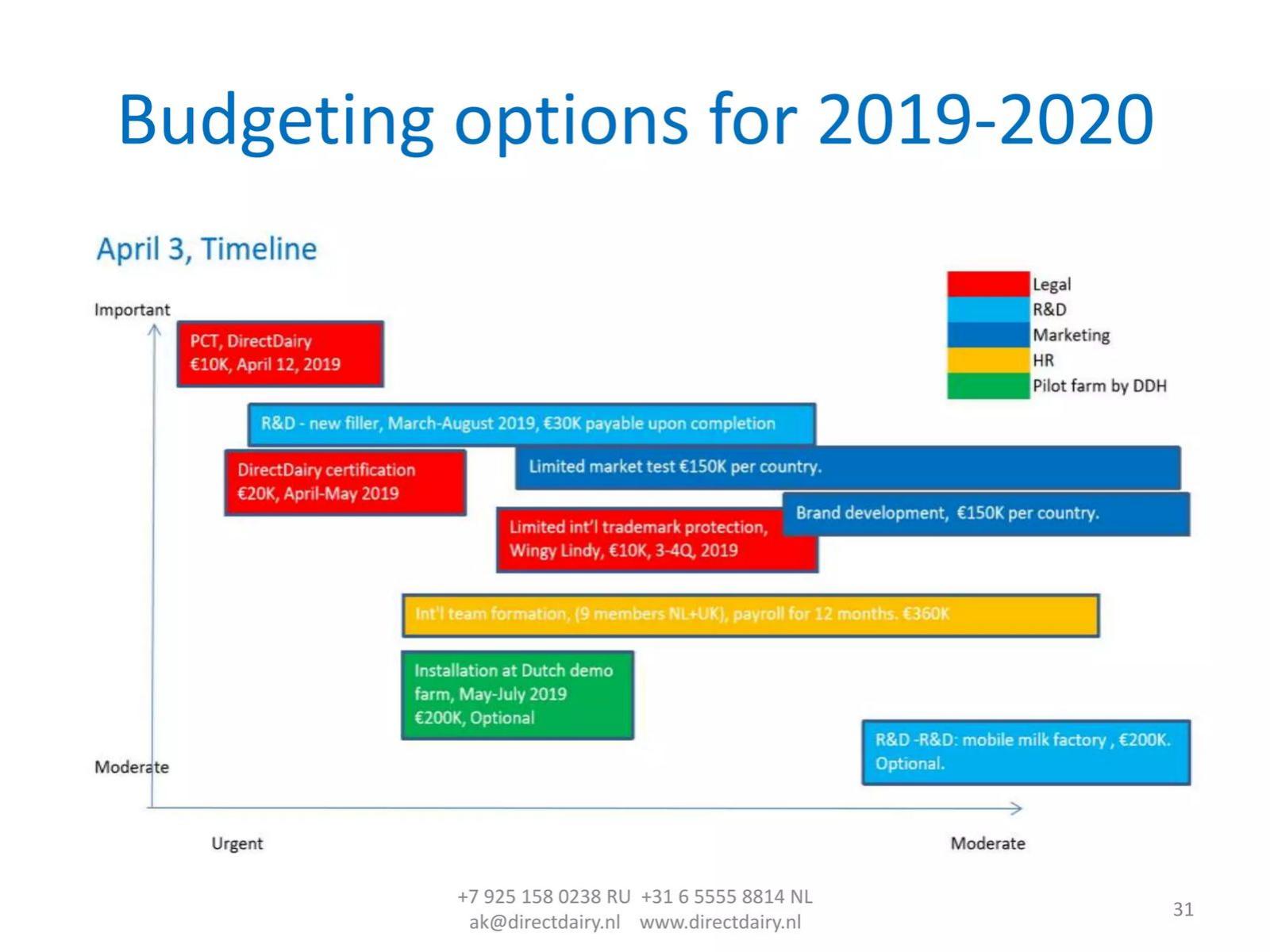
Direct Dairy Holding deck, slide 31. Exact stored slide matched to this analysis.
Our analysis: It is the only slide in this set that states what entering one country is budgeted to cost, and it splits that cost into named items rather than one lump: a market test and brand development at €150K per country each, with separate legal, certification, team and pilot-farm lines that are dated and, in two cases, marked optional.
Evidence and limitation: The €150K per country appears twice with no total and no list of which countries it applies to, and the deck's other slides name the Netherlands and the UK without saying the budget covers those two. Nothing on the slide shows the basis for the figure, and none of the spending is described as already made. Read the whole slide as a plan for 2019-2020.
What a founder can adapt: Break the entry budget into named items, date them, and mark which are optional. Then add the one thing this slide lacks: where the figure comes from, such as what the first market actually cost.
Supporting analysis
What the deck claims: "Budgeting options for 2019-2020", "April 3, Timeline". Blocks plotted on an importance/urgency chart, colour-coded Legal, R&D, Marketing, HR and "Pilot farm by DDH": "PCT, DirectDairy €10K, April 12, 2019"; "R&D - new filler, March-August 2019, €30K payable upon completion"; "DirectDairy certification €20K, April-May 2019"; "Limited int'l trademark protection, Wingy Lindy, €10K, 3-4Q, 2019"; "Limited market test €150K per country."; "Brand development, €150K per country."; "Int'l team formation, (9 members NL+UK), payroll for 12 months. €360K"; "Installation at Dutch demo farm, May-July 2019 €200K, Optional"; "R&D -R&D: mobile milk factory, €200K. Optional."
Presentation choice: It is the only slide in this set that states what entering one country is budgeted to cost, and it splits that cost into named items rather than one lump: a market test and brand development at €150K per country each, with separate legal, certification, team and pilot-farm lines that are dated and, in two cases, marked optional.
When it does not fit: The €150K per country appears twice with no total and no list of which countries it applies to, and the deck's other slides name the Netherlands and the UK without saying the budget covers those two. Nothing on the slide shows the basis for the figure, and none of the spending is described as already made. Read the whole slide as a plan for 2019-2020.
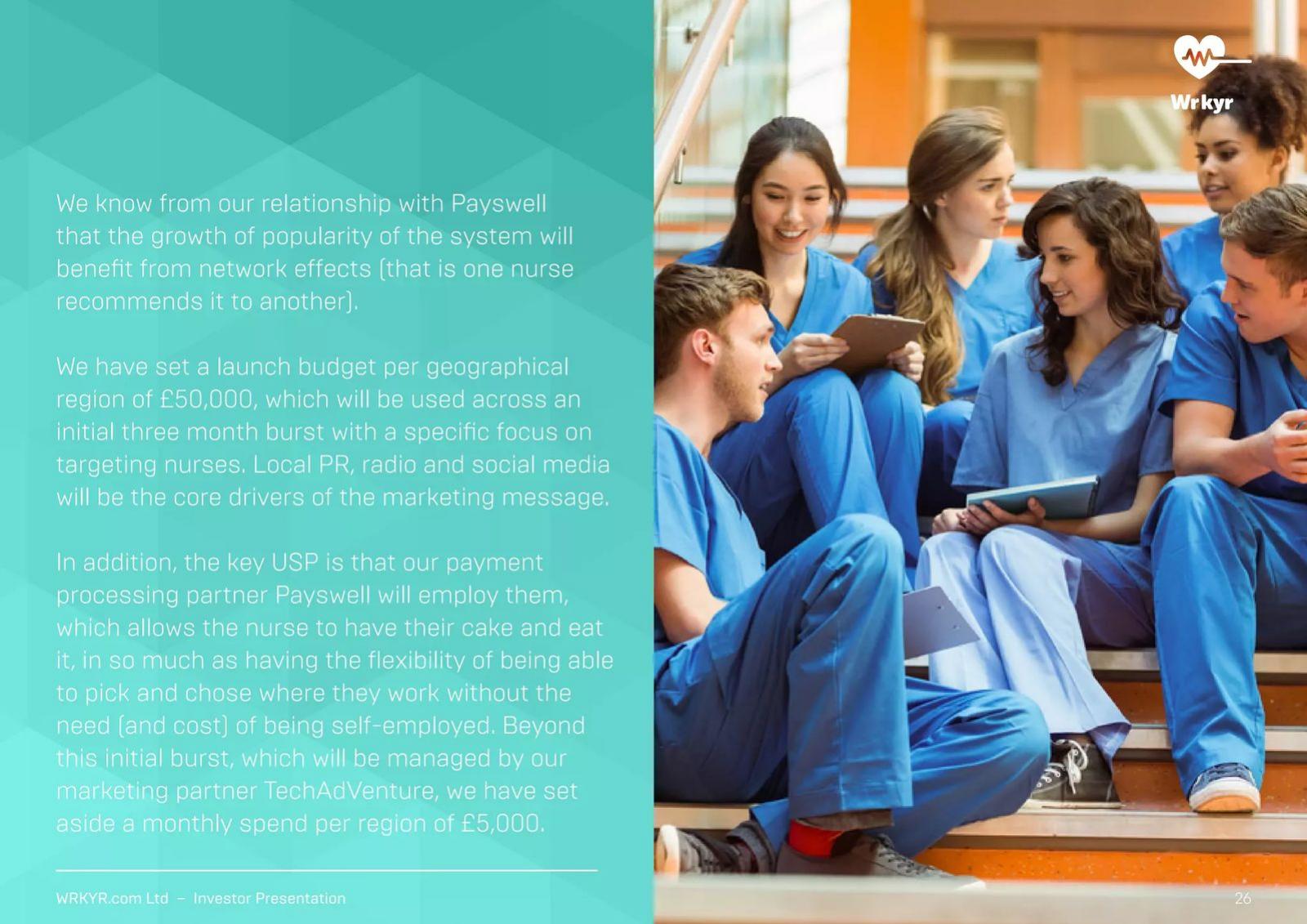
UK nurse-shift marketplace, investor presentation dated 2017. A text slide inside the go-to-market part of the deck.
Wrkyr.com Ltd deck, slide 26. Exact stored slide matched to this analysis.
Our analysis: It gives the launch budget a period and a purpose rather than a single figure: £50,000 across a three-month burst to reach one audience in one region, then £5,000 a month to hold it. That separation between launch spend and running spend is what an expansion budget usually leaves out.
Evidence and limitation: These are UK regions, not countries, so the figure does not price international entry. No region is named, no number of regions is given, no total follows, and there is no result from a region already launched. "Network effects" is attributed to a relationship with Payswell, with no data shown.
What a founder can adapt: Split the entry budget the same way, into a launch burst and a monthly cost to stay, and name the channels each pays for.
Supporting analysis
What the deck claims: "We know from our relationship with Payswell that the growth of popularity of the system will benefit from network effects (that is one nurse recommends it to another)." "We have set a launch budget per geographical region of £50,000, which will be used across an initial three month burst with a specific focus on targeting nurses. Local PR, radio and social media will be the core drivers of the marketing message." "Beyond this initial burst, which will be managed by our marketing partner TechAdVenture, we have set aside a monthly spend per region of £5,000."
Presentation choice: It gives the launch budget a period and a purpose rather than a single figure: £50,000 across a three-month burst to reach one audience in one region, then £5,000 a month to hold it. That separation between launch spend and running spend is what an expansion budget usually leaves out.
When it does not fit: These are UK regions, not countries, so the figure does not price international entry. No region is named, no number of regions is given, no total follows, and there is no result from a region already launched. "Network effects" is attributed to a relationship with Payswell, with no data shown.
"Yes" means the slide states it; it does not mean the requirement was verified or the expansion happened. Cost figures are budgets stated on the slide, not spending shown to have taken place.
Example
Countries named
Timing
Reason for market
Entry evidence shown
Cost per market stated
Mwabu
Yes (provisional)
Year ranges
Home-market result
No
No
StudentFinance
Regions after 2022
Yes, by year
No
Yes, dated approvals (slide 12)
No
Superscript
No (map only)
Addressable counts by year
Market size
Claimed, not named
No
Wirex
Yes (USA)
2020
Market size
One dated state licence
No
Hervé
Yes, by status
24-month plan
Criteria named; legal status
Status per market
No
Pimentae
Yes
By year
No
Trigger stated, no threshold
No
Direct Dairy
No (per country, unnamed)
2019-2020, dated items
No
No
Budget: €150K per country for a market test, €150K per country for brand development
Wrykr
No (UK regions)
Three-month burst, then monthly
No
No
Budget: £50,000 per region to launch, then £5,000 a month
Key Takeaways
Separate intended countries, dates, reasons, entry evidence and entry cost. They are different claims and investors check them differently.
Give the reason for each country. Mwabu's "replicate the Zambian market success" is a basis; its footnote admits the list "may change".
Name what is already secured. StudentFinance dates its FCA authorisation (April 2022) and BaFin confirmation (November 2022); Superscript's "in place" can't be checked.
Don't let one licence stand for a country. Wirex's July 2020 Georgia licence is one state, not permission to operate across the US.
Show status per market. Hervé's map separates the one state it operates in from five under NDA or in development and others in initial discussion.
State the trigger. Pimentae's EU and Australia move sits in year 3, after UK distribution "proof of concept".
If you price entry, say what the figure buys and where it came from. Direct Dairy's €150K per country covers a limited market test and, separately, brand development; Wrykr's £50,000 covers a three-month launch burst. Neither slide shows the basis for the number or a country it has already been spent in.
Write your expansion slide
One row per market you plan to enter in the next 24 months.
Market and date. Which country, and in which quarter or year?
Reason. Why this market before the others: demand, an existing customer, a partner, regulation you already meet, payment access or distribution?
Entry requirements. What must be true before launch (licence, partner, distributor, local entity), and which of those is already done, with a date?
Cost. What is entering this market budgeted to cost, split into launch spend and monthly running spend, and what did your first market actually cost?
Trigger. What result in your current market earns this move?
Copyable framework: [Country], [date]: chosen because [reason]. Done: [licence/partner, date]. Still needed: [requirement, expected date]. Budget: [launch spend] to launch, then [monthly spend]; our first market cost [actual]. We enter once [current-market metric] reaches [threshold].
Illustrative example 1 — written by us
Before: 2023 - Europe
After: Germany, Q2 2023: chosen because 40 UK customers already have German teams. Done: regulator confirmation (Nov 2022). Still needed: local bank partner (in negotiation). We enter once UK revenue reaches £100k a month.
What improved: Our illustrative rewrite, not any company's text or figures. It turns a region label into a market with a reason, done and pending requirements, and a trigger.
What this guide adds
The go-to-market guide covers the first customer segment, the channel and the order of expansion in general, and its worksheet asks what evidence must be true before the next move. The roadmap guide shows an expansion map (TransferWise) as one kind of milestone and notes it gives no order or timing. The licensing guide covers how to name a licence, regulator and country. The regulatory guide covers approval pathways. None of them compares how founders justify a specific next country or show which entry conditions are already met. That is the question here.
Five claims an expansion slide can make
This is our editorial framework, not something any one slide below contains in full. Intended countries: the list. Timing: a date or sequence for each. Reason: why this country before others, such as local demand, an existing customer, a partner, regulation you already meet, payment access or distribution. Entry evidence: what is already done (licence granted, partner signed, distributor in place) and what is still needed, with a date. Entry cost: what entering one market is budgeted to cost, what that figure buys, and whether it is a plan or money already spent.
Keep plan and fact apart. "Launch 2020" or "expansion plans have begun" describe intent. A dated licence or a named signed partner is evidence, and even then only for the scope it covers.
What entering one market costs
Two of the eight slides attach money to a single market. Direct Dairy's budget timeline blocks out "Limited market test €150K per country" and "Brand development, €150K per country" alongside dated line items for legal work, certification, trademarks, a nine-person international team and a demo farm. Wrykr writes it as a sentence: "We have set a launch budget per geographical region of £50,000, which will be used across an initial three month burst", then "a monthly spend per region of £5,000" afterwards. Wrykr's regions are UK geographies, not countries, so read it as a per-market launch budget rather than an international entry cost.
Both are forward budgets. Neither slide says how the figure was worked out, what a market it has already entered actually cost, or what the spend is expected to return. A budget per market answers "what will this take", not "does it work": if you have a first market, give what it cost and what it produced beside the plan for the next one.
What the slides here leave out
None of the eight slides shows local unit economics or a measurable threshold (for example, revenue or customers in the first market) that triggers the next one. Pimentae comes closest by tying expansion to a proven UK distribution model, but it gives no number. Direct Dairy and Wrykr price entry but show no basis for the figure and no cost from a market already entered. If you have these, they are what turns a map into a plan.
Common mistakes
A map with no reasons. Shading countries says where, not why.
Plans shown as launches. "Launch 2020" or "expansion has begun" is intent until customers are served there.
"In place" without names. Name the licence, regulator or partner so it can be checked.
One licence for a whole country. A single state or regional permission covers only that territory.
A budget with no basis. A cost per country is a plan. Say how it was worked out, or what your first market actually cost.
No trigger. Say what result in the current market earns the next one.
Diagnostic checklist
Each target market is named, with a date or sequence.
Each market has a stated reason.
Entry requirements are listed, split into done (dated) and pending.
Licences and partners are named, with their scope.
Any cost per market says what it buys, over what period, and whether it is budgeted or spent.
The trigger for expansion is a metric in the current market.
Plans and achieved launches are labelled differently.
Frequently asked questions
How we chose these examples
Corpus: published pitch deck teardowns on StartupFundraising.com. Founder-uploaded private decks are excluded.
Selection (2026-09-29): we started from four slides on the coverage-map shortlist (Mwabu 14, StudentFinance 13, Superscript 24, Hervé 24) and searched the private research text index for expansion, market entry, new markets, launch and international wording paired with licence, regulation, partner, demand, payment or distribution terms, setting aside listed-company, cannabis-operator investor presentations focused on share stakes, and business plans. From 86 matches we inspected the original pages and neighbours for Wirex (9–11), Pimentae (16–18), Mwabu (13–15), StudentFinance (12–14), Hervé (23–25) and Superscript (1, 22–26).
Entry-cost search (2026-09-30): we searched the reconciled corpus of 70,927 unique searchable pages (21,986 public pages 1–15, 48,477 readable pages from the private text extraction, 464 pages from earlier batches, deduplicated by deck file checksum and PDF page) for per-country and per-market wording, licence fees, launch budgets, local staffing, country managers, go-to-market budgets and market-entry cost phrases, together with a currency-amount pattern. Of 47 matching pages, most named a licence fee inside a pricing table or a national figure rather than an entry cost. Only Direct Dairy Holding page 31 and Wrykr page 26 survived inspection of the original pages; both are added here. Two candidates below the bar are recorded in our research notes rather than published.
Overlap check: we read the expansion sections of the go-to-market, roadmap, licensing and regulatory guides. Superscript and StudentFinance appear in other guides with different slides (insurtech go-to-market slide 3; fintech business model slide 9).
Images: all ten pages were rendered from the original public deck files, whose checksums matched our saved records (Mwabu 24 pages, StudentFinance 17, Superscript 26, Wirex 21, Hervé 31, Pimentae 19, Direct Dairy Holding 34, Wrykr 31), and matched to company and page on 2026-09-29, and 2026-09-30 for Direct Dairy 31 and Wrykr 26 (editorial model review). No person has yet completed an editorial review of this page.
The five-claim framework is our editorial template. We make no claim that any listed expansion, licence use, partnership or budget went ahead after the deck.