Superscript’s Series A deck is a sophisticated example of how to pitch a Managing General Agent (MGA) model to venture capitalists. By positioning themselves as a tech-first intermediary that shares in underwriting profits without assuming balance sheet risk, the company demonstrates a capital-efficient path to scaling business insurance. The deck excels at visualizing the transition from a simple online direct-to-consumer tool to a complex enterprise service provider. It relies heavily on unit economics, specifically LTV:CAC ratios and cross-product uptake, to prove that their 'hyper-persona…
Key takeaways
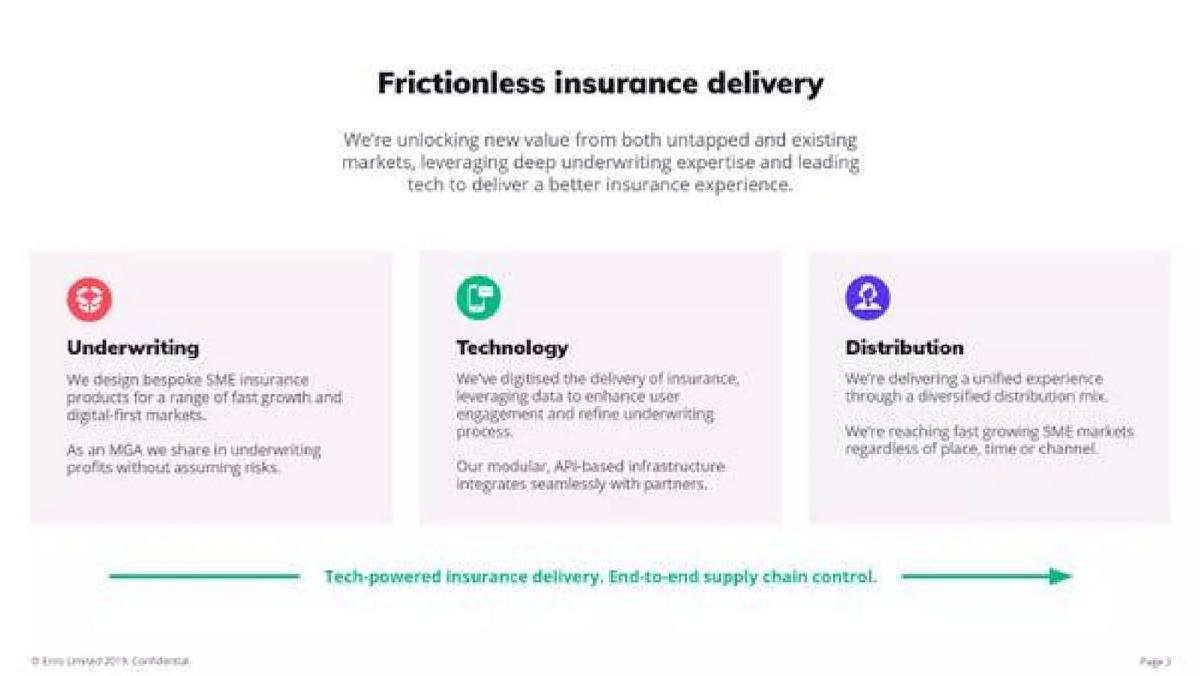
- The company operates as an MGA, allowing them to share in underwriting profits without assuming the underlying insurance risks (Slide 3).
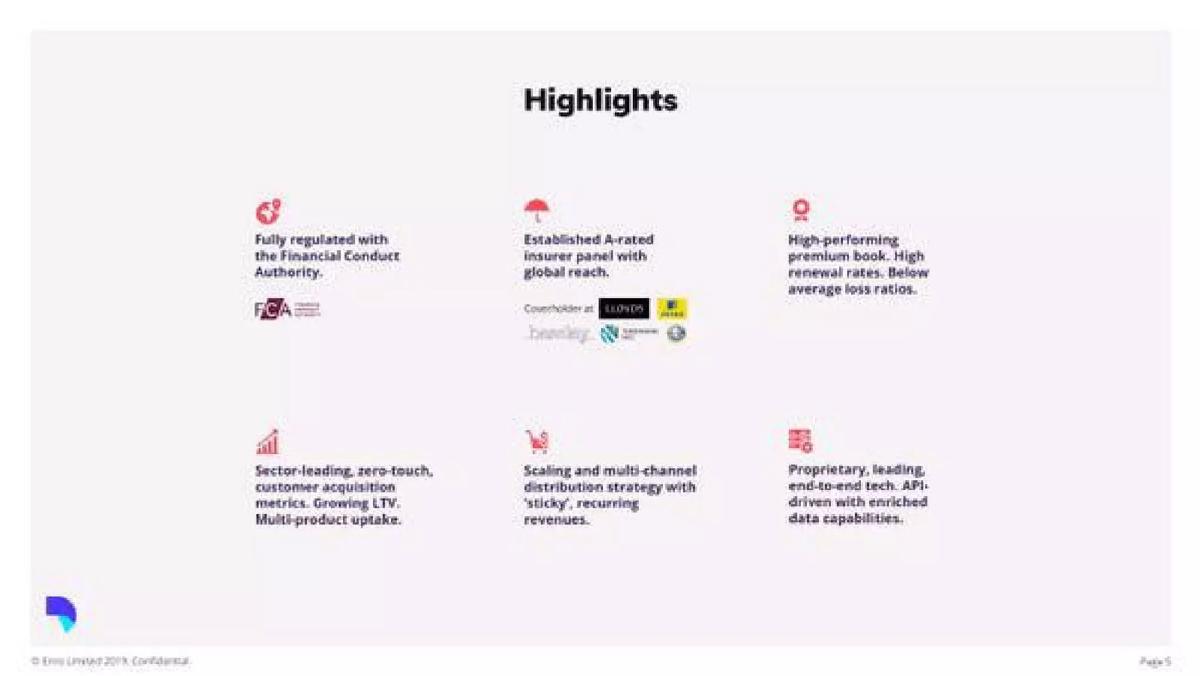
- Superscript emphasizes regulatory credibility by highlighting their status as fully regulated by the Financial Conduct Authority (Slide 5).
- The product strategy bifurcates into an automated 'Online service' for SMEs and an 'Enterprise service' for complex risks (Slide 15).
- Distribution is diversified across direct channels, partnerships, and aggregators to unlock 'massive growth' (Slide 19).
- The company reported servicing over 750 trades in 2019, representing a 4x increase from the previous year (Slide 23).
- Unit economics are a core focus, with the company averaging 2.4 products per customer as of the 2019 reporting period (Slide 25).
- A technology update (quote & bind v4.0) in January 2019 led to a 150% uplift in quote starts and a 10% improvement in conversion (Slide 25).
- The deck projects an LTV:CAC ratio scaling toward 6x by 2021, driven by improved retention and product uptake (Slide 25).
Introduction: The MGA Advantage
Superscript, originally founded as Digital Risks in 2015, represents a specific breed of insurtech that focuses on the 'distribution and underwriting' layer rather than the 'capital' layer. This Series A deck, used to secure part of their $24.4 million total funding, is a clinical look at how to scale a B2B service by leveraging technology to solve the 'friction' of traditional insurance. The deck is notable for its clean aesthetic and its heavy reliance on unit economics to tell a story of efficiency and expansion.
Slide 1: Brand Transition
The cover slide serves a dual purpose. It introduces the new brand, Superscript , while maintaining the legacy of Digital Risks . This is a common tactic for startups undergoing a Series A or B rebrand to signal a broadening of their market scope—moving from 'digital risks' (a niche) to 'superscript' (a broader, more authoritative platform). The subtitle 'Investment overview - Series A' sets a formal tone for the presentation.
Slide 3: The Three Pillars of Frictionless Delivery
This slide defines the company's value proposition through three distinct lenses: Underwriting , Technology , and Distribution . The most critical piece of information here is the statement: 'As an MGA we share in underwriting profits without assuming risks.' This is a signal to investors that the company has a high-margin potential with lower capital volatility than a traditional insurer. They describe their tech as 'modular' and 'API-based,' emphasizing their ability to integrate with partners seamlessly.
Slide 5: Institutional Credibility and Highlights
The 'Highlights' slide is a 'trust' slide. It lists six key achievements, including being 'Fully regulated with the Financial Conduct Authority' and having an 'Established A-rated insurer panel.' By featuring logos like Lloyd's and Beazley , Superscript borrows the credibility of century-old institutions. The slide also mentions 'Below average loss ratios,' which is the ultimate proof of their underwriting expertise—essentially telling investors that they are better at picking 'good' risks than the industry at large.
Slides 7-9: The Customer Experience
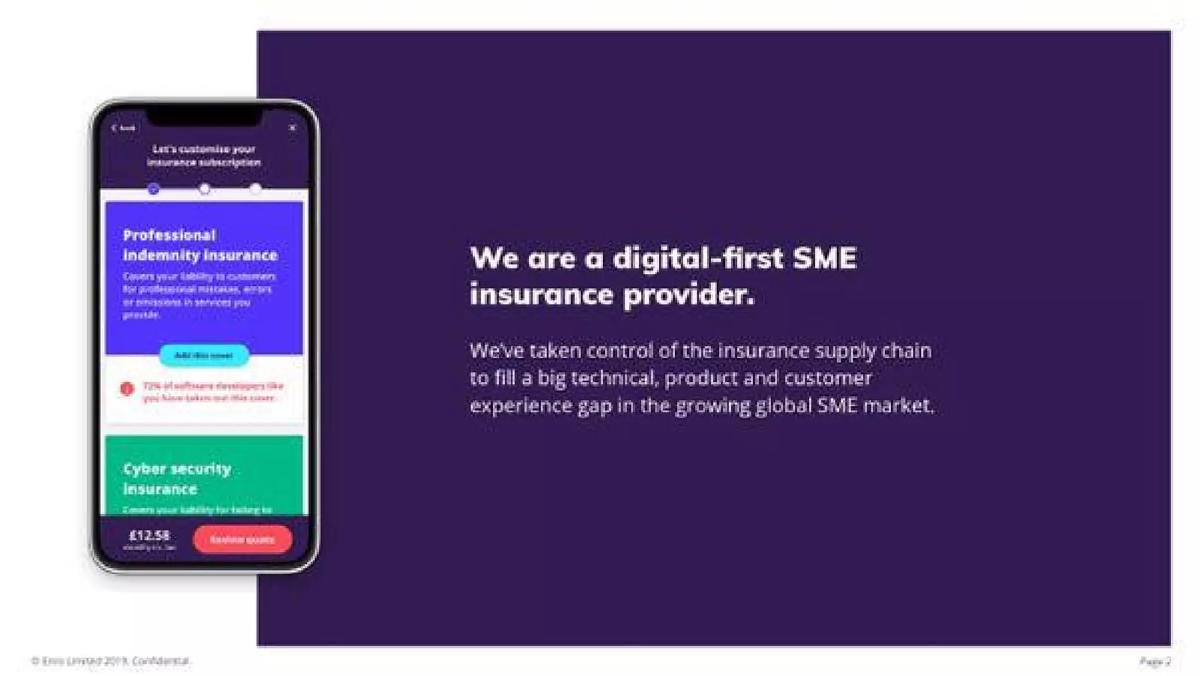
Slide 7 acts as a section break ('The Digital Risks experience'), leading into Slide 9, which focuses on 'hyper-personal' delivery. The deck argues that 'one size fits all just doesn't cut it anymore.' The visual of a mobile interface showing 'Professional Indemnity Insurance' with specific monthly costs (£12.58) makes the abstract concept of insurance feel like a modern SaaS product. They claim that 'No other online insurer does this,' positioning their data-driven insights as a unique competitive advantage that improves conversion metrics.
Slide 11: Addressing Complex Risks
Insurance for SMEs often hits a ceiling when risks become complex. Slide 11 addresses this by introducing their 'enterprise service.' This is for businesses with 'premium spends of £20k - £100k.' By offering a 'dedicated account manager' and 'whole of market negotiation power,' Superscript shows they can capture the high-value end of the market that automated bots cannot serve. This prevents customer churn as their SME clients grow into larger enterprises.
Slides 13-15: Service Architecture
Slide 15 provides a clear visual map of their product tiers: Essential , Professional , Management , Specialist , and Bespoke . It illustrates a 'seamless transition' from automated online services to account-managed enterprise services. This is a crucial 'land and expand' strategy. They list specific covers like 'Cyber security,' 'Medical malpractice,' and 'Business interruption,' showing the breadth of their licensing and partnership capabilities.
Slides 17-19: Distribution Strategy
Slide 19 is one of the most important in the deck. It uses a pie chart to show a 'diversified distribution strategy' transitioning from 2020 to 2021. The strategy relies on three prongs: Online direct , Enterprise , and Partnerships & aggregator channel growth . The arrow indicating growth in the partnership/aggregator segment suggests that Superscript intends to scale by 'plugging in' to other platforms rather than just relying on expensive direct-to-consumer marketing.
Slide 21: Social Proof
The Trustpilot slide provides qualitative validation. The reviews highlight 'flexibility,' 'monthly cost,' and 'lovely people.' For a Series A investor, this confirms that the 'hyper-personal' claims made in earlier slides are actually being felt by the end-user. The mention of 'flexibility to potentially change the policy month by month' reinforces the subscription-based model mentioned in the company's self-description.
Slide 23: Exponential Market Growth
This slide uses a bubble chart to show growth. In 2018, the market reach was a small circle; by 2019, it grew by 160%, servicing 'over 750 trades.' The projection for 2020 shows a '420+%' increase with a 'Launch in key tech cities across Europe.' This slide is designed to show momentum and a clear path toward internationalization, moving beyond the UK market.
Slide 25: Unit Economics and Roadmap
The final slide in this selection is the 'money slide.' It shows a bar chart of LTV:CAC (Lifetime Value to Customer Acquisition Cost) ratios. The chart shows LTV:CAC growing from approximately 2x in 2019 to a projected 6x in 2021. They attribute this growth to three factors: Product uptake , Improved retention , and Underwriting profit . The text reveals a significant technical milestone: 'Our quote & bind v4.0 was released in January 2019 resulting in an immediate 150% uplift on customers starting quotes.' This provides concrete evidence that their technology investments yield immediate financial returns.
What Works in the Superscript Deck
The MGA Positioning: By explicitly stating they don't assume risk, they distance themselves from the capital-intensive 'carrier' model that often scares off VCs looking for software-like margins. · Clear Segmentation: The distinction between the 'Online' and 'Enterprise' services shows a sophisticated understanding of the customer lifecycle. They aren't just a 'bot'; they are a full-service partner. · Data-Backed Tech Claims: Instead of just saying their tech is 'better,' they cite the 150% uplift from their v4.0 release. This makes the 'proprietary technology' claim credible. · Visual Consistency: The use of a dark, professional palette with high-contrast accents (green and purple) gives the deck a premium, 'fintech' feel rather than a 'stodgy insurance' feel.
What is Missing from the Superscript Deck
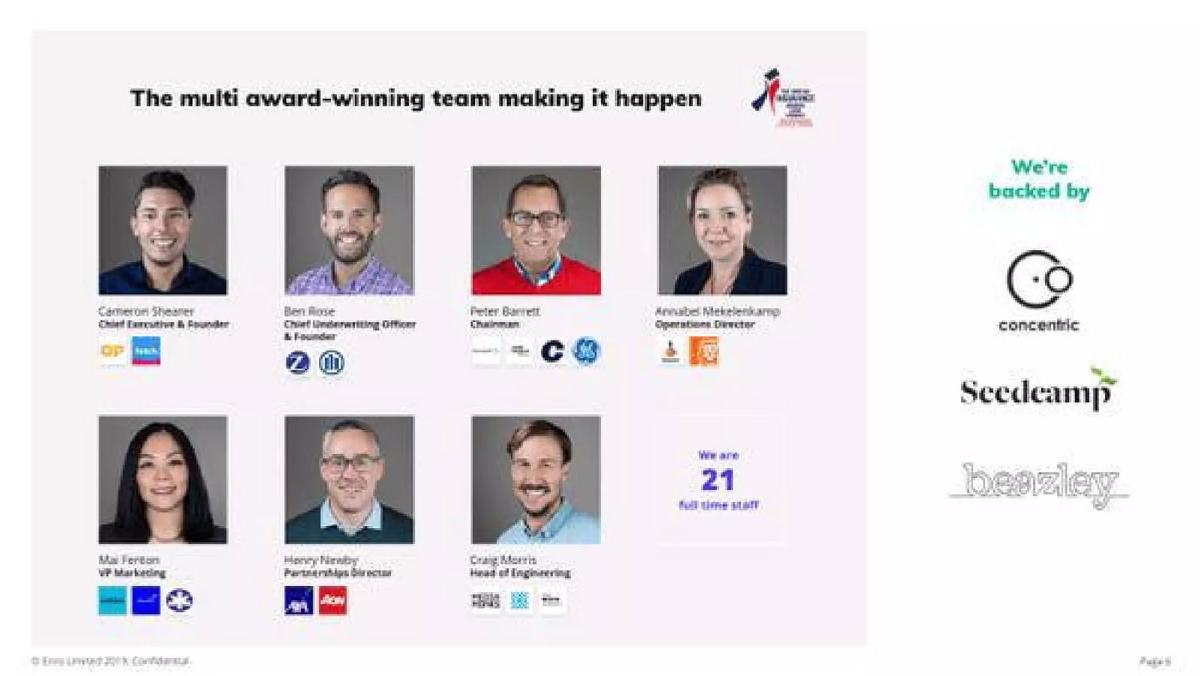
The Team Slide: In this 13-slide selection, there is no mention of the founders or the leadership team. For a Series A, the 'Why us?' is usually as important as the 'What?'. · Competitor Landscape: The deck claims 'No other online insurer does this,' but it doesn't name competitors like Zego, Marshmallow, or traditional incumbents. Investors need to see how Superscript wins in a crowded market. · The Ask: There is no slide detailing how much capital is being raised or how it will be allocated (e.g., 40% Engineering, 40% Marketing, 20% Operations). · Detailed Financials: While the LTV:CAC chart is excellent, it lacks the raw numbers (Revenue, Burn, Gross Written Premium) that usually accompany a Series A pitch.
What a Founder Should Copy
The 'Highlights' Slide: Use a single slide early in the deck to stack your most impressive 'trust' signals—regulations, high-tier partners, and key growth percentages. · LTV:CAC Visualization: If you are a subscription or recurring revenue business, a stacked bar chart showing the components of LTV (retention, cross-sell, margin) is the best way to prove long-term viability. · Service Tiering: Show how you handle small customers versus large ones. It demonstrates that you have a plan for 'up-market' movement, which is where the real enterprise value is created. · The 'How it's Done' Section: Use section breaks to guide the investor through the narrative. It prevents the deck from feeling like a random collection of data points.
Frequently asked questions
- What is Superscript's business model based on the deck?
- Superscript operates as a Managing General Agent (MGA). This means they design bespoke insurance products and handle distribution and technology, but the actual risk is carried by a panel of A-rated insurers. This allows Superscript to earn a share of underwriting profits and commissions without the heavy capital requirements of a full-stack insurance carrier.
- How does Superscript differentiate its product offering?
- The deck highlights a 'hyper-personal' experience using real-time data to provide targeted insights. They offer a tiered service model: an automated online platform for essential and professional cover for SMEs, and a dedicated enterprise service for larger companies with complex risks requiring 'whole of market' negotiation.
- What are the key growth metrics mentioned in the slides?
- Key metrics include a 160% increase in market reach from 2018 to 2019, servicing over 750 trades. They also highlight a 150% uplift in customer quote starts following a software update and an average of 2.4 products per customer, which is central to their LTV expansion strategy.
- Who are Superscript's partners?
- Slide 5 displays logos for several high-profile insurance partners and regulators, including the Financial Conduct Authority (FCA), Lloyd's of London, Beazley, and QBE. These partnerships are used to establish institutional trust and global reach.
- What is missing from this version of the pitch deck?
- This 13-slide selection omits several standard pitch components, most notably a dedicated Team slide, a detailed Financial Projections table (beyond the LTV:CAC chart), a Competitor Analysis, and a specific 'Use of Funds' or 'The Ask' slide.