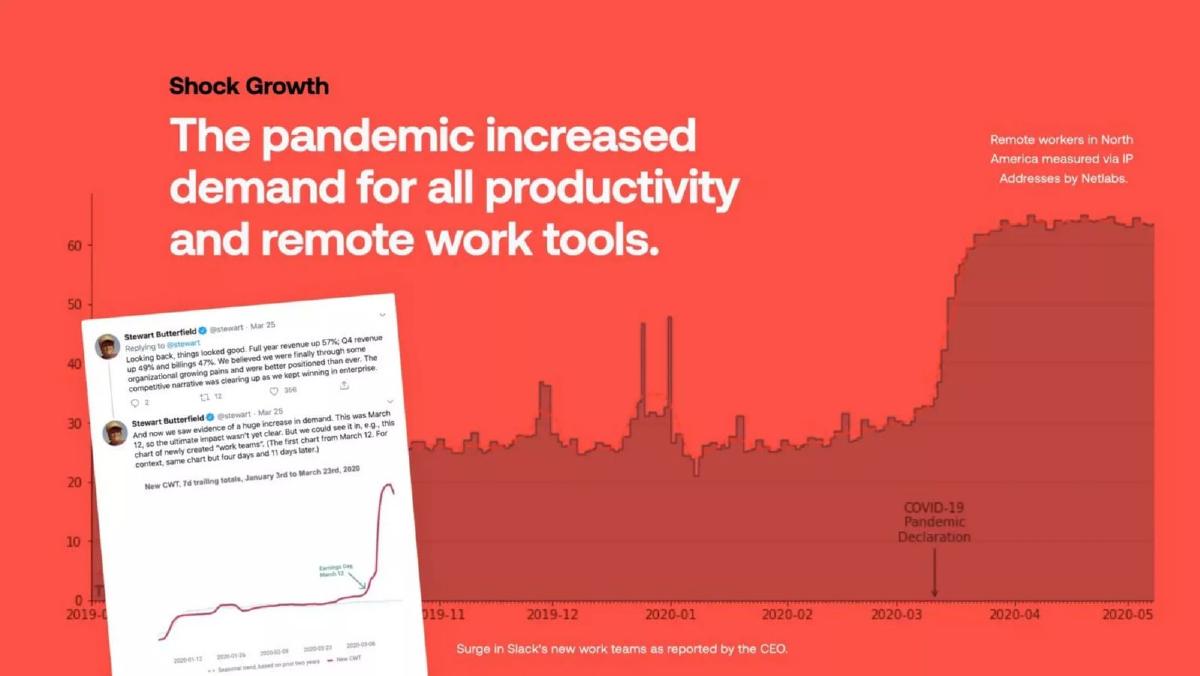
Superlist’s seed deck is a masterclass in pedigree-driven fundraising. Rather than leading with complex feature sets or revenue projections, the deck leans heavily on the 'who' and the 'why.' By positioning themselves as the original innovators behind Wunderlist (sold to Microsoft), the founders bypass the need for early-stage traction metrics. The deck identifies a specific gap in the market created by the COVID-19 pandemic, arguing that while communication and knowledge management have seen 'winners' like Slack and Notion, the task management sector remains fragmented. The visual language i…
Key takeaways
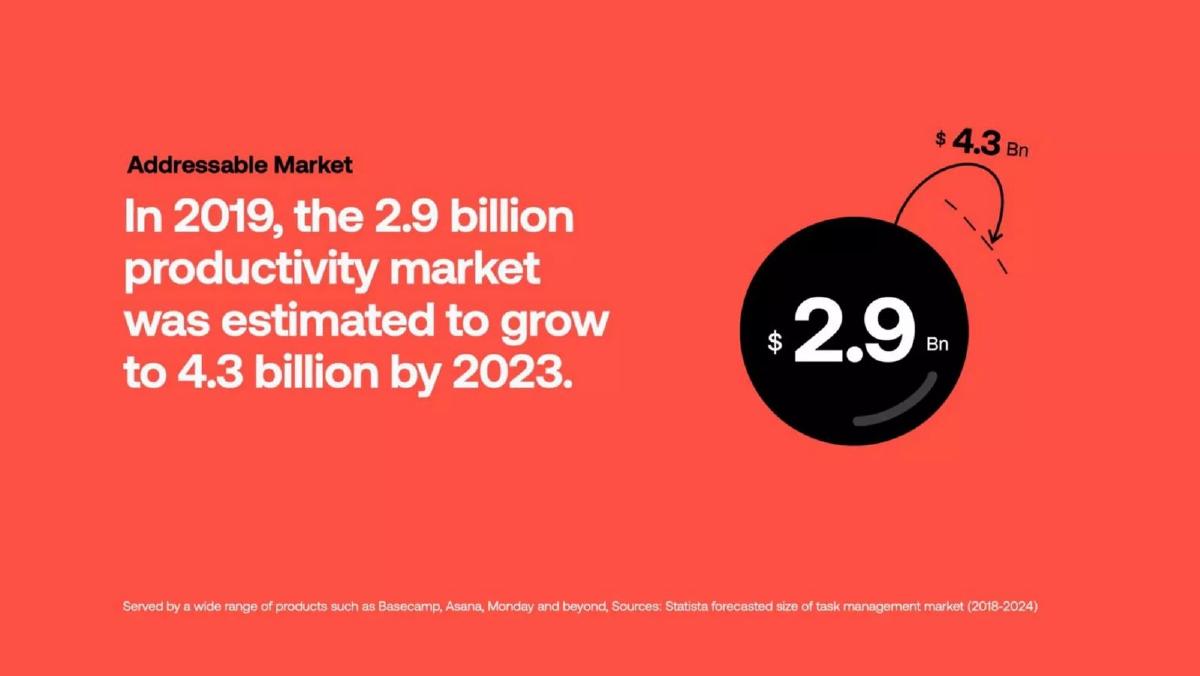
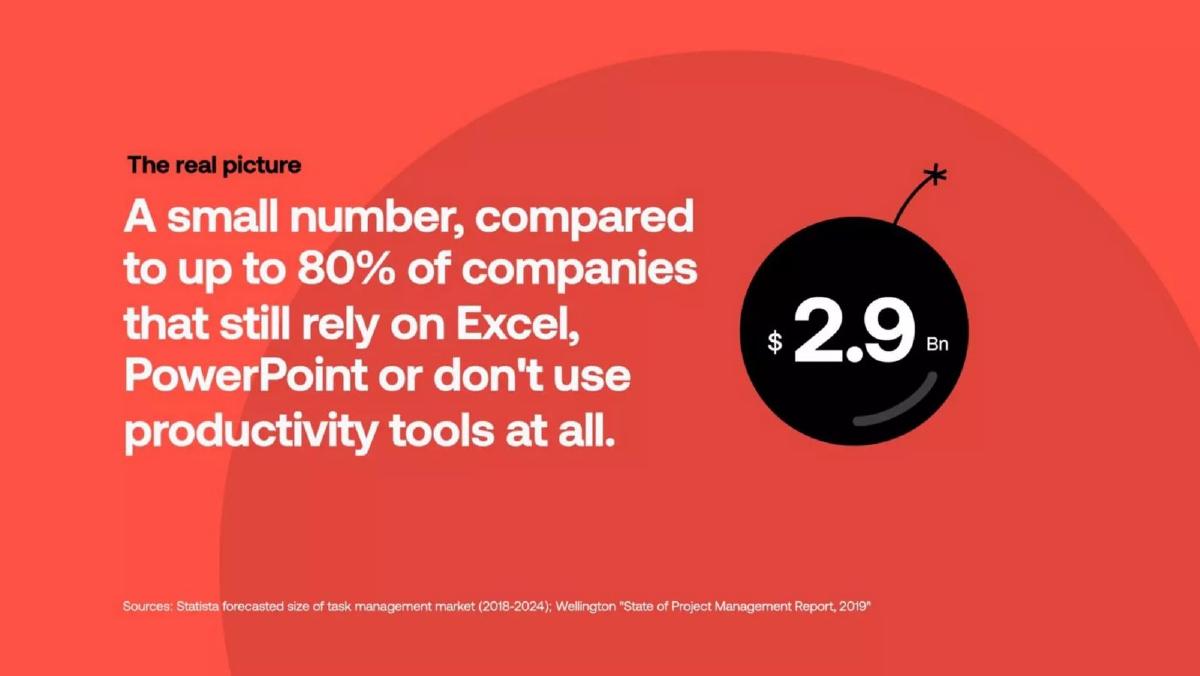
- The deck identifies a $2.9 billion productivity market in 2019, forecasted to grow to $4.3 billion by 2023 (Slide 2).
- It positions Superlist as the missing 'winner' in task management, alongside established giants like Slack ($40bn market cap) and Zoom ($120bn market cap) (Slide 4).
- The product strategy focuses on being 'integrated not competitive,' aiming to co-exist with Slack, Notion, Zoom, and Google (Slide 9).
- The founders leverage significant social proof by highlighting their history as the 'innovative minds behind Wunderlist' (Slide 11).
- The deck emphasizes design excellence through a partnership with Metalab, the studio behind Slack and Coinbase (Slide 12).
- Superlist differentiates itself on a 2x2 matrix by targeting the intersection of 'Simple' and 'Enterprise,' contrasting with 'Complex' enterprise tools like Asana and Jira (Slide 7).
- The core product philosophy is defined by four principles: Innovative but friendly, Useful yet unobtrusive, Encouraging not controlling, and Integrated not competitive (Slide 8).
- The deck uses a 'Then COVID happened' narrative to explain the sudden shift in market urgency and the need for new collaboration tools (Slide 3).
The Pedigree Play: A Superlist Deck Teardown
Superlist is a productivity tool designed for both teams and individuals. In a crowded SaaS landscape, the company relies on a high-conviction narrative and a team with a legendary track record in the 'to-do' space. This teardown examines the 13 slides of their seed-stage deck to understand how they position a new entrant in a market dominated by giants.
The Market Context and the COVID Catalyst
Slide 1: Title Slide The deck opens with a bold red background and the Superlist logo. The tagline, "Made for teams, built for people," immediately establishes the dual-use nature of the product. It suggests a tool that is powerful enough for professional collaboration but intuitive enough for personal use.
Slide 2: Addressable Market Superlist cites a $2.9 billion productivity market in 2019, with an estimated growth to $4.3 billion by 2023. The slide notes that this market is served by products like Basecamp, Asana, and Monday.com. By using Statista as a source, they ground their ambitions in third-party data, though the definition of "productivity market" here is specifically tied to task management.
Slide 3: The Pivot Point A stark black slide with the text "Then COVID happened." This serves as a narrative bridge. It implies that the previous market estimates and the way people worked were fundamentally altered, creating a vacuum for new tools to fill.
Slide 4: Winners in the New Normal This is a crucial positioning slide. It lists Slack ($40bn Market Cap) for Communication, Zoom ($120bn Market Cap) for Meetings, and Notion ($2bn Market Cap at the time) for Knowledge. It then shows an empty, dashed box for "Task & Project Mgmt." The message is clear: the category is still up for grabs, and Superlist intends to fill that box.
Product Vision and Competitive Strategy
Slide 5: Why Superlist and not Paper? This slide introduces the first glimpse of the product UI. It features a dark-mode interface with a clean "All Tasks" view. The question "Why Superlist and not Paper?" suggests that the primary competition isn't just other software, but the simplicity of analog tools that digital tools have failed to replicate effectively.
Slide 6: The Competitive Landscape (Part 1) Superlist uses a standard 2x2 matrix with "Simple vs. Complex" on the Y-axis and "Consumer vs. Enterprise" on the X-axis. They populate the bottom-left (Simple/Consumer) with apps like Apple Reminders, Todoist, and Things. The top-right (Complex/Enterprise) is filled with Asana, Jira, Monday.com, and ClickUp. The slide notes, "Then, there are the tools we 'have' to use," referring to the complex enterprise software.
Slide 7: The Competitive Landscape (Part 2) Superlist places itself in the bottom-right quadrant: Simple yet Enterprise-ready. The text states, "This is Superlist, built for teams made for people." This is their unique value proposition—the power of an enterprise tool with the simplicity of a consumer app.
Slide 8: Core Principles The product is built around four principles: Innovative but friendly, Useful yet unobtrusive, Encouraging not controlling, and Integrated not competitive. This slide reinforces the "experience over features" philosophy. It shows a UI snippet of a "Pitch Deck" project with a floral header, emphasizing the aesthetic appeal of the tool.
Slide 9: The Ecosystem Strategy Expanding on the "Integrated not competitive" principle, this slide shows Superlist co-existing with Slack, Notion, Zoom, and Google. The text explicitly states their goal is to "compete on experience, not features, and create an easy synergy with other top products in the market." This is a smart move for a Seed-stage company; it tells investors they don't need to kill the giants to win; they just need to be the best at their specific niche.
The Team: The Unfair Advantage
Slide 10: Team Intro A simple transition slide: "We have the team to get it done!"
Slide 11: The Wunderlist Pedigree This is arguably the most important slide in the deck. It features Christian Reber (Chairman), Steffen Kiedel (CEO), and Marcel Käding (Head of PM). It identifies them as the "innovative minds behind Wunderlist," a tool that was sold to Microsoft. For a Seed investor, this represents a massive reduction in execution risk. The founders have already built, scaled, and exited a company in this exact category.
Slide 12: Design Excellence The deck highlights Brandon Arnold (CPO) and his connection to Metalab. By mentioning Metalab's work on Slack and Coinbase, Superlist aligns itself with some of the most successful product designs in the SaaS era. This justifies the company's focus on "experience" and "design" as a competitive moat.
Slide 13: Closing A return to the title slide branding. It serves as a bookend to the presentation.
What Works in This Deck
The Founder-Market Fit: The deck's strongest asset is the team. By explicitly linking Superlist to the success of Wunderlist, the founders establish immediate credibility. They aren't just pitching a new app; they are pitching a "v2.0" of a proven success story.
Category Positioning: The use of the empty box on Slide 4 is a powerful visual metaphor. It creates a sense of inevitability—that a winner must emerge in task management, and Superlist is the logical candidate.
Design-First Approach: In a market where many tools feel like bloated spreadsheets (Jira, Asana), Superlist’s emphasis on being "unobtrusive" and "friendly" appeals to the growing trend of consumerized enterprise software. The UI snippets shown are clean and modern.
Realistic Integration: Acknowledging that users won't leave Slack or Notion is a mature take. The "integrated not competitive" stance makes the product feel like a frictionless addition to a team's workflow rather than a disruptive overhaul.
What Is Missing
Traction Metrics: There is no mention of a beta waitlist, user numbers, or early pilot programs. While the team's pedigree might carry the round, investors usually want to see some signal of product-market fit, even at the Seed stage.
Business Model: The deck is silent on how Superlist intends to make money. While a freemium SaaS model is implied, there are no details on pricing tiers, seat-based costs, or enterprise licensing strategies.
The Ask: This version of the deck does not include a slide detailing how much capital is being raised, the valuation, or the specific milestones the team intends to hit with the funding.
Technical Architecture: For a tool that claims to be "integrated not competitive," there is no detail on how these integrations work. Is it a bi-directional sync? A simple API? Technical investors might want to see the "how" behind the synergy.
What a Founder Should Copy
The 'Empty Box' Strategy: If you are entering a crowded market, don't just list your competitors. Group them into categories and show the specific gap that none of them are filling. Superlist does this perfectly on Slide 4.
The 2x2 Matrix with a Twist: Instead of just putting yourself in the top-right corner of a generic chart, use your axes to highlight a specific philosophical difference. Superlist’s use of "Simple" vs. "Complex" directly addresses a common pain point in enterprise software.
Leveraging Past Wins: If you have a successful exit or worked at a high-growth startup, make that the centerpiece of your team slide. Use logos of previous companies to build instant trust.
Narrative Continuity: The deck follows a logical flow: Market size -> The shift (COVID) -> The gap -> The solution -> The principles -> The team. Each slide builds on the previous one to create a cohesive argument for why this company needs to exist right now.
Frequently asked questions
- What is the primary market opportunity identified by Superlist?
- Superlist targets the task and project management sector within the broader productivity market. According to Slide 2, this market was estimated to reach $4.3 billion by 2023. Slide 4 argues that while communication (Slack), meetings (Zoom), and knowledge (Notion) have clear winners, the 'jury's still out' on who will dominate task management in the post-COVID era.
- How does Superlist plan to compete with established tools like Jira or Asana?
- Instead of competing on feature density, Superlist competes on experience. Slide 7 shows a competitive landscape where tools like Asana, Jira, and Monday.com are categorized as 'Complex' and 'Enterprise.' Superlist positions itself as a 'Simple' tool that is still 'built for teams,' aiming to provide the ease of consumer apps with the power required for professional collaboration.
- Who are the key people behind the company?
- The team is the deck's strongest selling point. Slide 11 features Christian Reber (Chairman), Steffen Kiedel (CEO), and Marcel Käding (Head of PM), identifying them as the creators of Wunderlist, which was sold to Microsoft. Slide 12 introduces Brandon Arnold (CPO) from Metalab, connecting the product to the design heritage of Slack and Coinbase.
- What is the 'Integrated not competitive' strategy?
- As detailed on Slide 9, Superlist does not intend to replace the entire tech stack. Their goal is to 'create an easy synergy' with existing tools like Slack, Notion, and Google. By focusing on experience over a 'walled garden' feature set, they aim to fit into a user's existing workflow rather than forcing a total migration.
- Does the deck include financial projections or a funding ask?
- No. The 13 slides provided focus entirely on the market problem, the product vision, the competitive positioning, and the team's pedigree. There are no slides detailing revenue models, unit economics, user growth targets, or the specific amount of capital being raised in this Seed round.