The Super pitch deck is a unique artifact from Meta’s New Product Experimentation (NPE) division, dated H2 2021. Rather than a traditional venture capital ask, it functions as a partnership proposal to test sponsorship hypotheses. The deck is heavily weighted toward product visualization, with 10 of the 17 slides dedicated to UI mockups and feature descriptions like 'Super Selfies' and 'Super Trivia.' It explicitly states that creators keep 100% of sponsorship revenue, signaling an aggressive user acquisition strategy typical of early-stage corporate incubations. However, the deck lacks tradi…
Key takeaways
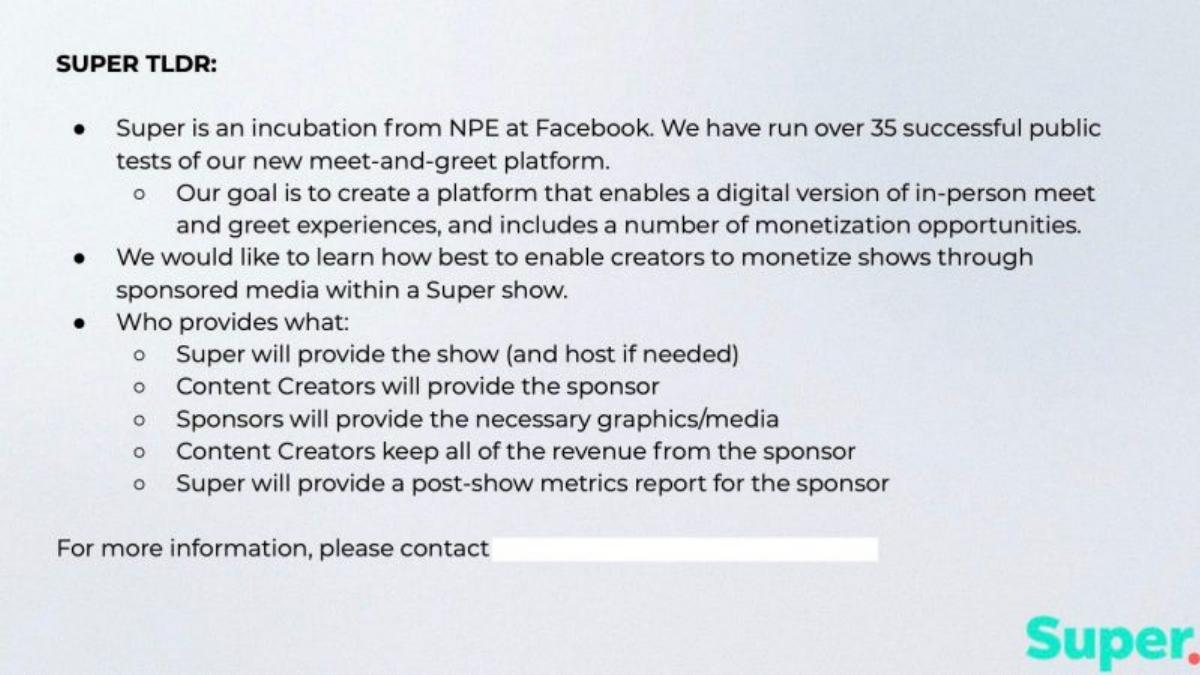
- Super is an incubation from NPE at Facebook that had run over 35 successful public tests by late 2021 (Slide 2).
- The platform's primary goal is to create a digital version of in-person meet-and-greet experiences (Slide 2).
- A core business hypothesis is that creators should keep 100% of sponsorship revenue during the alpha phase (Slide 5).
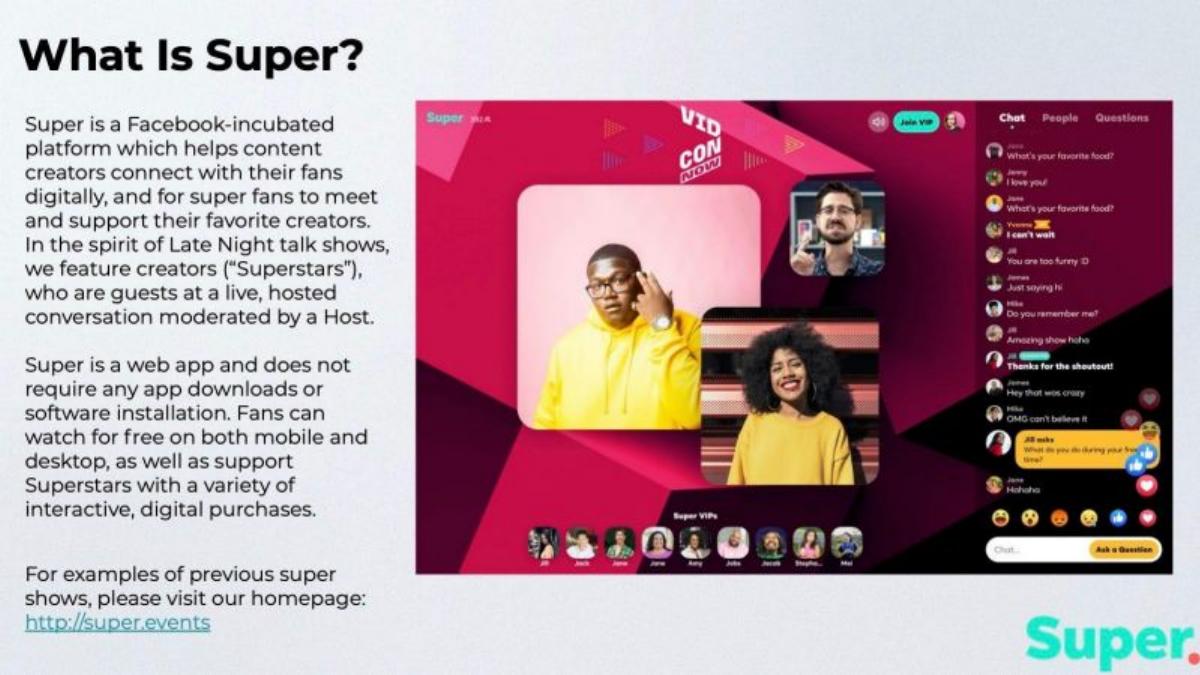
- The product is a web app that requires no downloads, allowing fans to watch for free on mobile and desktop (Slide 3).
- Alpha metrics show an event with 3,201 page views resulted in 2,192 attendees and 290 hours of watch time (Slide 12).
- The deck highlights specific interactive features like 'Super Selfies' which provide shareable digital takeaways for social media (Slide 10).
- Future product stages include 'Super Trivia' and 'Giveaways,' though the latter was not yet fully tested at the time of the deck (Slide 16).
- The deck omits standard fundraising elements such as a team slide, market size (TAM), and a specific capital ask.
The Corporate Incubation Deck: Super by Meta
The Super pitch deck, produced by Meta’s New Product Experimentation (NPE) team in the second half of 2021, is not a traditional fundraising document. Because it originated within a trillion-dollar parent company, it bypasses the need to prove 'runway' or 'founder-market fit.' Instead, this 17-slide deck serves as a tactical partnership proposal designed to recruit creators and sponsors for an alpha testing phase. It is a masterclass in feature-first communication, though it leaves significant gaps that a standalone startup could never afford to ignore.
Slides 1-2: The Context and TLDR
Slide 1 introduces the brand with a clean, minimalist aesthetic, identifying the project as 'Sponsorship Opportunities [Alpha]' from 'NPE from Facebook.' The use of the H2 2021 date establishes the timeline of the project. Slide 2 provides a 'Super TLDR,' which is a highly effective way to start a deck. It establishes immediate credibility by stating they have already run 'over 35 successful public tests.' This slide also sets the stakes for the business model: creators keep 100% of the revenue. This is a classic 'loss leader' strategy used by corporate incubations to drain talent from competitors like Twitch or OnlyFans by offering superior margins during the growth phase.
Slides 3-5: Defining the Product and Roles
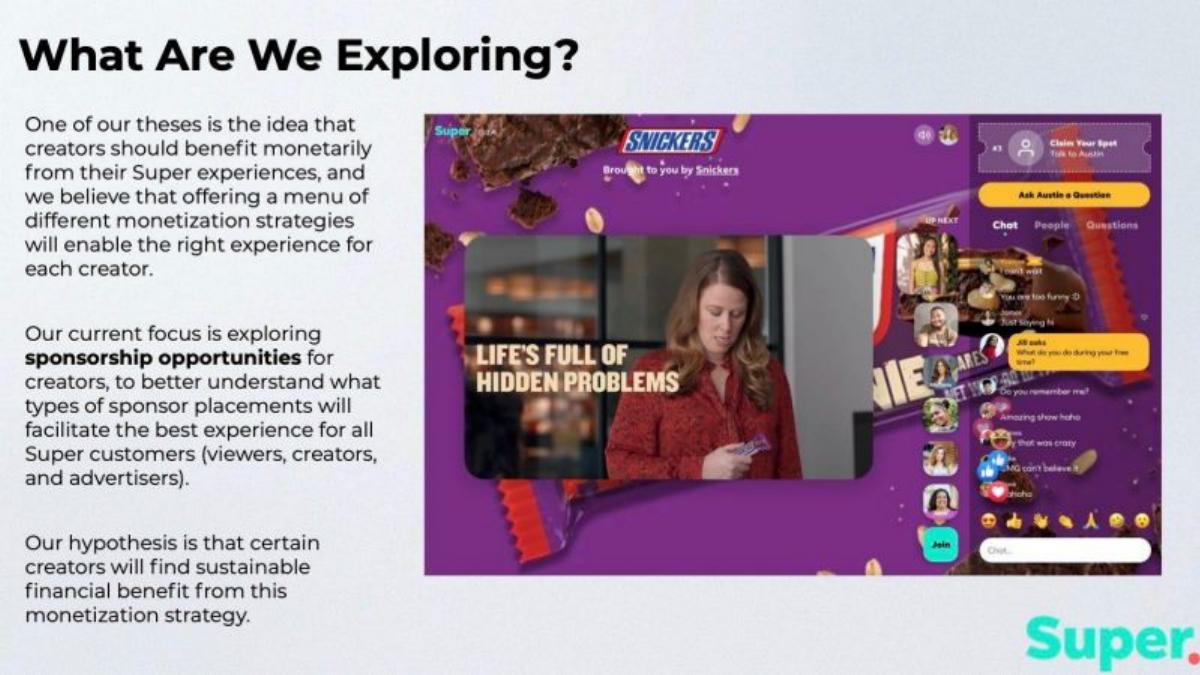
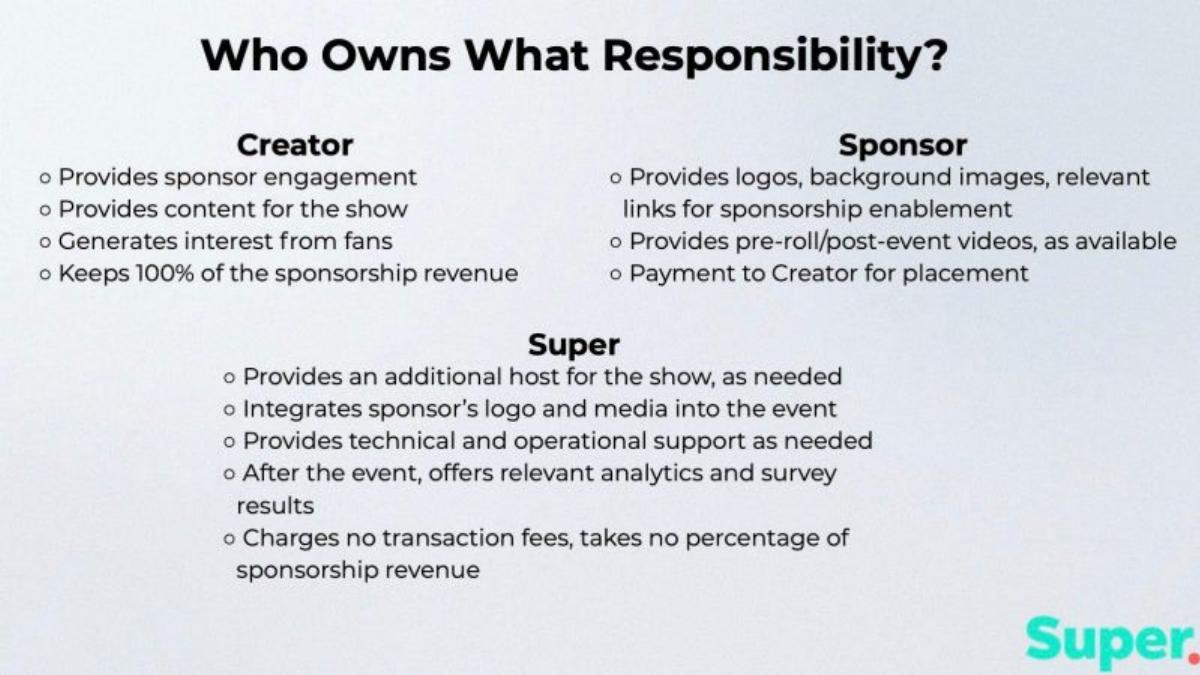
Slide 3 answers 'What Is Super?' by comparing the experience to 'Late Night talk shows.' This is a crucial bit of positioning; it tells the reader that this isn't just a webcam stream, but a structured, moderated event. The slide also highlights that it is a web app, removing the 'app store friction' that kills many new social platforms. Slide 4 explains the 'Monetization Strategy,' framing it as a hypothesis-driven exploration of sponsorship. Slide 5 is perhaps the most important for potential partners, as it clearly delineates the 'Who Owns What Responsibility' matrix. By listing the specific duties of the Creator, Sponsor, and Super, the deck reduces the perceived complexity of joining an alpha test.
Slides 6-11: The Sponsored Show Experience
This section of the deck is a deep dive into the user interface. Slide 6 acts as a transition, and Slides 7 through 11 walk through the chronological experience of a show. Slide 7 shows the Pre-Show page, which enables 30 minutes prior to the event. Slide 8 demonstrates the Pre-Roll video ad, which auto-plays at the start. Slide 9 shows the 'Meet and Greet' interface, while Slide 10 introduces 'Super Selfies.' The 'Super Selfies' feature is a clever viral loop; it provides a 'digital take away' for fans to share on other social media platforms, effectively using the fan base as a free marketing department. Slide 11 concludes the experience with the 'Post-Event' screen, which includes on-demand video and sponsored links.
Slide 12: The Alpha Metrics
Slide 12 provides the hard data. For a platform in its early stages, the numbers are respectable: 3,201 page views leading to 2,192 attendees suggests a high conversion rate from the landing page to the event. The '30,302 Reactions' metric is included to demonstrate high engagement, though the deck admits they are still building a 'robust analytics dashboard.' This honesty about the product's maturity is refreshing and helps manage expectations for early partners.
Slides 13-17: Future Roadmap and Conclusion
Slide 13 transitions into 'Additional Stages.' Slide 14 details 'Super Trivia,' a gamification layer intended to increase fan participation. Slide 15 shows 'Merch/Products' integration, which moves the platform closer to a traditional e-commerce play. Slide 16 discusses 'Giveaways,' though it includes a candid note that this product 'has not yet been fully tested.' This level of transparency is rare in decks but vital for alpha partnerships. The deck ends on Slide 17 with a simple 'Thanks!' and contact information.
What Works in This Deck
Clarity of Roles: Slide 5 is the strongest slide in the deck. In the creator economy, there is often confusion about who handles the tech, who handles the money, and who handles the assets. Super eliminates this friction by listing responsibilities in bullet points. Any founder building a three-sided marketplace (Creator, Sponsor, Platform) should copy this format.
Visual Walkthrough: By using a consistent 'Snickers' sponsorship example throughout the UI mockups (Slides 7-11), the deck makes the abstract concept of 'digital sponsorship' feel concrete. It allows a potential sponsor to see exactly where their logo will sit and how their video will play.
Zero-Friction Value Proposition: The '100% revenue to creator' hook (Slide 2) is an unbeatable value proposition for the alpha phase. While not sustainable long-term, it is the correct way to frame an early-stage test to ensure high-quality participants.
What is Missing from This Deck
The Team: There is no mention of who is actually building Super. While 'NPE from Facebook' carries weight, investors and partners usually want to see the specific product leads and engineers. In a corporate setting, this is often omitted to prevent poaching, but in a startup deck, this would be a fatal flaw.
Competitive Landscape: The deck exists in a vacuum. There is no mention of Twitch, YouTube Live, or specialized meet-and-greet platforms like Cameo. Without a competitive matrix, it’s hard to judge if Super’s features are truly 'super' or just table stakes.
The 'Ask': Because this is a corporate project, there is no slide asking for $2M in seed funding. However, even for a partnership deck, there is no clear 'Call to Action' other than a contact email. It doesn't specify how many creators they are looking for or what the deadline is for the alpha test.
Founder Lessons
Hypothesis-Driven Pitching: Founders should notice how often the deck uses words like 'theses,' 'hypothesis,' and 'exploring' (Slide 4). Instead of claiming they have all the answers, the Super team frames the deck as a collaborative experiment. This lowers the barrier to entry for partners who might be wary of unproven tech.
Feature Gamification: The 'Super Selfies' (Slide 10) and 'Super Trivia' (Slide 14) are excellent examples of building 'shareability' into the core product. A livestreaming platform that only streams is a commodity; a platform that generates unique, branded social content for its users has a built-in growth engine.
Web-First Strategy: The emphasis on being a 'web app' (Slide 3) is a strategic choice that many social startups overlook in favor of building expensive iOS/Android apps. For a platform that relies on creators sending their fans to a specific link, the ability to join instantly in a browser is a significant competitive advantage.
Final Verdict: The Super deck is a highly professional, visually cohesive document that excels at product demonstration. While it lacks the financial and competitive rigor of a VC-facing deck, its tactical clarity makes it an excellent template for any founder looking to pitch a pilot program or an alpha partnership.
Frequently asked questions
- What is the primary business model for Super according to the deck?
- During the alpha phase described in the 2021 deck, Super operated on a zero-fee model. Slide 5 explicitly states that Super 'charges no transaction fees' and 'takes no percentage of sponsorship revenue.' The creator keeps 100% of the revenue. This suggests the platform was in a user-acquisition and data-gathering phase, rather than a revenue-generating phase.
- How does Super differentiate itself from other livestreaming platforms?
- Super positions itself as a 'digital version of in-person meet and greets' rather than a general broadcast tool. Slide 3 notes the platform follows the spirit of 'Late Night talk shows,' featuring a host to moderate conversations between creators and fans. It also emphasizes that it is a web app requiring no downloads, lowering the friction for casual viewers.
- What kind of engagement metrics does the platform track?
- Slide 12 provides a snapshot of 'Event Stats' from an alpha test. It tracks Event Page Views (3,201), Registered users (392), Attended Event (2,192), Peak Concurrent viewers (293), Meet & Greet Queue size (29), Questions Asked (38), Reactions (30,302), and total Watch Time (290 hours).
- What responsibilities does the platform take on for sponsors?
- According to Slide 5, Super handles the technical integration of sponsor logos and media, provides operational support, and delivers a post-show metrics report. The sponsor is responsible for providing the creative assets (logos, background images, videos) and paying the creator directly for the placement.
- What interactive features are planned for future development?
- Slides 14 through 16 detail 'Additional Stages' of the product. These include 'Super Trivia,' where fans compete to talk to the creator; 'Merch/Products,' which integrates direct links to sponsor stores; and 'Giveaways,' which uses a digital wheel to select winners, though the deck notes this feature required more development work.