Superlegal raised $5M in a 2024 Seed round to scale its generative AI platform for contract drafting and negotiation. The deck stands out by addressing the primary weakness of general-purpose LLMs in the legal sector: the inability to provide binding legal advice and the tendency to hallucinate. By securing an innovative license to practice law as an AI company, Superlegal positions itself as a regulated entity rather than just a software provider. The presentation relies heavily on efficiency metrics, claiming a reduction in contract review time from 2 hours to just 5-7 minutes. While severa…
Key takeaways
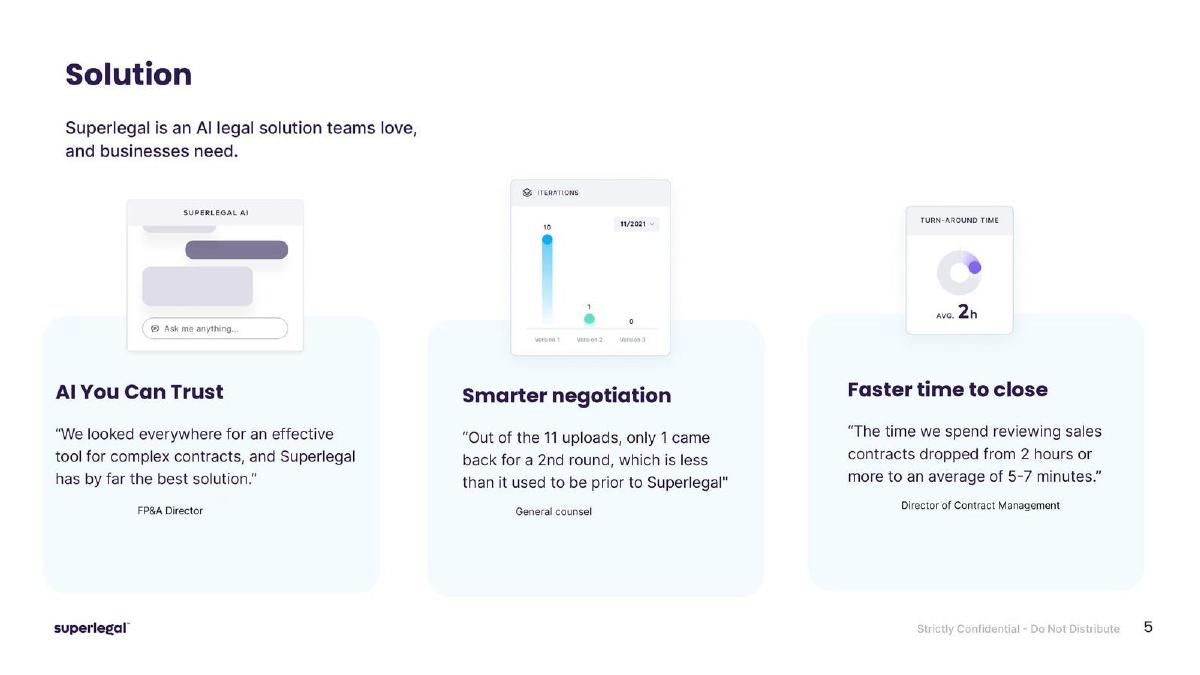
- Superlegal claims a reduction in contract review time from 2 hours to an average of 5-7 minutes (Slide 5).
- The company holds an 'innovative license to practice law as an AI company,' which allows them to provide guaranteed legal advice (Slide 7).
- Their proprietary dataset includes over 4 million annotated samples and 4,400 mapped contract concepts (Slide 7).
- The platform has already reviewed and approved over 40,000 deals through its digital infrastructure (Slide 7).
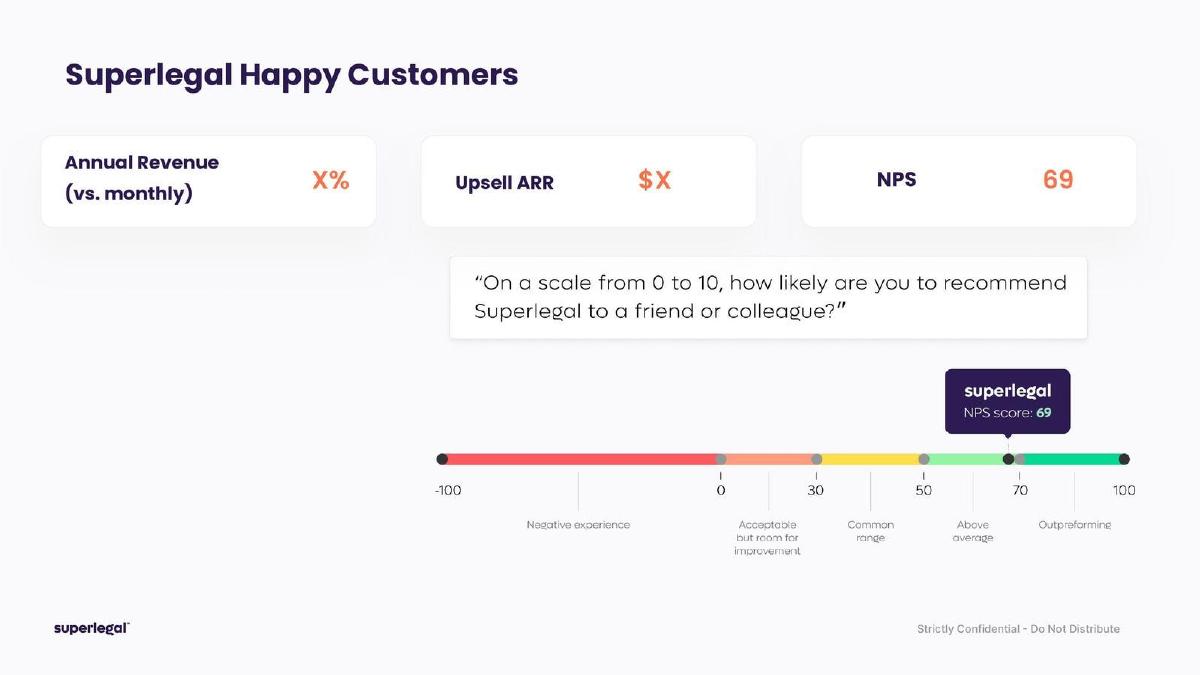
- Superlegal reports a Net Promoter Score (NPS) of 69, placing them in the 'Above average' category on their scale (Slide 13).
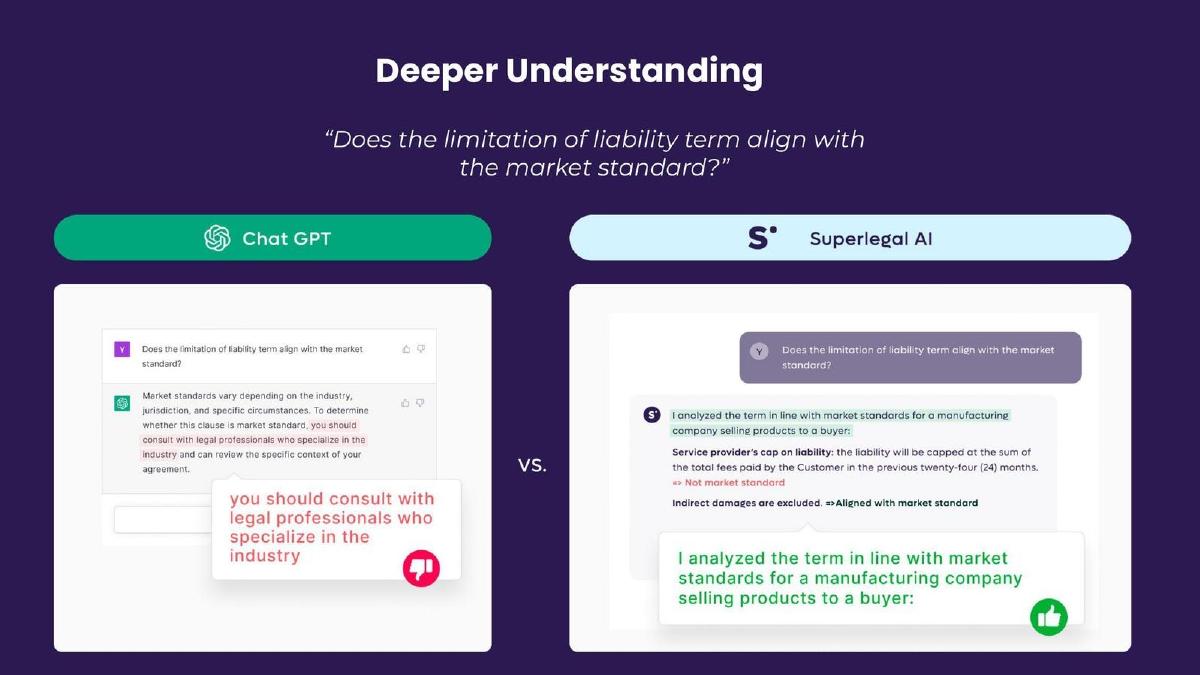
- The deck uses a direct comparison with ChatGPT to highlight how generic LLMs fail by deferring to human professionals, whereas Superlegal provides market-aligned analysis (Slide 9).
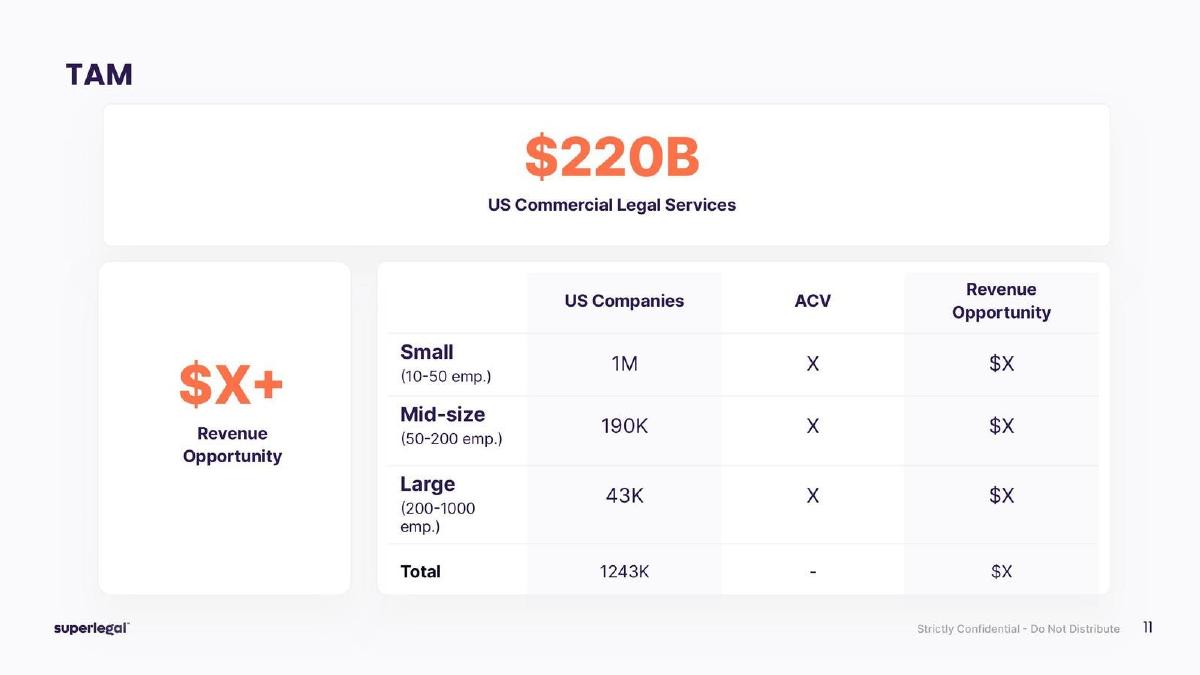
- The total addressable market for US Commercial Legal Services is cited at $220 billion (Slide 11).
- The deck identifies three core pillars of defensibility: proprietary algorithms, a deep legal dataset, and digital legal infrastructure (Slide 7).
Superlegal Pitch Deck Analysis
Superlegal’s Seed deck is a masterclass in positioning a vertical AI solution against horizontal giants. In a world where every startup claims to be 'AI-powered,' Superlegal focuses on the two things legal professionals care about most: liability and accuracy. By securing a license to practice law, they move from being a 'tool' to being a 'service,' a distinction that justifies higher ACVs and deeper integration into customer workflows. The following teardown examines how they presented this case to investors to secure $5M in funding.
Slide 1-2: Title and Branding
The deck opens with a minimalist title slide featuring the company name and the tagline: 'The leader in Generative AI for Legal.' The branding uses a high-contrast purple and coral palette, which feels modern and tech-forward rather than the traditional, stodgy blues and greys associated with the legal industry. This immediately signals a disruptive intent.
Slide 3: The Persona - Meet Emily
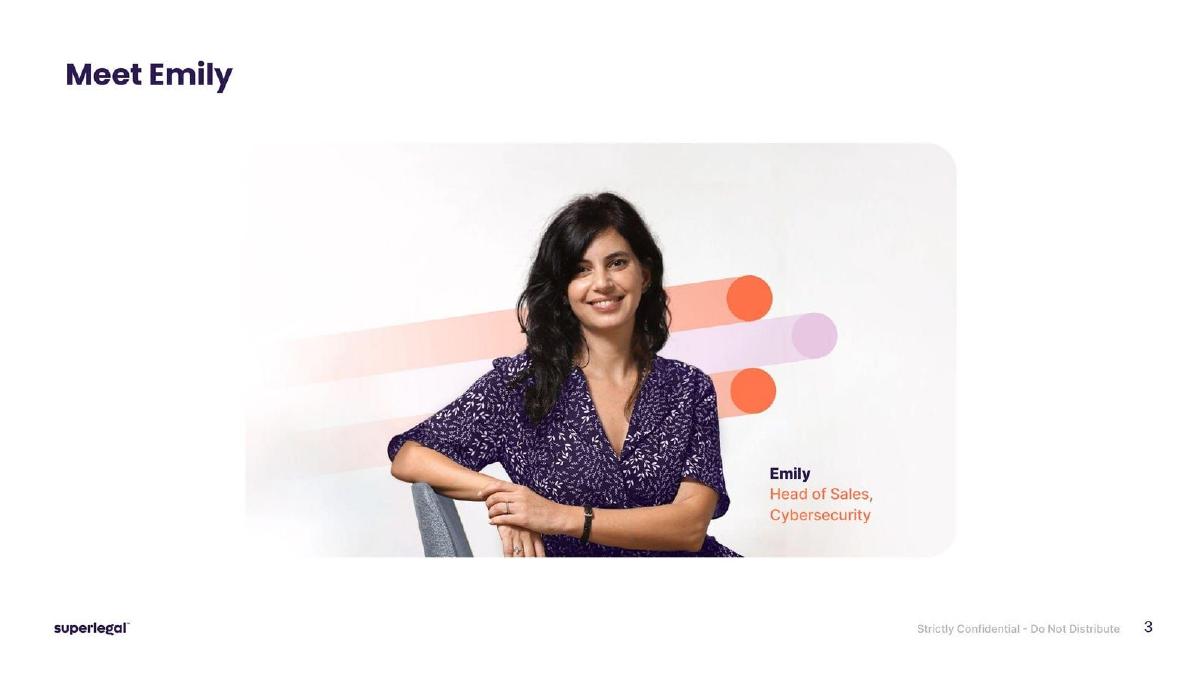
Slide 3 introduces 'Emily, Head of Sales, Cybersecurity.' This is a classic 'User Persona' slide. While the slide itself is light on text, its purpose is to anchor the problem in a human context. In many B2B companies, the bottleneck for closing deals isn't the sales team—it's the legal review process. By introducing a Head of Sales, Superlegal hints that their solution isn't just for lawyers; it's for the business units that are tired of waiting for legal to sign off on contracts.
Slide 5: The Solution and Efficiency Metrics
This is one of the most impactful slides in the deck. It breaks the solution down into three pillars: AI You Can Trust, Smarter Negotiation, and Faster Time to Close. The metrics provided are specific and compelling. A quote from a Director of Contract Management states that review time dropped from '2 hours or more to an average of 5-7 minutes.' Another quote mentions that out of 11 uploads, only 1 came back for a second round of negotiation. These are 'hard' ROI metrics that make a Seed investment feel like a logical bet on efficiency.
Slide 7: The Moat - Proprietary Infrastructure
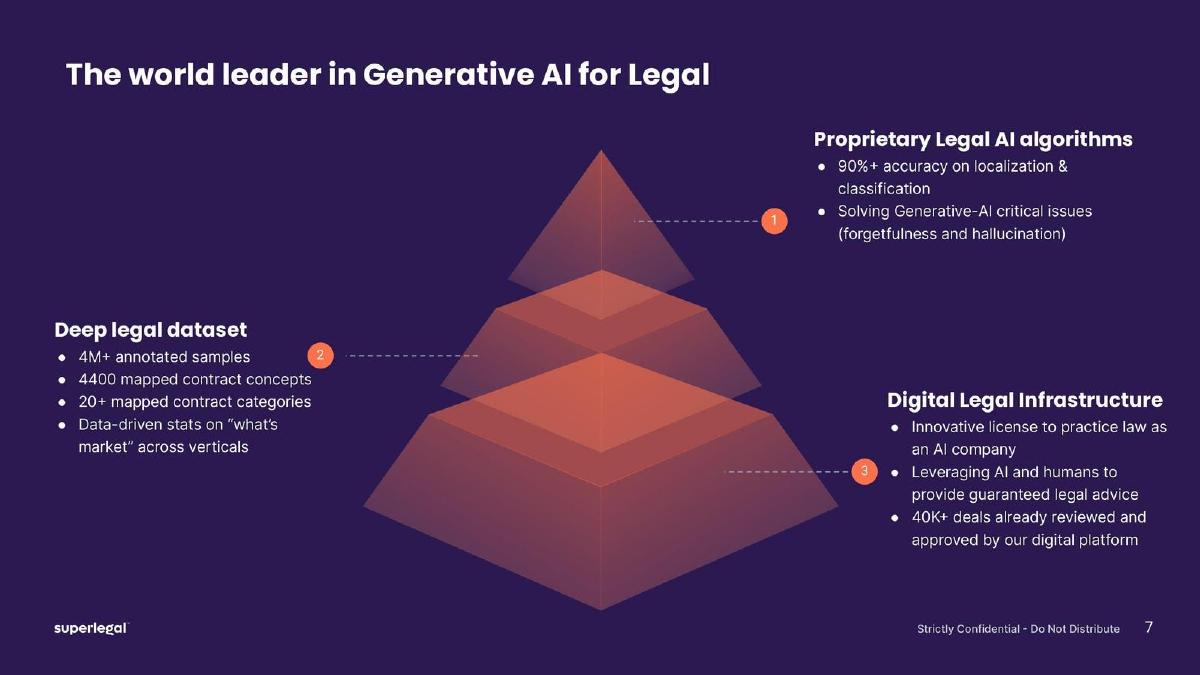
Slide 7 uses a pyramid graphic to explain the company’s defensibility. This is crucial for AI startups in 2024. They list three layers:
Proprietary Legal AI algorithms: Claiming 90%+ accuracy on localization and classification, specifically solving for 'forgetfulness and hallucination.' · Deep legal dataset: Citing 4M+ annotated samples and 4,400 mapped contract concepts. This suggests they aren't just hitting the OpenAI API; they have a proprietary data loop. · Digital Legal Infrastructure: The most unique claim is their 'innovative license to practice law as an AI company.' This allows them to provide 'guaranteed legal advice,' something a standard SaaS company cannot legally do.
Slide 9: The Comparison - Superlegal vs. ChatGPT
This slide addresses the 'Why not just use ChatGPT?' question head-on. It shows a side-by-side prompt: 'Does the limitation of liability term align with the market standard?' ChatGPT provides a standard AI disclaimer, telling the user to consult a professional. Superlegal’s AI actually answers the question, identifying specific clauses as 'Not market standard' or 'Aligned with market standard.' This visual proof of 'Deeper Understanding' is a powerful way to demonstrate product-market fit for a specialized vertical.
Slide 11: Total Addressable Market (TAM)
Superlegal targets the US Commercial Legal Services market, valued at $220 billion. The slide breaks down the opportunity by company size, from small (10-50 employees) to large (200-1000 employees). While the specific Revenue Opportunity ($X) and ACV ($X) figures are redacted in this public version, the methodology is clear: they are counting the number of companies in the US (1.24 million total) and applying a tiered pricing model to calculate a multi-billion dollar opportunity.
Slide 13: Customer Satisfaction (NPS)
The deck concludes its narrative with a slide on 'Happy Customers.' The standout metric here is a Net Promoter Score (NPS) of 69. According to the scale provided on the slide, this puts them in the 'Above average' to 'Outperforming' range. High NPS is a leading indicator of low churn and high organic growth, which is exactly what Seed investors look for to validate that the product actually works in the wild.
What Works in This Deck
Specific ROI: The jump from 2 hours to 7 minutes is a 17x efficiency gain. When a startup can point to a specific, repeatable time-saving metric, the sales pitch becomes an easy math problem for the customer.
Regulatory Defensibility: Most AI startups are terrified of regulation. Superlegal leans into it. By obtaining a license to practice law, they create a massive barrier to entry for competitors who are only building software wrappers. This 'Digital Legal Infrastructure' is their strongest moat.
Head-to-Head Comparison: The ChatGPT comparison slide is brilliant. It identifies the exact moment a generic tool fails a professional user and shows how Superlegal bridges that gap. It turns a perceived threat (free AI) into a validation of their specialized value.
What Is Missing
The Team Slide: The provided images do not include a team slide. In a Seed round, the founders' pedigree is often as important as the tech. Given the legal complexities, investors would want to see a mix of high-level legal expertise and top-tier AI engineering talent.
Unit Economics: While the TAM is shown, the deck (in this version) redacts the ACV and revenue figures. A complete teardown would ideally look at the LTV/CAC ratio to see if the cost of acquiring these 1.2M companies is sustainable.
Product Roadmap: The deck focuses heavily on what the product does today (contract review). It doesn't explicitly show where the product goes next—does it move into litigation support, IP, or employment law? Investors want to see the path from a 'feature' to a 'platform.'
Founder Takeaways
Verticalize or Die: If you are building in AI, don't try to be everything to everyone. Superlegal wins because they are better at one thing (contracts) than the world's most famous AI. Find the 'disclaimer' your competitors have to give, and build a product that removes it.
Use Social Proof Early: Even at the Seed stage, Superlegal uses quotes from FP&A Directors and General Counsels. This proves that they have already navigated the complex procurement cycles of mid-to-large enterprises.
Quantify the 'Magic': Don't just say your AI is 'fast.' Say it takes 5-7 minutes. Don't just say it's 'accurate.' Say it has 4 million annotated samples. Specificity builds trust; generalities build skepticism.
Frequently asked questions
- What is Superlegal's primary value proposition?
- Superlegal focuses on speed and trust. According to Slide 5, they reduce contract review time from over 2 hours to 5-7 minutes. Unlike generic AI, they claim to provide 'guaranteed legal advice' because the company holds a specific license to practice law, which addresses the liability and hallucination concerns that typically prevent legal departments from fully adopting AI.
- How does Superlegal differentiate itself from ChatGPT?
- Slide 9 shows a side-by-side comparison. When asked if a liability term aligns with market standards, ChatGPT gives a generic disclaimer suggesting the user consult a professional. Superlegal’s AI provides a specific analysis, stating whether a term is 'Not market standard' or 'Aligned with market standard' based on the specific industry context, such as a manufacturing company selling to a buyer.
- What data does Superlegal use to train its models?
- As detailed on Slide 7, the company utilizes a 'Deep legal dataset' consisting of 4 million+ annotated samples, 4,400 mapped contract concepts, and 20+ mapped contract categories. They also leverage data-driven stats on 'what’s market' across various verticals to ensure their AI's recommendations are grounded in current industry norms.
- What is the scale of Superlegal's current operations?
- While specific revenue figures were redacted in this version of the deck, Slide 7 notes that their platform has already reviewed and approved more than 40,000 deals. This indicates significant high-volume usage and a level of maturity beyond a simple prototype or early beta.
- Who is the target customer for Superlegal?
- Slide 11 breaks down the US market into three segments: Small (10-50 employees, 1M companies), Mid-size (50-200 employees, 190K companies), and Large (200-1000 employees, 43K companies). The presence of testimonials from an FP&A Director and a General Counsel on Slide 5 suggests they target both legal departments and finance/sales operations that handle high contract volumes.