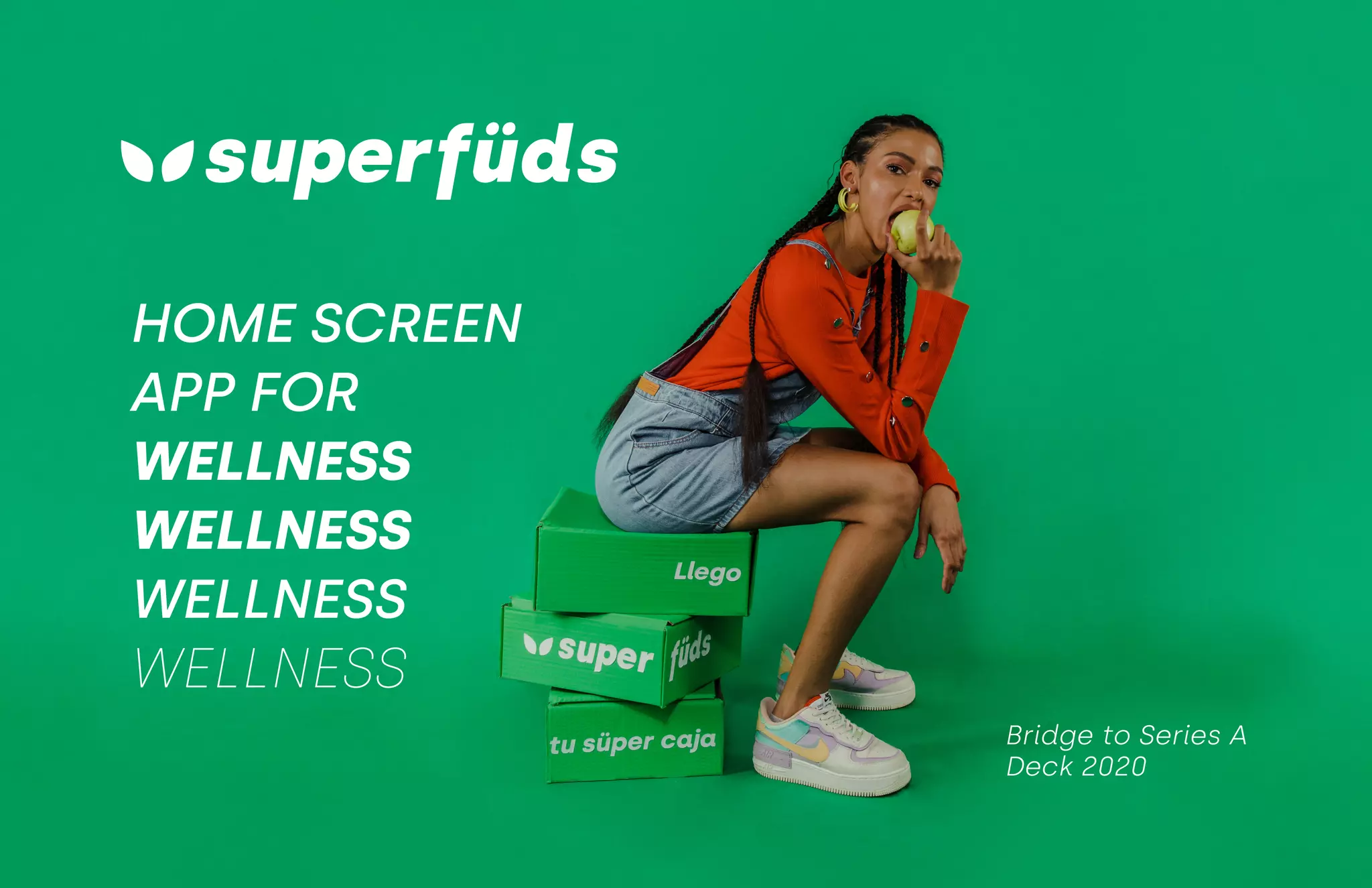
Superfüds is a Latin American wellness distribution platform that connects emerging brands with major retailers and specialty stores. Their 2020 Bridge to Series A deck highlights a successful transition from traditional distribution to a B2B marketplace model. The company reports serving 700 chain stores and 300 specialty stores, with a massive TAM of 30,000 stores in the specialty segment alone. Key metrics include a high LTV/CAC ratio of 59 in their chain store segment and profitable unit economics across both B2B and B2C channels. The deck effectively uses a roadmap to show how they plan…
Key takeaways
- Superfüds identifies a lack of distribution infrastructure for emerging wellness brands in Latin America as their core problem (Slide 2).
- The company achieved 500% growth by helping Colombian chain stores establish their first health food sections (Slide 3).
- Their B2B marketplace targets a TAM of 30,000 specialty stores, currently serving 300 with a 15% churn rate (Slide 4).
- Unit economics are presented as profitable for both B2B (15% net margin) and B2C (22% net margin) segments (Slide 12).
- A clear margin expansion strategy is outlined, moving from 20% in retail chains to 30-50% through private label products (Slide 11).
- The total addressable market for clean label products in LATAM is valued at $32 billion (Slide 13).
- The team features experience from McKinsey, Kimberly-Clark, Rappi, and Columbia Business School (Slide 14).
- The company had raised $2M prior to this 2020 bridge round, with backing from Siddhi Capital and others (Slide 14).
Superfüds: Bridging the Wellness Gap in Latin America
The Superfüds "Bridge to Series A Deck 2020" is a masterclass in explaining a complex distribution business through the lens of technology and market opportunity. With only 9 slides provided in this set (numbered up to 14, indicating some slides were omitted), the company manages to convey a clear transition from a traditional distributor to a tech-enabled marketplace. The deck is visually consistent, using a vibrant green and yellow palette that aligns with the wellness sector.
Slide 1: Title and Positioning
The cover slide establishes the brand identity immediately. The tagline "Home Screen App for Wellness" repeated multiple times suggests a goal of becoming the primary consumer and business interface for healthy living. It clearly labels the deck as a "Bridge to Series A Deck 2020," setting the stage for an investor conversation about scaling existing traction.
Slide 2: The Infrastructure Problem
Superfüds identifies a specific logistical bottleneck in Latin America. They note that while they "dreamed of building our own Whole Foods," the necessary distribution infrastructure for emerging brands simply did not exist. The slide breaks down the failure points for three stakeholders: Distributors (failed to invest in tech), Emerging Brands (lacked retail know-how and capital), and Store Buyers (lacked logistics and scale). This slide effectively justifies why a new platform is necessary rather than just another retail store.
Slide 3: Initial Traction in Chain Stores
This slide focuses on the company's first phase of growth. By acting as distributors, they helped Colombian chain stores create their first health food sections, resulting in 500% growth . They cite a TAM of 5,000 stores and state they are currently serving 700. The metrics here are exceptionally strong: an LTV of $75,151 against a CAC of $1,317 , resulting in a ratio of 59. The slide also lists major retail partners including Éxito, Cencosud, and Carulla, as well as pharmacies like Farmatodo and Cruz Verde.
Slide 4: The B2B Marketplace Pivot
Slide 4 introduces the second phase: reaching the "untapped market" of specialty stores via a B2B marketplace. This segment has a much larger TAM of 30,000 stores. While the LTV/CAC ratio is lower here (8) compared to the chain store segment, it represents a massive volume opportunity. The slide highlights features like store personalization and product recommendations to drive Average Order Value (AOV). They report serving 300 stores in this segment with a 15% churn rate.
Slide 9: The B2C and Micro-Fulfillment Strategy
Moving into the consumer space, slide 9 explains how Superfüds uses its network of specialty stores as micro-fulfillment centers. This allows for 1-hour delivery for a $1 fee via a "last mile micro-mobility network of bikes." This strategy effectively turns their B2B customers into a decentralized warehouse network, a common play for high-efficiency delivery startups.
Slide 11: The Margin Expansion Roadmap
One of the most important slides for an investor, this roadmap shows how Superfüds plans to increase profitability. They move from 20% gross margins in retail chains (2020) to 30-50% gross margins through private label products. The 2021 plan includes adding restaurants as a vertical and launching digital services (ad space, credit, WMS) which are projected to contribute 2% to 15% of revenue. This demonstrates that the founders are thinking about the business as a platform, not just a wholesaler.
Slide 12: Unit Economics Breakdown
Superfüds provides a transparent look at their unit economics in USD. The B2B side shows an AOV of $364 with a $55 net margin (15%) . The B2C side shows an AOV of $23 with a $5 net margin (22%) . Showing profitability at the unit level is crucial for a bridge round, as it proves the core business model works before more capital is injected for growth.
Slide 13: Market Size (TAM)
The market opportunity is framed within the broader Latin American context. They value the total food and beverage market at $80 billion, the clean label market share at $32 billion, and their specific TAM at $11.2 billion (targeting 35% of specialty stores in major LATAM cities). This slide helps investors understand the ceiling of the opportunity.
Slide 14: Team and Funding History
The final slide showcases a robust team with diverse backgrounds. Leadership includes alumni from Columbia Business School, McKinsey, Kimberly-Clark, and Rappi . The presence of a "Software Architect" from Princeton and growth leads from Rappi suggests a strong technical and operational foundation. The slide also notes they have raised $2M to date , with logos from Siddhi Capital, Nordstrom, and Falabella, indicating previous institutional validation.
What Makes This Deck Effective?
The Superfüds deck succeeds because it tells a logical story of evolution. It starts with a clear problem (lack of distribution), shows a successful pilot (chain stores), introduces a scalable technology solution (B2B marketplace), and then layers on high-margin opportunities (private labels and digital services). The use of specific LTV/CAC ratios and net margin dollars provides the quantitative proof that sophisticated investors require during a Series A or Bridge round.
What Is Missing?
The most glaring omission is the Ask . While the deck is labeled as a "Bridge to Series A," it does not state how much money is being raised or how those funds will be allocated. Additionally, there is no Competition slide. In the crowded LATAM delivery and B2B marketplace space (populated by giants like Rappi or Frubana), explaining how Superfüds defends its "wellness" niche is vital. Finally, the deck lacks a Financial Projections slide showing expected top-line revenue growth over the next 3-5 years.
Founder's Playbook: What to Copy
Segmented Unit Economics: Breaking down B2B vs. B2C unit economics (Slide 12) is a great way to show that different parts of the business are healthy. · The Margin Roadmap: Showing how you will move from low-margin distribution to high-margin private labels and services (Slide 11) gives investors a reason to believe in long-term profitability. · Visualizing the Ecosystem: Using logos of famous retail partners (Slide 3) provides immediate social proof and validates the market demand. · LTV/CAC Ratios: Including these specific metrics (Slide 3 and 4) demonstrates a data-driven management style.
Frequently asked questions
- What is the primary business model of Superfüds?
- Superfüds operates as a B2B marketplace and distributor for wellness and 'clean label' brands in Latin America. According to slide 3 and 4, they connect emerging brands to both large retail chains (like Éxito and Cencosud) and smaller specialty stores. They also have a B2C component, utilizing specialty stores as micro-fulfillment centers for 1-hour delivery (Slide 9).
- How does Superfüds plan to improve its profit margins?
- The company outlines a clear path to margin expansion on slide 11. While their initial retail chain distribution yields a 20% gross margin, they plan to reach 30-50% gross margins by launching private label food and beverage products. They also intend to add high-margin digital services like ad space, credit, and warehouse management systems (WMS) for brands.
- What are the key unit economics for their B2B versus B2C segments?
- Slide 12 breaks down unit economics in USD. The B2B segment has a high Average Order Value (AOV) of $364 with a 15% net margin ($55). The B2C segment has a much lower AOV of $23 but a higher net margin percentage of 22% ($5), largely due to lower relative costs to serve.
- Who is the target customer for Superfüds?
- Superfüds targets two main B2B customer groups: large retail chains and pharmacies (Slide 3) and smaller specialty 'Mom & Pop' stores (Slide 4). On the supply side, they target emerging wellness brands that lack the infrastructure to scale. Slide 9 also shows a 'Personal' profile, indicating a direct-to-consumer reach.
- What is missing from the Superfüds pitch deck?
- The deck is missing a specific 'Ask' slide detailing how much capital they are looking to raise in this Bridge to Series A round. It also lacks a detailed slide on the competitive landscape and comprehensive historical financial statements (Income Statement/Balance Sheet), though it provides strong unit economics and growth percentages.