SunRoof's growth deck is a lean, visually-driven presentation that successfully raised $14.6M in 2023. The deck excels at contrasting the 'ugly' reality of traditional solar installations with the sleek, architectural integration of their proprietary BIPV (Building-Integrated Photovoltaics) technology. By focusing on three core European markets—Sweden, Poland, and Germany—the company presents a clear path to a €4.0bn Serviceable Available Market (SAM). While the deck is light on specific unit economics and historical revenue growth, it compensates with a strong management slide featuring alum…
Key takeaways
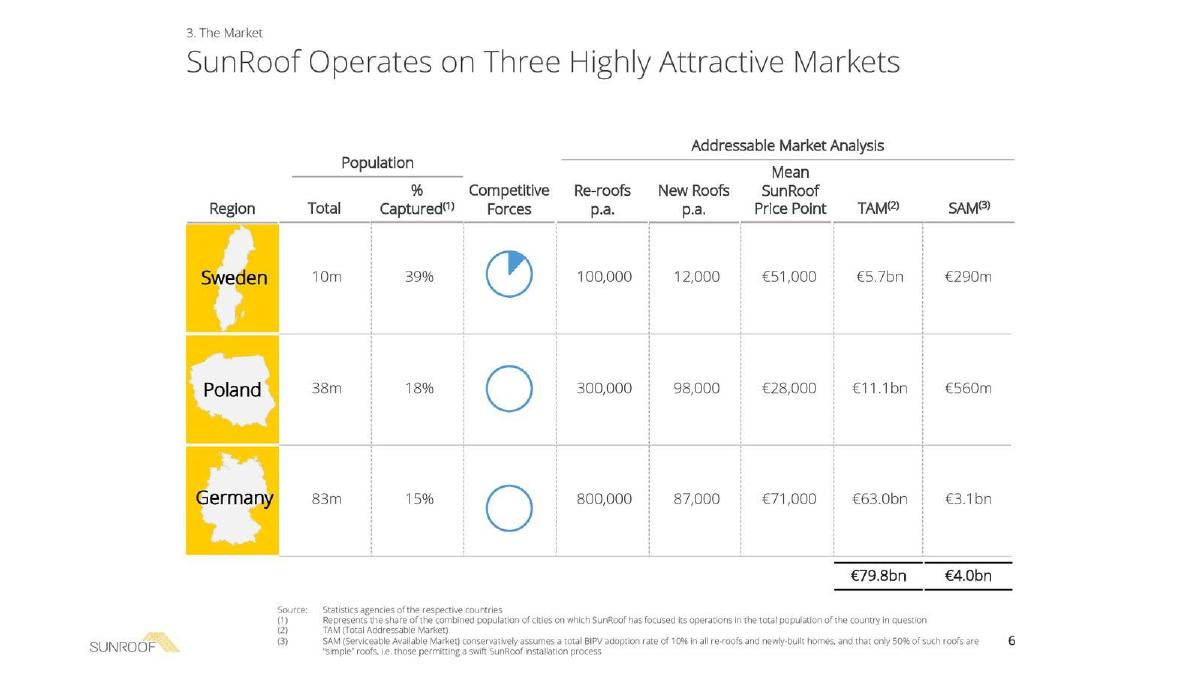
- The deck identifies a €79.8bn Total Addressable Market across Sweden, Poland, and Germany on slide 6.
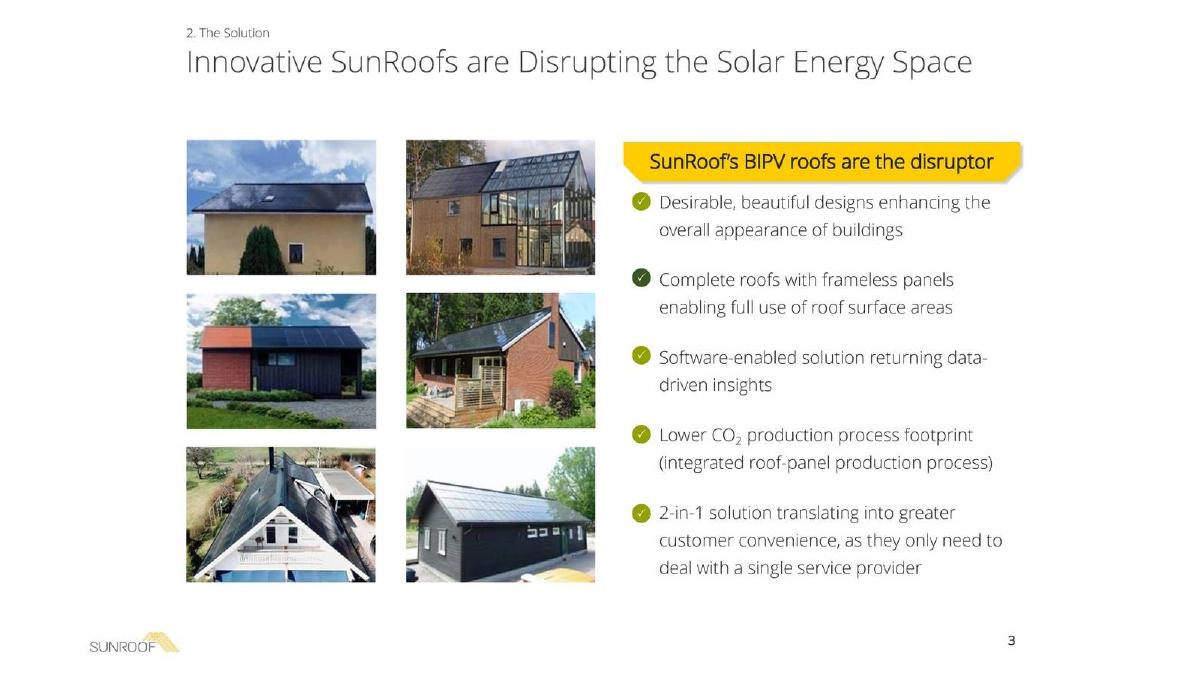
- SunRoof positions its product as a 2-in-1 solution that eliminates the need for separate roofers and PV installers (slide 3).
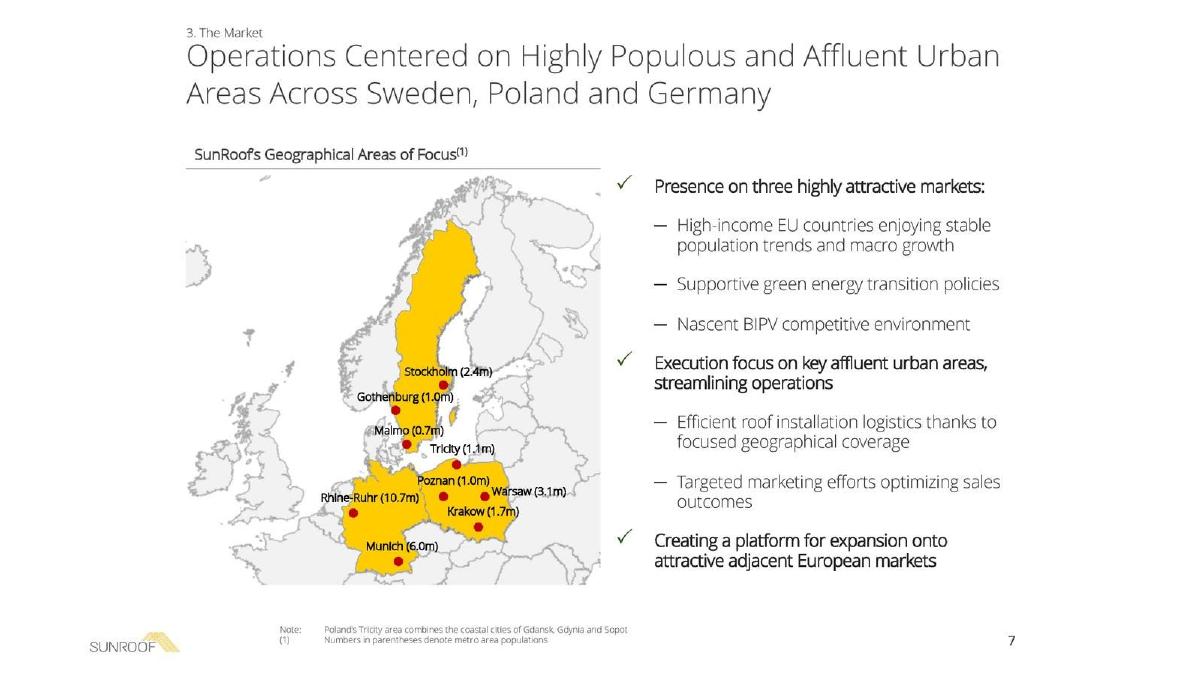
- The company targets high-income urban areas, specifically citing metro populations like Munich at 6.0m and Warsaw at 3.1m (slide 7).
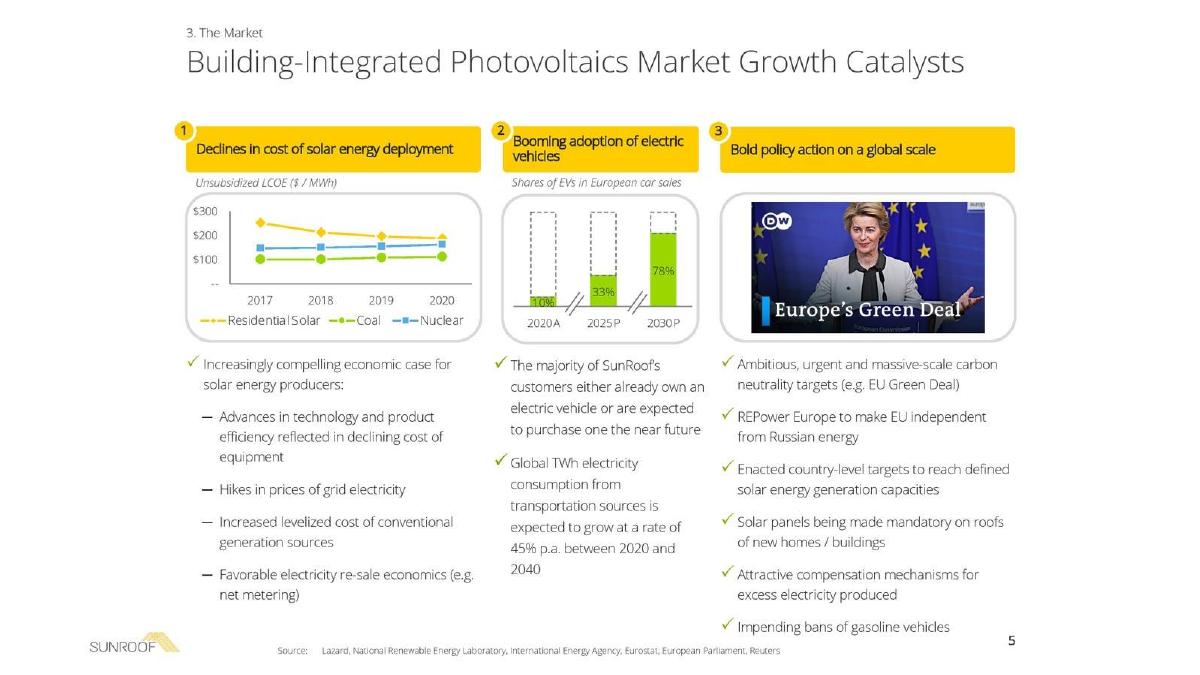
- Macro growth is tied to the EU Green Deal and the REPower Europe initiative to reduce reliance on Russian energy (slide 5).
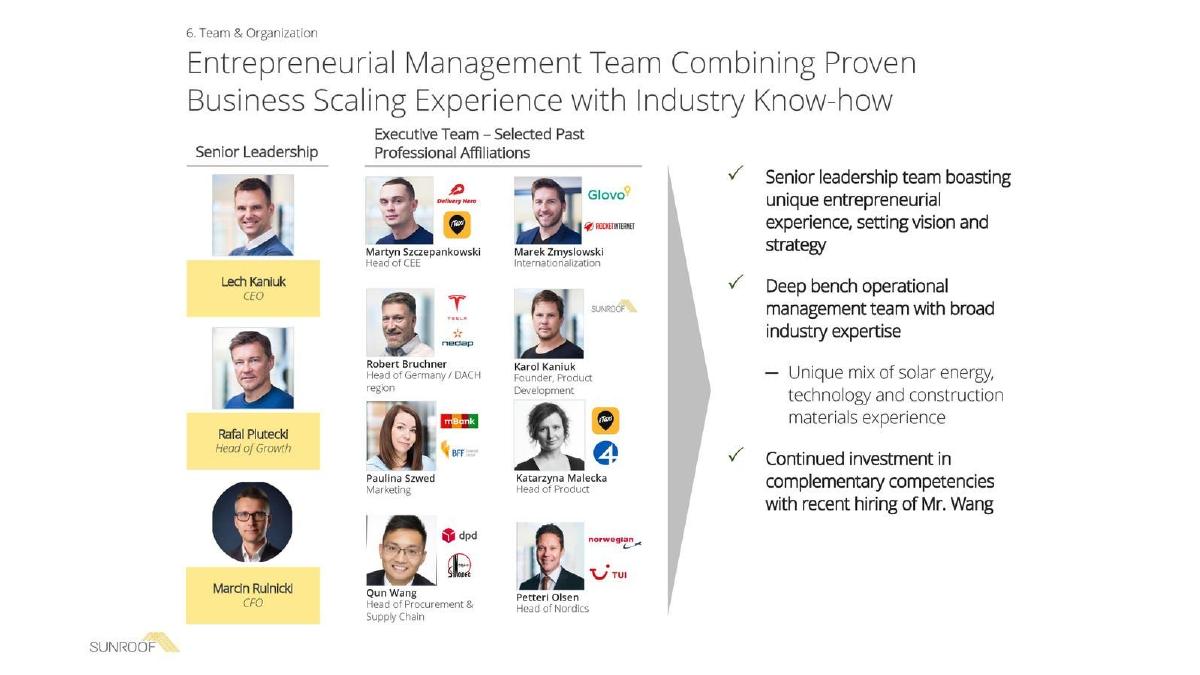
- The team slide highlights significant industry experience, including a Head of Germany with a background at Tesla (slide 8).
- SunRoof claims its integrated production process results in a lower CO2 footprint compared to traditional separate manufacturing (slide 3).
- The deck omits a specific 'Ask' slide, financial projections, and current revenue metrics, focusing instead on market potential and product design.
- Competitive forces are visualized as low in Poland and Germany, with Sweden showing slightly more market saturation (slide 6).
The Visual Case for Architectural Solar
SunRoof’s 9-slide deck is a study in brevity. In the world of growth-stage fundraising, where decks often bloat to 30+ slides of data rooms and cohort analyses, SunRoof takes a different path. They rely on the visual disparity between 'old' solar and 'new' solar to do the heavy lifting. According to publisher-reported facts, this deck supported a $14.6M raise in 2023, a year when the venture market was tightening significantly. The success of this raise likely rested on the company's ability to frame solar not just as a utility, but as a premium construction material.
Slide 1: The Visual Hook
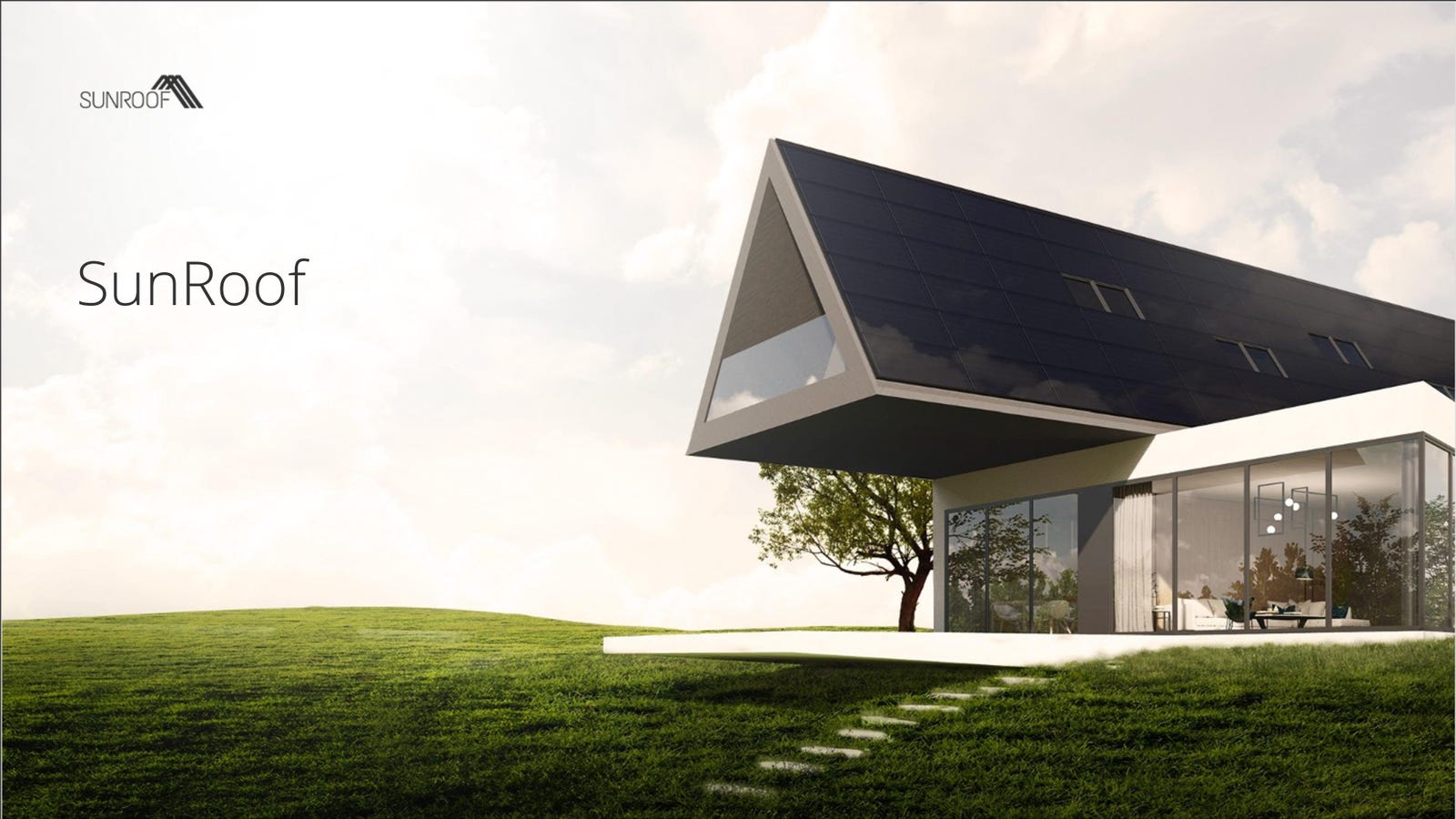
The title slide features a high-end, minimalist architectural render of a home with a SunRoof installation. There is no subtitle, no mission statement, and no 'Uber for X' tagline. The branding is clean, positioning SunRoof as a design-first technology company rather than a traditional construction firm. This sets the tone for the 'aesthetic disruption' argument that follows.
Slide 2: The Problem - Aesthetic and Logistical Friction
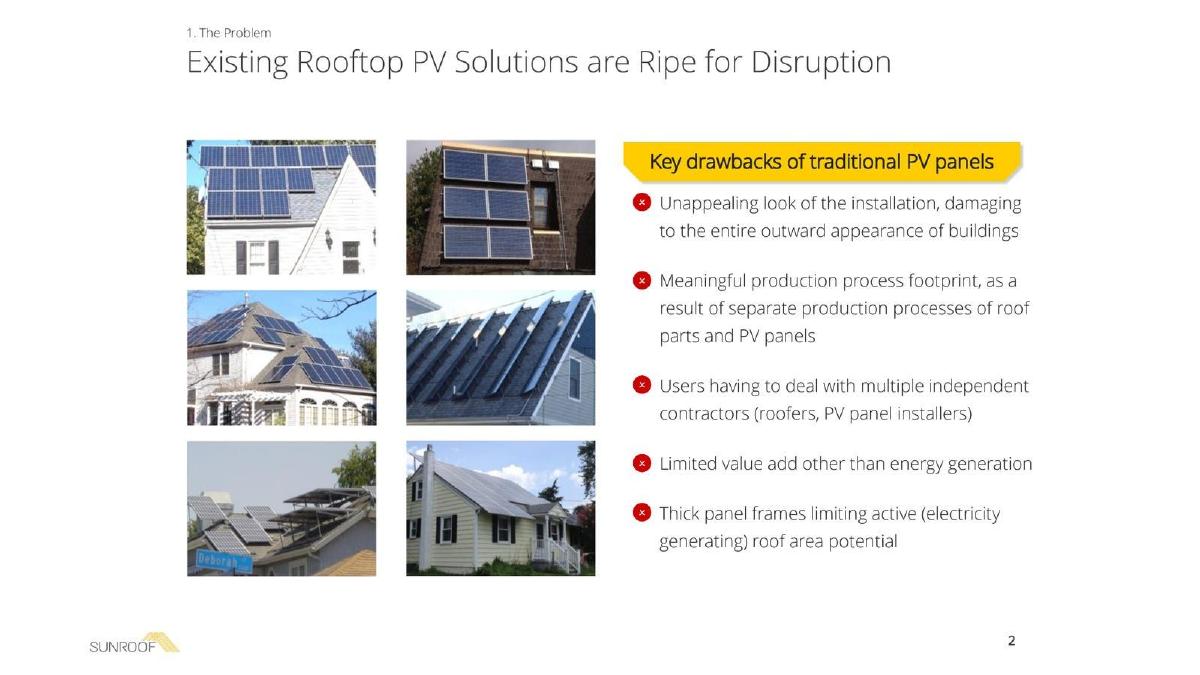
Slide 2, titled 'Existing Rooftop PV Solutions are Ripe for Disruption,' uses six photos of traditional solar installations. These photos are intentionally chosen to look cluttered and poorly integrated. The slide lists five 'Key drawbacks of traditional PV panels':
Unappealing look damaging the outward appearance of buildings. · Meaningful production process footprint due to separate manufacturing of roof parts and panels. · The friction of dealing with multiple independent contractors (roofers vs. installers). · Limited value add beyond energy generation. · Thick frames that limit the active electricity-generating area.
Slide 3: The Solution - The BIPV Disruptor
Slide 3 mirrors the problem slide but replaces the 'ugly' photos with six images of SunRoof installations. The company introduces the term 'BIPV' (Building-Integrated Photovoltaics). The value proposition is framed as a '2-in-1 solution,' which is a powerful sales hook for both homeowners and developers. By combining the roof and the solar system, they claim to offer 'greater customer convenience' and a lower CO2 footprint through an integrated production process. Notably, they mention a 'software-enabled solution returning data-driven insights,' though the deck does not elaborate on what this software actually does.
Slide 4: Real-World Applications
This slide is a collage of actual installations, moving beyond residential homes to show carports and public transport hubs (bus stations). This suggests that the technology is modular and scalable across different types of infrastructure, though the primary focus remains on the residential sector.
Slide 5: Market Growth Catalysts
Slide 5 provides the 'Why Now?' narrative. It cites three specific catalysts:
Declining Costs: A chart shows Residential Solar LCOE dropping from ~$250/MWh in 2017 to under $200/MWh in 2020. · EV Adoption: A projection that EV shares in European car sales will reach 78% by 2030. SunRoof notes that most of their customers already own or plan to buy an EV. · Policy Action: References to the 'Europe Green Deal' and 'REPower Europe' to make the EU independent from Russian energy.
This slide is crucial because it ties SunRoof's success to massive, unstoppable macroeconomic and geopolitical shifts.
Slide 6: The €79.8bn Opportunity
Slide 6 is the most data-dense slide in the deck, providing an 'Addressable Market Analysis' for Sweden, Poland, and Germany. The figures are specific:
Sweden: 100k re-roofs p.a., 12k new roofs p.a., with a mean SunRoof price point of €51,000. SAM is €290m. · Poland: 300k re-roofs p.a., 98k new roofs p.a., with a mean price point of €28,000. SAM is €560m. · Germany: 800k re-roofs p.a., 87k new roofs p.a., with a mean price point of €71,000. SAM is €3.1bn.
The total TAM is cited at €79.8bn, with a combined SAM of €4.0bn. The 'Competitive Forces' column suggests that Poland and Germany are relatively open markets, while Sweden has more established competition.
Slide 7: Geographic Focus and Logistics
Slide 7 maps out the specific urban centers where SunRoof operates. By highlighting cities like Munich (6.0m), Warsaw (3.1m), and Stockholm (2.4m), the company demonstrates a strategy of 'Execution focus on key affluent urban areas.' This is a smart way to signal that they aren't trying to boil the ocean; they are targeting high-margin, high-density areas where logistics are efficient and customers have the disposable income for a premium roof.
Slide 8: The Management Team
For a growth round, the team slide is vital. SunRoof showcases a 'Deep bench operational management team.' The slide includes logos from previous affiliations to borrow credibility: Tesla, Google, Rocket Internet, Delivery Hero, and Glovo. Specifically, Robert Bruchner (Head of Germany) is tagged with the Tesla logo, which is a significant signal for a company in the solar/energy space. The slide also mentions the recent hiring of Qun Wang as Head of Procurement & Supply Chain, addressing a common investor concern for hardware companies: scaling the supply chain.
Slide 9: Contact and Location
The final slide provides the corporate address in Vänersborg, Sweden, and the website. It is a standard closing slide that maintains the minimalist aesthetic of the rest of the deck.
What SunRoof Does Well
The deck is exceptionally good at contrast-based selling . By dedicating entire slides to the visual difference between their product and the status quo, they bypass technical jargon and appeal to the emotional and aesthetic desires of the end-user. This is particularly effective in the construction and home-improvement sector, where 'curb appeal' is a quantifiable metric for property value.
Furthermore, the market sizing (Slide 6) is grounded in reality. Instead of just throwing out a trillion-dollar global number, they break it down by country, by 'new' vs 're-roof,' and by specific price points. This level of granularity gives investors confidence that the founders understand the mechanics of their revenue model.
What is Missing from the Deck
The most glaring omission is financial traction . There are no charts showing revenue growth, number of installations completed to date, or gross margins. For a 'Growth Round' raising $14.6M, investors typically expect to see a 'T-minus 12 and T-plus 24' month financial view. The absence of these metrics suggests this deck was likely a 'teaser' or a high-level vision deck used to open doors, with the heavy financial lifting happening in a separate data room.
There is also no Unit Economics slide. For a hardware-heavy business involving installation and logistics, understanding the Customer Acquisition Cost (CAC) vs. the Lifetime Value (LTV) is critical. While they mention a 'mean price point,' they don't mention the cost of goods sold (COGS) or the margin per installation.
Finally, the 'Ask' is missing. The deck does not state how much money they are looking for or how they intend to spend the capital (e.g., R&D, geographic expansion, or manufacturing capacity). We only know the $14.6M figure from external reporting.
Lessons for Founders
1. Use Visual Comparisons: If your product is significantly more attractive than the incumbent, show them side-by-side. Don't just say you are 'better'; prove it with high-quality imagery.
2. Segment Your TAM: Don't just present a global market size. Break it down by the specific regions you are targeting and explain why those regions are attractive (e.g., 'affluent urban areas' or 'supportive policies').
3. Leverage 'Alumni' Credibility: If your team has worked at industry leaders (like Tesla for a solar company), make those logos prominent. It acts as a shorthand for 'this team knows how to scale.'
4. Tie Your Growth to Macro Trends: SunRoof doesn't just say they want to sell roofs; they say they are the solution to the EU's energy independence and the shift to EVs. Aligning your company with 'unstoppable' global trends makes your success seem inevitable to an investor.
Frequently asked questions
- How much did SunRoof raise with this deck?
- As reported by Business Insider, SunRoof raised $14.6M in a growth round in 2023. The deck itself does not specify the amount raised or the valuation, which is common for growth-stage decks intended for private circulation among institutional investors.
- What is the primary value proposition of SunRoof?
- The deck emphasizes a '2-in-1' solution. Instead of mounting panels on top of an existing roof, SunRoof provides the roof itself as a power generator. This eliminates the 'unappealing look' of traditional panels and simplifies logistics by requiring only one service provider instead of separate roofers and solar installers.
- Which markets is SunRoof currently focusing on?
- Slide 6 and 7 detail a specific focus on Sweden, Poland, and Germany. They target affluent urban centers such as Stockholm, Munich, and Warsaw, citing high-income levels and supportive green energy transition policies in these regions.
- Does the deck show any financial performance metrics?
- No. The deck is notably missing historical revenue, burn rate, or profitability metrics. It focuses entirely on the market opportunity, the product's aesthetic superiority, and the tailwinds provided by European climate policy.
- What are the 'Market Growth Catalysts' mentioned?
- Slide 5 identifies three catalysts: the declining cost of solar energy (LCOE), the booming adoption of electric vehicles (projected at 78% of European car sales by 2030), and bold policy actions like the EU Green Deal and REPower Europe.