Superintelligent’s 13-slide pre-seed deck is a masterclass in narrative minimalism, prioritizing a clear 'paradigm shift' over dense data. The company successfully raised $2M in 2024 by framing AI education not as a static product, but as a 'learning stream' necessitated by the rapid decay of AI knowledge. While the deck lacks traditional components like a team slide, detailed financials, or a competitive matrix, it leans heavily on the urgency of the market—citing a Morgan Stanley estimate that AI will impact 44% of workers within three years. By positioning themselves as the 'Liquid Death f…
Key takeaways
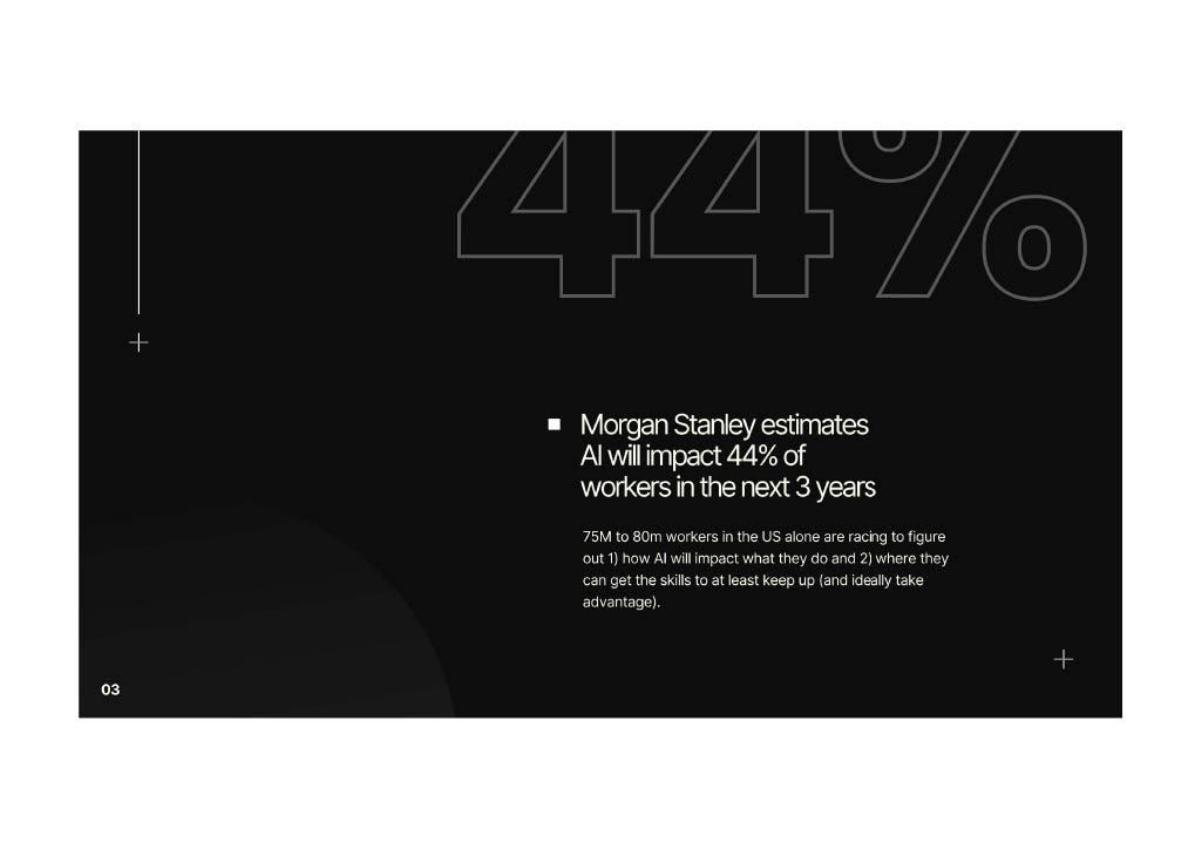
- The deck relies on a high-urgency problem statement, citing that 75M to 80M US workers are racing to understand AI's impact (Slide 3).
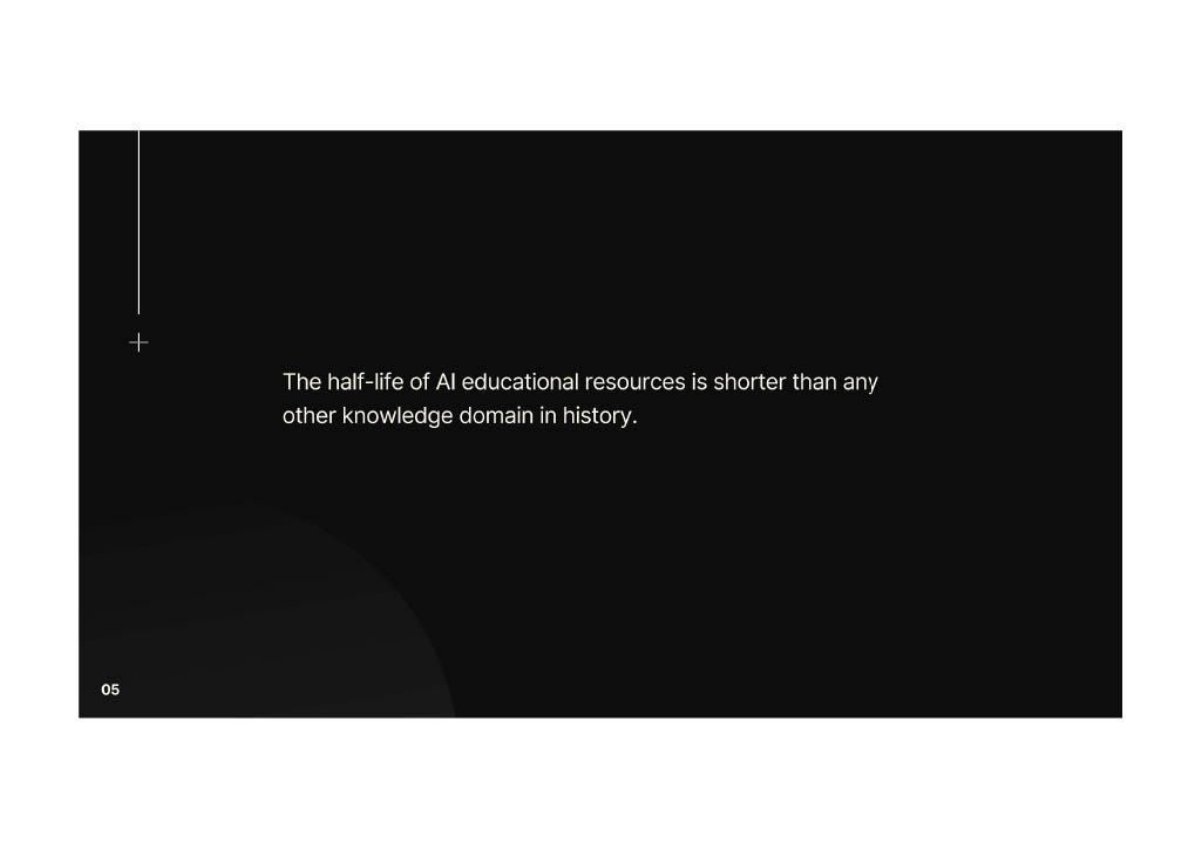
- Superintelligent defines the core challenge as the 'half-life' of AI resources being shorter than any other domain in history (Slide 5).
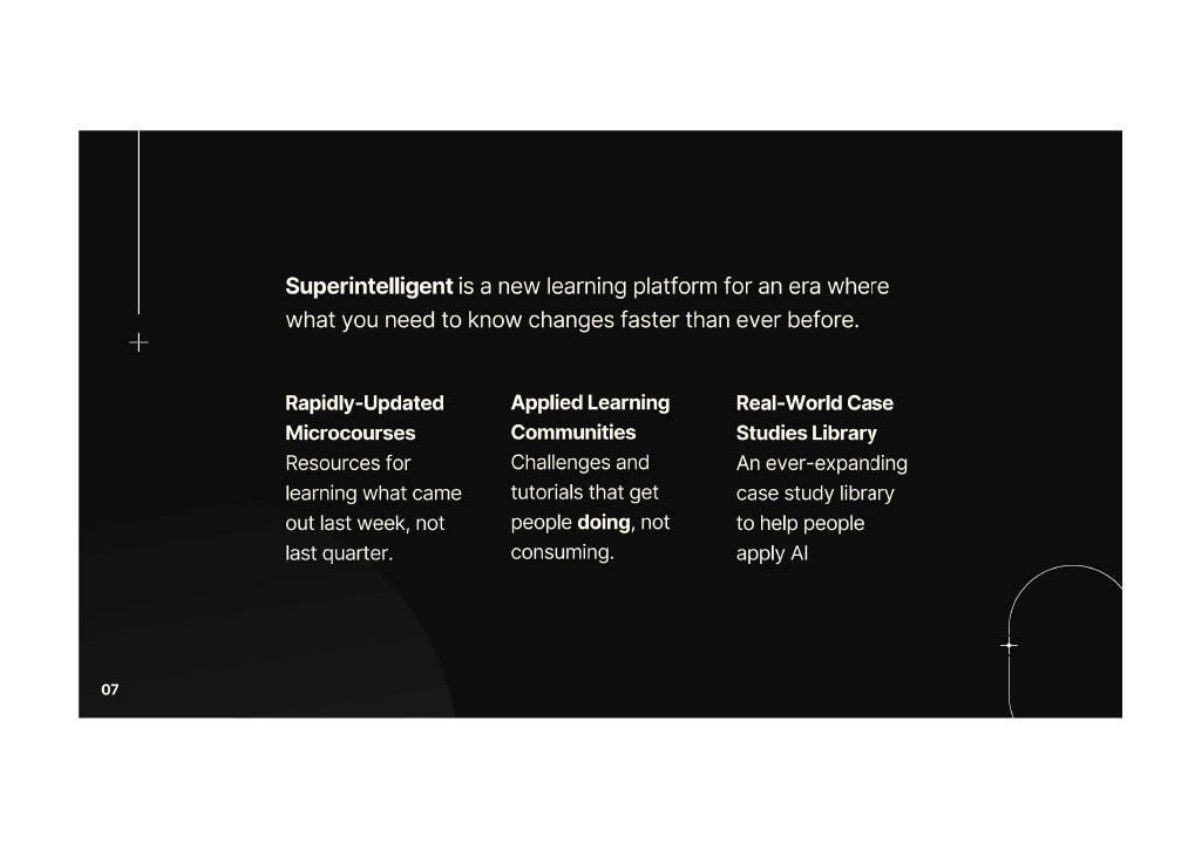
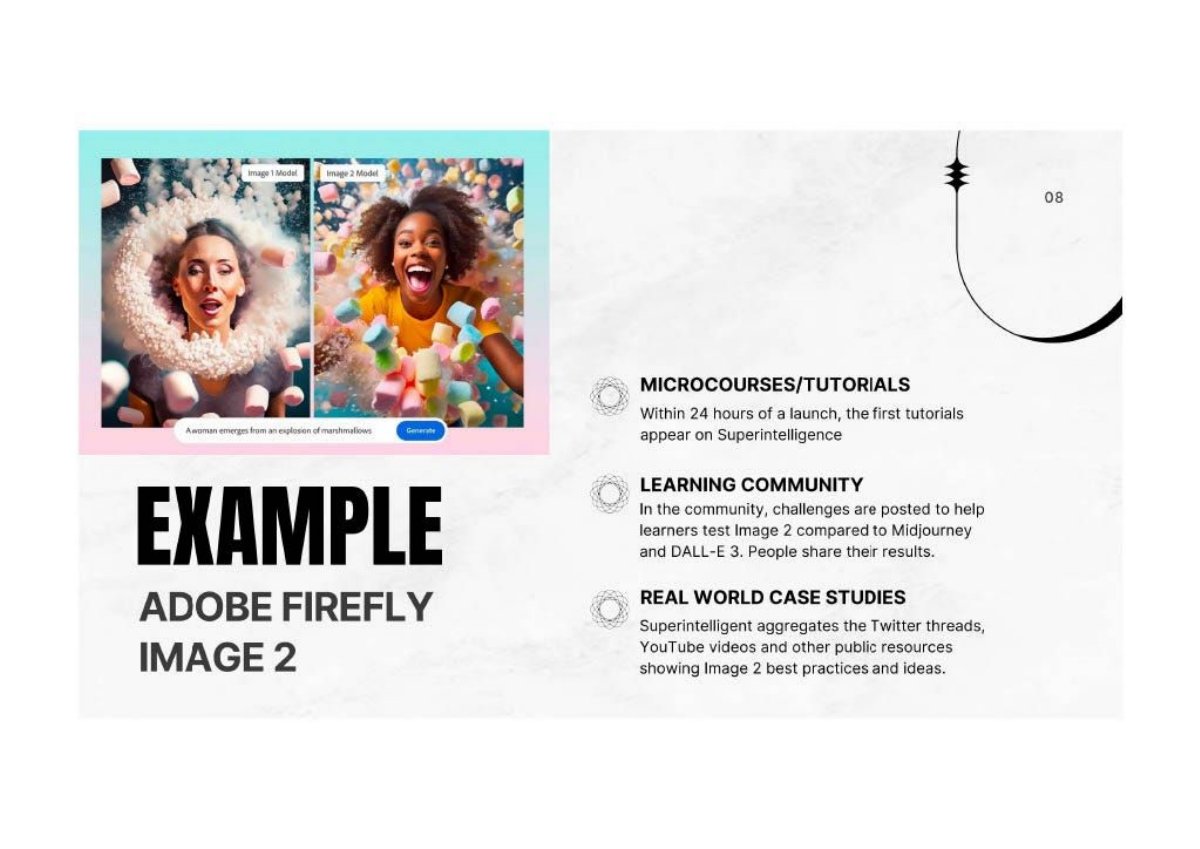
- The product is structured around three pillars: Rapidly-Updated Microcourses, Applied Learning Communities, and a Real-World Case Studies Library (Slide 7).
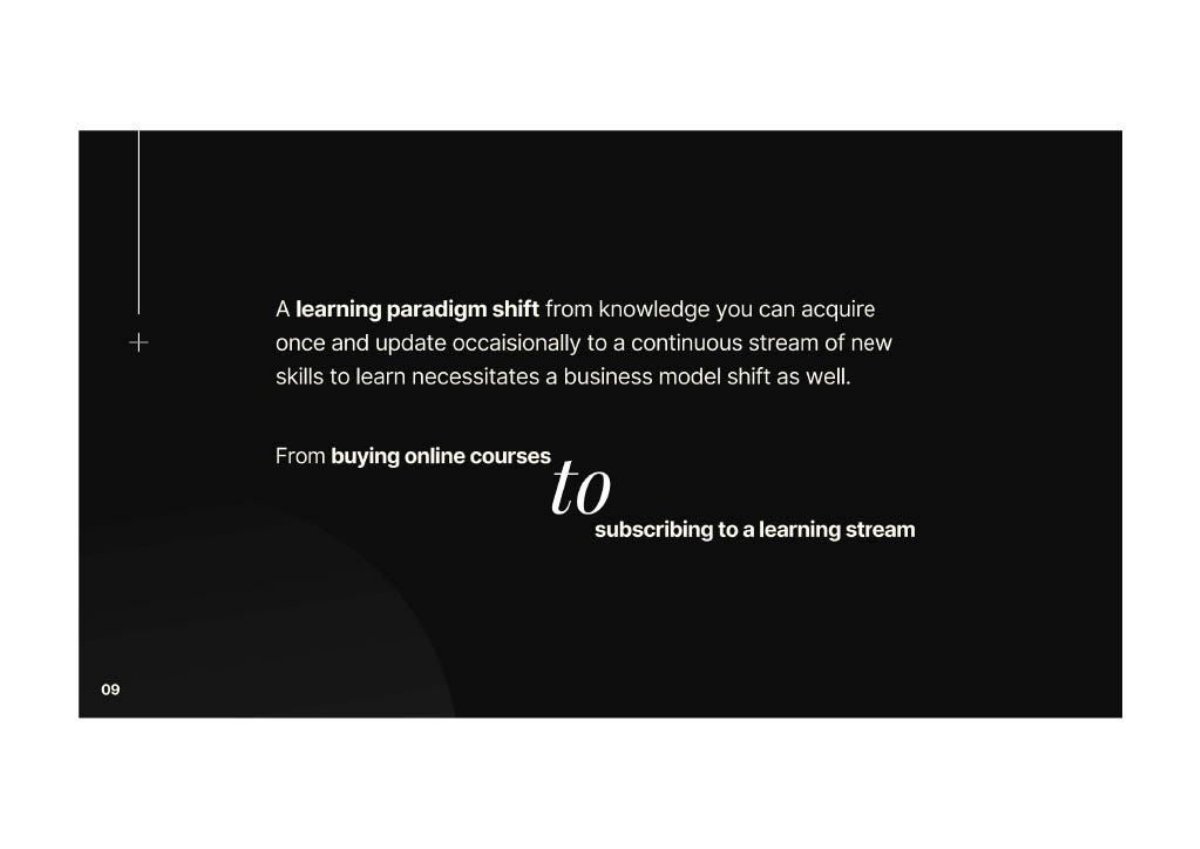
- A central thesis of the pitch is the transition from buying one-off online courses to 'subscribing to a learning stream' (Slide 9).
- The company identifies three specific moats: Brand, Network (shared learning community), and Model (subscription stickiness) (Slide 11).
- The deck uses a 'Liquid Death' analogy to describe its brand strategy, aiming to make AI education something people actively want to engage with (Slide 11).
- Traditional fundraising slides, including Team, Competition, and Financial Projections, are entirely absent from the provided deck materials.
- The deck is dated October 2023, preceding the reported $2M raise in 2024.
Superintelligent: The Minimalist Case for Continuous AI Learning
Superintelligent’s pitch deck is a striking example of 'less is more' in the pre-seed stage. In an industry often bogged down by complex technical jargon and dense pedagogical frameworks, this deck uses high-contrast visuals and a lean narrative to sell a single, compelling idea: that AI knowledge expires so quickly that the only viable solution is a continuous subscription. According to publisher reports, this approach helped secure $2M in pre-seed funding in 2024.
Slide 1-2: Title and Branding
The deck opens with a bold, typographic treatment of the company name. The design is stark—white text on a black background. Slide 1 includes the date 'October 2023.' There are no taglines or mission statements here; the brand name 'Superintelligent' is intended to carry the weight of the introduction. This minimalist aesthetic is maintained throughout the entire 13-slide presentation, signaling a brand that values clarity and modern design.
Slide 3: The Macro Opportunity
Slide 3 establishes the 'Why Now?' of the business. It features a large '44%' graphic and cites a Morgan Stanley estimate that AI will impact 44% of workers within the next three years. The text explicitly identifies a target audience of 75M to 80M workers in the US alone . The slide frames the problem as a 'race' where workers are looking for two things: an understanding of AI's impact and a place to acquire skills to 'take advantage' of the shift. By using a reputable third-party source like Morgan Stanley, the deck grounds its ambition in credible market data.
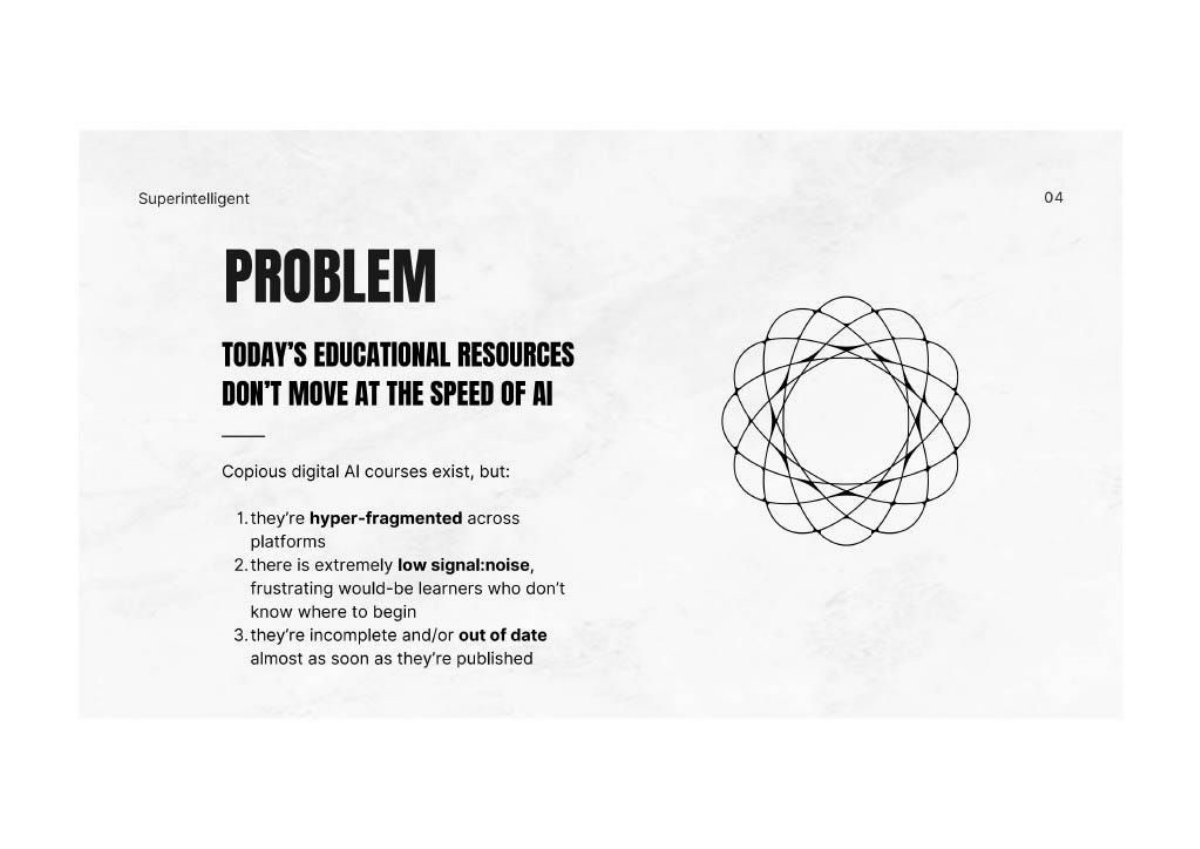
Slide 4-5: The Problem of Knowledge Decay
Slide 5 introduces the core thesis of the platform: 'The half-life of AI educational resources is shorter than any other knowledge domain in history.' This is a critical strategic pivot. Instead of competing on the depth of their content, Superintelligent is competing on the freshness of their content. This slide sets the stage for why traditional, static online courses (like those found on Coursera or Udemy) are insufficient for the AI era.
Slide 6-7: The Solution and Product Pillars
Slide 7 defines what Superintelligent actually is. It is described as a 'new learning platform for an era where what you need to know changes faster than ever before.' The product is broken down into three distinct components:
Rapidly-Updated Microcourses: Resources for learning what came out 'last week, not last quarter.' · Applied Learning Communities: Challenges and tutorials designed to get people 'doing, not consuming.' · Real-World Case Studies Library: An 'ever-expanding' library to help users apply AI in practical scenarios.
This slide successfully moves from the abstract problem to a concrete product offering without getting lost in feature lists.
Slide 8-9: The Paradigm Shift
Slide 9 is the 'Business Model' slide, though it is framed as a 'learning paradigm shift.' It argues that a continuous stream of new skills 'necessitates a business model shift as well.' The slide uses a simple 'From/To' construction: From buying online courses to subscribing to a learning stream. This is a sophisticated way to justify a SaaS-style recurring revenue model in a sector (education) where one-off transactions are common.
Slide 10-11: Defensibility and Moats
Slide 11 addresses the question of 'Why you?' by listing three moats. The most notable is the Brand Moat , where the company describes itself as the 'Liquid Death for AI Education.' This suggests a focus on high-quality, edgy marketing that makes a boring subject (learning) feel culturally relevant. The Network Moat focuses on the community aspect, and the Model Moat reiterates the stickiness of the subscription. This slide demonstrates that the founders are thinking about long-term enterprise value, not just short-term content sales.
Slide 12-13: Conclusion and Contact
The deck ends as simply as it began. Slide 13 provides a single contact email: nlw@whittemore.io . There is no 'Thank You' slide or summary of the ask. The brevity suggests a high level of confidence, assuming that the narrative presented is enough to trigger a follow-up conversation.
What Superintelligent Does Well
The primary strength of this deck is its narrative focus . It identifies a specific, undeniable truth—that AI changes fast—and builds an entire business case around it. By focusing on the 'half-life' of knowledge, they turn their competitors' massive libraries into a liability (outdated content) and their own small, fresh platform into an asset.
The visual consistency is also a major plus. The deck looks like a premium product. For a company that claims to be the 'Liquid Death' of its category, having a strong, distinct visual identity is non-negotiable. The minimalist design ensures that the investor's attention is always on the core text, which is written in plain, punchy English.
What is Missing from the Deck
Despite raising $2M, the deck is missing several 'standard' slides that most founders are told are mandatory:
Team Slide: There is no mention of the founders' backgrounds, previous exits, or technical expertise. In a pre-seed round, the team is usually the most important factor. · Competition: There is no competitive matrix. While they hint at the flaws of 'one-off courseware,' they don't name specific competitors or explain how they will win against incumbents like LinkedIn Learning or specialized AI newsletters. · Traction: There are no metrics regarding current users, waitlist size, or early revenue. This suggests the deck was used at the very earliest stage of the company's life. · The Ask: The deck does not state how much money is being raised or what the milestones for the next 18 months will be.
Lessons for Founders
Founders can learn two major lessons from the Superintelligent deck. First, sell the shift, not the features. Superintelligent doesn't talk about their video player or their AI-powered search; they talk about the shift from 'buying' to 'subscribing' and the 'half-life' of knowledge. They are selling a new way of thinking about education.
Second, embrace a 'Brand-First' mentality. By referencing Liquid Death, the founders are signaling to investors that they understand the importance of community and culture in a crowded market. If you are entering a commodity market (like online videos), your brand is often your only real moat. Superintelligent leans into this early, making it a core part of their pitch rather than an afterthought.
Frequently asked questions
- What is the primary business model for Superintelligent?
- Superintelligent operates on a subscription-based model. As stated on Slide 9, they are driving a shift from 'buying online courses' to 'subscribing to a learning stream.' They argue on Slide 11 that this model is 'inherently stickier' than one-off courseware, providing them with a 'Model Moat' in the competitive edtech space.
- How does Superintelligent differentiate itself from other AI course providers?
- The company differentiates through speed and application. Slide 7 highlights 'Rapidly-Updated Microcourses' that focus on what came out 'last week, not last quarter.' They also emphasize 'Applied Learning Communities' that focus on 'doing, not consuming,' and a library of real-world case studies to facilitate immediate AI implementation.
- What market data does the deck use to justify the opportunity?
- The deck leans on a Morgan Stanley estimate presented on Slide 3, which claims AI will impact 44% of workers in the next three years. It further quantifies the immediate target as 75M to 80M workers in the US who are currently 'racing to figure out' how to gain the skills necessary to keep up with AI advancements.
- What are the 'moats' described in the pitch?
- Slide 11 outlines three moats: a Brand Moat (aiming to be the 'Liquid Death for AI Education'), a Network Moat (a shared learning community that creates a light network effect), and a Model Moat (the stickiness of a subscription versus one-off purchases).
- Is there information about the founders or the amount being raised in the deck?
- No. The provided 13-slide deck omits a team slide, an 'ask' slide detailing the round size, and any financial use-of-funds breakdown. While Business Insider reports a $2M pre-seed raise, these details were likely handled in supplemental documents or verbal discussions rather than the primary narrative deck.