From Courses to Subscriptions: How Superintelligent's
A whole-deck walkthrough of Superintelligent's 13-slide pre-seed deck: how one premise, that AI know-how goes out of date fast.
From Courses to Subscriptions: Following One Premise Through Superintelligent's Deck
Most decks pick a pricing model and then defend it. Superintelligent's 13-slide pre-seed deck, dated October 2023, tries something tighter: it argues that its subscription model follows from its problem. If what people need to learn about AI changes every week, the deck says, a course you buy once is the wrong product, and a subscription to a stream of new lessons is the right one. We follow that single premise across the slides to show where it holds, where the deck asks the reader to take it on trust, and what a founder making the same argument should add.
TL;DR
To justify moving from one-off purchases to subscriptions, a deck has to show three links: the customer's need recurs, the product meets that need again and again, and the cost of doing so stays below what subscribers pay. Superintelligent's deck makes the first two links explicitly and in order. Page 4 says courses are 'out of date almost as soon as they're published'; page 5 says the 'half-life of AI educational resources is shorter than any other knowledge domain in history'; page 7 promises 'resources for learning what came out last week, not last quarter'; page 8 shows tutorials appearing 'within 24 hours of a launch'; page 9 concludes that this shift 'necessitates a business model shift as well', 'from buying online courses to subscribing to a learning stream'.
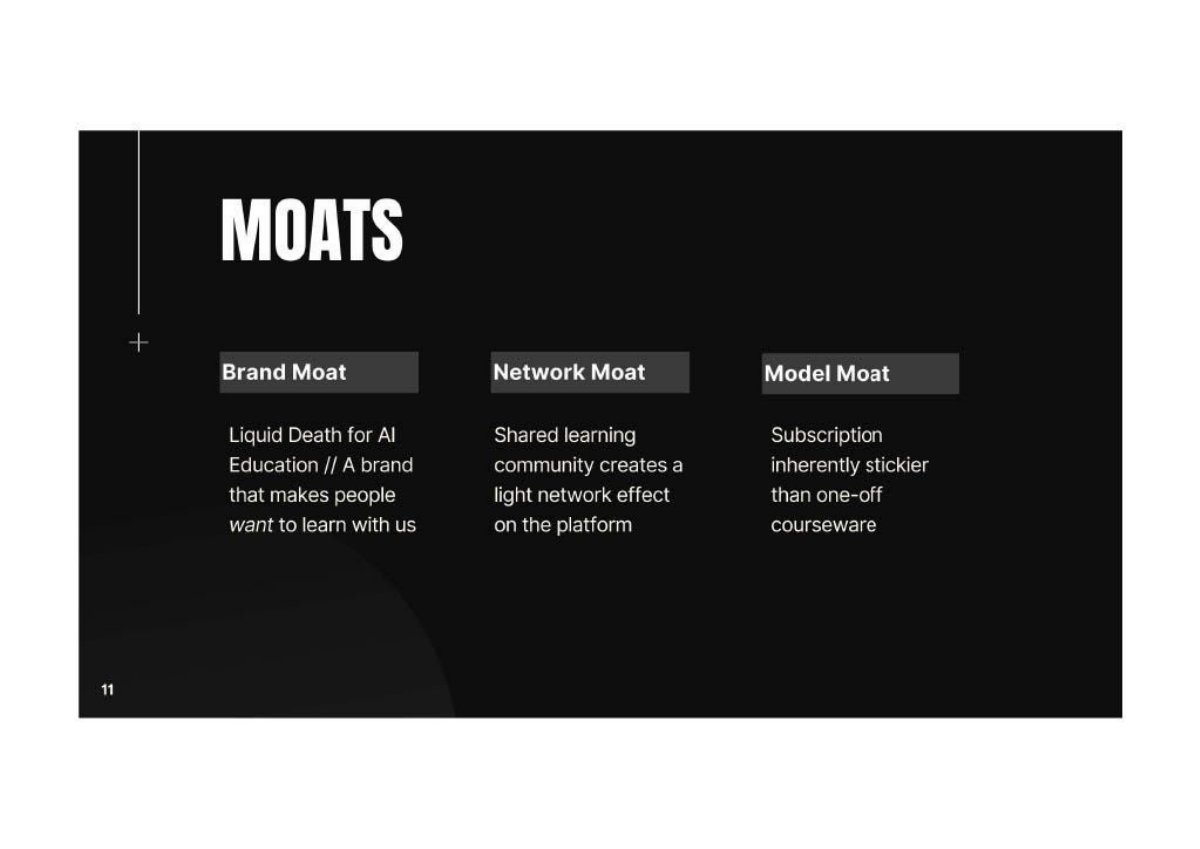
The third link is missing. The deck shows no price, no subscriber numbers, no retention and no cost of producing a constant flow of lessons. That's partly the stage: the deck is dated October 2023, and the company's own launch release says the beta went live in December 2023, so it could not yet have retention data. But page 11's claim that a subscription is 'inherently stickier than one-off courseware' is stated, not shown, and nothing says what keeping content fresh will cost.
The lesson for founders: when you argue that your problem requires a subscription, the same premise creates a recurring cost. Show that you can produce the fresh value cheaply (Superintelligent's pages 8 and 10 hint at how, through aggregating public material and a podcast audience) and say what you'll measure to prove people stay.
The argument page by page
Seven pages from Superintelligent's 13-slide deck, each one link in the case that a fast-decaying subject needs a subscription.
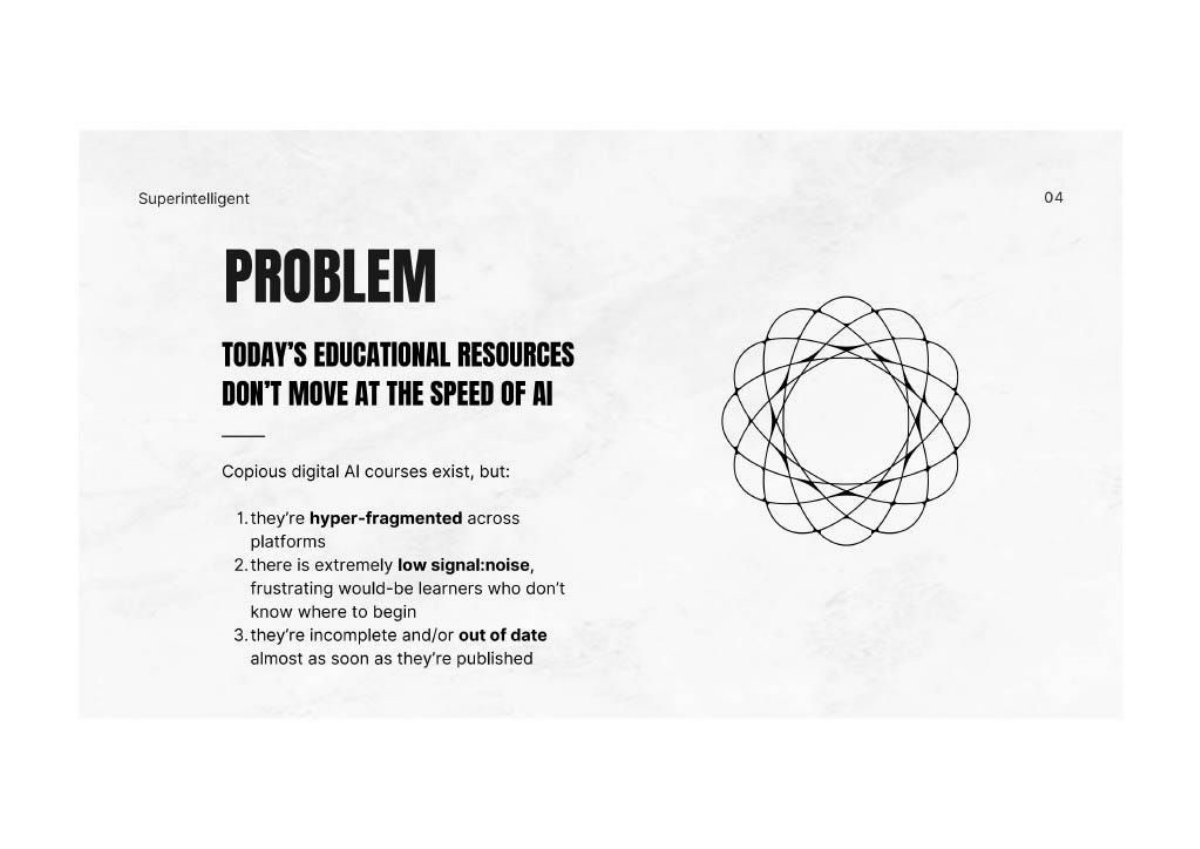
AI learning platform, pre-seed. The problem slide.
Superintelligent deck, slide 4. Exact stored slide matched to this analysis.
Our analysis: Our reading: only the third fault can't be fixed by a better course, so it carries the argument.
Evidence and limitation: Three faults listed; no measure of how fast courses go stale.
What a founder can adapt: Lead with the fault a one-off product can never fix.
Supporting analysis
What the deck claims: 'Today's educational resources don't move at the speed of AI': 'hyper-fragmented', 'low signal:noise', 'out of date almost as soon as they're published'.
Presentation choice: A subscription is justified when the problem is about time.
When it does not fit: Don't give equal weight to faults a competitor could fix with a better version.
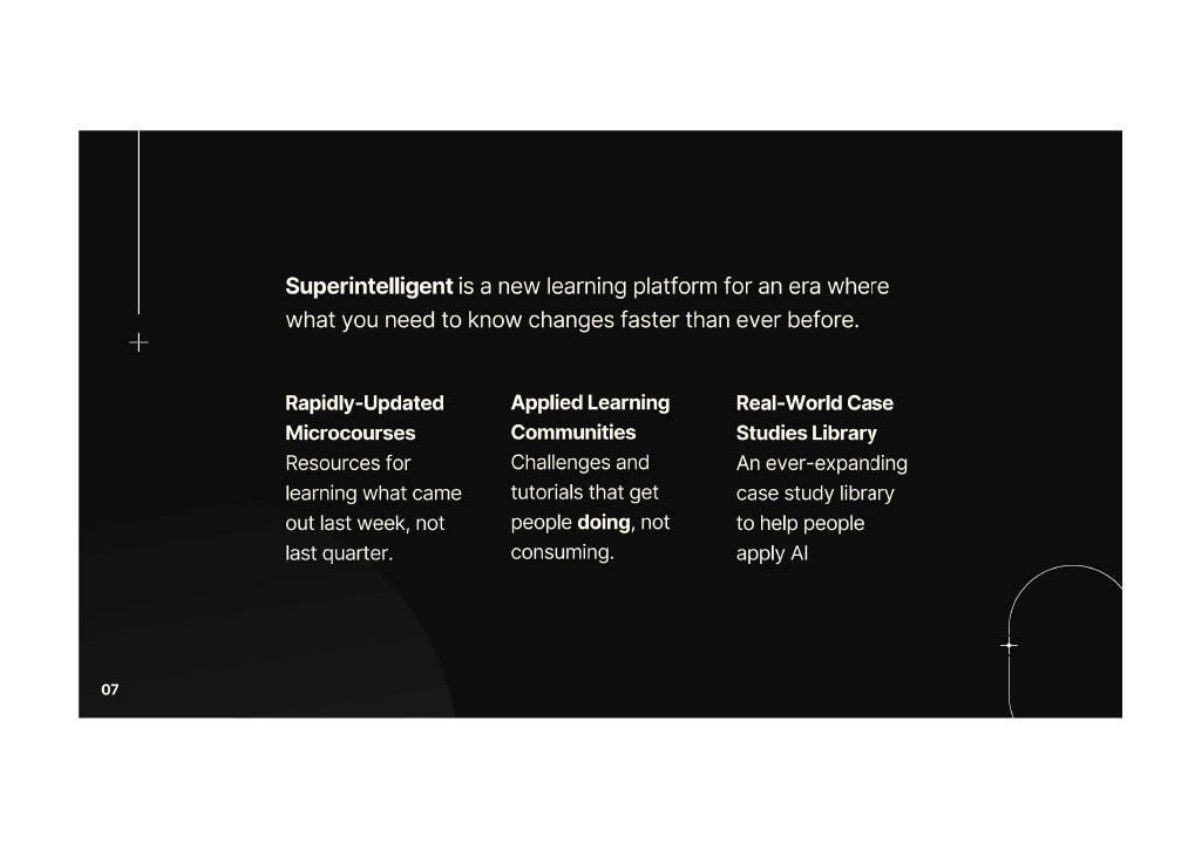
Superintelligent deck, slide 7. Exact stored slide matched to this analysis.
Our analysis: Our reading: the product is designed around the decay premise.
Evidence and limitation: Each part renews itself; no volumes given.
What a founder can adapt: Describe each part by how often it renews.
Supporting analysis
What the deck claims: 'Rapidly-Updated Microcourses' ('what came out last week, not last quarter'), 'Applied Learning Communities', 'Real-World Case Studies Library' ('ever-expanding').
Presentation choice: Subscribers pay for what keeps arriving.
When it does not fit: Don't describe a subscription product as a fixed library.
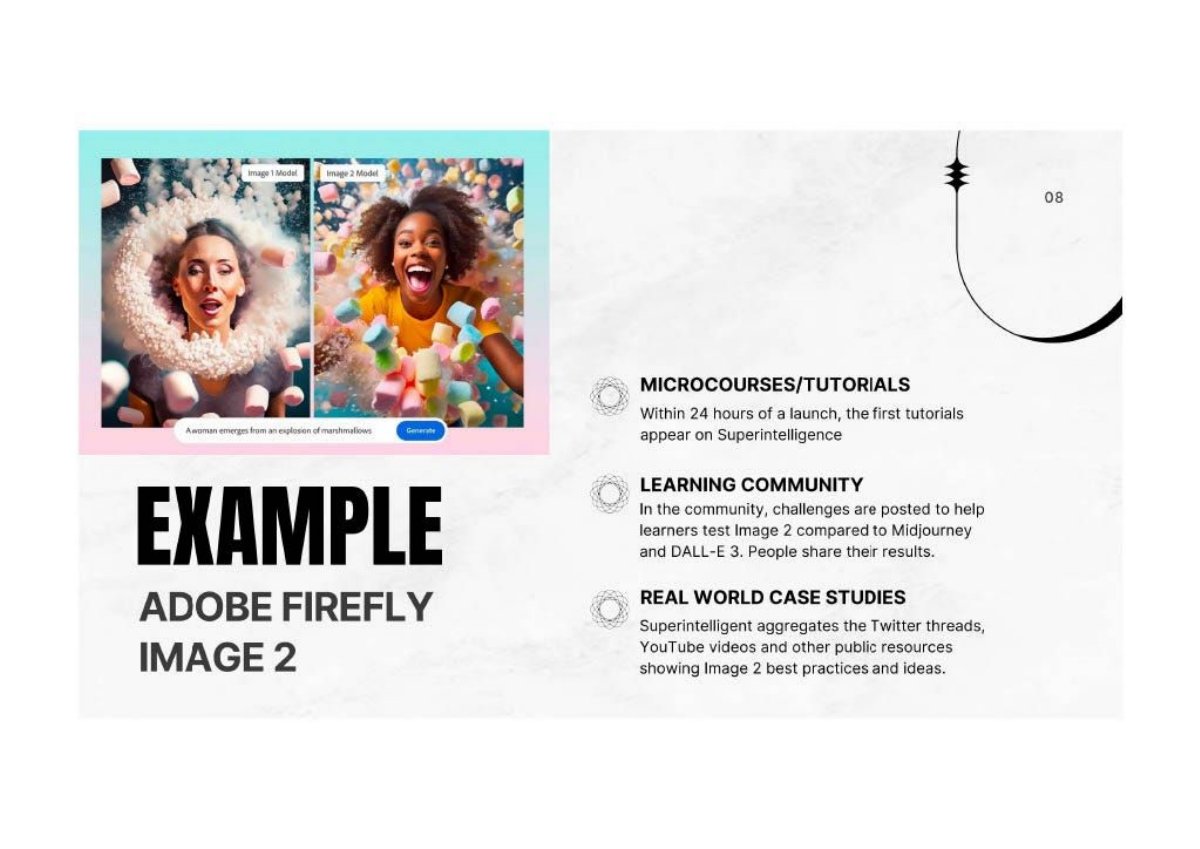
Superintelligent deck, slide 8. Exact stored slide matched to this analysis.
Our analysis: Our reading: the deck's best evidence, and a hint at low-cost content through aggregation.
Evidence and limitation: One example of the cadence; frequency not stated.
What a founder can adapt: Show one launch-to-lesson example, then how often it happens.
Supporting analysis
What the deck claims: 'Within 24 hours of a launch, the first tutorials appear'; community challenges; Superintelligent 'aggregates the Twitter threads, YouTube videos and other public resources'.
Presentation choice: A concrete cadence makes 'rapidly updated' believable.
When it does not fit: Don't let one example stand for every week.
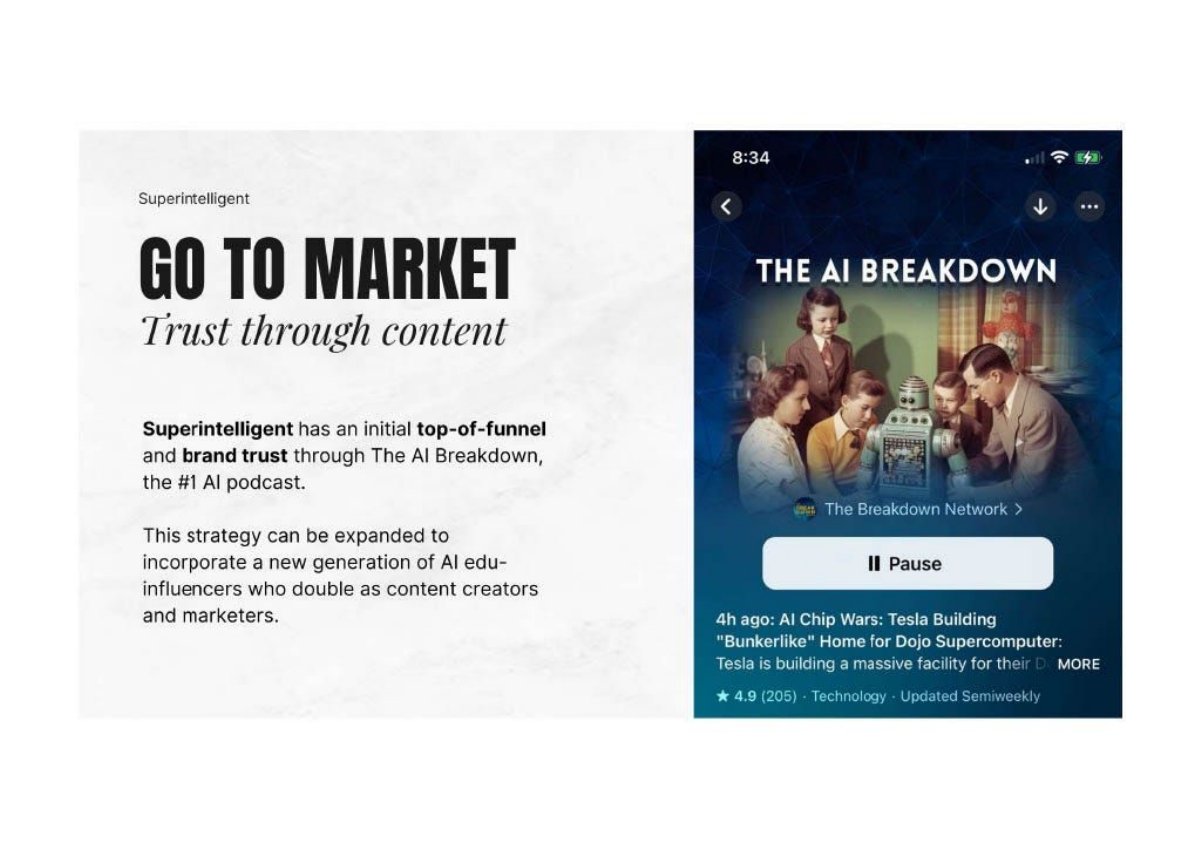
Superintelligent deck, slide 10. Exact stored slide matched to this analysis.
Our analysis: Our reading: creators as marketers would lower content and acquisition cost, but the deck doesn't link this to page 9.
Evidence and limitation: Screenshot shows a 4.9 rating from 205 reviews; '#1' is the company's claim.
What a founder can adapt: Put the content-supply plan next to the model, with a cost per lesson.
Supporting analysis
What the deck claims: 'Initial top-of-funnel and brand trust through The AI Breakdown, the #1 AI podcast'; expand to 'AI edu-influencers who double as content creators and marketers'.
Presentation choice: The cost of renewing content decides whether a stream pays for itself.
When it does not fit: Don't bury your cost answer on a distribution slide.
Each row is one link in the subscription case. 'Support' is our reading of what the slides show.
Link
Page
Readable evidence
Support
Need recurs
4, 5
Courses 'out of date'; 'half-life' claim
Clear premise, unmeasured
Product renews
7, 8
Three self-renewing parts; tutorials 'within 24 hours'
Strong for one example
Model follows
9
Courses to 'learning stream'
Clear logic, no price
Content cost covered
8, 10
Aggregation; creators who market
Implied, not linked
People stay
11
'Inherently stickier'
Asserted
Who can execute
12
Founder with podcast audience
Supports distribution
Ask
None
No amount or use of funds
Missing
Key Takeaways
Derive the subscription from a need that recurs, and say how often it recurs.
Show the update cadence the subscription pays for, with one concrete example.
Admit that the same premise makes content a recurring cost, and show how you'll keep it cheap.
Before launch, name the retention measure you'll report instead of claiming stickiness.
Put price and the ask in the deck; a business-model argument with neither stops halfway.
Build your subscription case
Fill in each line. Any line you can't fill is the proof your deck still needs.
Recurring need. What goes out of date, and how fast (one measured example).
Renewal cadence. What arrives for subscribers, and how often.
Price and payer. Who pays, how much, and how often they're billed.
Content cost. Cost to produce each renewal, and how you keep it low.
Retention measure. The measure you'll report and the level that counts as success.
Ask. The amount, and which of the lines above it improves.
Copyable framework: What [customers] need to know about [subject] goes stale in about [time]. We deliver [renewal] every [period], priced at [price] per [period] to [payer]. Each [renewal] costs us [cost], kept low by [method]. We'll measure [retention measure] and aim for [target]. We're raising [amount] to [improve which line].
Illustrative example 1 — written by us
Before: Subscription inherently stickier than one-off courseware.
After: We'll report the share of subscribers still active after [months]; our target is [level], based on [comparable or pilot].
What improved: Our illustrative rewrite. Bracketed values are placeholders, not Superintelligent's figures; it turns an assertion into a measure a pre-launch company can commit to.
The question this guide answers
Our Superintelligent teardown summarises this deck's minimalist design, its 'paradigm shift' framing and its lack of financials. No guide or draft in our library uses its slides. Our Smartcat walkthrough asks a related but different question: how a deck argues that a whole industry's model (translation agencies) should be replaced. Smartcat's case rests on cost; Superintelligent's rests on how fast the product goes stale. Our freemium-conversion and pricing guides explain how to show revenue from a model that already exists; they don't follow a deck that deduces its model from its problem.
This guide asks: how does a deck justify selling a subscription instead of a one-off course, and which links in that argument does a pre-launch deck have to supply before anyone can measure them?
How we read the deck
We rendered all 13 pages of the original deck file held in our library and read each at full size; the file has no text layer. The cover is dated October 2023. Business Insider published the deck on 10 April 2024 when Superintelligent came out of stealth with $2 million in pre-seed funding from Learn Capital; FinSMEs and the company's PR Newswire release report the same round. We use these articles as context only; a deck can't show why investors decided.
Superintelligent is a private company. The deck shows no amounts, prices or ask. Page 3 cites a Morgan Stanley estimate that AI will affect 44% of workers in three years; we treat that as the company's citation and haven't relied on it.
Link one: the problem is about time, not quality
Page 4, 'Problem: today's educational resources don't move at the speed of AI', lists three faults with existing courses: they're 'hyper-fragmented across platforms', there is 'extremely low signal:noise', and they're 'incomplete and/or out of date almost as soon as they're published'. Page 5 isolates the third fault on its own slide: 'The half-life of AI educational resources is shorter than any other knowledge domain in history.'
Our reading: the first two faults could be fixed by a better course. The third can't, because any course goes stale. By giving the third fault its own slide, the deck chooses the premise that the rest of the argument depends on. That's the right instinct: a subscription case is strongest when the problem is about time.
What remains unknown: 'shorter than any other knowledge domain in history' is a claim, not a measure. The deck doesn't say how quickly an AI tutorial goes out of date, which is the number that would set how often subscribers need something new.
Recommendation: if your model depends on how fast value decays, give one measured example: how many weeks a typical lesson stays accurate.
Link two: the product is built around the decay
Page 7 describes 'a new learning platform for an era where what you need to know changes faster than ever before', with three parts: 'Rapidly-Updated Microcourses' ('learning what came out last week, not last quarter'), 'Applied Learning Communities' ('challenges and tutorials that get people doing, not consuming') and a 'Real-World Case Studies Library' ('ever-expanding').
Page 8 makes it concrete with one example, Adobe Firefly Image 2: 'Within 24 hours of a launch, the first tutorials appear'; community challenges compare it 'to Midjourney and DALL-E 3'; and Superintelligent 'aggregates the Twitter threads, YouTube videos and other public resources showing Image 2 best practices'.
Our reading: page 8 is the deck's best evidence, because it turns 'rapidly updated' into a cadence a reader can picture: a new tool ships, lessons follow within a day. Each of the three parts on page 7 also renews itself, which is what a subscriber would be paying for. The '24 hours' is shown for one example; the deck doesn't say how often it happens or how many launches it covers.
Link three: the model follows from the premise
Page 9 is the hinge: 'A learning paradigm shift from knowledge you can acquire once and update occasionally to a continuous stream of new skills to learn necessitates a business model shift as well. From buying online courses to subscribing to a learning stream.'
Our reading: this is the only slide that names the business model, and it presents it as a consequence rather than a choice. Placing it after the problem and the product, not before, lets the reader arrive at 'subscription' just ahead of the slide. That ordering is the deck's main lesson for founders.
What the slide doesn't do is price the stream. It doesn't say who pays (individuals or employers), how much, or monthly versus annually. A subscription argument without a price leaves the reader unable to check whether the stream can pay for itself.
The cost the premise creates
The same premise that justifies a subscription also makes content a recurring cost: if lessons go stale fast, they must be replaced fast. The deck never says this outright. It does, in our reading, point to two ways of keeping that cost down. Page 8 says Superintelligent 'aggregates' public threads and videos rather than producing everything itself. Page 10, 'Go to market: trust through content', says the company has 'an initial top-of-funnel and brand trust through The AI Breakdown', which it calls 'the #1 AI podcast', and that the strategy 'can be expanded to incorporate a new generation of AI edu-influencers who double as content creators and marketers'.
Our reading: creators who are also marketers would lower both content cost and acquisition cost at once. That's a real economic idea, but the deck makes it in passing on a go-to-market slide, and doesn't connect it to page 9's model. A reader has to join them. The '#1 AI podcast' label is the company's claim; the screenshot on page 10 shows a 4.9 rating from 205 reviews, which is a rating, not a rank.
Recommendation: put the cost side next to the model. One line such as 'X new lessons a week at Y cost each, Z% from partner creators' would turn the premise into economics.
Link four: stickiness is asserted, not shown
Page 11, 'Moats', lists a 'Brand Moat' ('Liquid Death for AI Education // A brand that makes people want to learn with us'), a 'Network Moat' ('Shared learning community creates a light network effect') and a 'Model Moat' ('Subscription inherently stickier than one-off courseware').
Our reading: the 'Model Moat' repeats page 9's conclusion as an advantage. Calling a subscription 'inherently stickier' is the exact claim a subscription case needs to prove, and a pre-launch deck can't prove it yet. The honest substitute is to say which measure will show it (monthly retention, or the share of subscribers active each week) and what level would count as success. The 'light network effect' is described modestly, which is credible; the community on page 8 is how it would work.
Who makes the case, and what's not asked
Page 12, 'Meet NLW', describes the founder: former principal at Learn Capital, host of 'one of crypto's most popular daily news podcasts' and creator of 'the highest ranked pure AI podcast', and FTX's former head of marketing ('which was unfortunately very successful'). Page 13 is a contact address. There is no ask, use of funds or timeline anywhere in the deck.
Our reading: the team slide supports page 10. A founder who already has a podcast audience is the reason the low-cost content and distribution idea is plausible. The deck itself names no amount; the $2 million figure comes only from press coverage.
What a pre-launch subscription deck should add
Our reading of the gap: the deck makes the case for why a subscription fits, and stops there. Before launch, it can't show retention, but it can show intent: a price, a target customer (individual or employer), the content cadence and its cost, and the one retention measure the company will report. After launch, the company's own release cites '1,500+ early access subscribers' and '50+ new video lessons uploaded weekly'; those are the kind of figures the deck's argument was waiting for. FinSMEs describes the 1,500 as paying subscribers; the company's release says early access subscribers and members, so we don't state whether all were paying.
Recommendation: add one page that pairs the model with its numbers (price, lessons per week, cost per lesson, target retention), then an ask page that says which of those the money improves.
When this structure is the right choice
Our view, drawing on this deck: deriving the model from the problem works when the value genuinely decays (fast-moving skills, news, data, compliance rules) and the product renews itself on a visible schedule. It's weaker when the decay is asserted without a measure, or when renewing the product is expensive and the deck doesn't say how it will be paid for.
A short, design-led deck can carry the logic at pre-seed, especially from a founder with an existing audience. Sent cold, it leaves the reader to supply the price, the cost and the retention case.
Common mistakes
A premise without a measure. Say how fast value decays, with one example.
A model without a price. Name the payer, price and billing period.
Ignoring the recurring cost. Fresh content is a cost every period; show how you'll keep it low.
Stickiness by assertion. Name the retention measure and target instead.
No ask. Say which part of the subscription case the money strengthens.
Diagnostic checklist
The problem slide names a need that recurs, and how often.
The product slide shows what renews and on what schedule.
The model slide follows from both and states price and payer.
The cost of renewing content sits next to the model.
Retention is shown, or the measure and target are named.
The ask says which of these the money improves.
Frequently asked questions
How do I justify a subscription instead of a one-off purchase in a pitch deck?
Show that the customer's need recurs, that your product meets it again and again, and that renewing it costs less than subscribers pay. Superintelligent's deck makes the first two links clearly on pages 4 to 9 but shows no price or cost for the third.
Can a pre-launch deck prove a subscription is sticky?
Not with data. It can name the retention measure it will report and a target. Superintelligent's deck, dated before its beta launch, calls subscription 'inherently stickier' without a measure.
Where should the business-model slide go?
When the model follows from the problem, after the problem and product slides, as Superintelligent's page 9 does, so the reader reaches the conclusion first.
Does a fast-changing subject make content a bigger cost?
Yes. The premise that justifies a subscription also means content must be replaced often. Show how you'll produce it cheaply, for example through aggregation or partner creators, which Superintelligent's pages 8 and 10 only hint at.
Does this deck show why Superintelligent raised its pre-seed round?
No. Press reports a $2 million pre-seed round led by Learn Capital, but the deck names no amount, and one deck can't show why investors decided.
How we chose these examples
Selection (2026-10-02): saved lead from the previous run, checked for the 'business-model change supports the funding case' direction. Page 9 states a purchase-to-subscription change outright, and pages 4, 5, 7, 8 and 11 carry the premise behind it. Distinctness check: no existing guide or draft uses this deck; the teardown summarises design and framing; the Smartcat walkthrough replaces an industry model on cost, not a purchase model on product decay; freemium and pricing guides explain revenue from an existing model; the other walkthroughs (Accurx, Vajro, Deep Render, Front) answer different questions.
All 13 pages of the original deck file (no text layer; sha256 cea4984c…, matching our inventory) were rendered and read at full size (AI editorial model review, not human). Seven images are used (pages 4, 5, 7, 8, 9, 10, 11), all stored for this draft on 2026-10-02; pages 1 to 3, 6, 12 and 13 are read but not shown.
Eligibility: Superintelligent is a private company; Business Insider published the deck with its funding report; no takedown request is recorded. Funding and launch facts come from the articles in Sources and are context only. Nothing on the slides is blurred or redacted. Our teardown describes the deck as lacking a team slide; page 12 is a founder slide. Existing articles are outside this run, so that is recorded, not changed.