Airbyte’s Series B deck is a masterclass in demonstrating the 'network effect' of open-source software. By focusing on a 'participative model,' the company illustrates how community contributions allow them to outpace incumbents in connector volume, aiming for 500+ by the end of 2022 (Slide 2). The narrative shifts from technical velocity—moving from MVP to a $26M Series A in under a year (Slide 3)—to commercial validation via a waitlisted Cloud offering. While the provided slides redact specific revenue and user counts with 'X' placeholders, the structure reveals a heavy reliance on social p…
Key takeaways
- The company positions itself as the 'next standard for all data integration' on the cover slide.
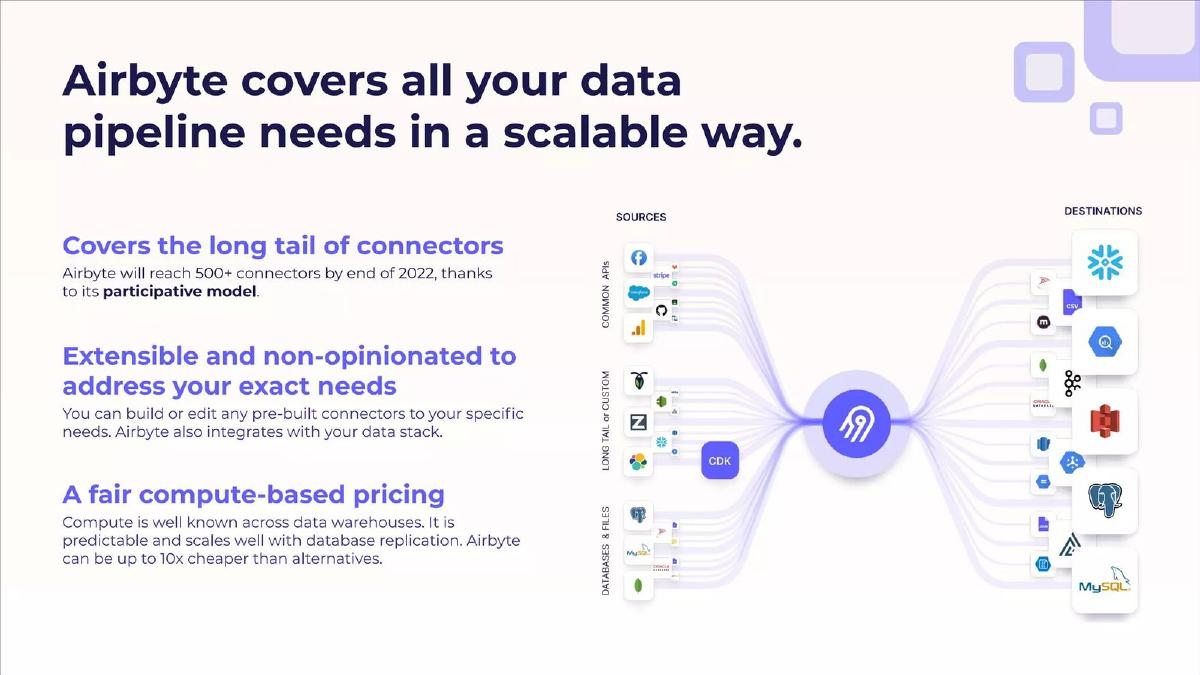
- Airbyte utilizes a participative model to scale, targeting 500+ connectors by the end of 2022 (Slide 2).
- The product offers compute-based pricing, which they claim can be up to 10x cheaper than alternatives (Slide 2).
- Development velocity is a core metric, showing a progression from MVP to a $26M Series A within three quarters (Slide 3).
- Community contribution is visualized as a secondary growth curve starting in Q2 2021 (Slide 3).
- Market validation is demonstrated through ecosystem 'acknowledgment' across marketplaces and official integrations (Slide 5).
- Early monetization is teased via Airbyte Cloud, showing a waitlist and average contract/POC values (Slide 6).
- The investor slide highlights top-tier VC backing (Benchmark, Accel, YC) and strategic angel investors from major data companies (Slide 9).
Airbyte Series B: The Open-Source Data Integration Standard
Airbyte’s Series B deck is a study in momentum. In the world of data engineering, the 'Extract, Load, Transform' (ELT) market is crowded, yet Airbyte managed to carve out a dominant position by leveraging open-source community dynamics. This teardown examines how they presented their rapid growth and technical roadmap to secure late-stage funding.
Slide 1: The Vision Statement
The cover slide is minimalist, featuring the Airbyte logo and the tagline: "The next standard for all data integration." By using the word 'standard,' Airbyte signals that they are not just another tool, but a foundational layer of the modern data stack. The background graphic, showing a grid of logos including Stripe, Salesforce, and Slack, visually represents the breadth of the problem they are solving: the fragmentation of data sources.
Slide 2: The Scalability Thesis
Slide 2 addresses the 'why' behind their model. It breaks down the value proposition into three pillars: Covers the long tail of connectors , Extensible and non-opinionated , and Fair compute-based pricing . The most important claim here is the 'participative model,' which Airbyte asserts will allow them to reach 500+ connectors by the end of 2022 . This is a direct challenge to proprietary competitors who must build every connector in-house. They also claim to be "up to 10x cheaper than alternatives" by pricing based on compute rather than data volume, a significant pain point for enterprise data teams.
Slide 3: The Velocity Roadmap
This slide is a dense timeline of the year leading up to the Series B. It tracks two concurrent growth curves: the number of connectors and the introduction of core features. Key milestones include a $5.2M Seed in Q1 2021 and a $26M Series A in Q2 2021. The slide highlights technical shipping speed, noting the addition of 'Change Data Capture,' 'dbt transformation support,' and 'First-class K8 support.' A secondary blue line at the bottom tracks contributions "from contributors," showing that the community started significantly augmenting the core team's output by mid-2021.
Slide 4: Usage and Retention
Slide 4 focuses on daily active usage. The headline states, "Already X of them sync data at least once a day." While the number is redacted, the chart shows a classic exponential growth curve starting in April and accelerating through October. The inclusion of 'LOGO' placeholders indicates where they showcased specific high-profile companies that have integrated the tool into their daily workflows. This slide is intended to prove that the software isn't just being downloaded; it is being used for production-grade data pipelines.
Slide 5: Ecosystem Validation
To reinforce the 'standard' narrative, Slide 5 shows how the broader industry has reacted. It categorizes validation into three buckets: Featured in Marketplace , Expanding Airbyte's catalog , and Official connectors / integrations . This is a 'social proof' slide, demonstrating that other platforms are now building toward Airbyte, rather than Airbyte always having to build toward them.
Slide 6: The Commercial Transition
Slide 6 introduces Airbyte Cloud , their primary monetization engine. Even in an 'invite-only' phase, the deck highlights a waitlist of 'X' companies and an 'Average contract/POC value' of '$Xk.' Below this, they list five noteworthy prospects or customers with their projected yearly spend. This slide is crucial for a Series B; it proves that the massive open-source top-of-funnel can be converted into high-value enterprise revenue.
Slides 7 & 8: Transition and Appendix
Slide 7 ( Our Ambitions ) and Slide 8 ( Appendix ) serve as section breaks. They feature the company's mascot, an octopus, in various poses. While these slides contain no data, they maintain the brand's friendly, developer-centric aesthetic, which is a hallmark of successful modern OSS (Open Source Software) companies.
Slide 9: The Investor Pedigree
The final slide in this set is a 'who's who' of the data world. It lists Benchmark , Accel , and YC as institutional backers. More impressively, it lists individual investors who are CEOs or founders of the very companies Airbyte integrates with or mimics in business model: Calvin French-Owen (Segment) , Shay Banon (Elastic) , Dev Ittycheria (MongoDB) , and Robert Bearden (Cloudera) . This level of strategic backing suggests that the leaders of the previous generation of data giants believe Airbyte is the next logical step in the industry's evolution.
What Works in the Airbyte Deck
The 'Participative Model' Logic: The deck clearly explains why an open-source model is a competitive advantage in a market defined by an infinite 'long tail' of integrations. · Velocity as a Metric: By showing how much they built in just one year (Slide 3), they convince investors that the team is capable of maintaining a 'blitzscaling' pace. · Pricing Disruption: Explicitly stating they are 10x cheaper (Slide 2) identifies a clear wedge to displace incumbents like Fivetran or Stitch. · Strategic Social Proof: The investor slide isn't just about money; it's about the endorsement of the most successful people in the specific sector Airbyte occupies.
What is Omitted
The Financial 'Ask': The specific amount raised in the Series B and the valuation targets are not present in these slides. · Unit Economics: While they mention contract values, there is no data on the cost of acquisition (CAC) or the churn rate for the Cloud product. · Competitive Landscape: The deck focuses entirely on Airbyte's growth without a slide dedicated to how they specifically beat named competitors in a head-to-head feature comparison. · Team Slide: The core operational team (beyond the investors) is not detailed in this 9-slide selection.
Founder Takeaways
Sell the 'Standard,' not the 'Tool': Airbyte doesn't pitch itself as a way to move data; it pitches itself as the standard for moving data. For Series B and beyond, you are selling a market position, not just a product.
Visualize the Community: If you are an open-source company, your community is your greatest asset. Airbyte’s Slide 3, which separates 'core' progress from 'contributor' progress, is a perfect way to show that the company has reached escape velocity where the world is helping them build the product.
Address Monetization Early: Even if your revenue is small compared to your user base, showing a waitlist and POC (Proof of Concept) values (Slide 6) proves that the 'free' users are willing to pay for managed services, de-risking the investment for VCs.
Frequently asked questions
- What is Airbyte's core value proposition according to the deck?
- Airbyte positions itself as a scalable, extensible, and non-opinionated open-source ELT (Extract, Load, Transform) solution. According to Slide 2, its primary advantages are covering the 'long tail' of data connectors through a community-driven model and offering compute-based pricing that is significantly more cost-effective—up to 10x cheaper—than traditional volume-based competitors.
- How does Airbyte plan to compete with established data integration players?
- The strategy relies on the 'participative model.' Slide 2 explains that by allowing users to build or edit connectors, Airbyte can reach a volume of integrations (500+) that proprietary companies struggle to maintain. This community-led growth is intended to make Airbyte the 'new standard' by being more flexible and comprehensive than closed-source alternatives.
- What evidence of traction does the deck provide?
- Traction is presented through three lenses: technical milestones, community growth, and commercial interest. Slide 3 tracks the rapid release of features like K8 support and dbt integration. Slide 4 shows an exponential curve of daily active syncs, while Slide 6 highlights a waitlist for their Cloud product and early yearly contract values (though specific figures are redacted in this version).
- Who are the key investors mentioned in the Series B deck?
- Airbyte showcases a high-pedigree investor base on Slide 9. Institutional backers include Benchmark, Accel, and Y Combinator. Strategic individual investors include founders and CEOs from major data infrastructure companies: Calvin French-Owen (Segment), Shay Banon (Elastic), Dev Ittycheria (MongoDB), Robert Bearden (Cloudera), and Auren Hoffman (LiveRamp).
- What is missing from these specific slides?
- This selection of slides omits the specific 'Ambitions' (Slide 7) and the detailed 'Appendix' (Slide 8). Crucially, the 'Ask' slide—detailing the exact amount being raised and the intended use of funds—is not included in this 9-slide set. Additionally, specific financial metrics like MRR or burn rate are replaced with placeholders, which is common in public-facing teardowns of private decks.