Airbyte’s seed deck positions the company as a disruptor in the data integration space by utilizing an open-source model to address the 'long tail' of data connectors. The narrative centers on the failure of existing solutions, which Airbyte claims cover less than 2% of needed connectors, leading to high internal maintenance costs for engineering teams. By offering an extensible, open-source EL(T) platform, Airbyte aims to commoditize data integration and shift pricing from volume-based to feature-based models. The deck leans heavily on the founding team's pedigree, specifically their experie…
Key takeaways
- Airbyte defines itself as a 'Simple & extensible Open-source EL(T)' platform on slide 1.
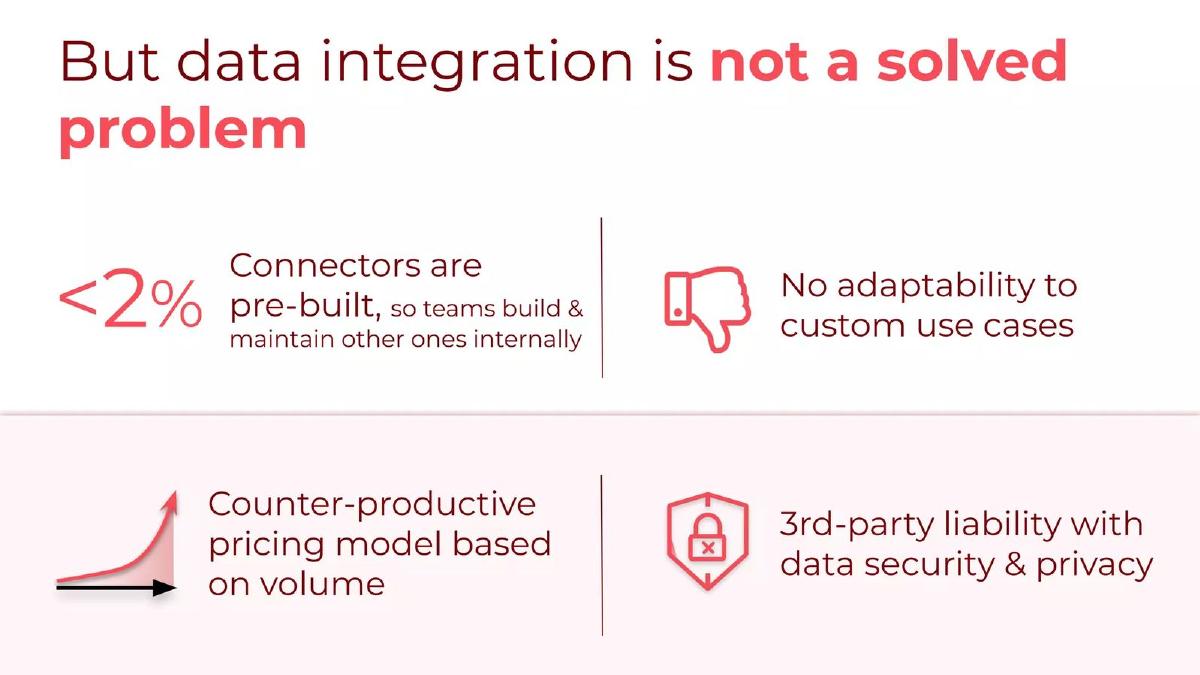
- The problem slide (Slide 2) asserts that less than 2% of connectors are pre-built in the current market, forcing teams to build the rest manually.
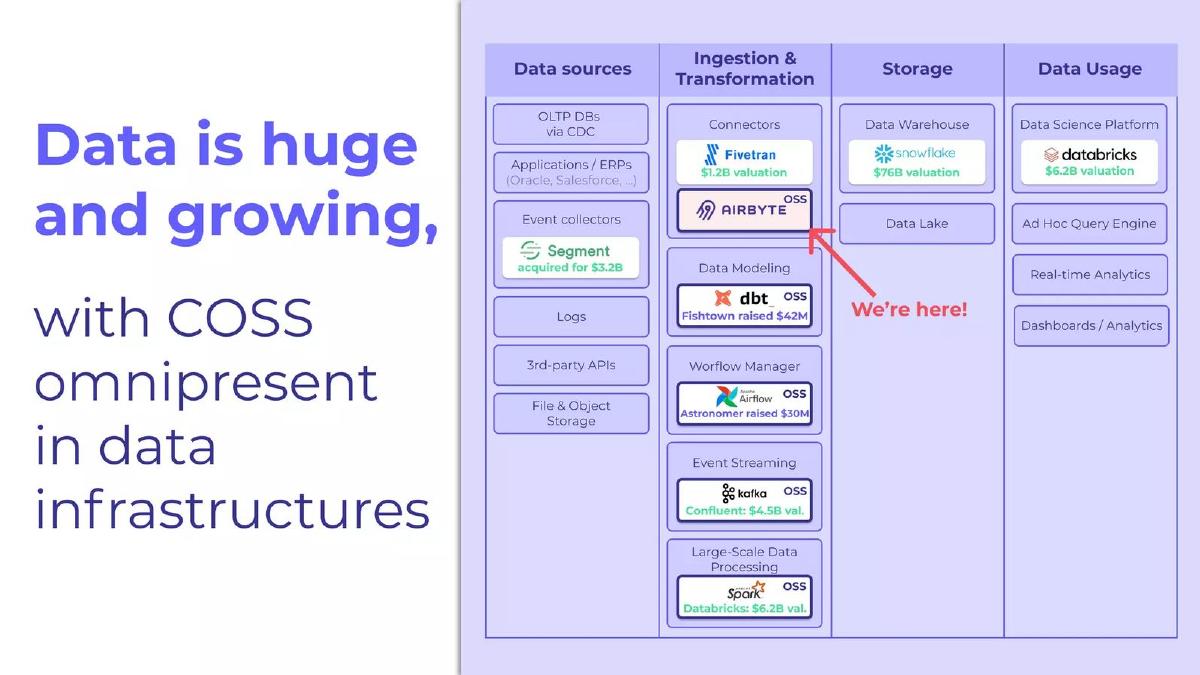
- Slide 3 proposes that open-source is the key to commoditizing data integration and solving the 'long tail' connector problem.
- The team slide (Slide 4) highlights a collective background from LiveRamp (NYSE: RAMP) and rideOS, emphasizing deep domain expertise.
- Slide 5 outlines a quarterly roadmap from Q4 2020 to Q1 2022, though specific feature names and engineer counts are redacted as 'X'.
- A deployment chart on slide 7 shows consistent weekly growth from October 19 to December 15, though absolute numbers are omitted from the Y-axis.
- The investor slide (Slide 8) confirms backing from 8VC and Y Combinator, along with individuals from Samba TV, Airbnb, and Netflix.
- The deck explicitly critiques volume-based pricing models as 'counter-productive' on slide 2, advocating for feature-based pricing instead.
Slide-by-Slide Analysis
Slide 1: Title Slide
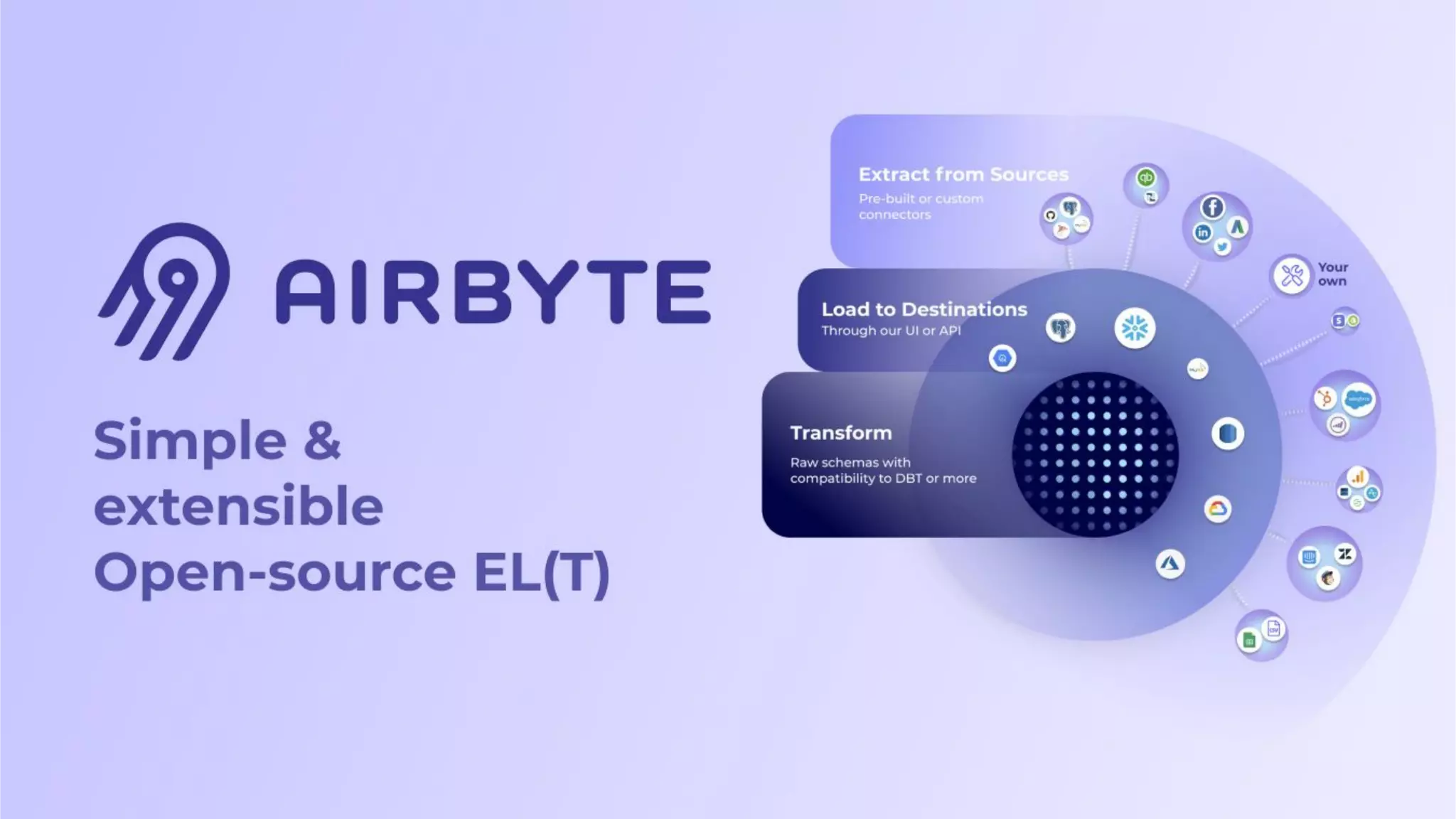
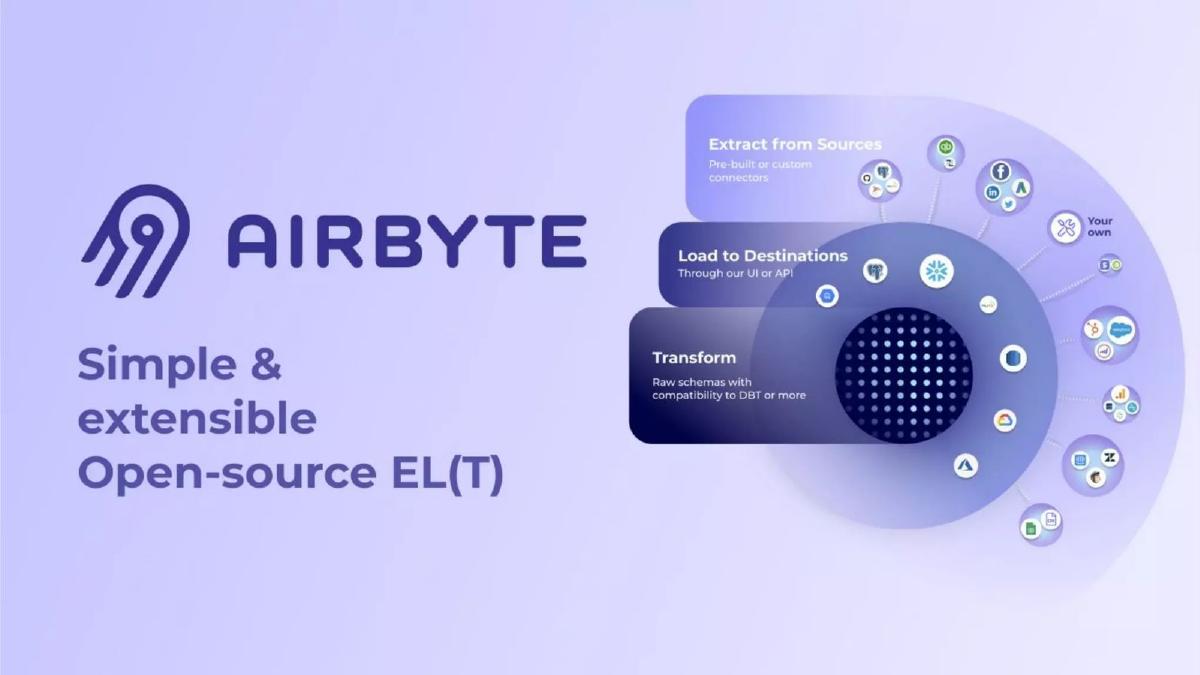
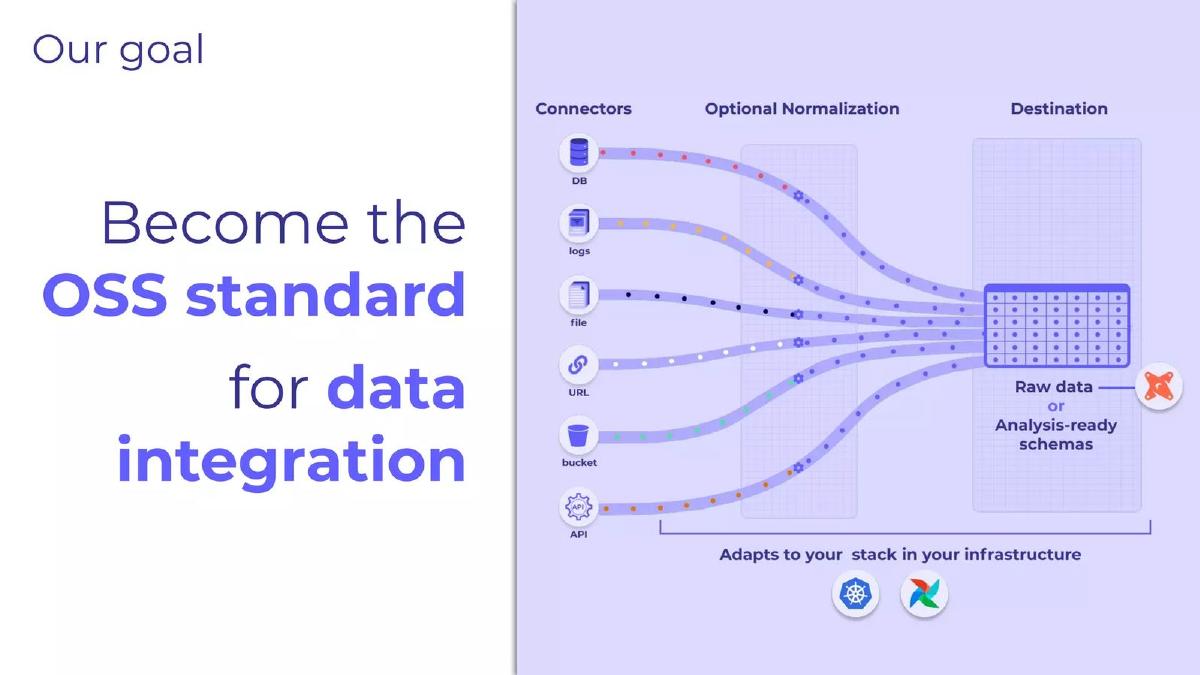
The deck opens with a clean, minimalist title slide. The company name, Airbyte , is accompanied by a logo and the tagline: Simple & extensible Open-source EL(T) . The visual focuses on a circular diagram showing the flow from 'Extract from Sources' (pre-built or custom connectors) to 'Load to Destinations' (via UI or API) and finally 'Transform' (raw schemas with DBT compatibility). This immediately establishes the product's position in the modern data stack.
Slide 2: The Problem
This slide argues that data integration is not a solved problem . It lists four specific pain points:
<2% Connectors are pre-built : This forces engineering teams to build and maintain the remaining 98% internally. · No adaptability : Existing tools lack the flexibility for custom use cases. · Pricing : A 'Counter-productive pricing model based on volume' that punishes users for growing their data. · Security : '3rd-party liability with data security & privacy' when using closed-source SaaS providers.
Slide 3: The Solution (Open-Source)
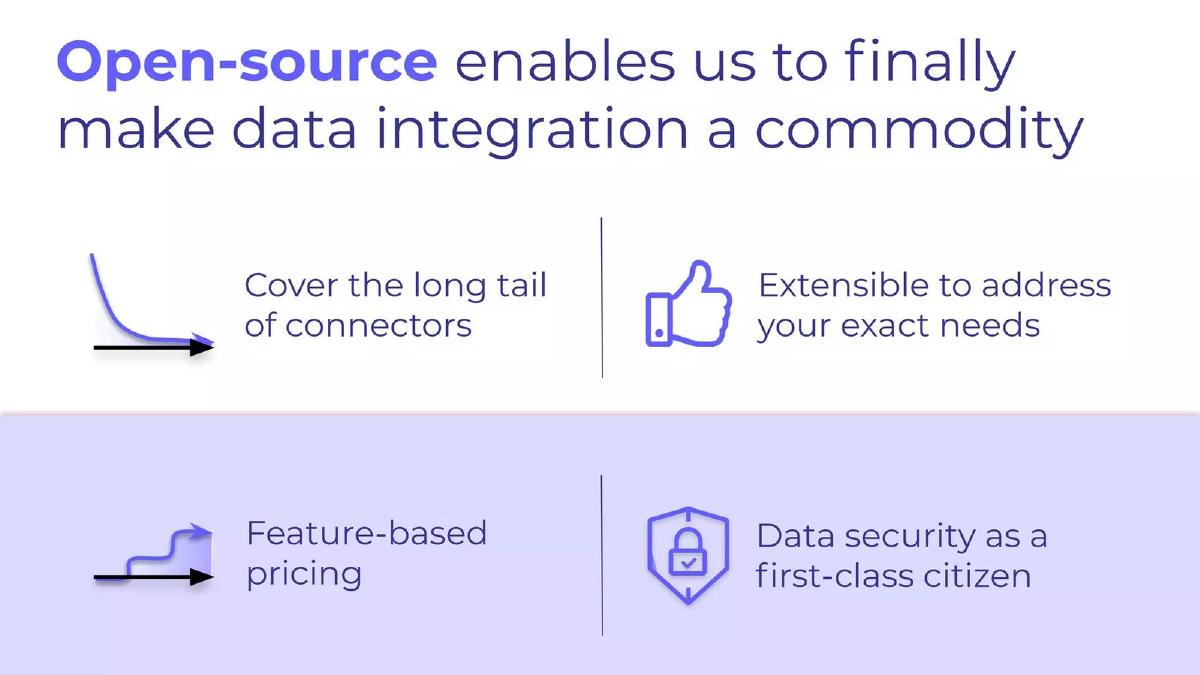
Airbyte presents Open-source as the catalyst to commoditize data integration. The slide mirrors the layout of the problem slide to show direct solutions:
Long tail : Open-source allows the community to cover the long tail of connectors. · Extensible : The platform can be modified to address exact user needs. · Feature-based pricing : A shift away from volume-based costs. · Security : Data security is treated as a 'first-class citizen,' likely referring to the ability to host the solution on-premise or within a private cloud.
Slide 4: The Team
The headline The team that built LiveRamp is a high-authority signal. It lists six team members:
Michel Tricot : Head of integration at LiveRamp & rideOS. · John Lafleur : Serial entrepreneur (3 startups, 2 exits). · Shrif Nada, Jared Rhizor, Charles Giardina : Technical leads with backgrounds at LiveRamp and rideOS. · Chris Duong : Head of data at Comet.
The slide also mentions LiveRamp [NYSE: RAMP] and rideOS ($35M - Sequoia) to reinforce the team's history of building and scaling successful ventures.
Slide 5: Roadmap
This slide provides a quarterly outlook from Q4 20 to Q1 2022 . However, it is a template-style slide with placeholders. It categories goals into Product (Main features and X connectors), Team (X engineers), KPI (KPI 1, 2, 3), and Cash in bank (X EOQ). While the specific targets are redacted in this version, the structure shows a commitment to tracking engineering headcount and runway without revenue dependencies.
Slide 6: Appendix
A simple transition slide titled Appendix . This indicates that the primary narrative has concluded and the following slides provide supporting data.
Slide 7: Traction (Our deployments)
This slide displays a bar chart showing weekly deployment growth from October 19 to December 15. The bars show a consistent upward trend. To the right, there are placeholders for Company name repeated ten times, suggesting that in the live pitch, these would be populated with recognizable logos or names of early adopters using the software.
Slide 8: Our investors
The final slide showcases the cap table. It prominently features 8VC and YC (Y Combinator) . It also includes three placeholders for individual 'Investor Names' who are described as 'Founder of X, CEO of Y.' Below these, it lists logos of companies where other investors originate, including Samba TV, Tango, Airbnb, and Netflix . This builds social proof by associating the startup with major tech brands.
What Works Well
The 'Founder-Market Fit' Narrative: By highlighting that the team 'built LiveRamp,' Airbyte bypasses the need to prove they understand the technical complexities of data integration. LiveRamp is a massive player in data connectivity, making this team an obvious choice for investors in this sector.
Clear Differentiation: The deck doesn't just say they are 'better'; it identifies a structural flaw in the market (the 2% connector coverage) and proposes a structural solution (open-source). This makes the 'why now' and 'why us' very clear.
Visual Simplicity: The slides are not cluttered. They use icons and short bullet points to convey complex infrastructure concepts, making the deck readable in under three minutes.
What Is Missing
Specific Metrics: The roadmap and traction slides in this version are heavily redacted. While this is common for public versions of decks, the lack of absolute numbers for deployments or connector counts makes it difficult to gauge the actual velocity of the project at the time of the seed round.
The Ask: There is no slide detailing the amount of capital sought, the primary use of funds (e.g., hiring vs. marketing), or the milestones the founders expect to hit with the new capital.
Competitive Landscape: While the deck critiques the 'status quo' of data integration, it does not explicitly name or compare itself to incumbents like Fivetran or Stitch. A slide showing how Airbyte stacks up against these specific competitors on a feature-by-feature basis would strengthen the case for technical users.
Founder Takeaways
Leverage Your Pedigree: If your team has built a successful product in the same industry, make that the centerpiece of your deck. Airbyte’s team slide is arguably their strongest asset, as it reduces the perceived execution risk for investors.
Identify a 'Structural' Problem: Don't just complain about features; complain about the business model. Airbyte’s critique of volume-based pricing and the 'long tail' problem suggests that the entire industry is built on a flawed foundation, which justifies a new, disruptive approach.
Use the Appendix Wisely: Keeping the main deck to 5-6 core slides and moving traction and investor lists to an appendix (or the end of the deck) keeps the narrative tight while still providing the 'proof' for interested parties.
Frequently asked questions
- What is Airbyte's core value proposition according to the deck?
- Airbyte positions itself as an open-source EL(T) platform that makes data integration a commodity. By being open-source, it allows users to build and maintain their own connectors, addressing the 'long tail' of data sources that proprietary vendors ignore. This approach aims to eliminate the need for teams to build internal systems and moves away from expensive volume-based pricing.
- How does Airbyte differentiate its pricing model from competitors?
- On slide 2, Airbyte identifies volume-based pricing as a major pain point, calling it 'counter-productive.' In response, slide 3 indicates they intend to implement 'Feature-based pricing.' This suggests a strategy where basic data movement might be commoditized or free, while advanced enterprise features or management tools drive revenue.
- What evidence of market traction is provided in the slides?
- Slide 7 provides a bar chart titled 'Our deployments,' showing weekly growth over a two-month period (Oct 19 to Dec 15). While the Y-axis lacks specific numerical values, the visual trend indicates a steady increase in usage. The slide also includes placeholders for 'Company name,' suggesting they had a list of early adopters to share with investors.
- Who are the key members of the Airbyte founding team?
- The team is led by Michel Tricot (former Head of Integration at LiveRamp) and John Lafleur (a serial entrepreneur with two exits). Other key technical leads include Shrif Nada, Jared Rhizor, and Charles Giardina, all of whom share a background at LiveRamp or rideOS, establishing a strong 'founder-market fit' for data infrastructure.
- What is missing from this version of the Airbyte seed deck?
- The deck is missing a specific 'Ask' slide detailing how much capital is being raised and the valuation. It also uses placeholders ('X') for its roadmap KPIs, engineer hiring targets, and cash runway. Furthermore, there is no detailed breakdown of unit economics or a competitive landscape matrix beyond the general critique of existing integration tools.