Airbyte’s Series A deck is a masterclass in leveraging open-source momentum to justify a significant capital injection. By framing the problem as a failure of closed-source and cloud-based incumbents to handle the 'long tail' of data connectors, Airbyte positions itself as the inevitable infrastructure layer for modern data teams. The deck leans heavily on community metrics—Slack users, GitHub contributions, and newsletter growth—to demonstrate product-market fit before revenue. With a team comprised of former LiveRamp and Fivetran engineers, the narrative transitions from technical capabilit…
Key takeaways
- The deck identifies that closed-source competitors only support 150 connectors out of a potential 10k+, leaving 98% of the market underserved (Slide 2).
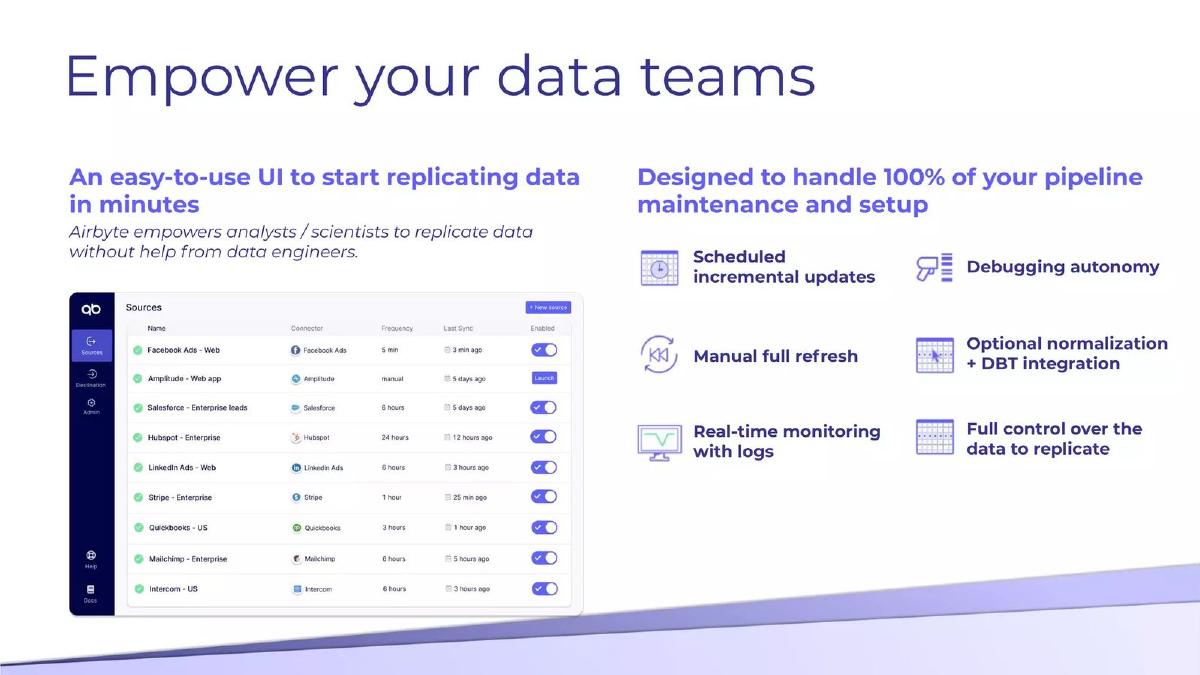
- Airbyte positions its UI as a tool that empowers analysts and scientists to replicate data without needing data engineers (Slide 3).
- The founding team highlights deep industry pedigree, featuring the 'team that built LiveRamp' and the first Fivetran engineer in India (Slide 4).
- Community growth is the primary proxy for traction, showing weekly Slack active users approaching 500 and GitHub issues/PRs scaling rapidly since October (Slide 8).
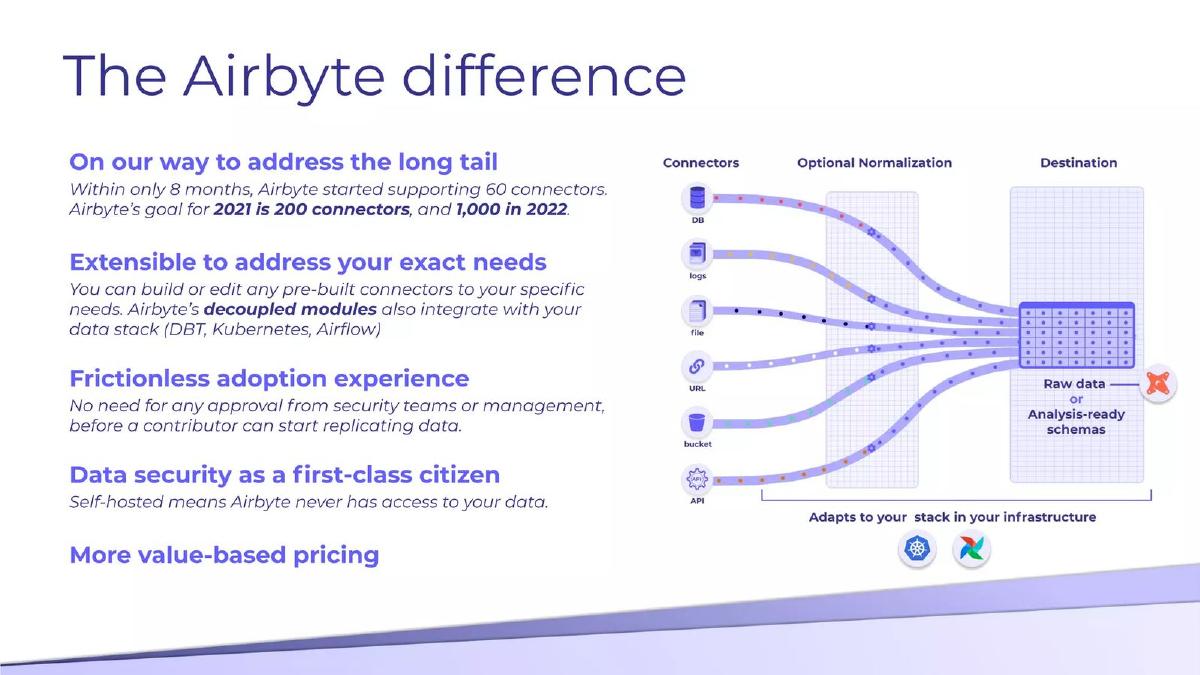
- The company achieved 60+ pre-built connectors in just 8 months, compared to 34 for Meltano over 2 years (Slide 7).
- The funding ask is $25M, specifically to optimize for velocity and become the standard for EL(T) adoption (Slide 6).
- Airbyte differentiates itself by allowing integrations to be built in any language via a low-code framework (Slide 7).
- The deck omits specific revenue figures, instead using placeholders like '$XM ARR' for future goals (Slide 6).
Airbyte Series A Teardown: Scaling the Open-Source Data Standard
Airbyte’s Series A pitch deck is a focused argument for why an open-source approach is the only way to solve the data integration problem at scale. The deck moves quickly from the structural failures of current market leaders to Airbyte's rapid community-led growth. By emphasizing the 'long tail' of data connectors, Airbyte makes a case for a platform that is not just a tool, but a new industry standard.
Slide 1: The Vision Statement
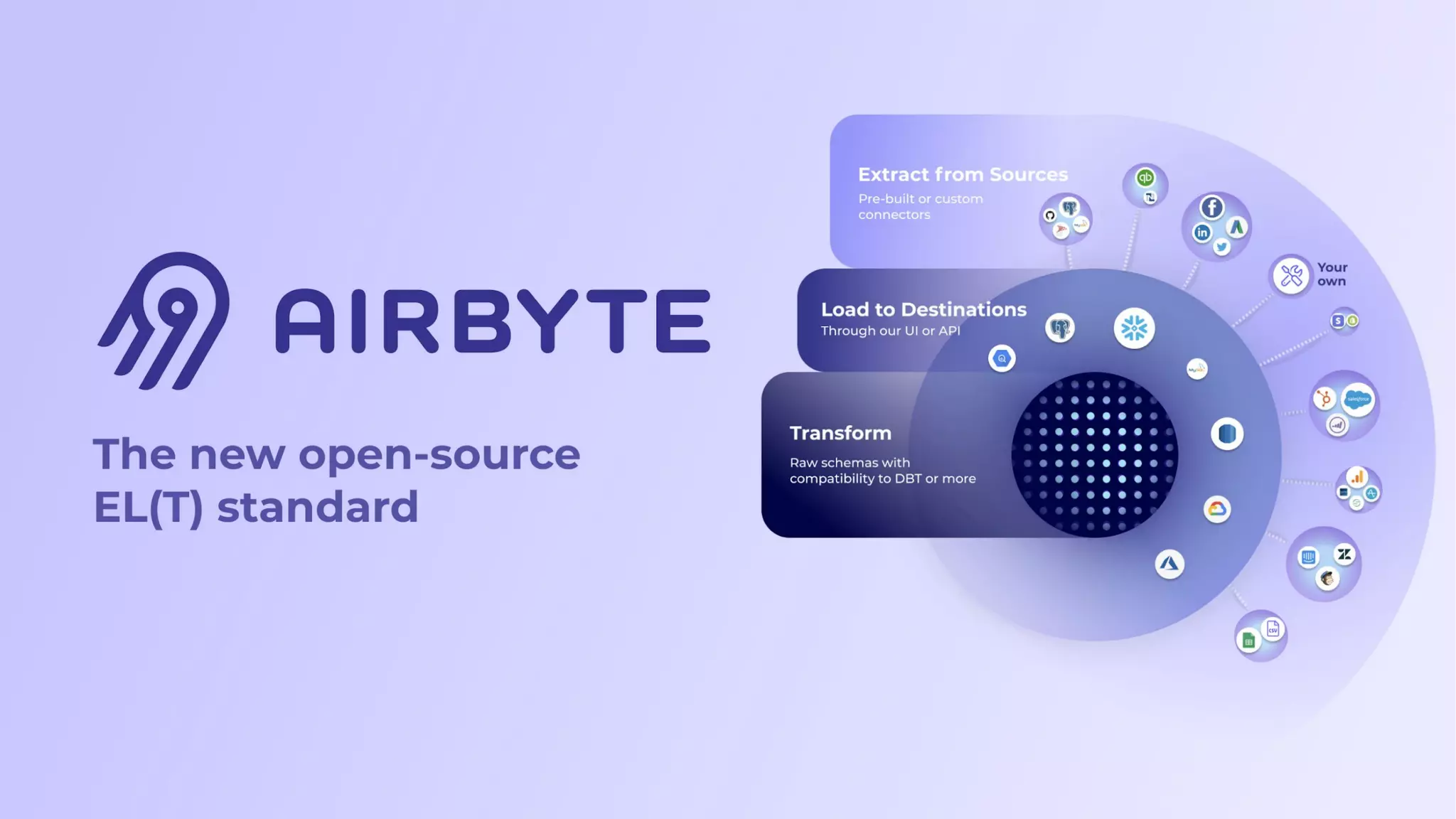
The cover slide establishes Airbyte as 'The new open-source EL(T) standard.' The visual diagram on the right illustrates the core product function: extracting from sources (pre-built or custom), loading to destinations (via UI or API), and transforming data (compatible with DBT). The inclusion of logos for Salesforce, Stripe, Snowflake, and others immediately signals the product's place within the modern data stack.
Slide 2: Limitations of Existing Solutions
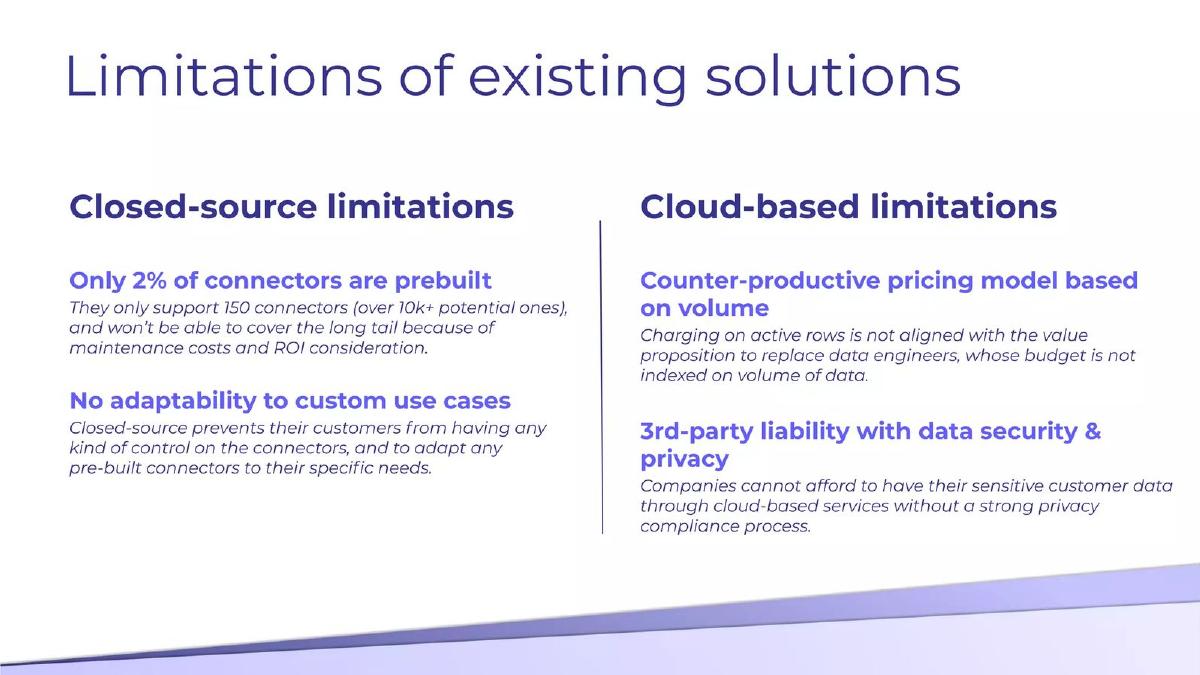
This slide serves as the 'Problem' slide, divided into two categories: closed-source and cloud-based limitations. Slide 2 claims that incumbents only support 150 connectors out of a potential 10,000+, meaning 'Only 2% of connectors are prebuilt.' It argues that closed-source models cannot afford to maintain the long tail of connectors due to ROI considerations. On the cloud side, it attacks volume-based pricing as 'counter-productive' and highlights 3rd-party liability regarding data security and privacy as a barrier for enterprise adoption.
Slide 3: Empowering Data Teams
Airbyte presents its solution as a bridge between technical and non-technical users. The slide features a screenshot of the UI, showing sources like Facebook Ads, HubSpot, and Stripe. The text states that Airbyte 'empowers analysts/scientists to replicate data without help from data engineers.' Key features listed include scheduled incremental updates, real-time monitoring with logs, and optional normalization with DBT integration. This positioning suggests a reduction in engineering bottlenecks, a high-value proposition for growing companies.
Slide 4: The Team Pedigree
The team slide is titled 'The team that built LiveRamp.' This is a powerful appeal to authority in the data space. It lists Michel Tricot (CEO) and John Lafleur (COO), along with six Lead Engineers and four Senior Engineers. Notable highlights include Slide 4 's mention of Subodh A. as the '1st Fivetran eng. in India' and multiple leads from LiveRamp and rideOS. The slide also notes a team of '~12 contractors' dedicated to frontend and connectors, showing a commitment to rapid development.
Slide 5 & 9: Production Usage and Traction
These slides focus on user growth. Slide 5 and Slide 9 show a bar chart of 'Prod users' and 'Users having synced data' from October to April. While the Y-axis lacks specific numerical values, the visual trend is a steep exponential curve. The right side of the slide lists 'Company name' placeholders, indicating where specific customer logos were likely presented in the live version of the deck to demonstrate social proof.
Slide 6: The $25M Ask
The 'ideal Series-A scenario' is explicitly stated as a $25M investment. The goals for this capital are clearly defined: optimize for velocity, become the standard for EL(T) adoption, and build the 'biggest developer community around data integration.' Interestingly, the slide uses placeholders for financial targets, aiming to 'Get to $XM ARR before Series-B.' This suggests the round was raised on the strength of the open-source community and product velocity rather than existing revenue milestones.
Slide 7: Competitive Landscape in OSS
Airbyte compares itself directly to Singer and Meltano. The table on Slide 7 claims Airbyte produced '60+ [connectors] in just 8 months,' whereas Singer has '96 mostly out of date' and Meltano has '34 after ~2 years.' Airbyte also differentiates itself by supporting any programming language for new integrations and having a significantly larger full-time team (20 members) compared to Meltano (3 maintainers).
Slide 8: Community Growth Metrics
For an open-source company, community is the leading indicator of success. Slide 8 provides three charts: Weekly Slack active users (approaching 500), GitHub contributions (showing a surge in both issues and pull requests), and Newsletter subscribers (scaling from near zero to nearly 600 in six months). These metrics demonstrate that the project has captured developer mindshare, which is critical for the 'standard' status they seek.
What Airbyte Does Well
Focus on the 'Long Tail': By identifying the 98% of connectors that incumbents ignore, Airbyte creates a massive, defensible niche that only an open-source community can realistically fill.
Team Credibility: The deck leans heavily on the fact that the team has 'been there, done that' at LiveRamp and Fivetran. In a technical infrastructure play, this domain expertise is often more important than early revenue.
Velocity as a Moat: The comparison slide with Meltano and Singer uses speed of development (60 connectors in 8 months) as a primary differentiator, suggesting that Airbyte is out-executing the market.
What is Missing from the Deck
Revenue and Unit Economics: The deck is almost entirely devoid of financial data. While common for early-stage open-source companies, the use of '$XM ARR' as a future goal confirms that the Series A was likely a 'pre-revenue' or 'early-revenue' round based on adoption metrics.
Market Size (TAM): There is no slide dedicated to the Total Addressable Market. The founders assume the investor understands the massive scale of the data integration market, focusing instead on why their specific approach will win it.
Monetization Strategy: While the deck mentions cloud-based limitations, it does not explicitly detail how Airbyte will eventually charge users (e.g., open-core, managed service, or enterprise features).
Founder Takeaways: What to Copy
Use Community as Traction: If you are building open-source or developer tools, follow Airbyte's lead by showing GitHub PRs, Slack activity, and contributor growth. These are the 'revenue' of the developer world.
Define the 'Standard': Airbyte doesn't just want to be a tool; they want to be the 'standard.' Framing your product as the inevitable infrastructure layer of your industry helps justify larger rounds and higher valuations.
Direct Competitive Comparison: Don't be afraid to name names. The table on Slide 7 is effective because it uses objective metrics (number of connectors, team size) to show why Airbyte is a better bet than its immediate rivals.
Frequently asked questions
- What is the primary problem Airbyte aims to solve?
- According to Slide 2, Airbyte addresses the limitations of closed-source and cloud-based data integration tools. Specifically, it notes that incumbents only cover 2% of potential connectors (150 out of 10,000+) because maintenance costs make the 'long tail' unprofitable for them. Additionally, it cites counter-productive volume-based pricing and data security liabilities as major pain points for existing solutions.
- How does Airbyte plan to use the $25M Series A investment?
- Slide 6 outlines the 'ideal Series-A scenario.' The funds are intended to optimize for velocity to ensure Airbyte becomes the industry standard for EL(T). Key objectives include building the largest developer community around data integration and reaching a target ARR (noted as $XM) before the Series B by scaling the internal team and contractor network.
- Who are the key competitors mentioned in the deck?
- Slide 7 provides a direct comparison with two other open-source projects: Singer and Meltano. Airbyte highlights its advantages in connector count (60+ in 8 months), ease of use for non-engineers via a UI, and a larger committed team (20 full-time members) compared to Meltano's 3 maintainers.
- What evidence of traction does the deck provide?
- The deck focuses on community and usage metrics rather than revenue. Slide 8 shows exponential growth in weekly Slack active users, GitHub contributions (issues and pull requests), and newsletter subscribers from October to April. Slide 9 displays a bar chart of 'prod users' and 'users having synced data,' showing a sharp upward trend over the same period.
- What is the technical advantage of Airbyte's connector model?
- Slide 7 highlights that Airbyte allows developers to build new integrations in any language using a low-code framework. This is contrasted with Singer, where building is described as 'as hard as building it by yourself,' and Meltano, which uses a specific low-code framework but has fewer connectors.