The AirBed&Breakfast (now Airbnb) pitch deck is frequently cited as the gold standard for seed-stage presentations due to its extreme brevity and clarity. The deck identifies a massive market opportunity of 2 billion+ annual trips (Slide 5) and proposes a simple 10% commission model (Slide 7). By positioning themselves at the intersection of 'Affordable' and 'Online Transaction' (Slide 9), the founders successfully carved out a niche that traditional hotels and offline classifieds like Craigslist could not fill. While the provided slides omit a specific financial 'Ask' or detailed roadmap, th…
Key takeaways
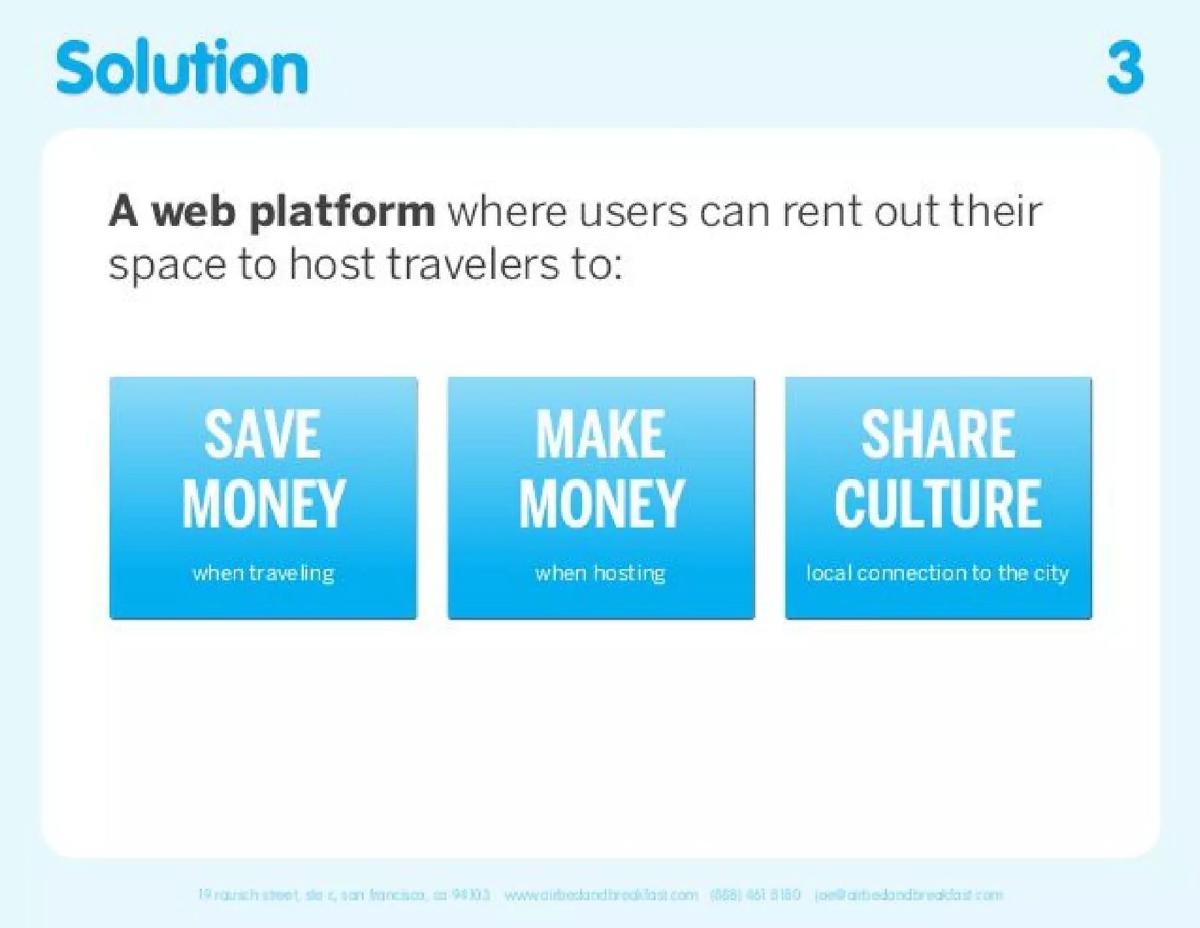
- The deck uses a clear three-pillar solution: Save Money, Make Money, and Share Culture (Slide 3).
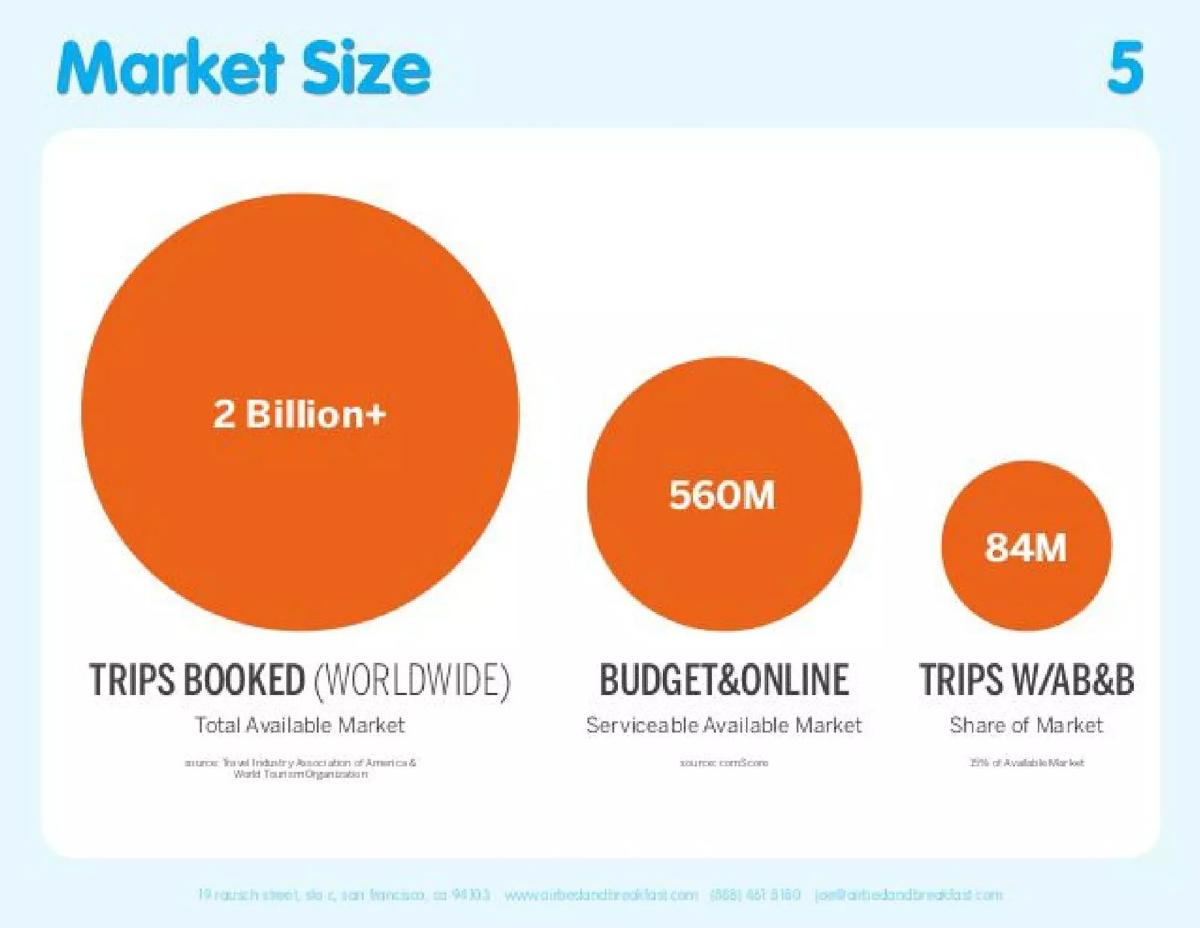
- Market sizing is broken down from a 2 Billion+ total market to a 84M share of market target (Slide 5).
- The business model is stated in a single sentence: 'We take a 10% commission on each transaction' (Slide 7).
- Revenue projections were ambitious, targeting $2.1B by 2011 based on a $25 average fee (Slide 7).
- The competitive landscape uses a 2x2 matrix to isolate the brand as the only 'Affordable' and 'Online' option (Slide 9).
- The team slide highlights specific technical achievements, such as Nathan Blecharczyk's Facebook Apps with 75,000 users (Slide 11).
- Social proof is established through four specific user testimonials from different geographic locations (Slide 13).
- The deck lacks a specific funding 'Ask' slide in the provided 8-slide sequence, though the source listing mentions a $7.2M investment outcome.
Introduction: The Blueprint for Marketplace Disruption
The AirBed&Breakfast pitch deck is perhaps the most analyzed document in venture capital history. It represents a moment in time when the 'sharing economy' was not yet a recognized term, and the idea of renting a room in a stranger's house was considered a fringe activity. The deck's primary strength lies in its ability to take a complex behavioral shift and distill it into simple, quantifiable metrics. By focusing on the economic benefits for both sides of the marketplace—saving money for guests and making money for hosts—the founders moved the conversation away from 'stranger danger' and toward financial utility.
Slide 1: Welcome and Value Proposition
The title slide introduces the original brand name, AirBed&Breakfast . The subtitle, 'Book rooms with locals, rather than hotels,' is a textbook example of a 'High-Concept Pitch.' It immediately identifies the service (booking rooms), the differentiator (with locals), and the incumbent competitor (hotels). The slide also includes contact information for Joe Gebbia at a San Francisco address, grounding the digital startup in a physical location.
Slide 3: The Three-Pillar Solution
Slide 3 defines the Solution as a 'web platform where users can rent out their space to host travelers.' The founders break the value proposition into three distinct boxes: SAVE MONEY (for travelers), MAKE MONEY (for hosts), and SHARE CULTURE (local connection). This slide is critical because it addresses the 'Why now?' factor. In a post-2008 economic climate, the financial incentives (saving and making money) were powerful drivers for adoption, while the 'culture' aspect provided the emotional hook.
Slide 5: Market Sizing (TAM, SAM, SOM)
The Market Size slide uses a visual 'bubble' approach to demonstrate scale.
Total Available Market (TAM): 2 Billion+ trips booked worldwide (Source: Travel Industry Association of America). · Serviceable Available Market (SAM): 560M trips categorized as 'Budget & Online' (Source: Comscore). · Share of Market (SOM): 84M trips, which represents 15% of the Serviceable Available Market.
This slide is effective because it starts with a massive, undeniable number and narrows it down to a specific, reachable goal that still feels significant enough to justify venture investment.
Slide 7: The 10% Business Model
Slide 7 is a masterclass in simplicity. It states: 'We take a 10% commission on each transaction.' The math is laid out horizontally: 84M (Trips) x $25 (Avg Fee) = $2.1B Revenue . The slide notes that the $25 fee is based on an average room price of $80 per night for a 3-night stay. By projecting revenue for 2011, the founders provided a clear target for investors to model against, even if the timeline was aggressive for a seed-stage company.
Slide 9: Competitive Landscape
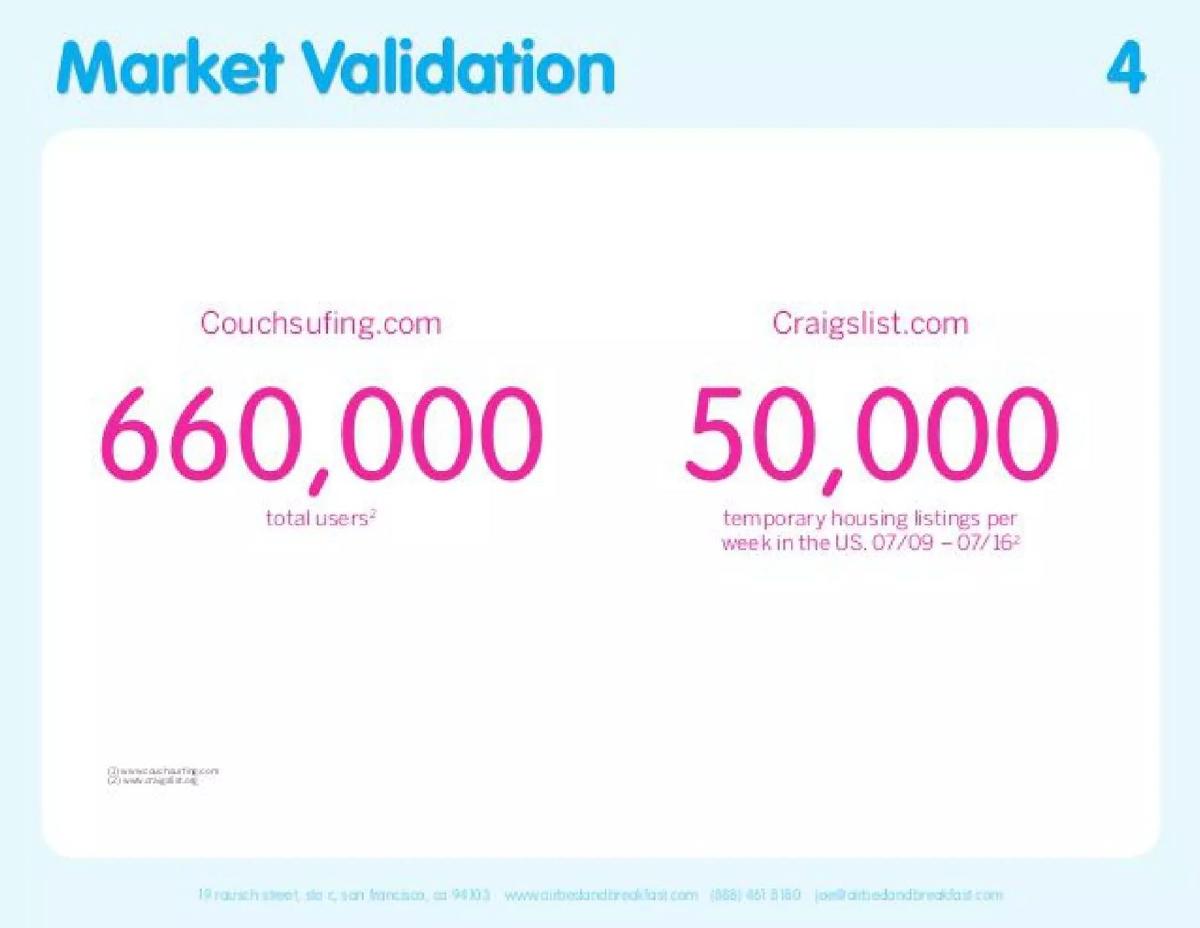
The Competition slide uses a standard 2x2 matrix. The X-axis measures 'Offline' vs. 'Online' transactions, and the Y-axis measures 'Affordable' vs. 'Expensive.' The founders placed AirBed&Breakfast in the top-right quadrant (Affordable and Online). They identified Craigslist and CouchSurfing as affordable but lacking online transaction capabilities, while Hotels.com and Orbitz were online but expensive. This positioning clearly defined their 'Blue Ocean'—a space where no other major player was currently operating.
Slide 11: The Founding Team
The Team slide highlights a balanced mix of design and technical talent. Joe Gebbia and Brian Chesky are both graduates of the Rhode Island School of Design (RISD), emphasizing the design-led nature of the product. Nathan Blecharczyk is presented as the technical powerhouse, with a Harvard CS degree and a track record of building Facebook Apps with 75,000 users. The inclusion of Michael Seibel (CEO of Justin.tv) as an advisor added significant Silicon Valley credibility to the young team.
Slide 13: User Testimonials
Slide 13 provides social proof through User Testimonials . It features four users: Jesse F. (Washington DC), Jason R. (Atlanta, GA), Emily M. (Austin, TX), and Dan A. (Ontario, Canada). The quotes emphasize different benefits: Jesse likes the 'rocks' factor, Jason highlights the 'price-range,' Emily mentions that it 'made me money,' and Dan focuses on the 'interactions' and 'people.' These testimonials proved that the concept worked across different demographics and geographies.
What Works in This Deck
The most impressive aspect of this deck is its brevity . Each slide contains a single, powerful idea. The market sizing is backed by reputable sources (Comscore, Travel Industry Association), which prevents the numbers from looking like 'founder math.' Furthermore, the business model is so simple that it requires no explanation—a 10% take rate is a standard, easily understood marketplace mechanic. The deck also successfully anticipates the biggest investor objection (safety/trust) by focusing on the financial and cultural benefits, essentially saying the reward outweighs the perceived risk.
What Is Missing
From the 8 slides provided, several key components are missing:
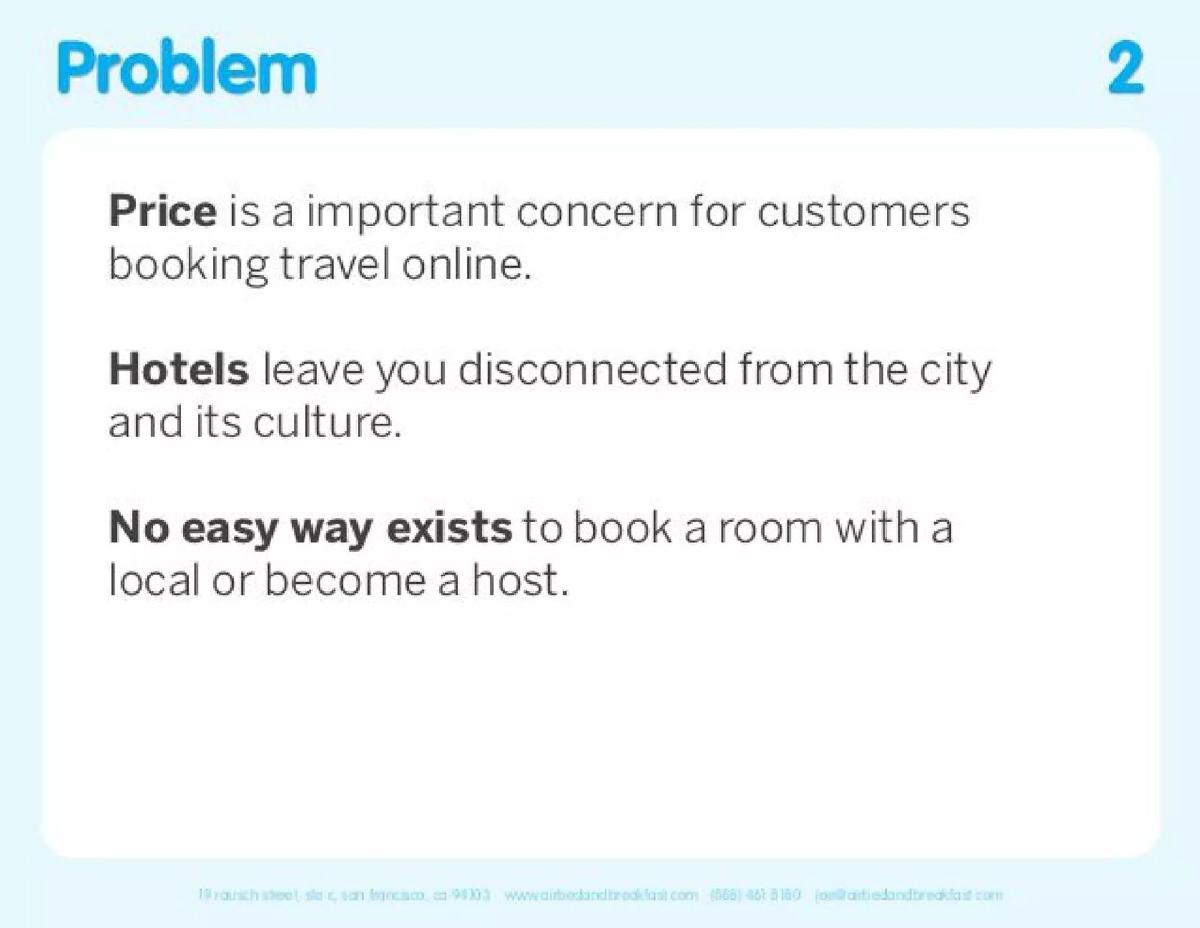
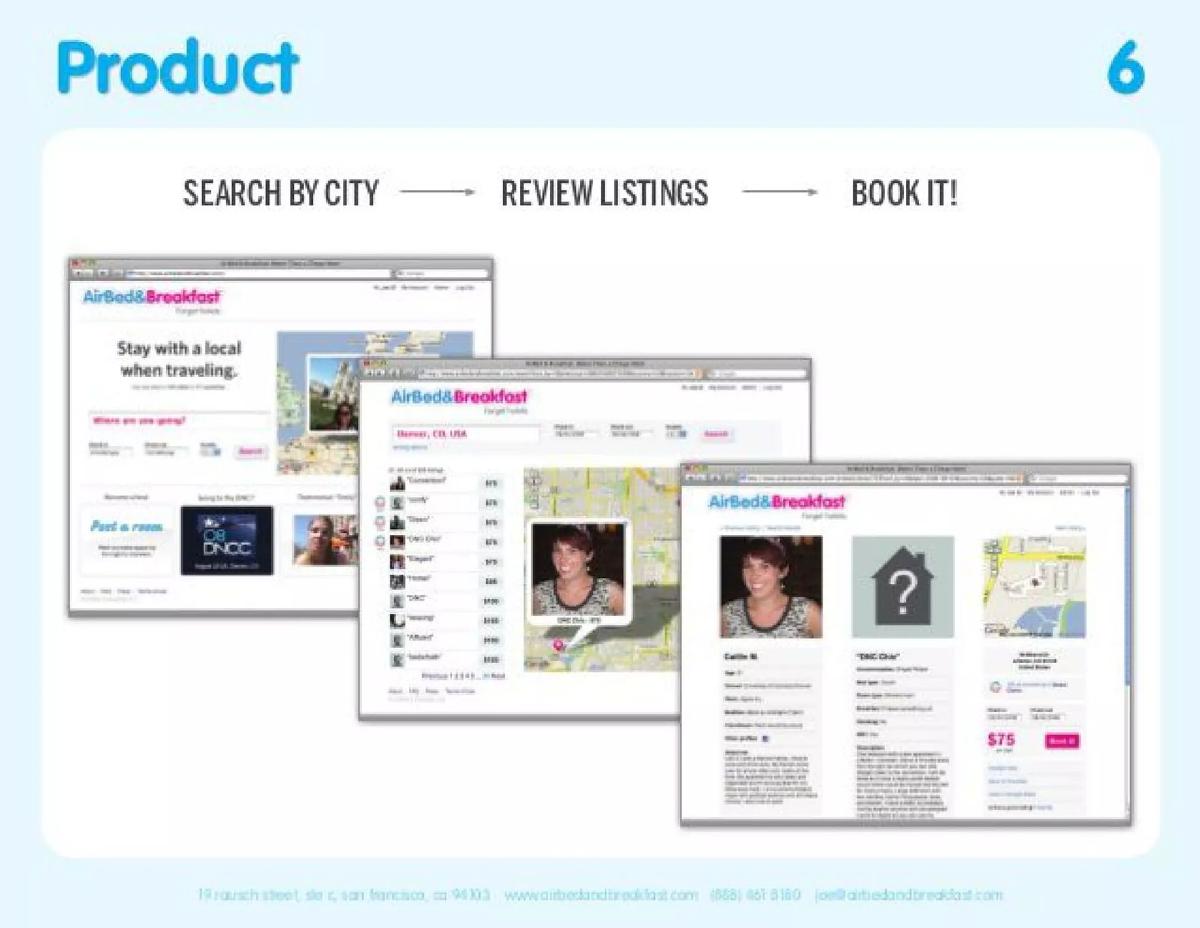
The Problem Slide: We don't see how the founders framed the pain point of expensive hotels or the lack of authentic travel experiences. · Product/Demo: There are no screenshots of the actual interface or the booking flow. · Unit Economics: While the 10% fee is clear, there is no mention of Customer Acquisition Cost (CAC) or Lifetime Value (LTV). · The Ask: The deck does not explicitly state how much money they are raising, the valuation, or the specific milestones they intend to hit with the capital. · Roadmap: There is no timeline for geographic expansion or product feature releases beyond the 2011 revenue projection.
Founder Takeaways
Founders should copy the 2x2 Competitive Matrix (Slide 9) format. It is the most efficient way to show investors that you have found a gap in the market. Additionally, the Market Size slide (Slide 5) is a perfect template for any startup; it shows scale while remaining grounded in a realistic 'Share of Market.' Finally, the Team slide (Slide 11) demonstrates how to highlight specific, quantifiable past achievements (like the number of users on a previous app) rather than just listing job titles. If your business model can't be explained in one sentence like Slide 7, it may be too complex for a seed-stage pitch.
Frequently asked questions
- What was the original name of Airbnb according to the deck?
- The company was originally pitched as 'AirBed&Breakfast,' as shown on the title slide (Slide 1) and throughout the competition and solution slides. The name reflected the initial concept of providing air mattresses and breakfast to travelers when hotels were fully booked during conferences.
- How did the founders calculate their projected revenue?
- On Slide 7, the founders projected $2.1B in revenue by 2011. This was calculated by taking their 'Share of Market' (84M trips) and multiplying it by an 'Average Fee' of $25. The fee was derived from a 10% commission on an average stay of $80 per night for 3 nights.
- Who were the primary competitors identified in the deck?
- The deck identifies two types of competitors on Slide 9. Offline/Affordable competitors included CouchSurfing and Craigslist. Online/Expensive competitors included Hotels.com, Orbitz, and VRBO. AirBed&Breakfast positioned itself as the unique intersection of affordable pricing and online transaction capabilities.
- What specific roles did the founders hold at the time of the pitch?
- According to Slide 11, Joe Gebbia focused on User Interface & PR, Brian Chesky on Business Development & Brand, and Nathan Blecharczyk served as the Developer. The slide also notes Michael Seibel, then-CEO of Justin.tv, as an advisor.
- What is missing from this version of the pitch deck?
- The provided 8 slides omit the 'Problem' slide, the 'Product' walkthrough, and the 'Financial Ask.' While the source listing mentions a $7.2M investment, the deck itself does not state how much capital is being raised or how it will be allocated among hiring, marketing, or operations.