This 13-slide Aircall deck from late 2019 is a masterclass in growth-stage narrative building, focusing on two key pillars: ecosystem density and elite retention metrics. By framing business telephony as the 'last piece of the stack to modernize,' Aircall positions itself alongside Slack and AWS as essential cloud infrastructure. The deck’s quantitative strength lies in its cohort analysis, claiming a net retention of 135%+, though it notably excludes 'micro-customers' from these figures. While it lacks transparency regarding absolute ARR and specific team details, it successfully argues for…
Key takeaways
- Aircall is positioning itself as an 'integrated voice platform' rather than just a phone system.
- The company claims a net retention rate of 135%+, indicating significant expansion within their existing customer base.
- The business model relies heavily on a growing ecosystem of over 60 third-party integrations to drive stickiness.
- Aircall identifies an $80 billion market opportunity, specifically targeting the $70 billion legacy on-premise segment.
- The company utilizes a multi-pronged GTM strategy involving inbound marketing, outbound sales for large deals, and indirect channels.
- Aircall reports a healthy unit economic profile with an LTV/CAC ratio greater than 3:1.
What this deck actually is
The Aircall deck is a Series C-stage growth narrative that emphasizes ecosystem dominance and retention dynamics over basic product utility. At 13 slides, it is an unusually lean presentation for a company reporting metrics as late as Q4 2019, suggesting it was designed as a high-level supplemental piece for investors already familiar with the SaaS VoIP space. The single most important finding in this deck is its focus on "net retention" as the primary value driver; by claiming 135%+ net retention and showcasing a cohort analysis where spending increases significantly over time, Aircall pivots from being a utility (a phone) to a platform (a data hub).
The deck is notably light on team biographies, specific revenue figures, or a detailed use-of-funds slide, focusing instead on the qualitative "ambition" and the quantitative "stickiness" of the existing user base. It relies heavily on visual momentum—using logo clouds and stacked area charts—to convey market leadership without disclosing the exact scale of the business. For a company operating in the crowded telecommunications space, this deck represents a strategic shift away from competing on "minutes and dial tones" toward competing on "integrations and insights."
Slide-by-slide walkthrough
Slide 1: Title Slide
The title slide is minimalist, featuring the "aircall" logo in a lowercase, sans-serif font against a green and white background with abstract curved shapes. The design is modern and clean, utilizing a two-tone green palette that becomes the signature brand identity throughout the deck. There is no subtitle, no date, no location, and no specific "Series X" labeling. The company website, "aircall.io," is absent on this specific page but appears as a footer on almost every subsequent slide.
For an investor, this slide serves as a branding stake. It establishes the visual identity—clean, modern, and professional. Because it lacks a "hook" or a summary sentence, it relies entirely on the brand recognition Aircall had built by late 2019. The abstract shapes suggest movement and fluidity, which aligns with the "modern business" theme mentioned later in the deck. However, the lack of a tagline means the company loses the first opportunity to define its category before the presentation begins.
The strongest version of this slide would include a one-sentence value proposition. While the logo is recognizable to some, adding "The Integrated Voice Platform for Modern Business" directly onto the cover would immediately frame the conversation. Including the current month and year would also provide necessary temporal context for the data that follows, especially given that the deck contains data points reaching into "Q4 2019."
Slide 2: Our Ambition
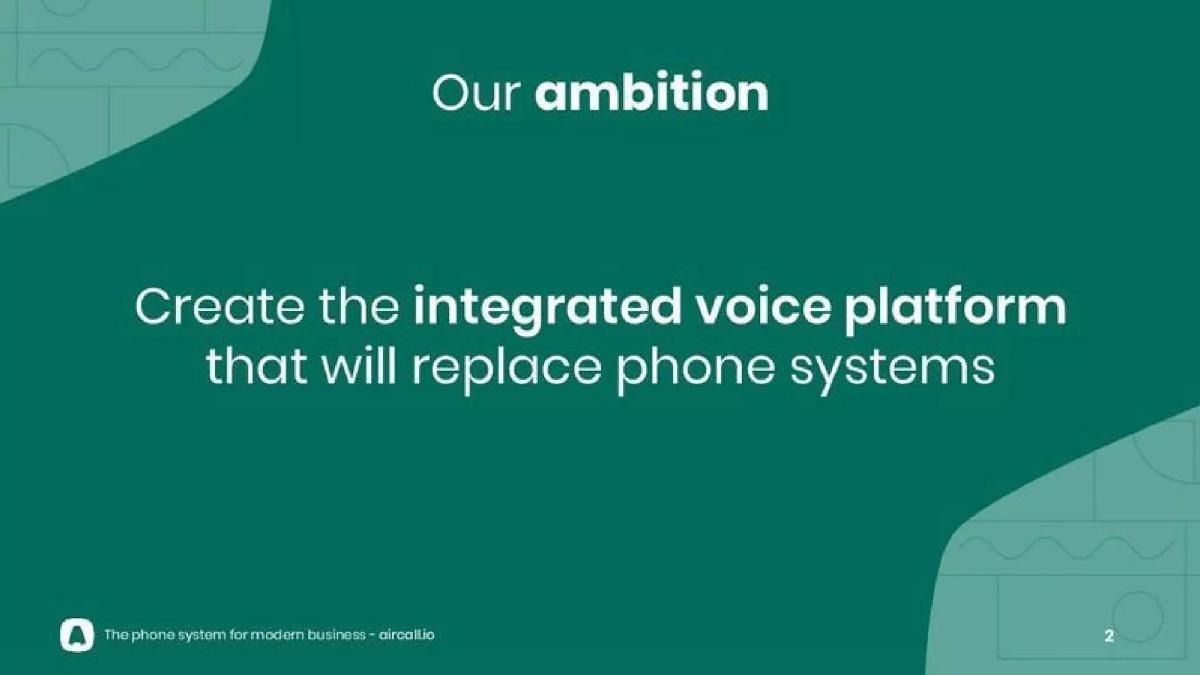
This slide explicitly states the company's goal: "Create the integrated voice platform that will replace phone systems." Below this, it positions the brand as "The phone system for modern business - aircall.io." The layout is simple: white text on a dark green background with light green abstract patterns in the corners. It is labeled as slide "2" in the bottom right corner.
Investors look for the "ceiling" of a company on this slide. By using the word "replace," Aircall signals a displacement strategy rather than a supplemental one. They are targeting the legacy PBX (Private Branch Exchange) market. The shift from "phone system" to "integrated voice platform" is the key nuance here; it tells the investor that Aircall intends to be the glue between voice data and the rest of the tech stack. It isn't just a communication tool; it's a piece of infrastructure.
A stronger version of this slide would quantify the ambition. "Replacing phone systems" is a broad statement. Specifying "Replacing 100 million legacy desk phones with a cloud-native API-first platform" would turn a vague ambition into a measurable mission. It also lacks a "Why now?" element—why is 2019 the tipping point for this replacement? Without that context, it feels like a mission statement that could have been written in 2010.
Slide 3: Market Context / Redefinition
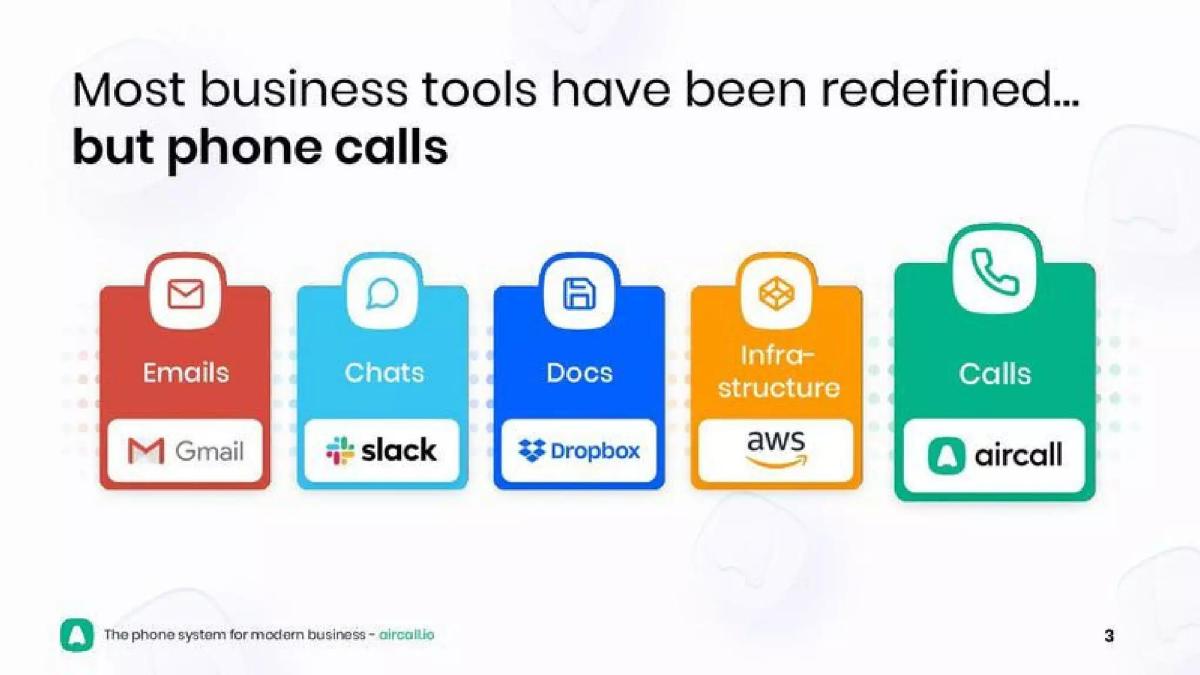
This slide uses a comparative framework to argue that telephony is the last piece of the office stack to modernize. It lists "Emails" (Gmail), "Chats" (Slack), "Docs" (Dropbox), and "Infra-structure" (AWS) as categories that have been redefined by modern software. It then places "Calls" alongside "Aircall" as the final piece of the modern stack. The slide features five colorful vertical boxes, each representing a tool and its modern counterpart, set against a white background.
This is a classic "category validation" slide. By placing themselves next to Slack and AWS, Aircall is attempting to borrow the "essentiality" and valuation multiples of those giants. It frames the current state of business telephony as an anachronism—the only part of the stack that hasn't yet moved to a modern, user-friendly cloud equivalent. It appeals to the investor's sense of logical progression: if every other tool has moved to the cloud, why wouldn't the phone?
The strongest version of this slide would include the "Pain of the Status Quo." While it shows the modern counterparts, it doesn't explicitly state the failure of the legacy tools. Adding a small "Legacy" row at the bottom—naming companies like "Avaya," "Cisco," or "Mitel"—would make the contrast between the clunky past and the streamlined future even more jarring. It would move the argument from "we are the next modern tool" to "the old tools are actively hurting your business."
Slide 4: The Three Competitor Archetypes
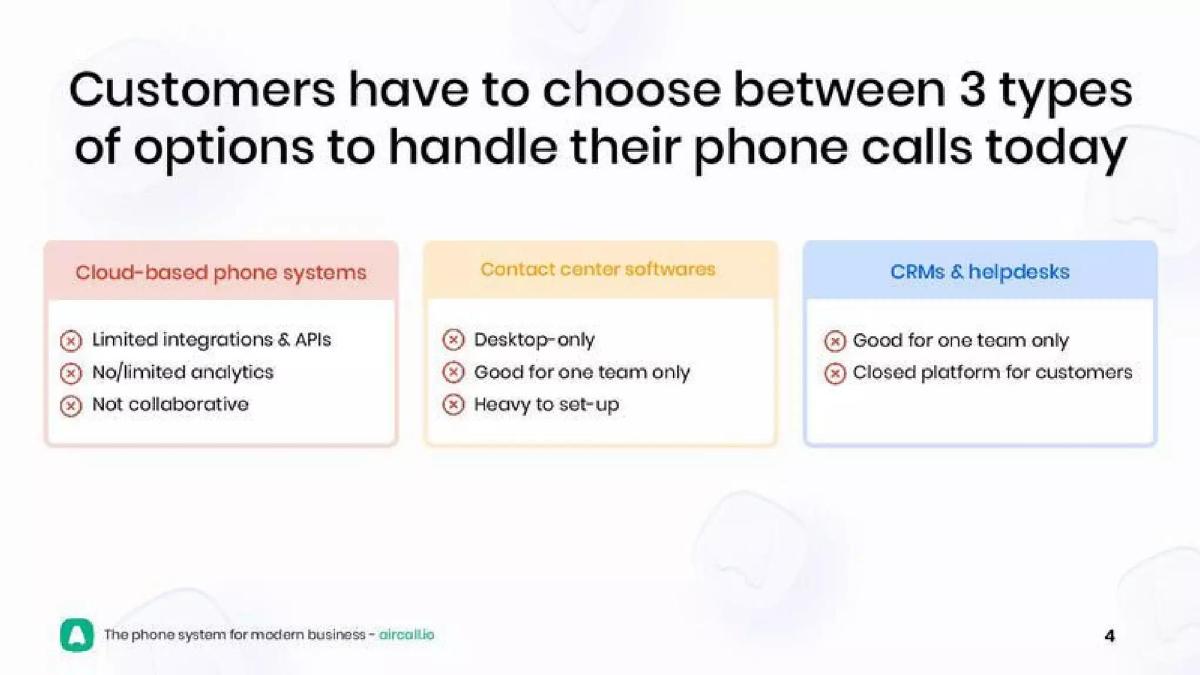
Slide 4 breaks down the current market failures into three distinct buckets: "Cloud-based phone systems," "Contact center softwares," and "CRMs & helpdesks." For the cloud systems, it cites "Limited integrations & APIs," "No/limited analytics," and "Not collaborative." For contact centers, it notes they are "Desktop-only," "Good for one team only," and "Heavy to set-up." For CRMs, it lists "Good for one team only" and "Closed platform for customers." Each bucket is punctuated with red "x" icons.
Investors see this as a "gap analysis." Aircall is arguing that the market is fragmented between tools that are too simple (basic cloud phones) and tools that are too complex and siloed (contact centers). By criticizing CRMs for being a "Closed platform for customers," they are setting up their own "Open API" value proposition. This slide effectively paints the current landscape as a series of compromises where customers have to choose which specific limitation they are willing to tolerate.
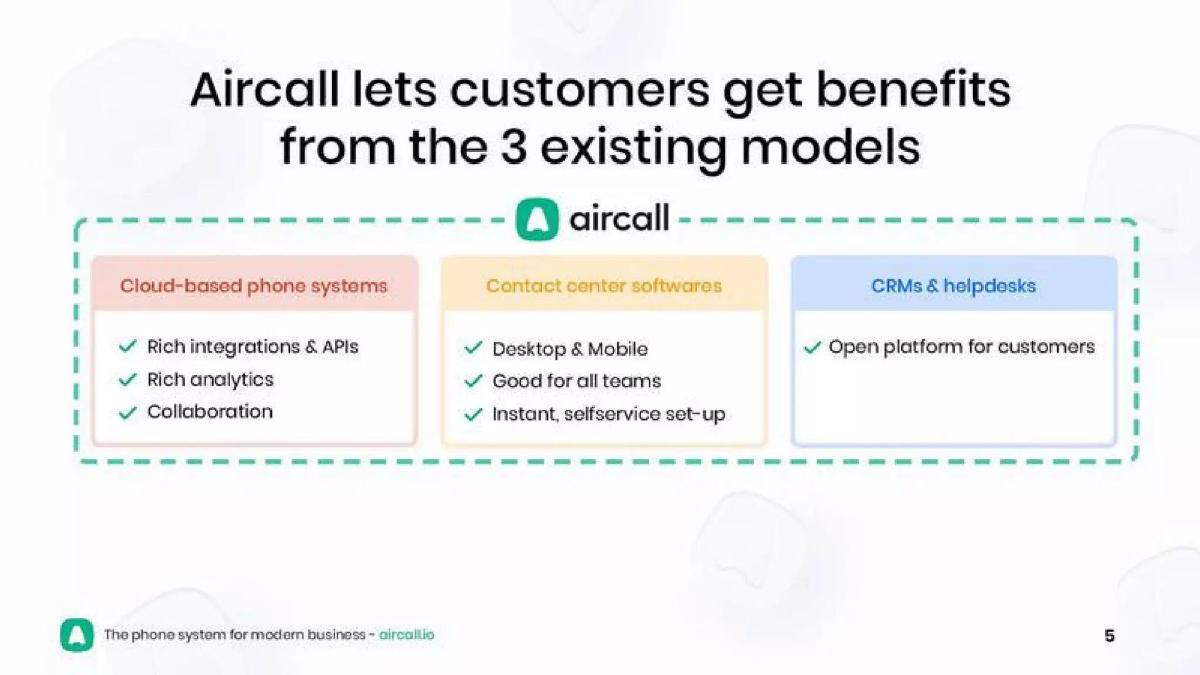
To improve this slide, the descriptions should be more quantitative. Instead of "Heavy to set-up," the slide could say "Average 3-6 month implementation cycles." Instead of "Limited integrations," it could state "Average of This slide is a direct mirror of Slide 4. It takes the three existing models and shows how Aircall incorporates the best of all of them while removing the negatives. The red "x" icons are replaced with green checkmarks. The "Cloud-based" box now includes "Rich integrations & APIs," "Rich analytics," and "Collaboration." The "Contact center" box adds "Desktop & Mobile" and "Instant, self-service set-up." The "CRMs" box is labeled as an "Open platform." The entire group is enclosed in a green dashed border labeled "aircall."
This is the "Synthesis" slide. The investor learns that Aircall's product strategy is to be a "hybrid" that offers the ease of a cloud phone with the power of a contact center. The mention of "Instant, self-service set-up" is a critical counter-point to the "Heavy to set-up" criticism of legacy software, highlighting a lower cost of customer acquisition (CAC) and faster time-to-value for the customer. It promises the power of Enterprise software with the UX of Consumer software.
The strongest version of this slide would show the "How." It claims to offer "Rich analytics" and "Rich integrations," but it hasn't shown the interface yet. A small screenshot or a specific mention of a proprietary feature—like a "universal API layer"—that enables this synthesis would bridge the gap between a marketing claim and a technical reality. As it stands, it’s a list of promises that require the next slide for proof.
Slide 6: Product Depth (Caller Insights)
This slide gets into the weeds of the product functionality, showcasing "Caller Insights." It displays a mobile UI where an incoming call from "Margot Chen" is enriched with data from Salesforce and HubSpot. The interface shows the caller's email (margot@acme.inc), the account owner (Benjamin Davis), and specific links to the "Contact page" and "Hubspot contact details." It emphasizes that caller insights "bring context to each call from other software and data sources."
This is the "aha!" moment for the investor. It proves the "Integrated Voice Platform" claim from Slide 2. By showing that a salesperson or support agent can see the HubSpot contact details before they even pick up the phone, Aircall demonstrates a clear productivity gain. It moves the conversation from "making calls" (a utility) to "having informed conversations" (a business outcome). The inclusion of buttons for "Hold," "Keypad," "Recording," "Notes," "Tags," and "Assign" shows the richness of the in-call experience.
The strongest version would include a metric related to this feature. For example: "Users with Caller Insights enabled see a 20% reduction in Average Handle Time (AHT)." Showing the interface is good; showing the business impact of the interface is better. Additionally, the slide is a bit cluttered with two overlapping screenshots that show very similar information; a single, larger, and annotated screenshot would communicate the value more clearly.
Slide 7: The Ecosystem Map
Slide 7 is a logo cloud categorized by function: "Communication apps" (Slack, G Suite), "Team-specific tools" (SalesLoft), "Data & BI tools" (Amazon Redshift, Segment), "Helpdesk" (Zendesk, Intercom), "CRMs" (Salesforce, HubSpot, Zoho), and "Business-specific CRMs" (Shopify, Clio, Neon). A central Aircall logo is connected to all these logos via dashed lines, emphasizing its role as a central hub.
This slide communicates "defensibility." In SaaS, integrations create high switching costs. If a law firm has Aircall integrated into Clio (a legal CRM), they are much less likely to churn. It also suggests a diversified Go-To-Market (GTM) strategy; Aircall isn't just selling to "businesses," they are selling to "Salesforce users" or "Shopify merchants." The mention of "API links to own back-end" suggests that they also cater to developers and custom enterprise needs.
The strongest version of this slide would distinguish between "out-of-the-box" integrations and "API-supported" ones. It mentions "API links" in small text, but the slide would be more powerful if it highlighted the number of "one-click" integrations versus those requiring developer work. Showing that they have, for instance, "40+ one-click integrations" would further push the "self-service" narrative mentioned on Slide 5.
Slide 8: Ecosystem Growth Timeline
This slide shows the velocity of Aircall’s integration strategy. It features a rising area chart filled with software icons, stating "Over 60 software integrations as of end of 2019." The timeline on the X-axis spans quarterly from "2015 Q1" to "2019 Q3," showing a consistent upward trajectory in the number of partners.
Investors look for the slope of the line. The chart shows an accelerating pace of integration development, especially from 2017 onwards. This isn't just a product slide; it's a "Network Effect" slide. As Aircall adds more integrations, the platform becomes more valuable to a wider variety of customers, which in turn attracts more integration partners. The sheer density of icons by 2019 creates a visual sense of momentum and "market gravity."
A stronger version of this slide would correlate this timeline with revenue or customer growth. If they could show that the "steepness" of the integration curve matches a "steepness" in ARR growth, it would prove that their ecosystem strategy is the primary driver of their financial success. As it stands, it is a list of logos without a direct, quantitative tie to the bottom line or the company's valuation.
Slide 9: Growth Engines and Unit Economics
Slide 9 introduces the sales machinery. It identifies "3 go-to-market engines in place": "High-velocity SaaS model" (Inbound marketing), "Indirect sales," and "Outbound sales" (focused on larger deals). It explicitly cites a "> 3:1 LTV/CAC" and mentions "Predictable sales cycle." The inbound engine is described as "Proven and scalable" with "solid inbound demand generation."
This is the "Engine" slide. Investors at the Series C stage are looking for a repeatable machine where they can "pour in capital and get out growth." By mentioning 3:1 LTV/CAC, Aircall is hitting the industry standard for a healthy, scalable SaaS business. The distinction between "high-velocity" and "larger deals" shows they are successfully moving up-market. The claim of a "Predictable sales cycle" suggests they have moved past the experimental phase and have reliable data on how long it takes to close a lead.
The strongest version of this slide would provide the actual CAC and LTV numbers, or at least the payback period in months. "3:1" is a good ratio, but 3:1 on a $100 CAC is different from 3:1 on a $10,000 CAC. Additionally, the "Indirect sales" engine is mentioned as "Growing fast & structured in 2019" but not explained—is this channel partners, resellers, or affiliates? Providing a percentage breakdown of revenue by engine would give investors more confidence in the maturity of the sales org.
Slide 10: Retention and Stickiness
This slide is the quantitative heart of the deck. It claims "87% gross retention" and "135+% net retention." It includes two line graphs side-by-side comparing the "2017 cohort," "2018 cohort," and "2019 cohort." A footer note explains that Gross Retention is "computed between months 3-11 and then annualized." Both charts specify they are "excl micro-customers."
For a growth investor, 135% net retention is an elite metric. It means that even without acquiring a single new customer, the existing customer base would grow Aircall's revenue by 35% annually through expansion and upsells. The charts show that the 2019 cohort is performing better (staying flatter or rising faster) than previous years, suggesting the product-market fit is sharpening. The "Gross Retention" graph shows high stability after the initial month 3 mark.
The slide's caveat—"(excl micro-customers)"—is a major point for scrutiny. It suggests that churn among very small businesses is likely high and would significantly drag down these numbers if included. A stronger, more transparent version would show the metrics for the entire base, or at least define what constitutes a "micro-customer" (e.g., Slide 11 features a stacked area chart showing "ARR by initial purchase quarter (excl. minutes)." The chart shows a multi-colored mountain of revenue, where each layer represents a cohort of customers from Q4 2015 to Q4 2019. The Y-axis values (the actual dollar amounts) are notably absent, and the X-axis tracks the passage of time by quarter.
The investor reads this as a "Layer Cake" of revenue. The fact that the layers don't thin out significantly as they move to the right confirms the retention story from the previous slide. The expanding thickness of the 2018 and 2019 layers indicates that Aircall is acquiring larger cohorts of customers at a faster rate. This is the visual representation of compounding growth—new sales stacking on top of a very stable and expanding base of existing revenue.
The total lack of dollar figures on the Y-axis is the slide's greatest weakness. While the shape of the curve is impressive, investors need to know if the top of the chart represents $10M or $100M. Without a scale, the chart only communicates "up and to the right," which is the bare minimum for a Series C deck. Additionally, the exclusion of "minutes" (usage fees) might mean the actual top-line revenue is higher, but it also obscures how much of their business is predictable subscription revenue versus variable usage.
Slide 12: Total Addressable Market (TAM)
The final content slide estimates an "$80Bn Market opportunity." It breaks this down into "On-prem legacy ($70Bn)" and "Cloud-based ($10Bn)" with a "20-25% YoY growth" rate for the cloud segment. A 2x2 matrix shows the opportunity to move from SMBs to "Mid Mkt/ Enterprise" (vertical axis) and from "Support & Sales" to "All teams" (horizontal axis).
This slide addresses the "Scale" question. By showing that 87.5% of the market (the $70Bn portion) is still on-premise, Aircall is positioning itself for a decade-long tailwind of cloud migration. The matrix identifies two clear axes for growth: seat expansion (moving from just the support team to the whole office) and account expansion (moving from small businesses to large enterprises). The "Up-sell opportunity" and "Cross-sell opportunity" are clearly mapped out.
The note "market sizing estimated in 2022 based on 2018/2019 data sources" is confusing, as it projects into the future relative to the data. The strongest version of this slide would cite third-party sources like Gartner or IDC for these massive figures. $80Bn is a very large number; breaking down how much of that is actually Serviceable Addressable Market (SAM) based on their current pricing model would be more grounded. If their average contract value is $2,000, they would need 40 million customers to hit $80Bn, which highlights the need for a reality-checked SAM.
Slide 13: Conclusion
The final slide matches the branding of the first, with a "Thank you!" message in white text on a green background. It includes the company website, "aircall.io," and the abstract curved shapes from the cover.
In a deck this lean, the final slide is wasted real estate. An investor often uses this time to ask questions while the slide remains on the screen. It should, at the very least, list the contact information for the CEO or the lead fundraiser to facilitate follow-up communication.
A stronger conclusion would include a "Summary of Investment Highlights" or a "Closing Vision Statement." Ending on a simple "Thank you!" is a missed opportunity to leave the investor with three bullet points on why this deal is a winner: the 135% Net Retention, the $80B TAM transition from on-prem to cloud, and the accelerating momentum of their integration ecosystem.
Concrete fixes in priority order
Add Revenue Scale: The ARR cohort chart (Slide 11) is functionally meaningless without a Y-axis. Even if the exact figures are sensitive, providing a range or a "Year 1 vs. Year 4" revenue multiple is essential for Series C investors to gauge the scale of the opportunity. · Define "Micro-Customers": The retention metrics (Slide 10) are heavily caveated. Investors need to know what percentage of the total customer base is excluded to understand if the 135% Net Retention is representative of the whole business or just a cherry-picked, high-performing segment. · Clarify Retention Calculations: Using a month 3-11 window to annualize gross retention (Slide 10) is non-standard. The deck should provide a standard trailing twelve-month (TTM) retention figure to allow for direct comparison with other SaaS industry benchmarks. · Quantify Market Sources: The $80Bn TAM (Slide 12) needs credible citations. Large, round numbers without sources are often discounted. Identifying which specific segments of the $70Bn legacy market are realistically "at risk" to Aircall would be more persuasive than a general market figure. · Show the Team: A 13-slide deck for a Series C round that completely omits the founding and management team is highly unusual. Investors at this stage are betting on the "Scale-up" leadership. A slide detailing the executive team's experience in scaling SaaS companies is a high-priority addition. · Include Use of Funds: The deck identifies growth engines but doesn't state how much capital is being raised or where it will be deployed (e.g., R&D for more integrations vs. doubling the outbound sales force vs. international expansion).
Frequently asked questions
- What is Aircall's retention rate?
- Aircall reports a gross retention of 87% and a net retention of 135%+. However, these figures explicitly exclude 'micro-customers' and use a non-standard 3-11 month annualized calculation.
- How does Aircall acquire customers?
- The deck outlines three primary GTM engines: a high-velocity Inbound SaaS model, a structured Indirect sales channel, and an Outbound sales team focused on larger deals.
- What is Aircall's integration strategy?
- Aircall positions itself as the central hub for voice data, boasting over 60 software integrations by late 2019, including major CRMs like Salesforce and HubSpot, and helpdesks like Zendesk.
- How large is the business phone market?
- Aircall estimates the total market opportunity at $80 billion, with $70 billion still tied to legacy on-premise systems and $10 billion already moved to the cloud.
- What is Aircall's core product advantage?
- The deck defines 'Caller Insights' as the ability to pull real-time data from tools like Salesforce and HubSpot directly into the call interface to provide agents with immediate context.