The 2008 AirBed&Breakfast (now Airbnb) pitch deck is frequently cited as the gold standard for early-stage fundraising due to its extreme clarity. Across 14 slides, the founders identify a massive gap in the travel market—specifically the lack of an easy way to book rooms with locals. They validate the market using Couchsurfing and Craigslist data, then propose a simple 10% commission model on an average $80/night stay. The deck concludes with a $500,000 angel round ask to reach 80,000 transactions and $2 million in revenue over 12 months. While it lacks detailed unit economics or a long-term…
Key takeaways
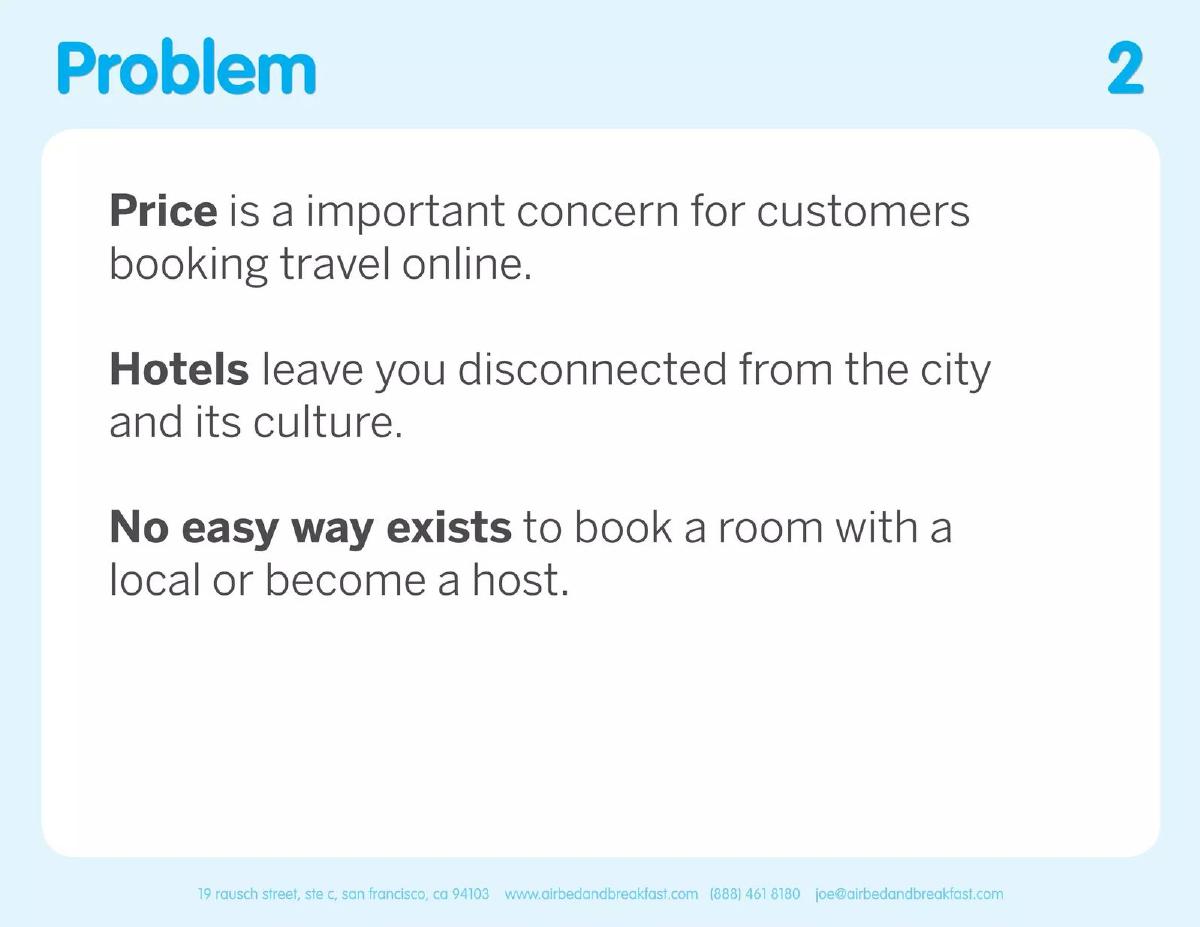
- The deck identifies three core problems: price concerns for travelers, cultural disconnection in hotels, and the lack of an easy booking platform for local hosts (Slide 2).
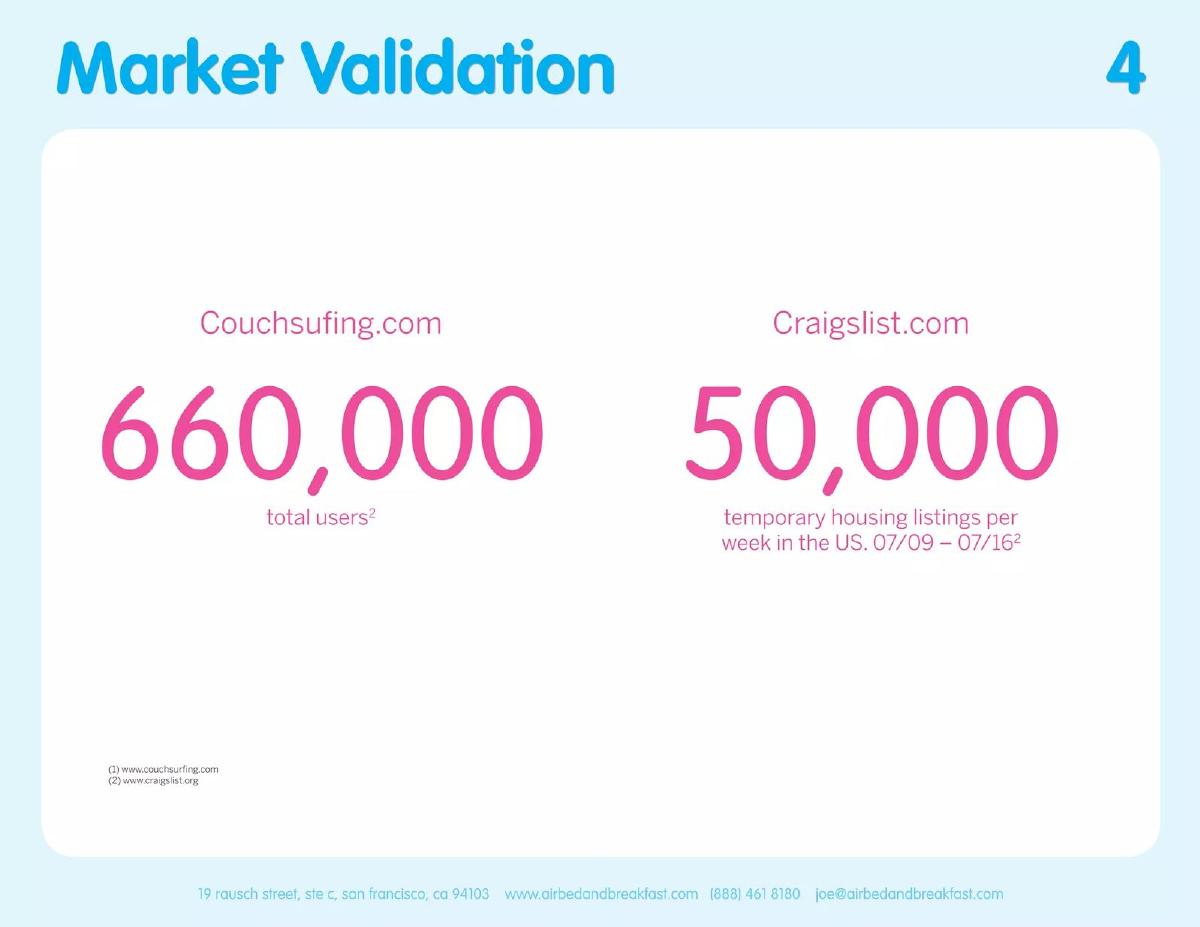
- Market validation is established by citing 660,000 Couchsurfing users and 50,000 weekly temporary housing listings on Craigslist (Slide 4).
- The business model is built on a 10% commission per transaction, projecting $2.1 billion in revenue by 2011 based on a 15% market share (Slide 7).
- The adoption strategy includes a 'dual posting feature' to siphon users from Craigslist and targeting large-scale events like Octoberfest and Mardi Gras (Slide 8).
- Competitive advantages are framed around being the first transaction-based site and offering a 'book in 3 clicks' user experience (Slide 10).
- The team slide highlights technical and design pedigree, including a Harvard-educated developer and RISD-trained designers (Slide 11).
- The final ask is for a $500,000 angel round to reach 80,000 transactions and $2 million in revenue within 12 months (Slide 14).
Introduction
The 2008 AirBed&Breakfast pitch deck is perhaps the most studied document in startup history. It represents a moment in time when the 'sharing economy' was an unproven concept. The deck is notable for its minimalist design and its ability to distill a complex marketplace dynamic into 14 simple slides. At this stage, the company was seeking a $500,000 angel investment to prove that travelers would pay to stay in a stranger's home.
Slide 1: Title and Tagline
The cover slide introduces the original name, AirBed&Breakfast , and a clear, one-sentence value proposition: "Book rooms with locals, rather than hotels." The contact information at the bottom lists an address at 19 Rausch Street in San Francisco, grounding the digital pitch in a physical location. The branding is distinctively early-web 2.0, using a bubble-letter logo with a pink and blue color scheme.
Slide 2: The Problem
Slide 2 identifies three specific pain points. First, it addresses Price , stating it is a major concern for online travel bookers. Second, it highlights a qualitative issue: Hotels leave travelers disconnected from a city's culture. Third, it points to a market inefficiency: No easy way exists to book a room with a local or become a host. By framing the problem this way, the founders justify the need for a new platform that is both cheaper and more 'authentic' than traditional lodging.
Slide 3: The Solution
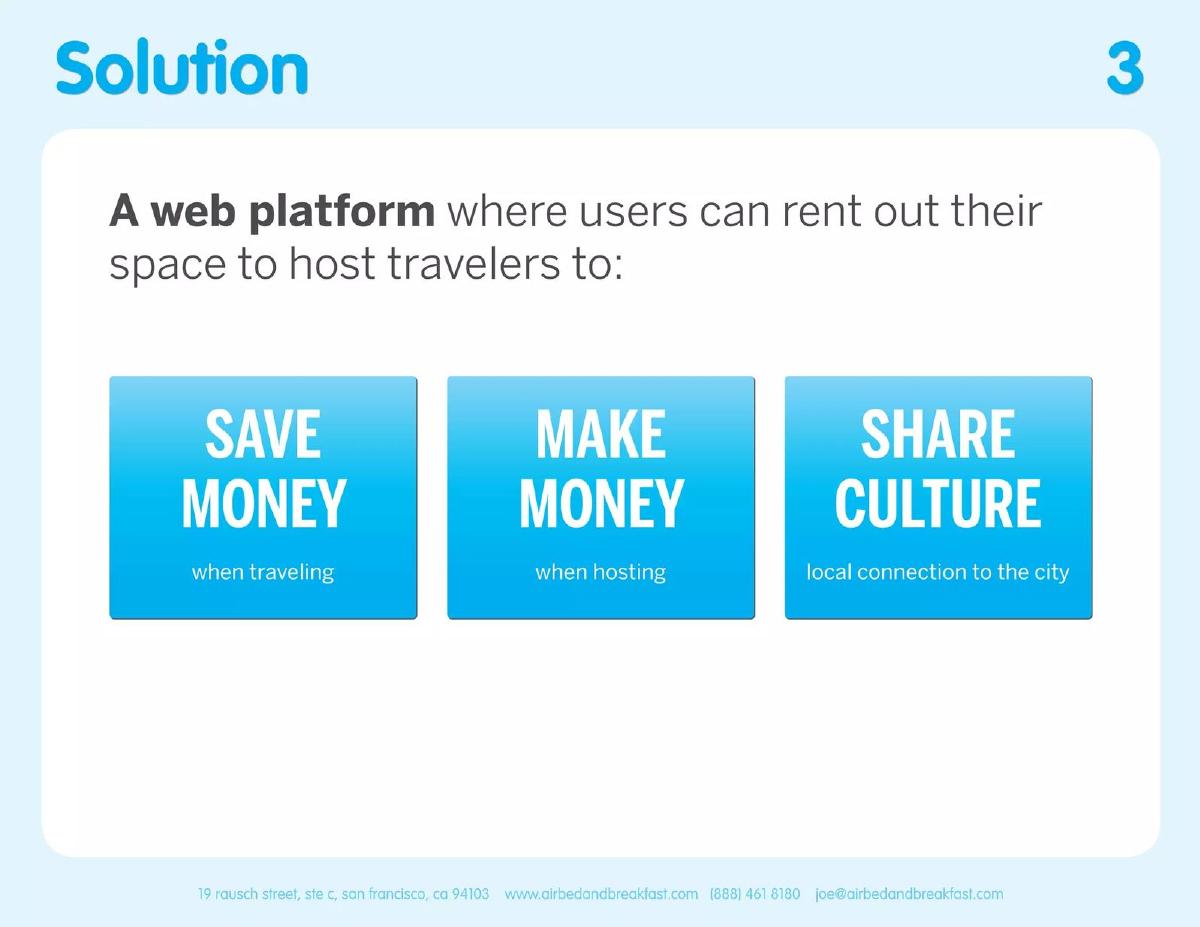
The solution is presented as a "web platform where users can rent out their space to host travelers." The slide uses three large blue boxes to summarize the benefits: Save Money (for travelers), Make Money (for hosts), and Share Culture (local connection). This slide establishes the two-sided marketplace benefit immediately, showing value for both supply and demand.
Slide 4: Market Validation
To prove the market exists, the founders look to existing platforms. They cite 660,000 total users on Couchsurfing.com and 50,000 temporary housing listings per week on Craigslist (specifically for the week of 07/09 – 07/16). This is a crucial strategic move; by showing that people are already doing this on 'clunky' or 'free' platforms, they argue that a dedicated, transaction-based platform will thrive.
Slide 5: Market Size
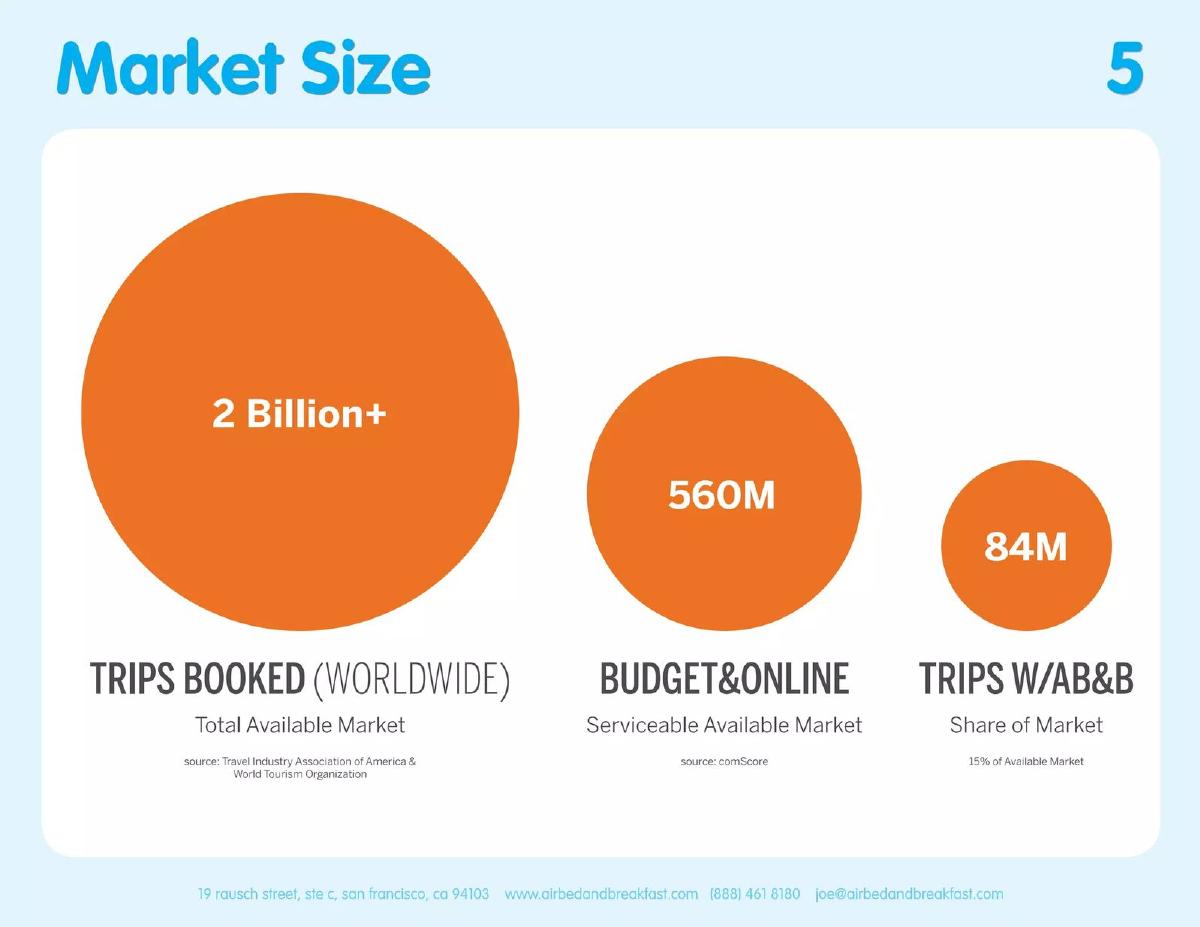
Slide 5 uses the TAM/SAM/SOM (Total Addressable Market, Serviceable Addressable Market, Share of Market) framework. They identify 2 Billion+ trips booked worldwide as the TAM. They narrow this to 560M budget and online trips as the SAM. Finally, they target 84M trips as their share of market, which represents 15% of the available budget/online market. Using 'trips' as the unit of measurement rather than dollars keeps the focus on volume.
Slide 6: Product
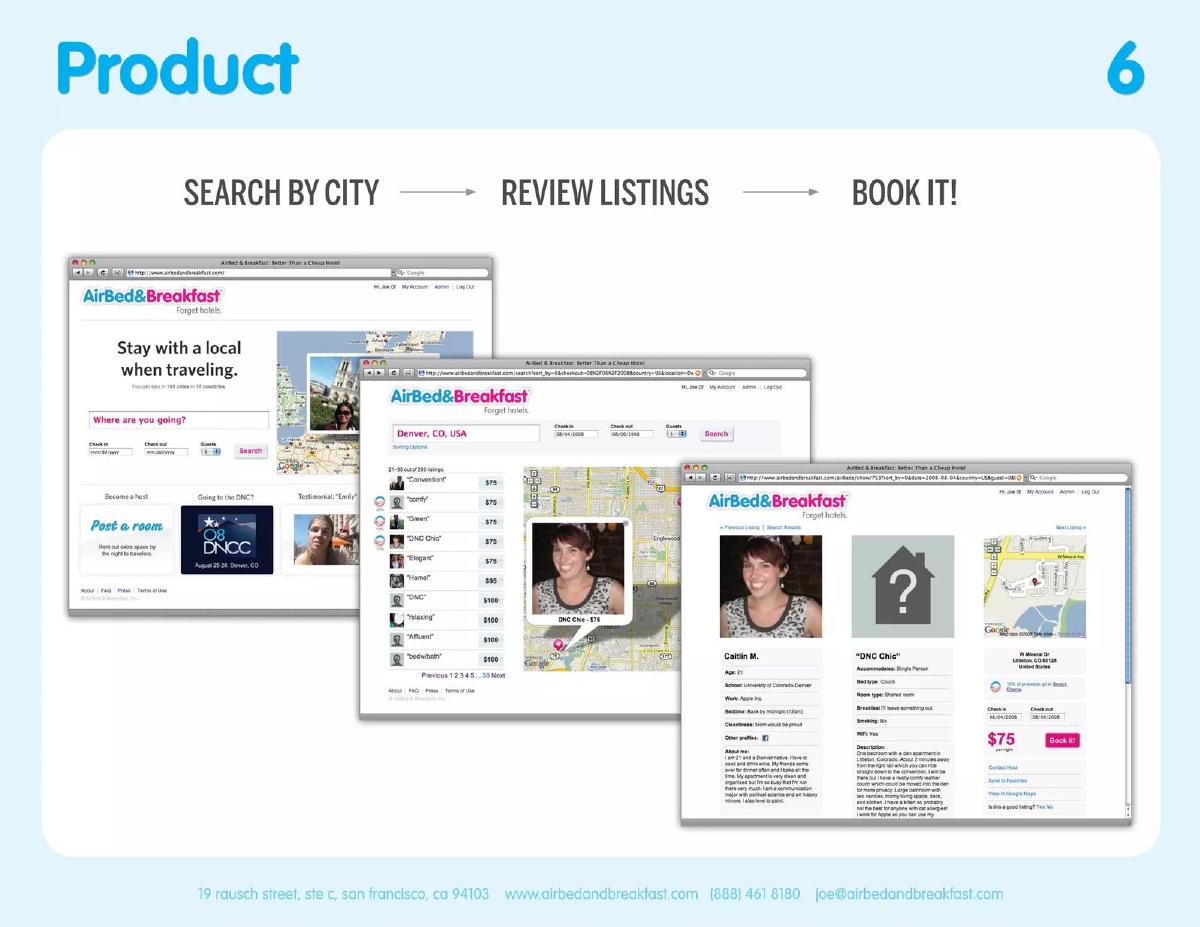
The product slide demonstrates a simple three-step user flow: Search by City , Review Listings , and Book It! The screenshots show a functional website with features like a 'Post a room' button, testimonials, and a search interface for Denver, CO. The UI includes a map integration and a 'Book It!' button, emphasizing that this is a transactional site, not just a message board.
Slide 7: Business Model
The business model is remarkably simple. The slide states: "We take a 10% commission on each transaction." They take their 84M trip target from Slide 5 and multiply it by an average fee of $25 (based on an $80/night stay for 3 nights). This leads to a projected $2.1B in revenue by 2011 . This slide is effective because it removes all ambiguity about how the company intends to make money.
Slide 8: Adoption Strategy
Slide 8 outlines how they will grow. They focus on Events (listing Octoberfest, Cebit, Summerfest, Eurocup, and Mardi Gras), Partnerships (listing GoLoco, Kayak, and Orbitz), and a Craigslist dual posting feature . The Craigslist hack is visualized with an arrow showing a listing moving from AirBed&Breakfast to Craigslist, a famous 'growth hack' that allowed them to tap into an existing user base.
Slide 9: Competition
The competition is mapped on a 2x2 grid with axes for Price (Affordable vs. Expensive) and Transaction Type (Offline vs. Online). AirBed&Breakfast is positioned in the top-right quadrant: Affordable and Online. They list Hostels.com as their closest online competitor, while Couchsurfing and Craigslist are categorized as affordable but offline transactions.
Slide 10: Competitive Advantages
The founders list six advantages: 1st to Market (for transaction-based temporary housing), Host Incentive (monetization vs. free sites), List Once (vs. daily posting on Craigslist), Ease of Use , Profiles (safety/trust), and Design & Brand . They specifically mention launching at the "historic DNC" (Democratic National Convention) to gain mindshare.
Slide 11: Team
The team slide features the three founders: Joe Gebbia (User Interface & PR), Brian Chesky (Business Development & Brand), and Nathan Blecharczyk (Developer). The slide highlights their pedigree: Gebbia and Chesky are RISD graduates, and Blecharczyk is a Harvard Computer Science graduate who previously worked at Microsoft. They also list Michael Seibel (CEO of Justin.tv) as an advisor, adding early-stage Silicon Valley credibility.
Slide 12: Press
Slide 12 features four press quotes from Webware , Josh Spear , Mashable , and Springwise . The quotes reinforce the concept as a "cool alternative" and a "fun approach to couch surfing." This slide serves to validate that the media is already paying attention to the concept.
Slide 13: User Testimonials
The deck includes four user testimonials with photos. Users like Josue F. and Emily M. are quoted saying the platform "freaking rocks" and "made me money." These testimonials provide social proof that the product works for both guests and hosts, addressing the 'trust' barrier inherent in staying in private homes.
Slide 14: Financial (The Ask)
The final slide presents the investment opportunity. They are seeking a $500K Angel Round . The goal for this capital is to reach 80,000 transactions on the platform, which they estimate will generate $2M in revenue over a 12-month period. The slide uses a simple green circle for the investment and an orange circle for the transaction goal, maintaining the deck's visual consistency.
What Works
The primary strength of this deck is its clarity of purpose . There is no jargon. A reader can understand the entire business model, the target customer, and the growth strategy in under three minutes. The use of Market Validation (Slide 4) is a brilliant way to handle the 'nobody will ever do this' objection by showing that hundreds of thousands of people were already doing it on less efficient platforms. The Business Model (Slide 7) is also a highlight; by picking a single, flat commission rate, they avoid the complexity of tiered pricing or advertising models, making the path to $2 billion seem mathematically plausible.
What is Missing
From a modern perspective, several key elements are missing. There is no discussion of unit economics or Customer Acquisition Cost (CAC) vs. Lifetime Value (LTV). While they mention a $25 average fee, they don't explain the costs associated with processing those transactions or supporting the users. There is also no mention of regulatory or legal risks , which would eventually become the company's biggest hurdles. Additionally, the Product roadmap is absent; the deck focuses entirely on the current state of the web platform without hinting at mobile apps or expansion into 'Experiences' or other travel verticals. Finally, the Trust and Safety section is very thin, relegated to a single mention of 'Profiles' on the competitive advantage slide, which is surprising given the inherent risks of the business model.
Founder Takeaways
Founders should copy the three-click rule mentioned on Slide 10. By emphasizing that a user can book in just three clicks, they highlight a superior user experience over the 'offline' back-and-forth of Craigslist. Another takeaway is the Event-Based Marketing strategy. Instead of trying to boil the ocean, they targeted specific high-demand periods like Octoberfest where hotel capacity was already maxed out, creating a natural 'pull' for their supply. Lastly, the TAM/SAM/SOM layout on Slide 5 is a perfect template for any early-stage founder; it shows a massive vision while grounding the immediate goals in a realistic, reachable slice of the market.
Frequently asked questions
- What was the original business model proposed in the 2008 deck?
- As stated on Slide 7, the company intended to take a flat 10% commission on each transaction. They calculated their potential revenue by estimating an average fee of $25 per booking, based on an average room price of $80 per night for a three-night stay. This simple take-rate model allowed them to project $2.1 billion in revenue by 2011.
- How did Airbnb plan to acquire its first users according to the slides?
- Slide 8 outlines a three-pronged adoption strategy: targeting high-traffic events (like the 6 million attendees of Octoberfest), forming partnerships with alternative travel sites like Kayak and Orbitz, and a technical 'hack' involving a Craigslist dual-posting feature to migrate existing temporary housing listings to their platform.
- What metrics did the founders use to prove the market existed?
- Instead of using internal growth metrics, which were likely small at the time, Slide 4 uses 'Market Validation' from competitors. They cited 660,000 total users on Couchsurfing.com and 50,000 weekly temporary housing listings on Craigslist in the US to prove that people were already willing to stay in non-hotel accommodations.
- Who were the primary competitors identified in the 2008 deck?
- Slide 9 uses a 2x2 matrix to map competitors. They positioned themselves as the 'Affordable' and 'Online Transaction' leader. Competitors listed include Couchsurfing and Craigslist (Offline/Affordable), BedandBreakfast.com and VRBO (Offline/Expensive), and Hotels.com and Orbitz (Online/Expensive). They specifically aimed to disrupt the gap between free social stays and expensive hotels.
- What was the specific funding ask and the expected outcome?
- Slide 14 clearly states the 'Angel Round' ask of $500,000. The founders intended to use this capital as 12 months of financing to reach a milestone of 80,000 transactions. They projected this volume would generate $2 million in revenue within that one-year period.