Gain Servicing is a legal-tech and health-tech hybrid platform based in Atlanta that aims to solve the friction inherent in personal injury litigation. By acting as a bridge between attorneys and healthcare providers, the company seeks to manage the complex lifecycle of medical liens. The deck highlights a value proposition centered on 'simplifying personal injury case management' through document exchange, case tracking, and AI-driven compliance. However, the presentation is notably light on hard data, omitting critical metrics such as current revenue, user growth, market size (TAM), and uni…
Key takeaways
- The platform aims to unify three distinct stakeholders—attorneys, healthcare providers, and patients—within a single system (Slide 5).
- Gain Servicing positions itself as an operational support layer that speeds up treatment and funding for personal injury cases (Slide 9).
- The company claims to use AI-driven tracking and compliance to reduce the administrative burden on providers (Slide 9).
- The deck identifies its headquarters as Atlanta and provides a direct contact number: (877) 263-4633 (Slide 11).
- Key functional features include streamlined document exchange and case tracking (Slide 5).
- The value proposition for healthcare providers is centered on 'financial predictability' (Slide 9).
- The deck follows a standard 11-slide structure but omits essential investor data like competition, team bios, and financial projections.
- The 'Agenda' slide indicates the deck covers managed services and specific workflows for both attorneys and providers (Slide 3).
Executive Summary: The Bridge Between Law and Medicine
Gain Servicing operates in the niche but high-value intersection of legal technology and healthcare finance. Their pitch deck focuses on the management of medical liens—a process where healthcare providers treat personal injury victims on the promise of payment from a future legal settlement. This process is notoriously manual, paper-heavy, and prone to financial risk. Gain Servicing proposes an AI-powered platform to automate these workflows. While the deck effectively communicates the pain points of the industry, it lacks the quantitative evidence required to validate the business's current scale or future potential.
Slide 1: Title Slide
The opening slide establishes the company name, Gain Servicing , and its core mission: "Simplifying Personal Injury Case Management." The visual elements—a gavel and hands signing documents—clearly signal the legal nature of the business. It is a functional, if generic, start that immediately identifies the sector.
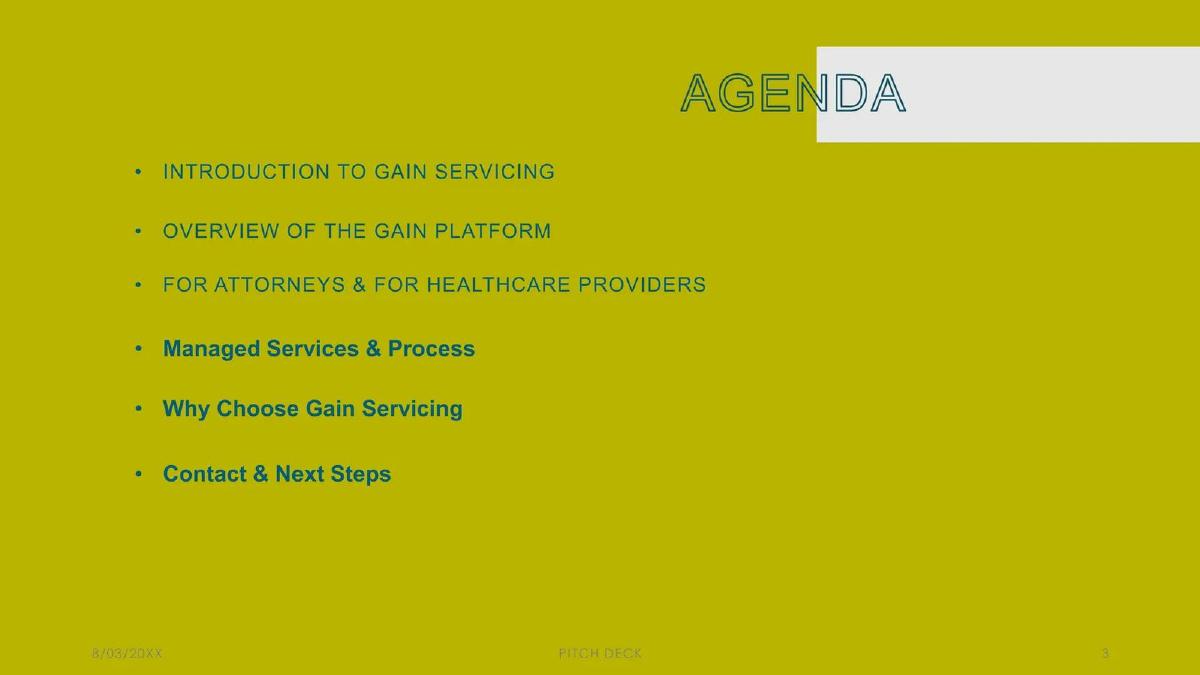
Slide 3: Agenda
The agenda slide outlines the flow of the presentation. It promises an "Introduction to Gain Servicing," an "Overview of the Gain Platform," specific sections for "Attorneys & Healthcare Providers," and a deep dive into "Managed Services & Process." It concludes with "Why Choose Gain Servicing" and "Contact & Next Steps." This structure suggests a logical progression from the problem to the specific software solution, though the actual slides provided are a subset of this full agenda.
Slide 5: The Gain Platform
This slide defines the product's scope. It claims to "Unify attorneys, healthcare providers, and patients in one efficient system." The two primary functional pillars listed are:
Streamlines document exchange, case tracking, and communications. · Unifies stakeholders into a single system.
The use of the word "unifies" is critical here; it suggests that Gain Servicing is positioning itself as a central hub or a System of Record (SoR) for medical liens, rather than just a point solution for one side of the transaction.
Slide 7: Company Overview
Slide 7 serves as a transition marker. It features a medical professional looking at a monitor, reinforcing the healthcare aspect of the business. However, despite the title "Company Overview," the slide itself contains no text describing the company's history, founding date, or mission statement. In a typical pitch deck, this is where one would expect to see the 'pedigree' of the firm, but here it acts merely as a section header.
Slide 9: Why Choose Gain Servicing?
This is the 'value proposition' slide, detailing the benefits of the platform. It lists four key advantages:
Simplifies complex interactions between attorneys and care providers. · Speeds up treatment and funding using modern tech and operational support. · Reduces administrative burden with AI-driven tracking and compliance. · Improves financial predictability for providers.
The mention of "operational support" alongside "modern tech" is a subtle indicator that Gain Servicing may not be a pure SaaS (Software as a Service) play, but rather a tech-enabled service provider that handles some of the manual heavy lifting of lien management.
Slide 11: Thank You and Contact Information
The final slide provides the closing call to action. It lists the website www.gainservicing.com and the phone number (877) 263-4633 . Crucially, it identifies the Headquarters as Atlanta . The background image of a stethoscope and a calculator atop financial charts reinforces the theme of medical-financial reconciliation.
What Works in This Deck
Clarity of Purpose: Within the first few slides, the viewer knows exactly what Gain Servicing does. They manage medical liens for personal injury cases. There is no jargon-heavy 'mission creep' here; the focus remains squarely on the friction between law firms and medical clinics.
Stakeholder Identification: By explicitly mentioning attorneys, providers, and patients, the deck shows an understanding of the three-sided marketplace dynamic inherent in personal injury litigation. The value proposition slide (Slide 9) correctly identifies that 'predictability' is the primary motivator for healthcare providers in this space.
What Is Missing from This Deck
The Team: There is no mention of who is building this. In early-stage fundraising, the 'who' is often as important as the 'what.' Investors look for founders with deep legal-tech experience or backgrounds in medical billing. The absence of a team slide is a significant hurdle for credibility.
Market Size (TAM/SAM/SOM): The deck does not quantify the opportunity. How many medical liens are issued annually? What is the total dollar volume of personal injury settlements in the US? Without these figures, it is impossible to judge if this is a venture-scale opportunity or a small lifestyle business.
Traction and Metrics: This is the most glaring omission. There are no figures regarding how many cases have been processed, how many law firms are currently using the platform, or the percentage reduction in administrative time achieved for current clients. Stating that the platform "reduces administrative burden" is a claim; showing a chart that proves a "40% reduction in document processing time" is evidence.
The Business Model: How does Gain Servicing make money? Do they charge a SaaS fee to the law firm, a percentage of the lien from the provider, or a per-transaction fee? The deck explains what the platform does but completely ignores how it captures value.
The Ask: A pitch deck usually ends with a request for capital. This deck has no "The Ask" slide. There is no mention of how much money is being raised, the valuation, or what the funds will be used for (e.g., hiring, R&D, sales expansion).
Founder Takeaways
Focus on the 'Why Now': Gain Servicing mentions AI-driven tracking. Founders should use this to explain why their solution is possible today when it wasn't five years ago. Is it better OCR for medical records? Better integration with legal practice management software? Be specific about the technology.
Balance Tech with Service: The deck mentions "operational support." If your startup requires a human-in-the-loop to function, be honest about it. Investors often prefer a tech-enabled service that actually works over a 'pure AI' solution that is still in beta.
Quantify the Friction: Instead of saying the process is "complex," a founder should use a slide to map out the current manual process (e.g., 15 phone calls, 10 faxes, 30 days of waiting) versus the Gain Servicing process. Visualizing the 'before and after' is more powerful than bullet points.
Conclusion
The Gain Servicing deck is a clean, professional-looking introduction to a specific legal-medical workflow solution. It identifies a clear pain point and proposes a logical technological fix. However, as an investment document, it is incomplete. It functions better as a sales deck for a law firm partner than a pitch for a VC. To move from a 'capabilities overview' to a 'fundable pitch,' the company needs to add slides covering their team, their specific financial metrics, and a clear roadmap for how they intend to capture a significant portion of the personal injury market.
Frequently asked questions
- What specific problem does Gain Servicing solve?
- Gain Servicing addresses the administrative and financial friction in personal injury cases where medical liens are involved. Typically, these cases involve complex interactions between law firms and medical providers regarding payment and documentation. The platform seeks to simplify these interactions by automating document exchange and providing AI-driven tracking to ensure compliance and speed up the funding process for medical treatments.
- Who are the primary users of the Gain Servicing platform?
- According to Slide 5, the platform is built for three primary groups: attorneys, healthcare providers, and patients. Attorneys use it for case management and document exchange, while healthcare providers use it to track liens and improve financial predictability. The deck suggests that by unifying these parties in one system, the overall efficiency of the personal injury litigation process is improved.
- What role does AI play in the Gain Servicing solution?
- The deck mentions AI specifically in the context of 'AI-driven tracking and compliance' on Slide 9. This suggests the technology is used to monitor the status of legal cases and medical bills, ensuring that all necessary documentation meets legal standards and that deadlines are tracked automatically, thereby reducing the manual administrative labor usually required by law firms and clinics.
- What financial or growth metrics are included in the deck?
- The deck contains zero financial metrics. There is no mention of Annual Recurring Revenue (ARR), Gross Merchandise Volume (GMV) of liens processed, number of law firms onboarded, or customer acquisition costs. This lack of data makes the deck function more as a sales presentation for potential partners rather than a formal pitch for venture capital funding.
- Where is the company located and how can they be reached?
- Gain Servicing is headquartered in Atlanta, Georgia. The final slide (Slide 11) provides their website, gainservicing.com, and a toll-free contact number, (877) 263-4633. The deck does not list specific founders or executive leadership contact information, opting instead for general corporate contact details.