Annovis (NYSE American: ANVS) utilizes this March 2021 presentation to position itself as a disruptive force in the neurodegenerative disease space. By shifting focus away from traditional amyloid plaque theories—which the deck notes resulted in over 500 failed drug attempts between 1998 and 2018 (Slide 4)—Annovis highlights its lead compound, ANVS401. The deck leans heavily on clinical data, showcasing significant reductions in inflammatory markers like Complement C3 (-86.9%) and MCP-1 (-87.5%) in MCI patients (Slide 13). While the presentation effectively communicates a robust pipeline span…
Key takeaways
- The company targets the 'Information Highway' of nerve cells, specifically focusing on axonal transport (Slide 1).
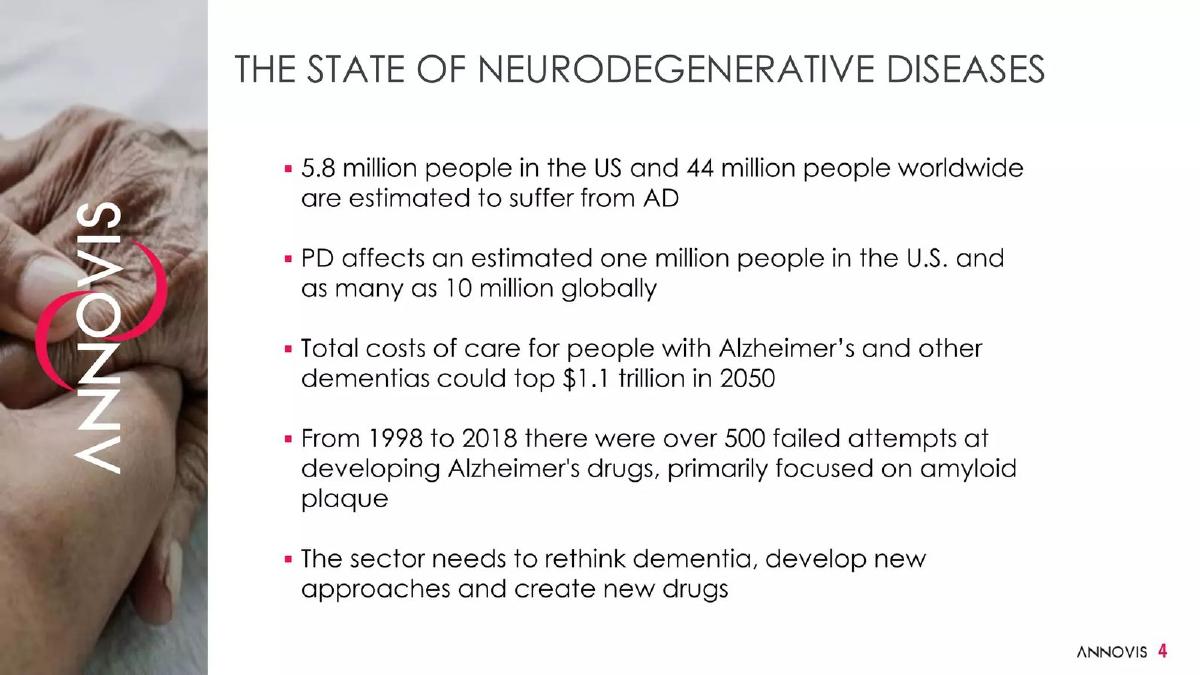
- Annovis identifies a massive market need, citing 5.8 million AD sufferers in the US and projected global care costs of $1.1 trillion by 2050 (Slide 4).
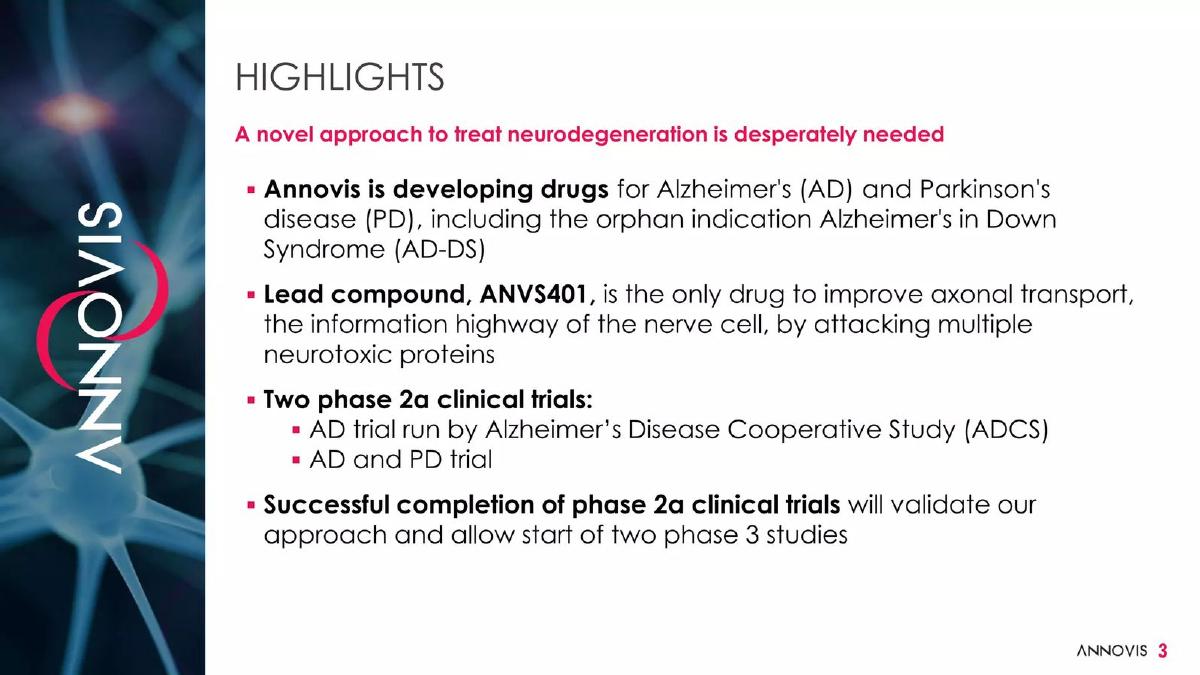
- The lead candidate, ANVS401, is an oral drug currently in Phase 2 for Alzheimer's and Parkinson's (Slide 7).
- Clinical data demonstrates a statistically significant decrease in inflammatory proteins, with p-values as low as 0.0007 for specific markers (Slide 13).
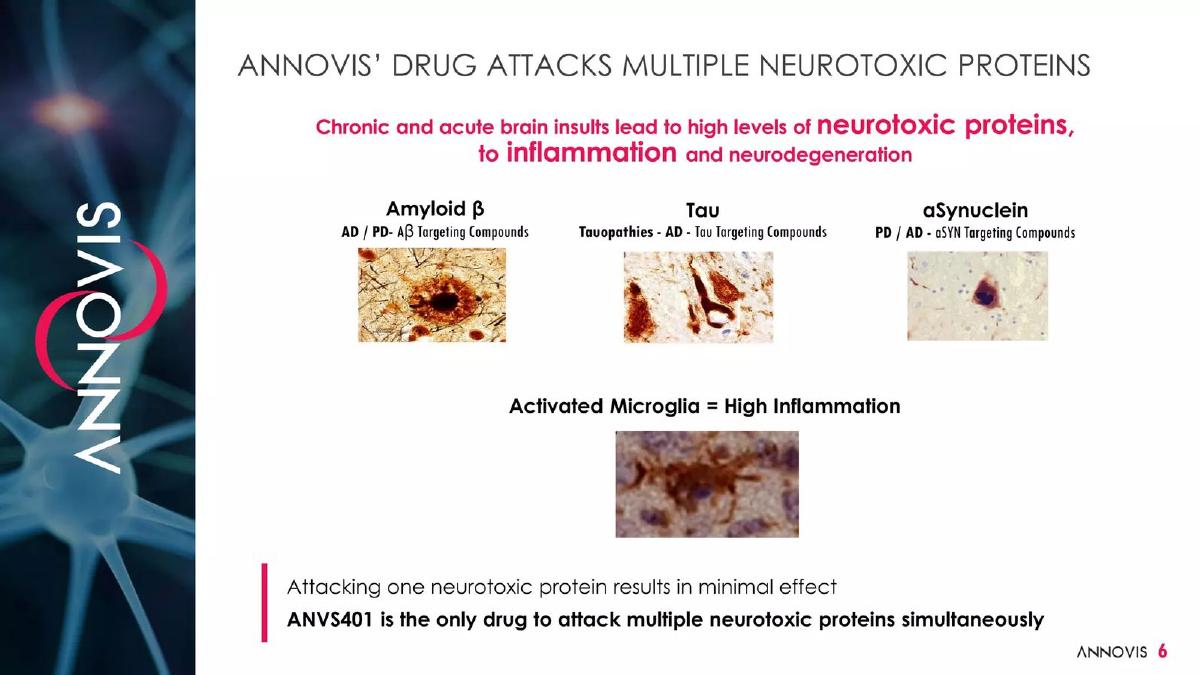
- The therapeutic hypothesis rests on lowering neurotoxic proteins to increase synaptic transmission and prevent nerve cell death (Slide 10).
- Preliminary data from the first 14 Parkinson's patients shows a positive trend in efficacy (Slide 19).
- The leadership team features deep academic and industry experience, including a founder who previously sold a biotech company to Transgenomic (Slide 22).
- The deck concludes that successful Phase 2 completion will provide the necessary validation to move into Phase 3 trials (Slide 25).
Annovis Pitch Deck Teardown: The Case for Axonal Transport
The March 2021 investor presentation for Annovis (NYSE American: ANVS) serves as a technical roadmap for a clinical-stage biotech company. Unlike early-stage startup decks that rely on vision and hypothetical markets, this deck is built on the foundation of clinical trial milestones and biological mechanisms. It seeks to convince investors that the company has found a viable path forward in a field—neurodegeneration—notorious for high-profile failures.
Slide 1: Title and Core Value Proposition
The cover slide establishes the company's focus immediately: attacking Alzheimer’s Disease and neurodegeneration by improving the 'Information Highway' of the nerve cell. By highlighting Axonal Transport in red, the company signals its specific biological niche. The inclusion of the ticker symbol ANVS and the date March 2021 indicates this is a public markets update, likely intended for institutional investors or follow-on offering participants.
Slide 4: The State of Neurodegenerative Diseases
This slide serves as the 'Problem' slide. It uses staggering statistics to establish the Total Addressable Market (TAM). Key figures include:
5.8 million people in the US and 44 million worldwide suffer from AD. · PD affects 1 million in the US and 10 million globally. · Total costs of care are projected to top $1.1 trillion in 2050 .
Crucially, the slide addresses the 'why now' by pointing out the failure of the industry's previous focus. It notes over 500 failed attempts between 1998 and 2018, primarily focused on amyloid plaque. This sets the stage for Annovis to present its alternative approach as the necessary solution.
Slide 7: The Product Pipeline
The pipeline slide is a standard but essential component of any biotech deck. It shows the breadth of the company's portfolio:
ANVS401: The flagship oral drug for chronic indications (AD, PD, CTE), shown as being deep into Phase 2. · ANVS405: An injectable for acute events (TBI, Stroke), currently in the IND phase. · ANVS301: An oral drug for advanced AD, completing Phase 1.
The visual representation of the progress bars provides a clear sense of maturity, suggesting that the company is not just a 'one-trick pony' but has multiple shots on goal across different delivery methods and disease stages.
Slide 10: The Biological Mechanism
This slide explains the 'Toxic Cascade.' It uses a side-by-side comparison to show the state of a diseased cell versus one treated with ANVS401. On the left, high levels of neurotoxic proteins lead to inflammation and cell death. On the right, ANVS401 lowers those levels, resulting in 'Healthy Nerve Cells' and 'Improved Cognitive and Motor Function.' This simplification of complex biology is designed to make the investment thesis accessible to non-scientific investors while maintaining technical credibility.
Slide 13: Clinical Data and Inflammatory Markers
This is arguably the most important slide for a clinical-stage company. It presents hard data from MCI patients. The table shows the percentage decrease of inflammatory proteins after just 10 days of oral treatment:
Complement C3: -86.9% (p-Value 0.0007) · MCP-1: -87.5% (p-Value 0.0007) · YKL40: -72.7% (p-Value 0.0113)
The inclusion of p-values is critical here; a p-value of 0.0007 is highly statistically significant, suggesting that the results are very unlikely to be due to chance. This data provides the 'proof' that the drug is doing what the company claims it does at a molecular level.
Slide 16: Phase 2 Clinical Trial Endpoints
Slide 16 outlines the goals of the ongoing Phase 2 trials. It categorizes endpoints into Target (decreasing proteins), Pathway (increasing neurotransmitters and lowering inflammation), and Efficacy (cognition and motor function). By laying out these specific metrics, Annovis tells investors exactly how success will be measured in the coming months. This transparency is vital for building trust in the biotech sector.
Slide 19: Preliminary Data from Parkinson's Patients
This slide provides a 'sneak peek' at the results from the first 14 Parkinson's patients. While the table for neurotoxic proteins and inflammation is not yet filled with percentages, it shows the 'Expected Outcome' (downward arrows) and an 'Actual Outcome' for Efficacy marked with a '+'. The legend indicates that '+' represents a p-value of The team slide emphasizes both entrepreneurial success and academic prestige. Maria L. Maccecchini, PhD , is highlighted for her previous exit (selling a company to Transgenomic in 2001). The advisors, Dr. Jeffrey Cummings and Dr. William Mobley , bring massive institutional credibility from UCLA and UC San Diego, respectively. In biotech, the pedigree of the scientific advisory board is often as important as the executive team, as it validates the underlying science.
Slide 25: Investment Summary
The deck concludes with a summary of the opportunity. It reiterates the multibillion-dollar market, the novel approach, and the specific function of ANVS401. The final bullet point is the most important: 'The successful completion of our Phase 2 clinical trials will provide validation... and allow us to move to Phase 3 trials.' This defines the next major value inflection point for the company.
What Annovis Does Well
The deck is exceptionally disciplined in its focus on data. By providing specific p-values and percentage decreases in inflammatory markers, Annovis moves beyond marketing speak into verifiable science. The narrative arc is also strong: it identifies a massive problem (Alzheimer's), explains why others failed (amyloid focus), presents a logical alternative (axonal transport), and provides early evidence that this alternative works.
The use of clear, consistent branding—specifically the 'waterfall' and 'nerve cell' imagery—helps maintain a professional tone throughout the 26-slide deck. The pipeline slide is also a model of clarity, showing exactly where each asset stands in the regulatory process.
What is Missing from the Deck
Despite its technical strengths, the deck omits several key pieces of information typically sought by investors:
Financials and Burn Rate: There is no mention of the company's current cash position, monthly burn, or how long the current capital will last. For a public company, this information is available in SEC filings, but including a summary in the deck helps frame the 'runway' for investors. · The Ask: The deck does not specify how much capital the company is looking to raise or how those funds will be allocated (e.g., how much for the Phase 3 trial vs. G&A). · Competitive Landscape: While it mentions the failure of amyloid-focused drugs, it does not list current competitors who might also be working on axonal transport or other non-amyloid pathways. · Intellectual Property: There is no slide detailing the patent portfolio, expiration dates, or the 'moat' protecting their lead compounds from generic competition.
Lessons for Founders
Founders in the deep tech or life sciences space can learn a great deal from the Annovis approach to data presentation. Don't hide your p-values. If you have statistically significant data, it should be the centerpiece of your deck. Annovis places their most impressive data (Slide 13) right in the middle of the presentation to anchor the technical argument.
Another lesson is the importance of framing the failure of others. By citing the 500+ failed attempts in the industry, Annovis doesn't just say they are good; they explain why the existing giants are wrong. This creates a 'contrarian' investment thesis that can be very attractive to investors looking for the next breakthrough. Finally, the use of a clear 'Mechanism of Action' slide (Slide 10) is a must-have for any company proposing a new way to solve an old problem; if an investor can't visualize how your product works, they are unlikely to fund it.
Frequently asked questions
- What is the primary mechanism of action for Annovis drugs?
- Annovis focuses on improving axonal transport, which they refer to as the 'information highway' of the nerve cell. According to Slide 10, their lead compound ANVS401 works by lowering levels of neurotoxic proteins. This reduction is intended to impede a 'toxic cascade' that otherwise leads to impaired transport, inflammation, and eventual nerve cell death. By restoring transport, the drug aims to increase synaptic transmission and improve both cognitive and motor functions.
- How does Annovis differentiate itself from previous failed Alzheimer's treatments?
- Slide 4 explicitly states that between 1998 and 2018, there were over 500 failed attempts at developing Alzheimer's drugs, most of which focused on amyloid plaque. Annovis differentiates itself by moving away from the plaque-centric model to focus on the underlying axonal transport mechanism. They frame this as a necessary 'rethink' of dementia, moving toward new approaches that address neurotoxicity and inflammation rather than just protein aggregation.
- What clinical evidence is provided for the efficacy of ANVS401?
- The deck provides specific data from MCI (Mild Cognitive Impairment) patients on Slide 13. After 10 days of oral ANVS401, inflammatory proteins showed significant decreases: Complement C3 dropped by 86.9% and MCP-1 by 87.5%, both with a p-value of 0.0007. Additionally, Slide 19 shows preliminary data from 14 Parkinson’s Disease patients, indicating a positive efficacy trend (p<0.05) and expected outcomes in reversing the toxic cascade.
- What does the company's product pipeline look like?
- As shown on Slide 7, the pipeline is led by ANVS401, an oral drug for chronic indications including AD, PD, and CTE, currently in Phase 2. They also have ANVS405, an injectable drug for acute traumatic events like TBI and Stroke, which is in the IND (Investigational New Drug) stage. Finally, ANVS301 is an oral drug for advanced Alzheimer's and dementia, currently positioned at the end of Phase 1.
- Who are the key members of the Annovis leadership team?
- The team is led by Founder, President, and CEO Maria L. Maccecchini, PhD, who previously founded and sold Symphony Pharmaceuticals. She is supported by CFO Jeffrey McGroarty, a Wharton MBA with experience at PWC and Safeguard Scientifics. The advisory side includes Dr. Jeffrey Cummings, a neurology expert with nearly 600 peer-reviewed papers, and Dr. William Mobley, a member of the National Academy of Medicine (Slide 22).