Cube’s 15-slide deck (8 slides analyzed here) is a study in minimalist B2B SaaS storytelling. The company successfully raised a $30M Series B by identifying a specific pain point: the 'Office of the CFO' has evolved, but tools have not. Rather than fighting the ubiquity of Excel and Google Sheets, Cube embraces them, positioning its platform as an enterprise-grade engine that lives within the spreadsheet UI. The deck’s strength lies in its clear problem-solution fit and a high-impact traction slide showing 5x YOY ARR growth. While it lacks granular unit economics or a detailed competitive lan…
Key takeaways
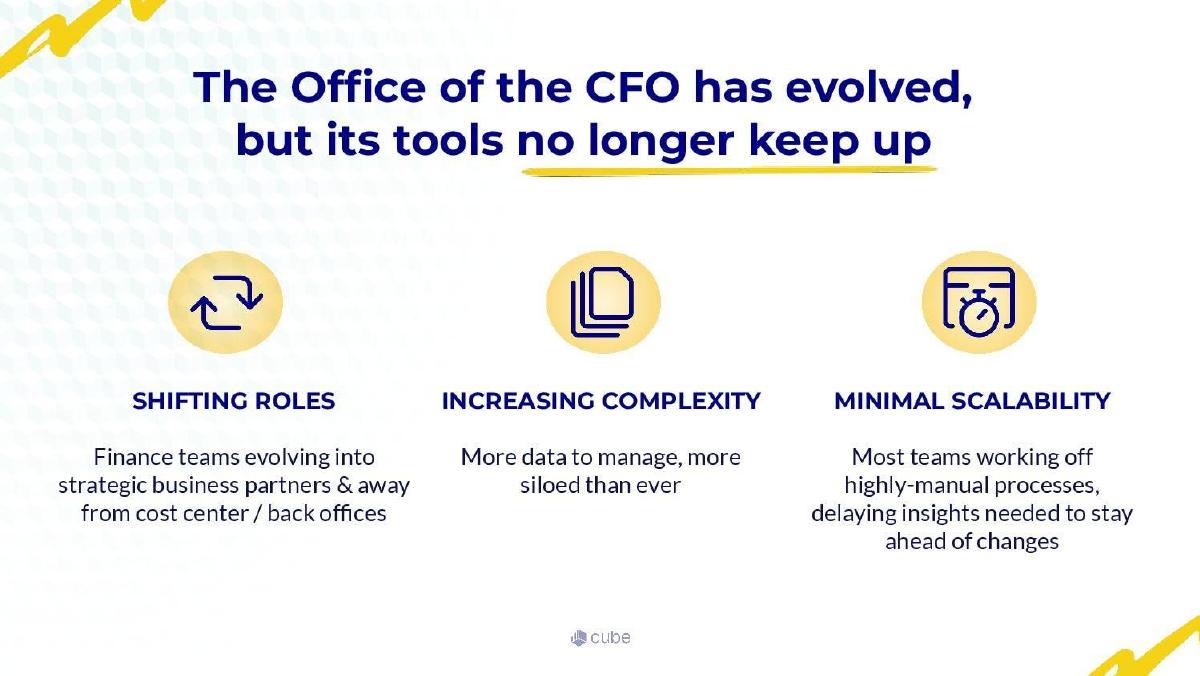
- The deck identifies three core drivers of market change: shifting roles, increasing complexity, and minimal scalability in the CFO's office (Slide 2).
- Cube positions itself as the 'first spreadsheet-native FP&A platform,' leveraging the familiarity of Excel and Google Sheets (Slide 5).
- The product strategy focuses on 'meeting finance users where they live,' reducing friction for adoption (Slide 6).
- A high-impact traction slide visually demonstrates a 5x Year-Over-Year (YOY) ARR growth rate (Slide 7).
- The deck uses a minimalist design with large, bold text to ensure the core value proposition is impossible to miss.
- FP&A software is cited as ranking the lowest among financial software categories, highlighting a clear opportunity for disruption (Slide 4).
- The team slide emphasizes a 'movement' rather than just a roster, using a Zoom-style grid of 30+ employees to show scale (Slide 8).
- The deck omits specific financial figures, valuation, and a detailed 'Ask' slide in the provided 8-slide sequence.
The Narrative of the 'Spreadsheet-Native' Revolution
Cube’s Series B deck is a masterclass in high-level narrative. In the world of Fintech, specifically Financial Planning and Analysis (FP&A), the temptation is often to lead with complex feature lists and integration maps. Cube takes the opposite approach. They focus on the psychological and operational reality of their end user: the finance professional who refuses to leave Excel. By raising $30M on this premise, Cube proved that 'meeting users where they are' is a powerful investment thesis.
Slide 1-3: The Problem of the Evolving CFO
The deck opens with a clean, branded title slide and moves immediately into the macro problem. Slide 2, titled The Office of the CFO has evolved, but its tools no longer keep up , breaks the problem into three digestible pillars: Shifting Roles, Increasing Complexity, and Minimal Scalability. This slide is critical because it frames the product not just as a tool, but as a necessity for a department undergoing a fundamental transformation from a 'cost center' to a 'strategic business partner.'
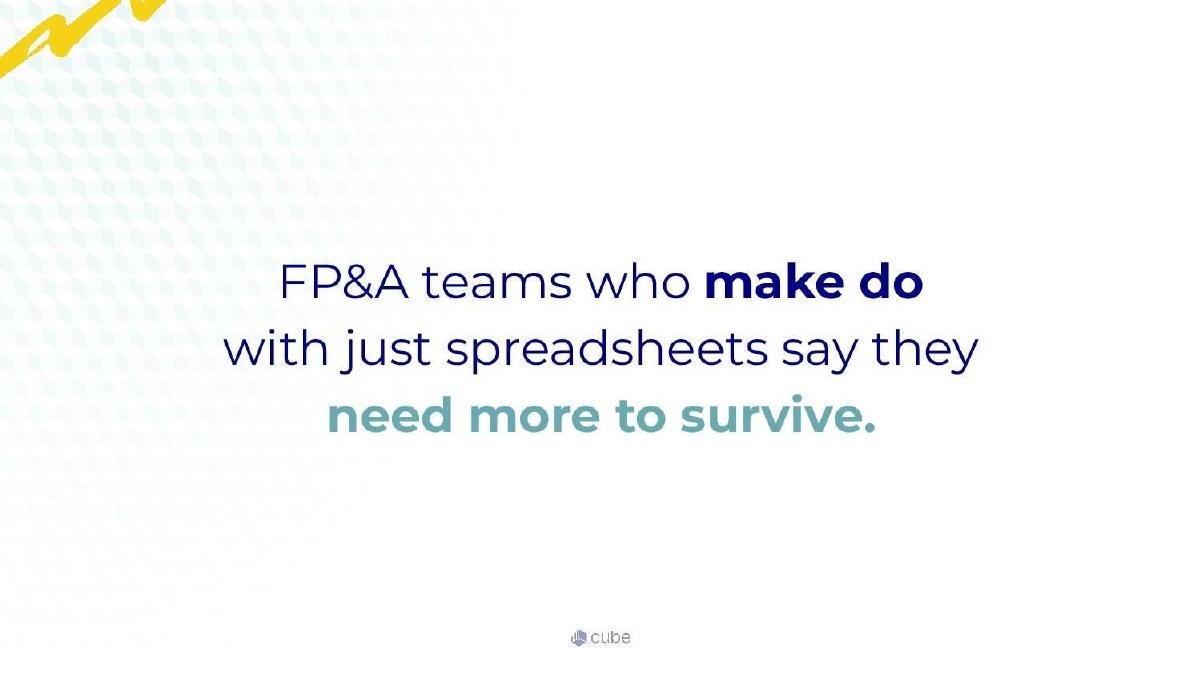
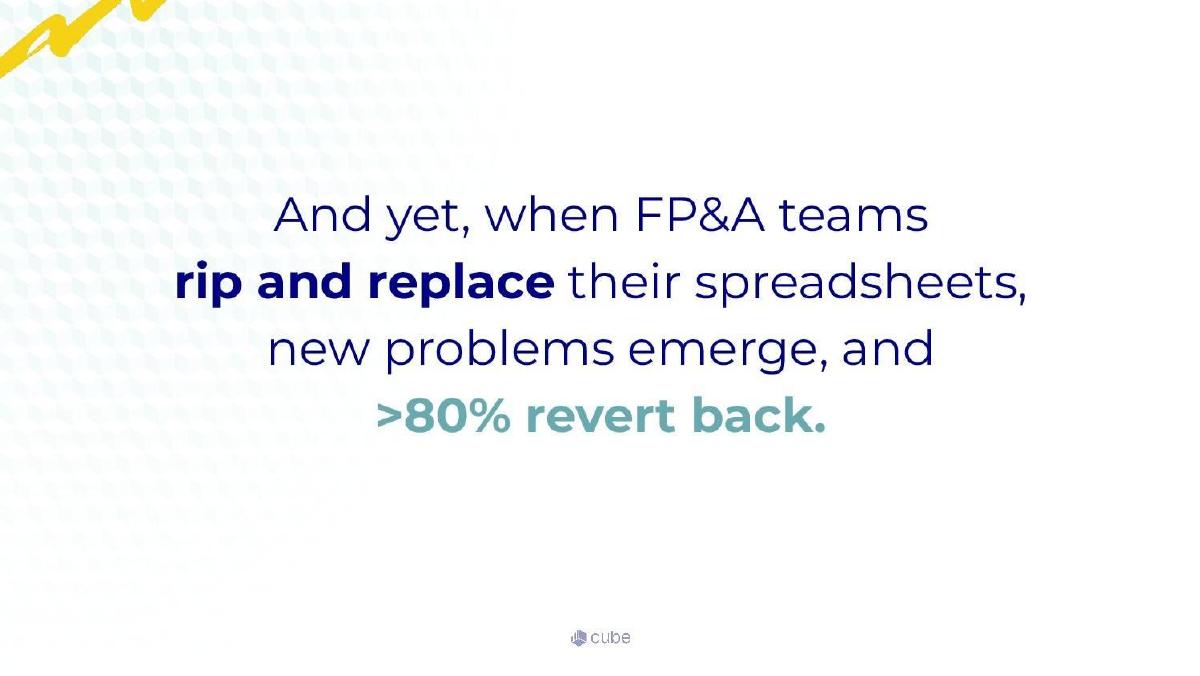
Slide 3 reinforces this with a simple, punchy statement: FP&A teams who make do with just spreadsheets say they need more to survive. This sets up a tension—spreadsheets are necessary but insufficient—which Cube will later resolve by offering a hybrid solution.
Slide 4: The Market Gap
Slide 4 focuses on IMPACT . It makes a bold claim that existing options hinder the ability to move at the pace of market conditions. Most importantly, it includes a footnote stating that FP&A software ranks the lowest of financial software categories . This is a classic 'blue ocean' setup. By pointing out that the current market leaders are failing to satisfy users, Cube creates a vacuum that their solution is designed to fill.
Slide 5-6: The 'Spreadsheet-Native' Solution
Slide 5 is the 'Aha!' moment of the deck. Titled Spreadsheet meets SaaS , it introduces Cube as the first spreadsheet-native FP&A platform . The visual is simple: an icon of a spreadsheet (Excel/Google Sheets) plus a Cube icon equals a modern SaaS dashboard. The text emphasizes the 'flexibility of the world’s most universal UI' combined with 'enterprise-grade engine' performance.
Slide 6 doubles down on this, stating that by meeting finance users where they live every day—the spreadsheet , Cube helps them work faster. This is a direct shot at competitors who try to force finance teams into proprietary web interfaces that lack the formulaic flexibility of Excel. It positions Cube as the path of least resistance for adoption.
Slide 7: The 5x Growth Engine
For a Series B, traction is the most important slide. Slide 7 is incredibly effective despite its simplicity. It features a bar chart showing aggressive upward momentum with the headline: Enabling us to grow ARR 5x YOY . While the Y-axis lacks specific dollar denominations, the visual representation of 12 consecutive bars of growth, culminating in a circled peak, tells the story of a company that has found product-market fit and is ready to pour gasoline on the fire.
Slide 8: The Movement
Instead of a traditional team slide with headshots and logos of former employers (Google, Goldman Sachs, etc.), Cube opts for a 'community' feel. Slide 8, titled The movement is here , shows a Zoom-style grid of over 30 team members. This conveys scale, culture, and momentum. It suggests that Cube is no longer a small founding team but a robust organization capable of supporting enterprise clients. The call to action is simple: Join us as we lead the clear approach to FP&A.
What Cube Got Right
Extreme Clarity: There is no jargon. The deck uses large fonts and simple analogies. An investor can flip through this in 60 seconds and understand exactly what the company does and why it is winning. · Embracing the 'Enemy': Most startups try to 'kill' the incumbent (Excel). Cube realizes that Excel is unkillable in finance, so they built a 'native' layer on top of it. This significantly lowers the perceived barrier to entry and churn risk. · Traction-First Mentality: The 5x YOY ARR growth claim is the anchor of the Series B. By putting this front and center, they validate that their 'spreadsheet-native' theory is working in the real world.
What is Missing from the Deck
Unit Economics: While 5x growth is impressive, Series B investors typically want to see CAC (Customer Acquisition Cost), LTV (Lifetime Value), and Net Revenue Retention (NRR). None of these are present in the provided slides. · Competitive Landscape: The FP&A space is crowded with players like Anaplan, Adaptive Insights, and Vena. The deck mentions that 'existing options hinder' users, but it doesn't explicitly map out how Cube wins against specific tiers of competitors. · The 'Ask': The provided slides do not include a formal 'Ask' slide detailing how much they are raising (though we know it was $30M) or what the specific milestones for the next 18-24 months are. · Product Deep Dive: There are no screenshots of the actual 'enterprise-grade engine' or how the data consolidation looks in practice. The deck stays at a very high conceptual level.
Founder's Playbook: Lessons to Copy
The Power of the Subtitle: Notice how Cube uses underlined subtitles to emphasize key points (e.g., Slide 2, Slide 5, Slide 7). This guides the reader's eye to the most important takeaway on every page. · Visual Metaphors: The 'Spreadsheet + Cube = SaaS' graphic on Slide 5 is a perfect way to explain a complex technical integration in a way that a non-technical investor can immediately grasp. · Focus on the 'Why Now': Slide 2 and 4 do a great job of explaining why the market is ready for a change right now (shifting roles and poor existing software rankings). Every deck needs a 'Why Now' to create urgency. · Minimalist Design: The use of white space and a consistent color palette (navy, yellow, light blue) makes the deck feel professional and 'enterprise-ready,' which is exactly the brand a Fintech company needs to project.
Frequently asked questions
- What is Cube's core product value proposition?
- Cube positions itself as a 'spreadsheet-native' FP&A platform. Instead of forcing finance teams to abandon Excel or Google Sheets for a new, complex interface, Cube integrates an enterprise-grade engine directly into the spreadsheets finance professionals already use. This allows for automation and data consolidation without the steep learning curve of traditional SaaS tools.
- How much did Cube raise with this deck?
- According to publisher-reported facts from Business Insider, Cube raised $30 million in a Series B round. The deck provided was used to facilitate this mid-stage growth funding, focusing on scaling the traction they had already established in the fintech and FP&A market.
- What metrics does Cube use to show traction?
- The primary metric highlighted on Slide 7 is a 5x Year-Over-Year (YOY) growth in Annual Recurring Revenue (ARR). The slide uses a bar chart to show consistent monthly or quarterly growth leading up to a significant peak, though specific dollar amounts are excluded from the visual representation.
- Who is the target audience for Cube's platform?
- The deck specifically targets the 'Office of the CFO' and Financial Planning and Analysis (FP&A) teams. It highlights that these teams are evolving from back-office cost centers into strategic business partners who require faster, more scalable data insights than manual spreadsheet processes can provide.
- What is missing from this version of the Cube pitch deck?
- This 8-slide teardown lacks a detailed competitive landscape, a breakdown of unit economics (like LTV/CAC), a specific use-of-funds slide, and a traditional executive team bio slide. While Slide 8 shows the broader team, it does not detail the founders' specific backgrounds or previous successes.