Cultivora's deck, dating to approximately 2012, positions the company as a specialized media and community hub for music festival enthusiasts. The platform combines editorial coverage, destination guides, and social media management services. While the deck leans heavily on visual screenshots of their web interface and Twitter presence, it provides a clear five-year financial roadmap. Projections show a transition from a $45,650 net loss in 2012 to a projected $1,047,605 net income by 2016. The team highlights strong backgrounds in media planning and brand strategy, specifically citing experi…
Key takeaways
- The company projects a significant revenue jump from $38,400 in 2012 to $5,475,000 by 2016 (Slide 7).
- Cultivora aims to reach profitability by 2014 with a projected net income of $133,445 (Slide 7).
- The platform strategy relies on three pillars: Festivals, Destinations, and Coverage (Slide 2).
- Director of Marketing Joseph Sunder brings experience from McCann Erickson and an MA in Music Business from NYU (Slide 6).
- The business model includes a B2B service component, offering 'Full social media management' for festivals (Slide 5).
- Community value is framed as a reciprocal relationship where users create value for themselves and the platform (Slide 4).
- The organizational structure is divided into two primary branches: Marketing and Editorial (Slide 8).
- The deck omits a specific funding request, valuation, or use of proceeds slide (Slides 1-10).
Executive Summary: The Festival Economy Playbook
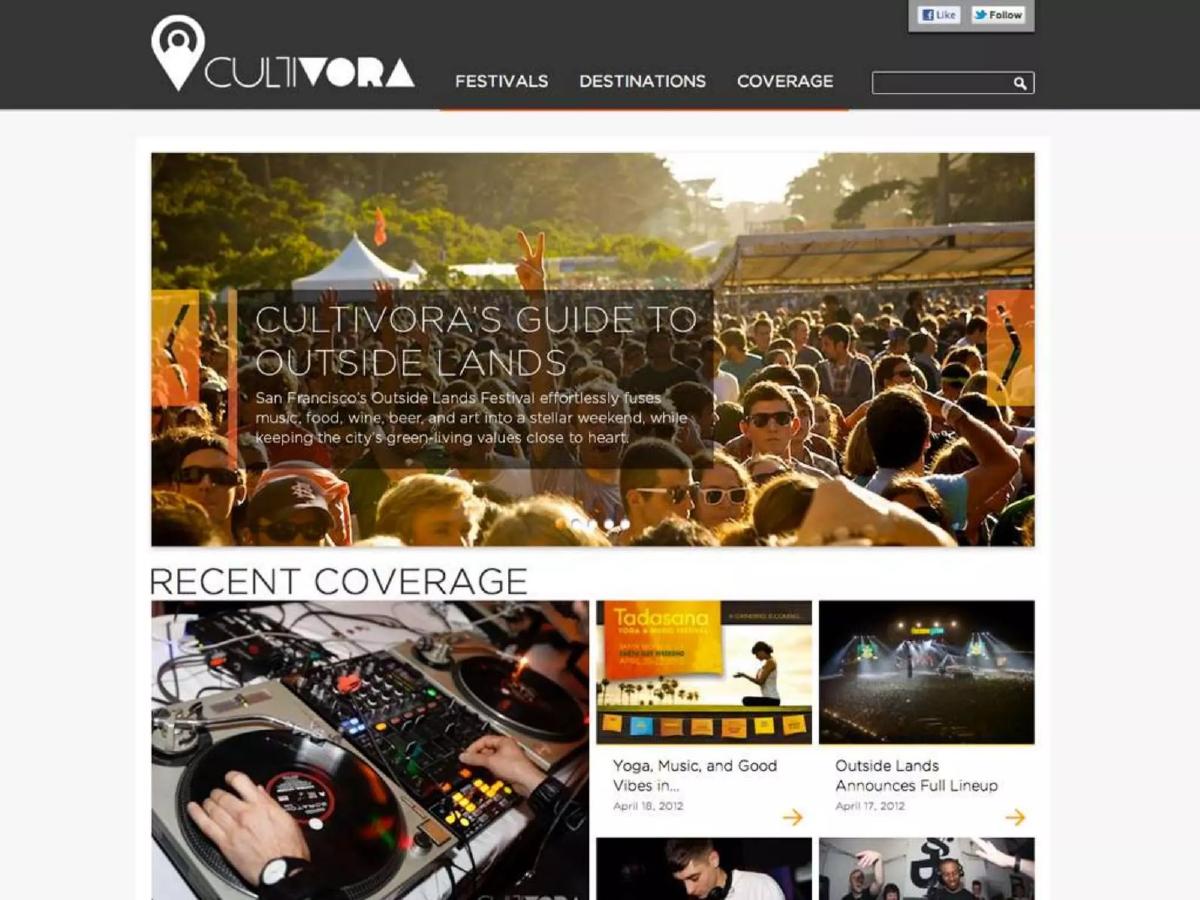
Cultivora enters the market during the early 2010s explosion of the global music festival industry. The deck positions the company not just as a blog, but as a 'mobilized' community and service provider. By blending B2C editorial content with B2B marketing services, the founders aim to capture value from both the festival-goer and the festival organizer. The visual language of the deck is heavily reliant on the product's existing web interface, suggesting a 'product-first' approach where the platform was already live at the time of the pitch.
Slide 1: Title and Leadership
The cover slide introduces the brand identity: 'Cultivora: Mobilized by Music.' It identifies the core executive team: Marjana Jaidi (CEO), Rishi Trivedi (CFO), and Joseph Sunder (Director of Marketing). The orange and white color palette is established here and maintained throughout the deck. The logo features a location pin integrated with a circular motif, signaling a focus on physical destinations and events.
Slide 2: Editorial Strategy and Coverage
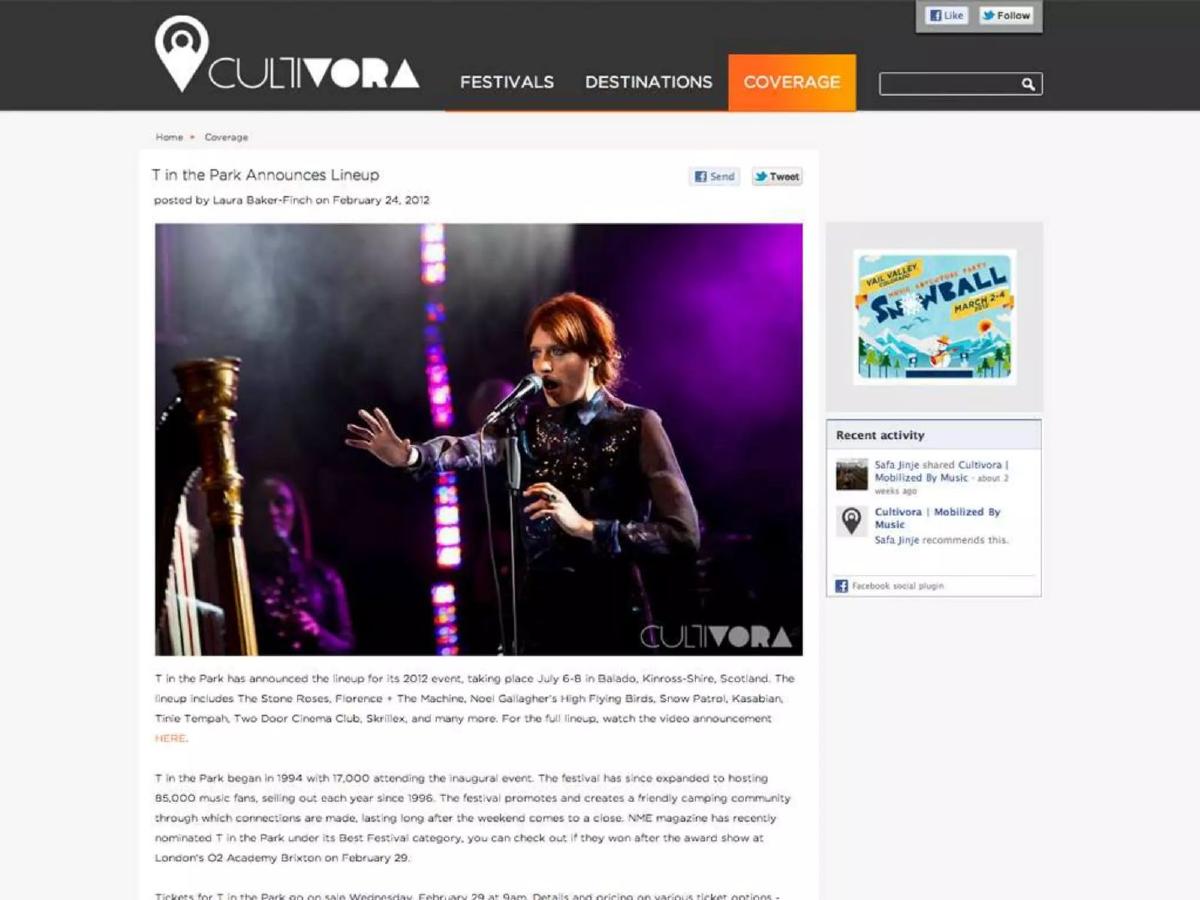
This slide showcases a live screenshot of the Cultivora website, specifically a 'Coverage' post about the 'T in the Park' festival lineup. It demonstrates the platform's ability to aggregate and report on major international events (citing Scotland's Kinross-Shire). The inclusion of social sharing buttons (Facebook 'Send' and 'Tweet') highlights the company's focus on viral distribution and social proof within the music community.
Slide 3: The Festival Guide Product
Slide 3 focuses on the 'Festivals' vertical, using 'Electric Zoo' as the case study. This is a critical slide because it shows the depth of data Cultivora provides: location, dates, and specific price points (GA 3-Day Pass $299 to Platinum $1199). By providing 'Insights' and 'At-A-Glance' sections, the company positions itself as a utility for high-intent consumers who are in the purchasing phase of the festival journey.
Slide 4: Community and Network Effects
The 'Community' slide is light on text but heavy on philosophy. It claims that 'Users create value for themselves while adding value to Cultivora.' This suggests a strategy involving user-generated content or social networking features, though the specific mechanics of this value creation are not detailed on the slide. The goal is to make the user feel like they are 'Part of something bigger.'
Slide 5: B2B Service Offerings
This is the first clear indication of a revenue-generating service model. Cultivora offers to 'Utilize our expertise in music festival online communities to develop social media marketing.' The bullet points list 'Full social media management' and 'Integrated Marketing Strategy.' This suggests the company acts as a boutique agency for festivals, potentially providing a more stable cash flow than advertising alone.
Slide 6: Team Deep Dive - Joseph Sunder
The deck highlights Joseph Sunder, Director of Marketing. His credentials are impressive for a media startup: Media Planner at McCann Erickson and experience with blue-chip clients like United Airlines. His MA in Music Business from NYU (May '12) provides the necessary domain expertise to bridge the gap between corporate marketing standards and the niche music festival industry.
Slide 7: Five-Year Financial Projections
This is the most data-dense slide in the deck. It outlines a growth trajectory from 2012 to 2016. Key figures include:
2012: $38,400 Revenue, ($45,650) Net Income. · 2014: $1,380,000 Revenue, $133,445 Net Income (the projected year of profitability). · 2016: $5,475,000 Revenue, $1,047,605 Net Income.
The Gross Margin is projected to stabilize in the 60-63% range in the later years, suggesting a shift toward a more labor-intensive service model or higher content production costs as they scale.
Slide 8: Organizational Chart
The organizational structure is presented as a simple hierarchy. The 'Executive Team' sits at the top, branching into 'Marketing' (Internal/External) and 'Editorial' (Content/Media). This structure reinforces the two-sided nature of the business: building an audience through editorial and monetizing/managing that audience through marketing.
Slide 9: Social Presence and Traction
Slide 9 shows a screenshot of the Cultivora Twitter profile. At the time of the screenshot, they had 1,179 tweets and 395 followers. While these numbers are modest, the slide is intended to show active engagement and the 'voice' of the brand, featuring retweets of artists like Frank Ocean and mentions of festivals like Coachella and Unsound.
Slide 10: Utility Content Case Study
The final slide in this set returns to editorial, focusing on 'Concert Essentials: High-Fidelity Earplugs.' This type of content is highly effective for SEO and affiliate marketing, though affiliate revenue is not explicitly mentioned in the financials. It demonstrates a commitment to 'evergreen' content that serves the festival-goer's practical needs.
What Works in This Deck
Specific Domain Expertise: The team slide for Joseph Sunder (Slide 6) is a strong point. It connects high-level agency experience with a specific degree in the field, giving investors confidence that the 'Marketing Services' mentioned on Slide 5 are backed by professional standards.
Product Maturity: By using actual screenshots of the site and social media (Slides 2, 3, 9, 10), the founders show that they are beyond the 'idea stage.' The platform is functional, the editorial voice is established, and the data structure for festival guides is already built.
Clear Financial Roadmap: The financial table (Slide 7) is transparent about early losses. It shows a realistic path to profitability over a three-year window, which is often more believable to investors than 'instant' profitability.
What Is Missing
The Ask: The most significant omission in these 10 slides is the funding request. There is no mention of how much money the company is seeking, the valuation, or how the funds will be allocated across the Marketing and Editorial departments.
Revenue Breakdown: While Slide 7 shows total revenue, it does not distinguish between B2B agency fees, B2C advertising, affiliate sales, or ticket commissions. Investors need to know which of these levers is the primary driver of the $5.4M projection.
Competitive Analysis: The deck does not address competitors like Resident Advisor, Pitchfork, or Songkick. Explaining how Cultivora's 'Destination' and 'Insight' focus differs from existing concert aggregators is a missed opportunity.
Founder's Takeaway: Copy the Clarity, Add the Context
Founders should emulate the way Cultivora uses actual product screenshots to explain their value proposition. Instead of abstract icons, showing the 'At-A-Glance' festival data (Slide 3) immediately tells the investor what the user experience looks like. However, a modern deck must include a clear Unit Economics slide. Cultivora hints at a community-driven model, but fails to show the cost to acquire a user (CAC) versus the lifetime value (LTV) of that user through their various revenue streams. Finally, always ensure your financial projections (Slide 7) are accompanied by a slide explaining the 'Assumptions' behind those numbers—specifically, how many festivals you need to sign as clients to reach a $5M run rate.
Frequently asked questions
- What is Cultivora's primary business model?
- Based on the slides, Cultivora operates as a hybrid media platform and marketing agency. They produce editorial content and festival guides to attract a consumer audience (Slides 2-3) while offering social media management and integrated marketing strategies to festivals as a service (Slide 5). Their financial projections suggest a diversified revenue stream that grows from $38,400 to over $5.4 million in five years.
- Who are the key leaders mentioned in the deck?
- The title slide lists Marjana Jaidi as CEO, Rishi Trivedi as CFO, and Joseph Sunder as Director of Marketing. A dedicated bio slide for Sunder highlights his background as a Media Planner and Brand Strategist at McCann Erickson and BD'M, working with clients like United Airlines and Marquis Hotels, and holding an MA in Music Business from NYU (Slide 6).
- How does the company plan to achieve profitability?
- According to the financial table on Slide 7, the company expects to operate at a loss in 2012 ($45,650) and 2013 ($119,200). They project hitting a 'break-even' point and reaching profitability in 2014 with a 9.03% net margin, eventually scaling to a 21.41% net margin by 2016 as revenue growth outpaces operating expenses.
- What specific content does the platform provide to users?
- Cultivora provides comprehensive festival coverage, including lineup announcements (Slide 2), 'At-A-Glance' festival data such as location and ticket pricing (Slide 3), and utility-based editorial like 'Concert Essentials' regarding high-fidelity earplugs (Slide 10). The platform also features 'Destinations' and 'Insights' sections to assist travelers attending these events.
- What is missing from this pitch deck?
- The provided slides lack several critical fundraising elements. There is no 'Ask' slide detailing how much capital is being raised or the terms of the round. Additionally, there is no competitive landscape analysis, no clear breakdown of unit economics (CAC/LTV), and no detailed explanation of the technology stack or proprietary data features.