Cuponomia’s 23-slide deck from 2012 is a lean, metric-driven presentation that successfully secured seed funding by highlighting a specific market gap in Brazil. The deck avoids fluff, moving quickly from the 'Newness' of coupons in the region to hard traction data, including a 10% week-over-week growth rate and a $32k monthly revenue run rate. It leans heavily on SEO dominance, showing top-three rankings for high-intent search terms like 'cupom desconto dafiti.' While the visual design is dated, the logic is sound: a massive, growing e-commerce market ($10B) lacked a centralized online coupo…
Key takeaways
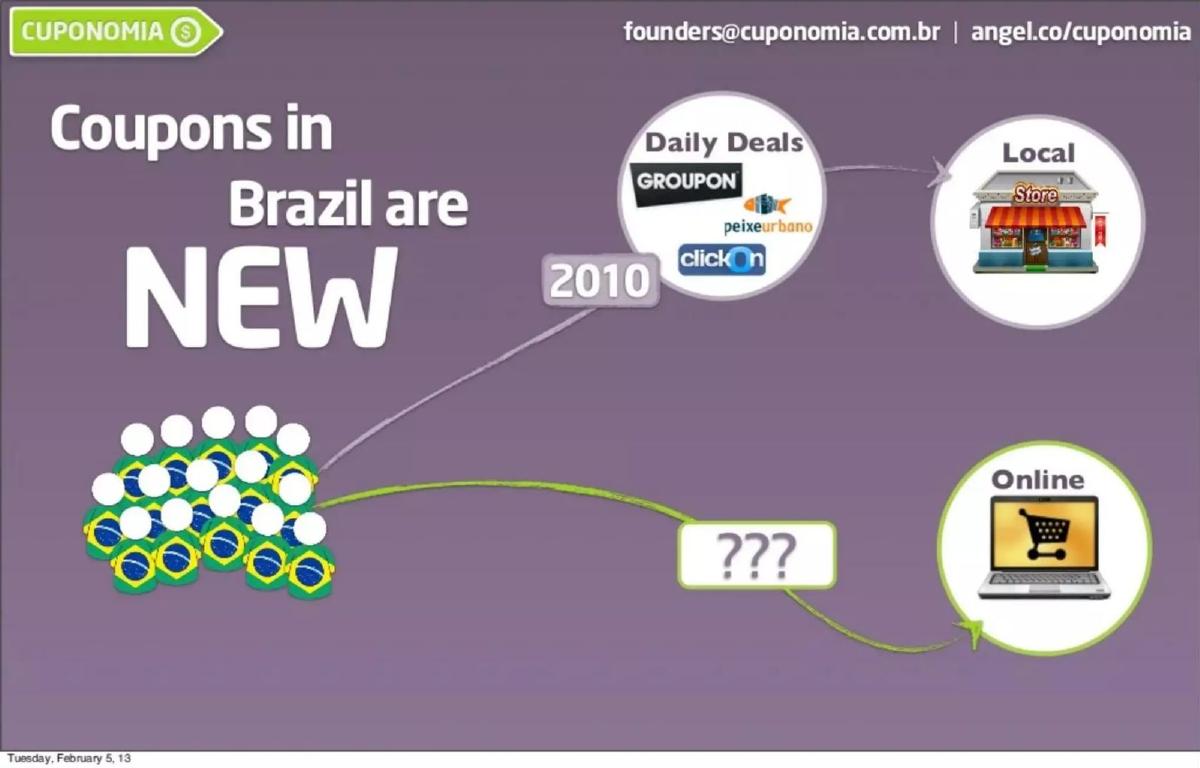
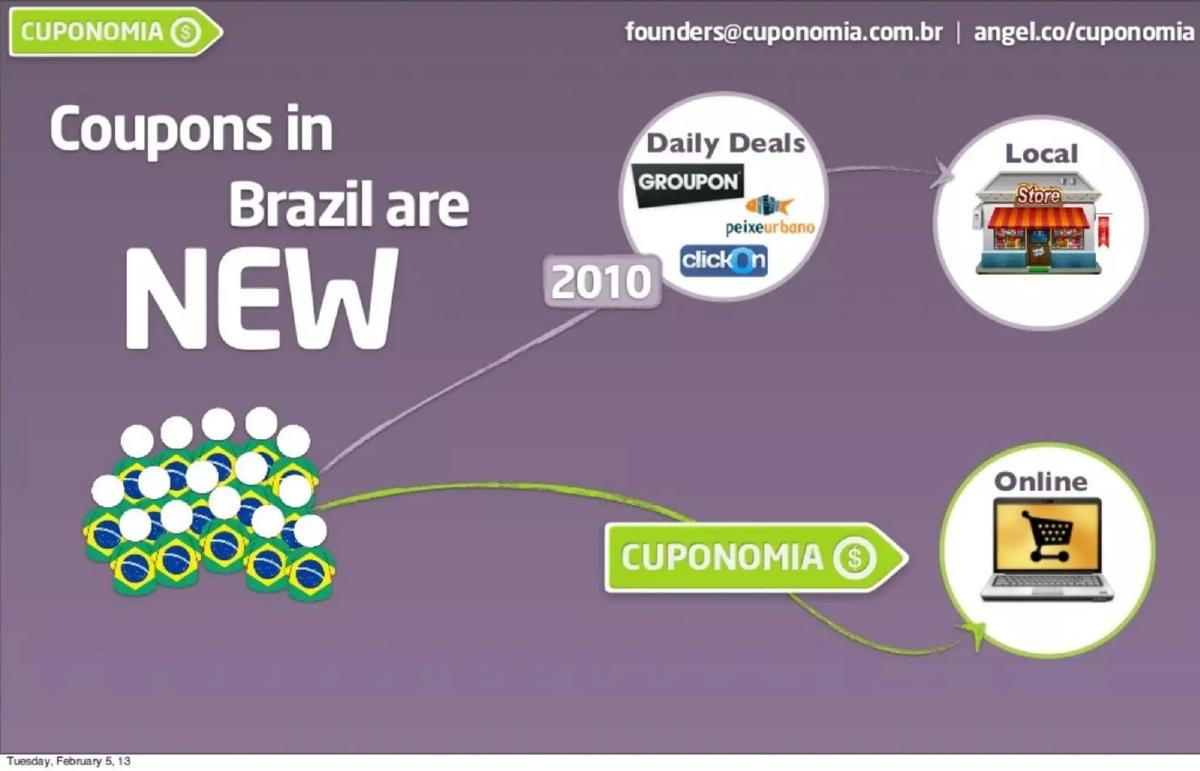
- The deck identifies a clear market transition on Slide 5, moving from 'Local' daily deals (Groupon style) to 'Online' couponing.
- Market size is quantified on Slide 9 as a $10 Billion Brazilian e-commerce market growing at +20% year-over-year.
- Google Trends data on Slide 10 provides external validation for the rising consumer interest in 'online coupon codes' in Brazil.
- Traction is explicitly stated on Slide 15, showing a monthly run rate of 160k visits and $32k in revenue.
- Unit economics are introduced early on Slide 16, citing a revenue value of $0.20 per visit.
- SEO is a core competitive advantage, with Slide 17 listing ten popular search queries where the company ranks in the top 5.
- The partner ecosystem is robust, with Slide 19 claiming over 250 partners including major brands like Walmart, Dell, and Pizza Hut.
- The team slide (Slide 23) highlights pedigree from top-tier firms like McKinsey & Company, AT Kearney, and Groupon.
The Market Timing Play: Cuponomia’s 2012 Seed Deck
Cuponomia’s pitch deck is a classic example of a 'copy-and-adapt' strategy. In 2012, coupon sites were already massive in the US (RetailMeNot, Coupons.com), but the Brazilian market was still catching up. This deck doesn't try to reinvent the wheel; instead, it focuses on proving that the US trend is hitting Brazil now and that Cuponomia is the best-positioned team to capture it.
Slides 1-6: Defining the Opportunity Gap
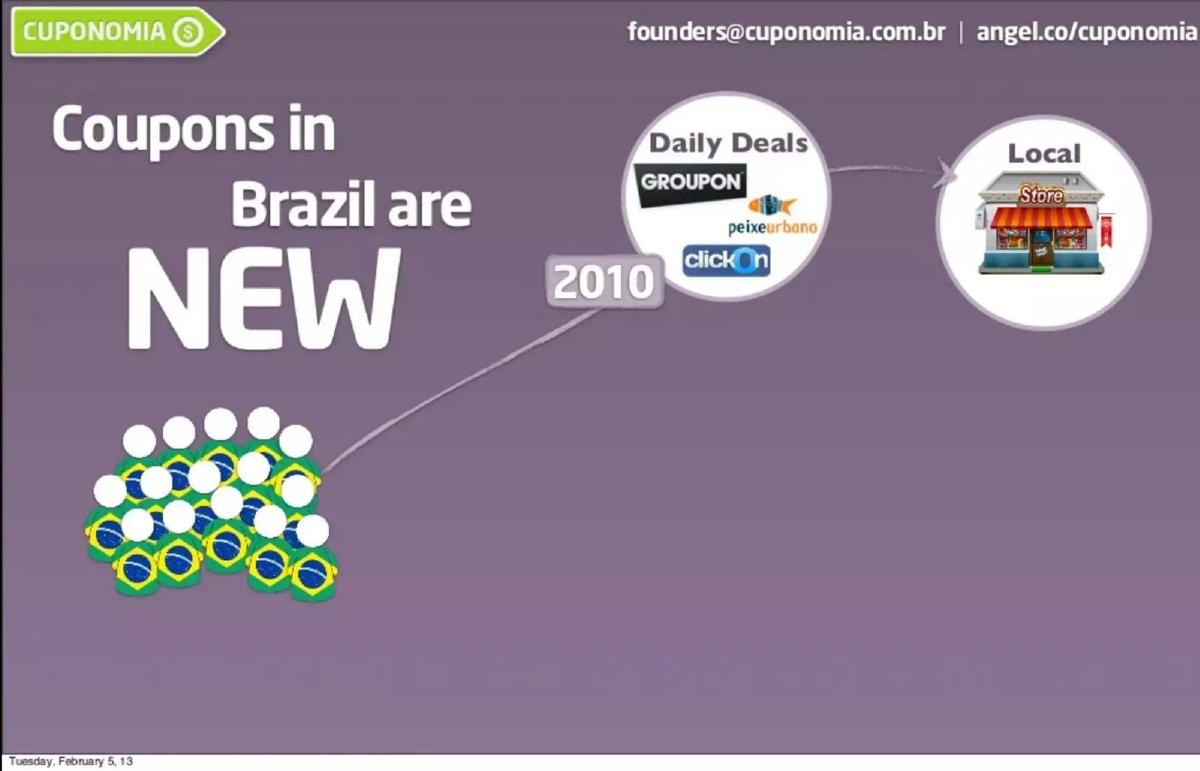
The deck opens with a bold claim on Slide 1 : 'The leading destination for online coupon, deal and promotional code hunting in Brazil.' This immediately sets the geographic and functional scope. Slides 2 through 6 use a progressive animation style to tell a story of market evolution. They start by stating that coupons in Brazil are 'NEW.'
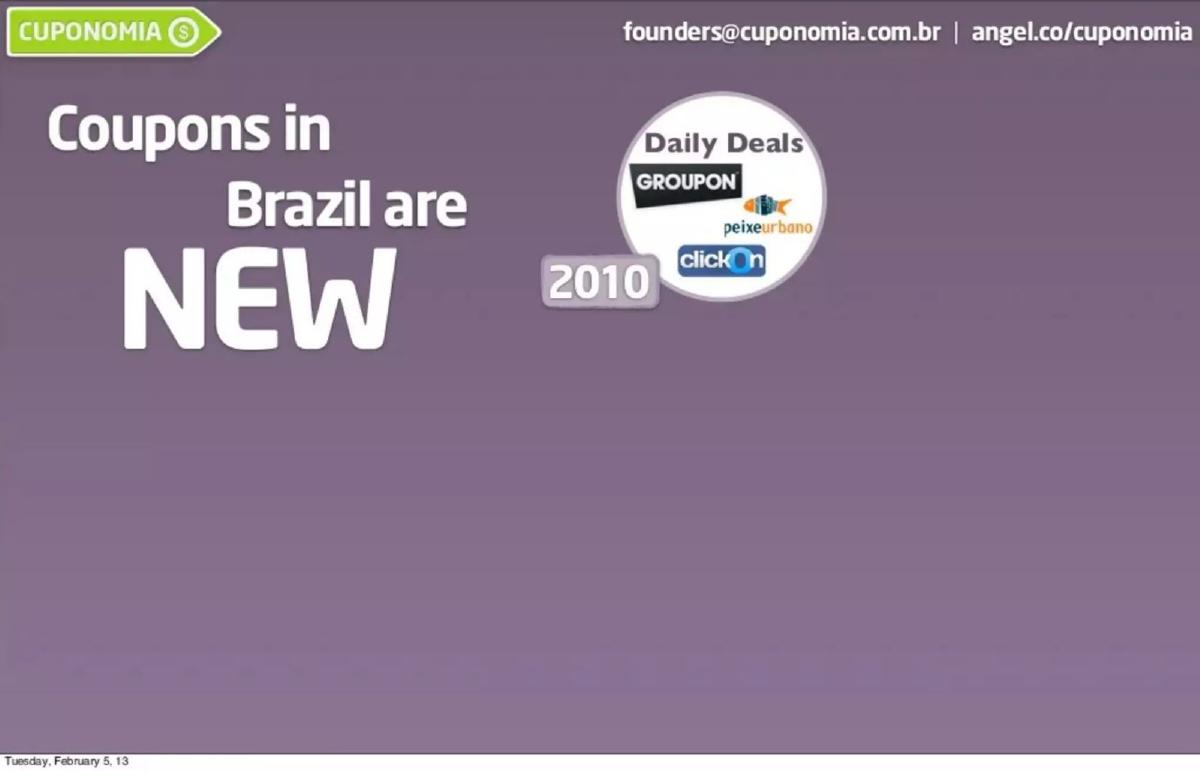
On Slide 3 , they reference the 2010 boom of 'Daily Deals' like Groupon and Peixe Urbano. Slide 4 and 5 create a visual distinction between 'Local' deals (the store icon) and 'Online' deals (the laptop icon). By placing a '???' over the online path on Slide 5 and then replacing it with the Cuponomia logo on Slide 6 , the founders effectively communicate that while local deals are solved, the online coupon market is wide open.
Slides 7-11: Market Size and Consumer Intent
After establishing the gap, the deck moves to market validation. Slide 9 provides the macro context: a $10 Billion Brazilian e-commerce market growing at more than 20% year-over-year. This is a crucial 'why now' metric. If the market is small, a coupon site is a hobby; at $10B, it is a venture-scale business.
Slide 10 and 11 use Google Trends data to show that this isn't just a founder's hunch. The graph shows a sharp upward trajectory for the search term 'online coupon code' in Brazil starting in 2012. The 'X' on the chart marks their entry point, suggesting they are catching the wave at the exact right moment of consumer awareness.
Slides 12-16: Traction and Unit Economics
The 'Traction' section is the strongest part of the deck. Slide 12 shows a weekly visit graph with a massive spike during Black Friday (63k visits). While spikes are common, Slide 13 emphasizes the underlying trend: +10% week-over-week growth.
Slide 15 gets into the hard numbers that investors crave. They report a monthly run rate of 160k visits and $32k in revenue. This is followed by Slide 16 , which breaks down the unit economics to a simple, digestible figure: $0.20 of revenue per visit. For a seed-stage company in 2012, having this level of clarity on monetization was a significant advantage.
Slides 17-19: The SEO Moat and Partner Network
How do they get those visits? Slide 17 answers this by showing their SEO dominance. They list ten high-value search queries, noting they rank #1 for three of them and in the top 5 for all of them. In the world of affiliate marketing and coupons, SEO is the primary moat. Showing they can outrank competitors for terms like 'cupom casas bahia' proves execution capability.
Slides 18 and 19 provide the 'Social Proof.' A logo wall of 250+ partners demonstrates that they have already solved the 'chicken and egg' problem of a marketplace. They have the supply (coupons from Walmart, Dell, etc.) to satisfy the demand (users).
Slides 20-23: The Team and The Ask
The team slides ( Slides 20-23 ) are built incrementally. They highlight a five-person core team including a CEO, COO, UX Leader, CTO, and Developer. The pedigree is emphasized on Slide 21 with logos from McKinsey, AT Kearney, and Groupon. This tells investors that the founders have 'big company' discipline and 'startup' industry knowledge.
The inclusion of an advisor from Coupons.com on Slide 22 adds a layer of global industry validation. Finally, Slide 23 delivers the 'Ask': $500k USD. While the slide doesn't detail the specific use of funds (e.g., hiring vs. marketing), the preceding slides make a strong case that the money will be used to scale an already-working engine.
What Works in This Deck
The 'Why Now' Logic: By using Google Trends and the $10B market stat, they make the opportunity feel urgent. · Metric Transparency: Sharing the $0.20/visit figure and the $32k revenue run rate removes the guesswork for investors. · SEO Proof: Showing actual search rankings is much more powerful than simply saying 'we are good at marketing.' · Marketplace Maturity: The 250+ partner count shows the business is past the experimental phase.
What Is Missing
Competitive Landscape: The deck implies they are the 'leading destination' but doesn't show a head-to-head comparison with other Brazilian players like Méliuz (which was also growing at the time). · Use of Funds: While they ask for $500k, they don't provide a breakdown of how that capital will be deployed over the next 12-18 months. · Product Roadmap: The deck focuses heavily on the current web portal but doesn't mention mobile apps or browser extensions, which became critical for coupon sites shortly after 2012. · Churn/Retention: We see traffic growth, but we don't see if users are coming back. In the coupon space, high dependency on one-off SEO traffic can be a risk if Google changes its algorithm.
What a Founder Should Copy
The Progressive Reveal: Use simple graphics to show a market shift (Local -> Online) rather than a wall of text. · External Validation: If your industry is trending, use Google Trends or third-party reports to prove it isn't just your opinion. · Unit Economics Early: Even if the numbers are small, showing you know exactly how much a single user/visit is worth to your bottom line builds massive trust. · Pedigree Alignment: If you have worked at a company that is a 'market leader' in a related space (like their Groupon hire), highlight that logo prominently.
Frequently asked questions
- What was the primary problem Cuponomia aimed to solve?
- Cuponomia addressed the lack of a centralized, reliable destination for online coupons in Brazil. While daily deal sites like Groupon were popular for local services in 2010, the deck argues on Slides 5 and 6 that there was a '???' gap for online e-commerce coupons. They positioned themselves as the 'leading destination' to fill this void as the $10B Brazilian e-commerce market matured.
- How did Cuponomia prove their business model was working?
- They used a combination of traffic and revenue metrics. Slide 15 shows a 10% week-over-week growth rate, reaching 160k monthly visits. Most importantly, they connected this traffic to a $32k monthly revenue run rate, proving they could monetize the 'deal-hunting' intent of their users at a rate of $0.20 per visit (Slide 16).
- What was their customer acquisition strategy?
- The deck suggests a heavy reliance on organic search (SEO). Slide 17 shows a screenshot of Google search results where Cuponomia ranks #1 for 'cupom desconto dafiti' and #2 for several other high-volume terms. This demonstrated to investors that they could acquire high-intent traffic without massive paid marketing spend.
- Who were the key partners mentioned in the deck?
- On Slides 18 and 19, the company displays a logo wall of over 250 partners. Notable global and local brands include Walmart, Dell, Pizza Hut, Booking.com, Sephora, and Americanas.com. This massive partner list served as social proof that retailers were willing to work with them to drive sales.
- What were the team's qualifications?
- The team slide (Slide 23) showcases a mix of strategic and operational experience. Founders and early hires had backgrounds at McKinsey & Company and AT Kearney (consulting), Groupon (industry-specific experience), and NetMovies. They also listed an advisor from Coupons.com, further validating their niche expertise.