Tennant Company’s May 2015 investor presentation is a masterclass in corporate strategic alignment, focusing on a singular 'Blueprint for $1 Billion' revenue goal by 2017. The deck highlights a shift toward modular product platforms, such as the T12 and T17 scrubbers, to increase speed to market. It identifies four key growth verticals: Industrial, Education, Healthcare, and Retail. While the financial performance in Q1 2015 showed a slight dip in operating profit margin to 4.4%, the company reaffirmed its long-term commitment to a 12% operating profit margin goal. The presentation also showc…
Key takeaways
- The company set a specific organic growth objective to reach $1 billion in revenue by 2017 (Slide 11).
- Tennant remains committed to a long-term 12% operating profit margin goal despite current fluctuations (Slide 11).
- A new modular platform strategy is being used to transition from the T12 to the T17 Rider Scrubber for faster speed to market (Slide 21).
- Growth efforts are focused on four specific verticals: Industrial, Education, Healthcare, and Retail (Slide 16).
- The Orbio os3 system won the 2014 ISSA Innovation Award for its on-site generation of cleaning solutions (Slide 26).
- Q1 2015 sales reached $185.7 million, a 1.0% increase over Q1 2014 (Slide 36).
- Operating profit for Q1 2015 was $8.3 million, down 10.6% from the previous year's $9.2 million (Slide 36).
- The 2015 outlook projects net sales between $825 million and $850 million (Slide 41).
Tennant Company: The Blueprint for $1 Billion
The May 2015 investor presentation for Tennant Company is a highly structured document designed to reassure public market investors of the company's long-term growth trajectory despite short-term macroeconomic headwinds. The deck is built around a central theme: the 'Blueprint for $1 Billion.' This teardown examines how a mature industrial company pitches innovation, modularity, and aggressive revenue targets.
Slide 1: Title and Brand Identity
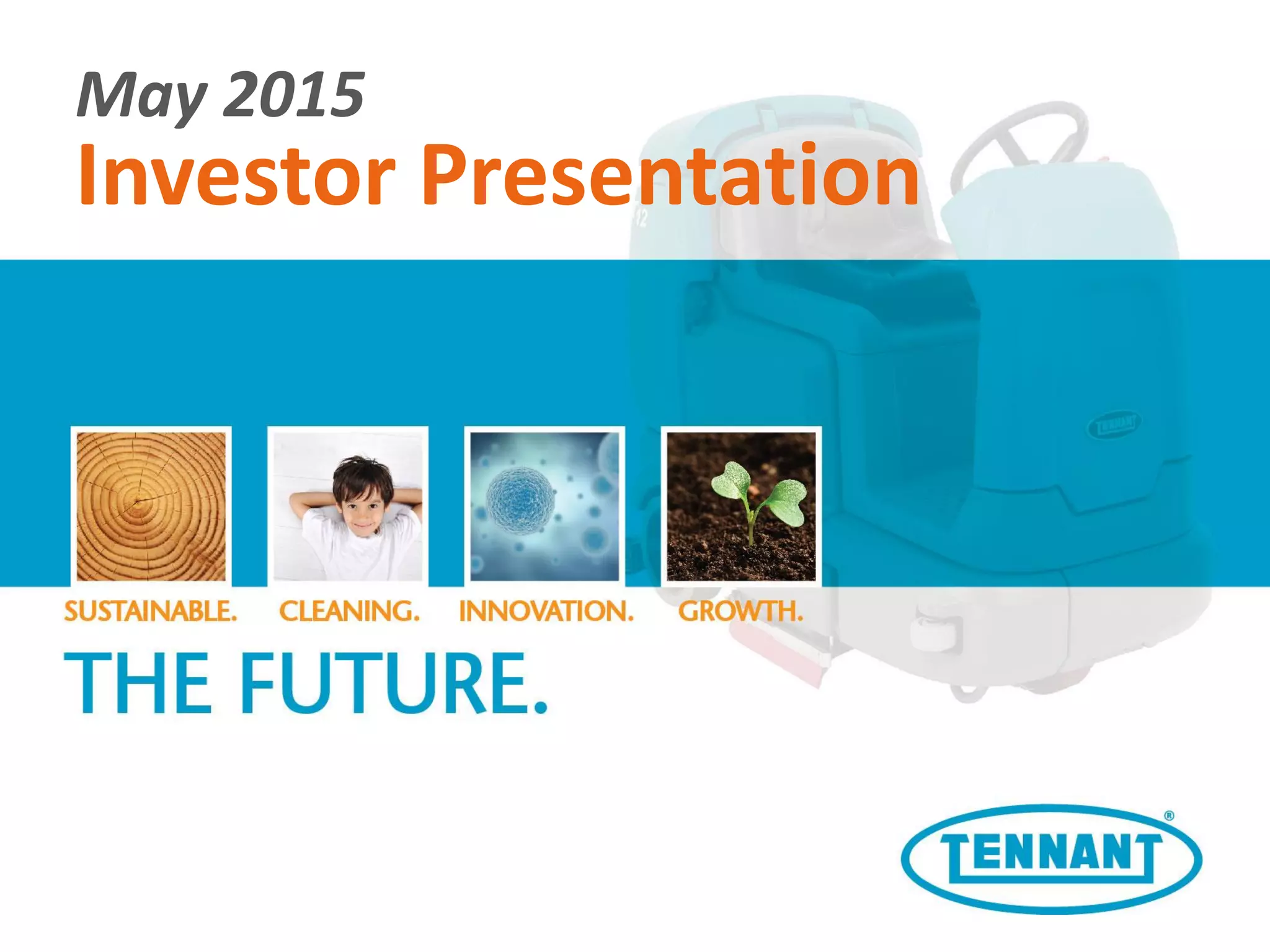
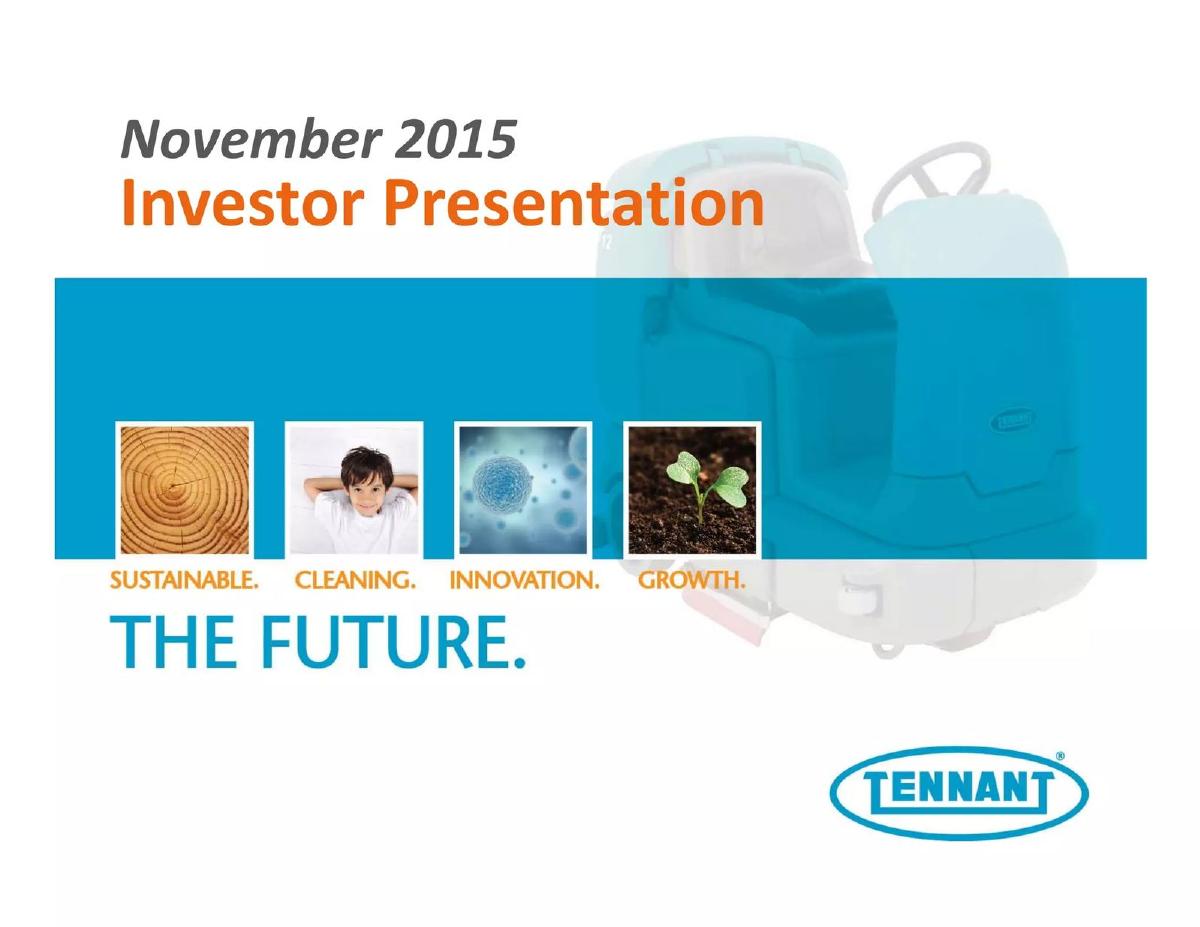
The cover slide establishes the core pillars of the presentation: Sustainable, Cleaning, Innovation, and Growth. It features the Tennant logo and a background image of a ride-on scrubber. The phrase 'THE FUTURE' is emphasized in large blue text, signaling a pivot from a traditional equipment manufacturer to a forward-looking technology company. The date, May 2015, sets the context for the financial data that follows.
Slide 6: Unique Cleaning Solutions
This slide uses a floor plan graphic to demonstrate the versatility of Tennant’s product line. It maps specific machines to different areas of a facility: the S30 for parking ramps, the T5 for loading docks, the B10 for hallways, and specialized equipment for office spaces, cafeterias, and conference rooms. This visual effectively communicates that Tennant is a full-facility solution provider, not just a vendor of individual machines. It justifies their presence in multiple verticals by showing a deep understanding of facility management workflows.
Slide 11: The $1 Billion Objective
Slide 11 is the 'North Star' of the deck. It introduces the 'Blueprint for $1 Billion' with two clear mandates: achieve $1 billion in revenue by 2017 and remain committed to a 12% operating profit margin goal. By stating these figures so boldly, the company provides a clear yardstick for success. This slide is critical for investor alignment, as it balances top-line growth with bottom-line discipline.
Slide 16: Key Verticals for Growth
To reach the $1 billion goal, Tennant identifies four key sectors: Industrial, Education, Healthcare, and Retail. Each is represented by a color-coded icon. This slide indicates a strategic shift toward diversification. By targeting healthcare and education, sectors often less sensitive to industrial cycles, Tennant suggests a more resilient revenue model to its investors.
Slide 21: New Modular Platform
This is a technical but vital slide for understanding Tennant's operational efficiency. It shows an exploded view of the T12 Rider Scrubber and how its modular components are adapted for the T17 Rider Scrubber. The headline 'Faster Speed to Market' explains the business value of this engineering approach. Modularity reduces R&D costs and simplifies the supply chain, which is essential for maintaining the 12% profit margin goal mentioned earlier.
Slide 26: Orbio os3 Innovation
Tennant uses this slide to highlight its intellectual property and innovation leadership. The Orbio os3 is described as 'Small, simple, affordable On-Site Generation (OSG) technology.' The slide prominently features the 2014 ISSA Innovation Award. By positioning this as the 'inevitable future of cleaning,' Tennant is telling investors they are disrupting the traditional cleaning chemical market, potentially creating new recurring revenue streams through technology licensing or specialized equipment sales.
Slide 31: Standardized Global Processes
This slide addresses the 'how' of their operational goals. It lists four areas of standardization: Collections, Invoicing, Pricing, and Machine Configuration. For a global company, these 'back-office' improvements are significant margin drivers. Standardizing discount and rebate policies globally while maintaining regional competitiveness is a sophisticated way to prevent 'margin leakage' in diverse markets.
Slide 36: 2015 First Quarter Financials
The financials for Q1 2015 show a company in transition. While sales grew 1.0% to $185.7 million, operating profit fell 10.6% to $8.3 million. The operating profit margin dipped from 5.0% to 4.4%. The slide notes 'Strong Growth in North America' and a 6.0% organic sales growth, suggesting that the underlying business is healthy, but costs or external factors (like the currency issues mentioned later) are weighing on the immediate bottom line.
Slide 41: Reaffirmed 2015 EPS Guidance
The final slide in this set is a detailed outlook for 2015. Despite the Q1 dip, the company reaffirmed its EPS guidance of $2.40 to $2.70. The 'Key Expectations' list is exhaustive, citing net sales of $825M to $850M and an R&D expense of approximately 4% of sales. Crucially, it quantifies the foreign currency headwind at $10M to $12M, providing a clear explanation for why the profit margins might look suppressed compared to the long-term 12% goal.
What Tennant Company Does Well
Tennant excels at connecting high-level strategic goals to granular operational changes. The 'Blueprint for $1 Billion' isn't just a slogan; it is backed by the modular platform strategy (Slide 21) and the standardization of global processes (Slide 31). They also do an excellent job of 'segmenting the sell' by showing how their products fit into every corner of a customer's facility (Slide 6). This makes the value proposition tangible rather than theoretical.
What is Missing from the Deck
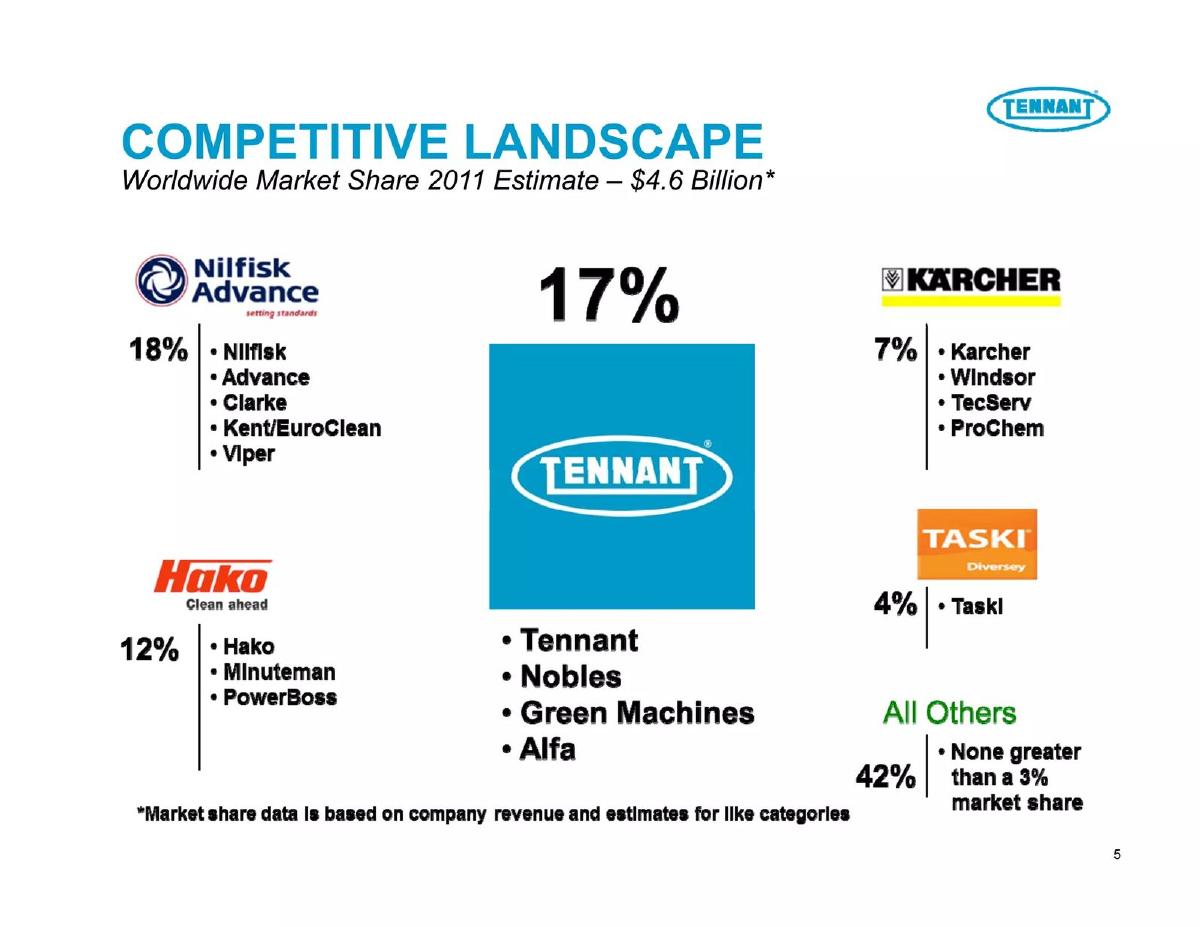
While the deck is strong on strategy and current financials, it lacks a detailed competitive landscape. There is no mention of how Tennant compares to other major industrial cleaning players in terms of market share or technology. Additionally, while 'Innovation' is a pillar, the deck does not provide a roadmap for future products beyond the Orbio os3 and the T17. Investors might also want to see more detail on the 'Emerging Markets' mentioned in the guidance—which specific countries are driving that growth and what the localized strategy looks like there.
Lessons for Founders
Set a 'North Star' Metric: Tennant’s $1 billion goal is simple, memorable, and measurable. Founders should have a similar 'headline' goal that anchors their entire pitch. · Show, Don't Just Tell, Efficiency: The modular platform slide (Slide 21) is a brilliant way to show how a company scales efficiently. If your startup has a way to build faster or cheaper through reuse or automation, visualize it. · Address Headwinds Head-On: By quantifying the impact of foreign currency (Slide 41), Tennant prevents investors from assuming the profit dip was due to poor management. Transparency regarding external factors builds trust. · Vertical Focus: Even a large company like Tennant picks its battles. Identifying specific growth verticals (Slide 16) shows focus and helps sales teams (and investors) understand where the next dollar is coming from.
Frequently asked questions
- What is Tennant Company's primary financial goal in this deck?
- Tennant Company explicitly states a 'Blueprint for $1 Billion,' aiming to achieve $1 billion in annual revenue by 2017. Alongside this top-line goal, they maintain a commitment to a 12% operating profit margin. This dual focus tells investors that the company is not just chasing growth at any cost, but is focused on profitable, sustainable scaling through organic means and operational efficiency.
- How does the company plan to improve its speed to market?
- The company is moving toward a 'New Modular Platform.' As shown on slide 21, they demonstrate how components from the T12 Rider Scrubber are utilized to develop the T17 Rider Scrubber. By standardizing parts and engineering across different machine sizes, they can reduce development time and manufacturing complexity, allowing them to respond more quickly to market demands and customer needs.
- Which market segments is Tennant prioritizing for expansion?
- Tennant identifies four key verticals for reaching new customers: Industrial, Education, Healthcare, and Retail. By categorizing their sales strategy into these specific buckets, the company can tailor its 'Unique Cleaning Solutions' (as seen on slide 6) to the specific floor types and sanitary requirements of environments ranging from loading docks to hospital hallways.
- What is the significance of the Orbio os3 technology mentioned?
- The Orbio os3 is positioned as the 'inevitable future of cleaning.' It is an On-Site Generation (OSG) technology that creates cleaning and antimicrobial solutions directly at the customer's location. This reduces the need for traditional chemical shipping and storage. The deck highlights its 2014 ISSA Innovation Award, signaling to investors that Tennant is leading in sustainable, high-margin technology beyond just mechanical scrubbers.
- What were the main financial headwinds facing the company in 2015?
- According to slide 41, foreign currency exchange was a major challenge, with an expected unfavorable impact of 4% to 6% on sales. This was estimated to reduce operating profit by $10M to $12M, or approximately $0.37 to $0.44 in Earnings Per Share (EPS). Despite these macro factors, the company reaffirmed its EPS guidance of $2.40 to $2.70 for the year.