Curve Health’s pitch deck is a masterclass in clinical validation and strategic positioning within the complex healthcare ecosystem. By identifying a specific, high-cost friction point—the $163B post-acute space where 2.1 million patients are transferred to emergency departments annually—Curve Health positions itself as the essential 'missing link.' The deck leans heavily on the 'proven platform' of Call9, showcasing a 50%+ reduction in hospital admissions (Slide 2). While the deck is light on traditional SaaS metrics like CAC or LTV, it compensates with peer-reviewed research and specific ca…
Key takeaways
- The deck identifies a massive inefficiency: two-thirds of the 2.1 million annual ED transfers from post-acute facilities are unnecessary (Slide 3).
- Curve Health utilizes a legacy of success, citing the Call9 platform's 50%+ reduction in hospital admissions as proof of concept (Slide 2).
- The business model relies on a dual-revenue stream consisting of a monthly fee plus a percentage of billing (Slide 10).
- The Total Addressable Market (TAM) is estimated at over $4B, spanning hospitals, SNFs, and assisted living facilities (Slide 10).
- Clinical efficiency is backed by peer-reviewed research in WestJEM, showing only 27% of the intervention group required ED transport vs 71% in the control (Slide 13).
- The deck explicitly addresses the 'Post-COVID' regulatory shift, quoting CMS Administrator Seema Verma on the permanence of telehealth (Slide 11).
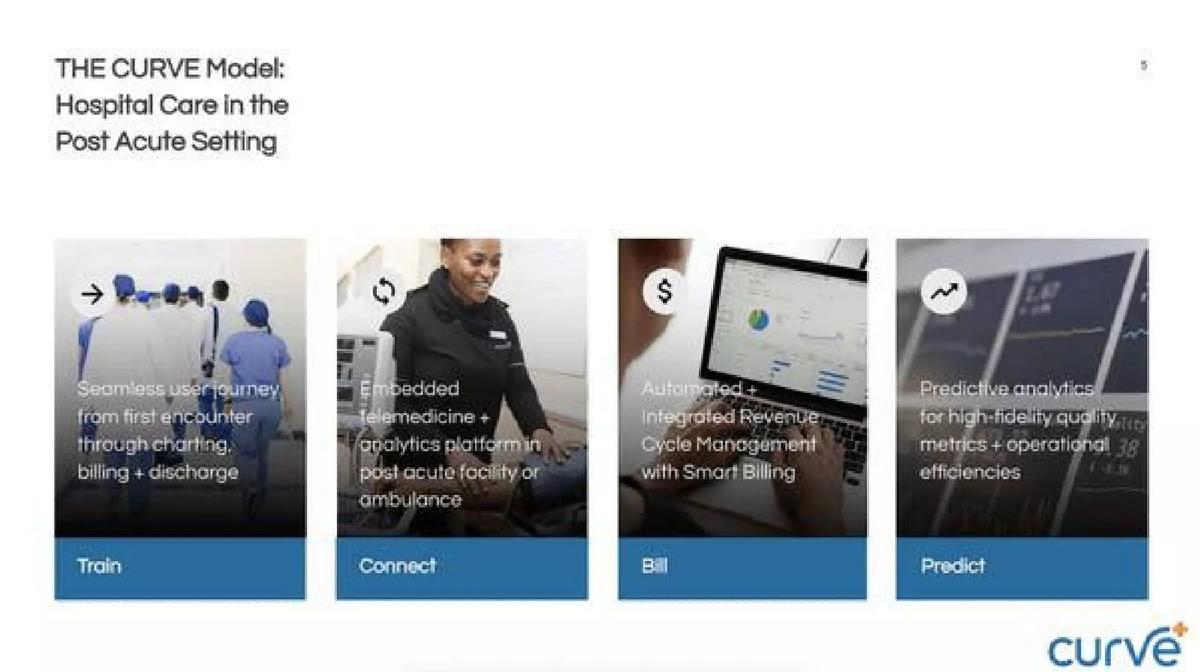
- The product is categorized into four functional pillars: Train, Connect, Bill, and Predict (Slides 6-9).
- The initial ask in this version of the deck was for a $5-$6M Seed Round, though the company eventually raised an $18M Series A (Slide 15 and Catalogue facts).
The Strategy of Clinical Credibility
Curve Health’s deck is not a typical 'growth at all costs' SaaS presentation. Instead, it is a clinical and operational argument for a systemic shift in how senior care is delivered. In a sector as regulated and risk-averse as healthcare, the founders understood that their primary hurdle wasn't just proving the technology worked, but proving it was safe, billable, and legally compliant. By the time an investor reaches the end of these 16 slides, the company has established a $4B+ market opportunity backed by peer-reviewed science and a clear regulatory tailwind.
Slides 1-2: The Hook and the Pedigree
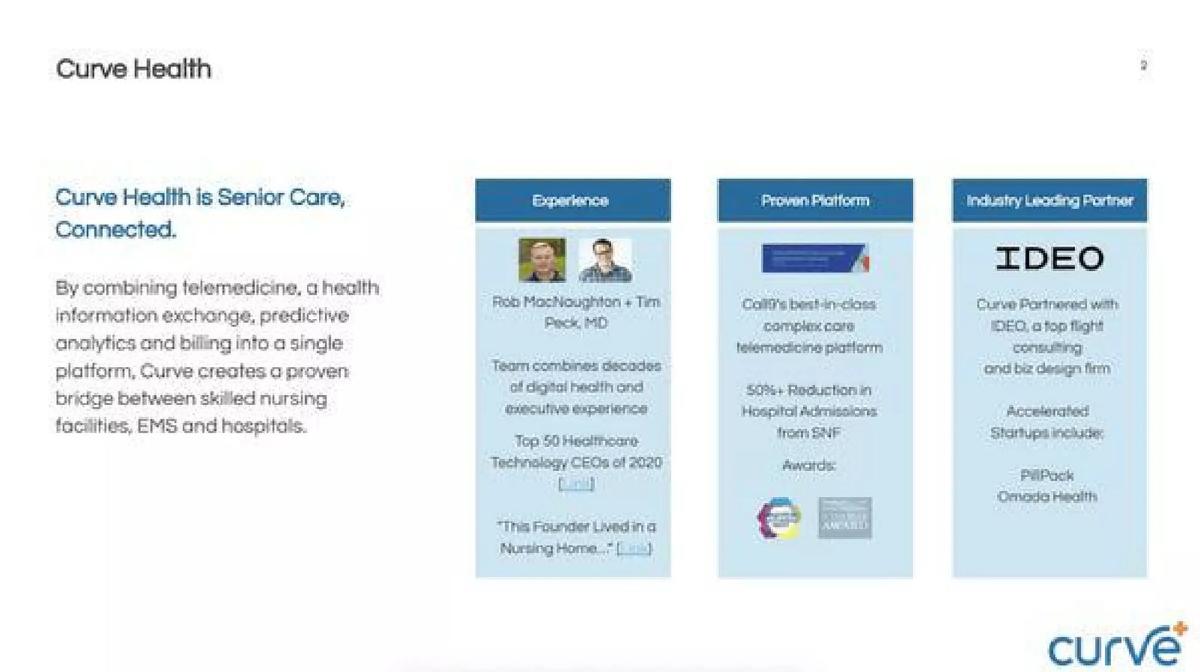
The deck opens with a clean, medical-themed cover slide (Slide 1) and moves immediately into a high-level summary (Slide 2). This 'Executive Summary' slide is dense but effective. It highlights three pillars: Experience (featuring founders Rob MacNaughton and Tim Peck, MD), Proven Platform (referencing the Call9 legacy and a 50%+ reduction in admissions), and Industry Leading Partner (IDEO). Mentioning IDEO early is a strategic move to signal that the user experience—often a failure point in medical software—has been handled by world-class designers.
Slides 3-4: Defining the $163B Friction Point
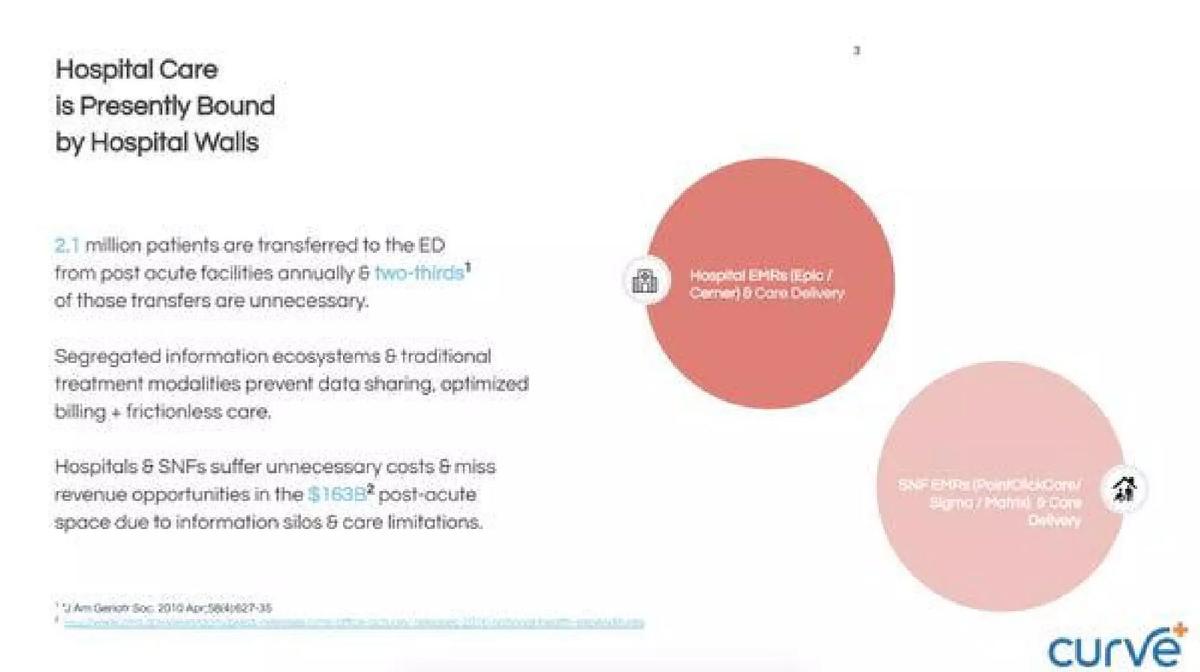
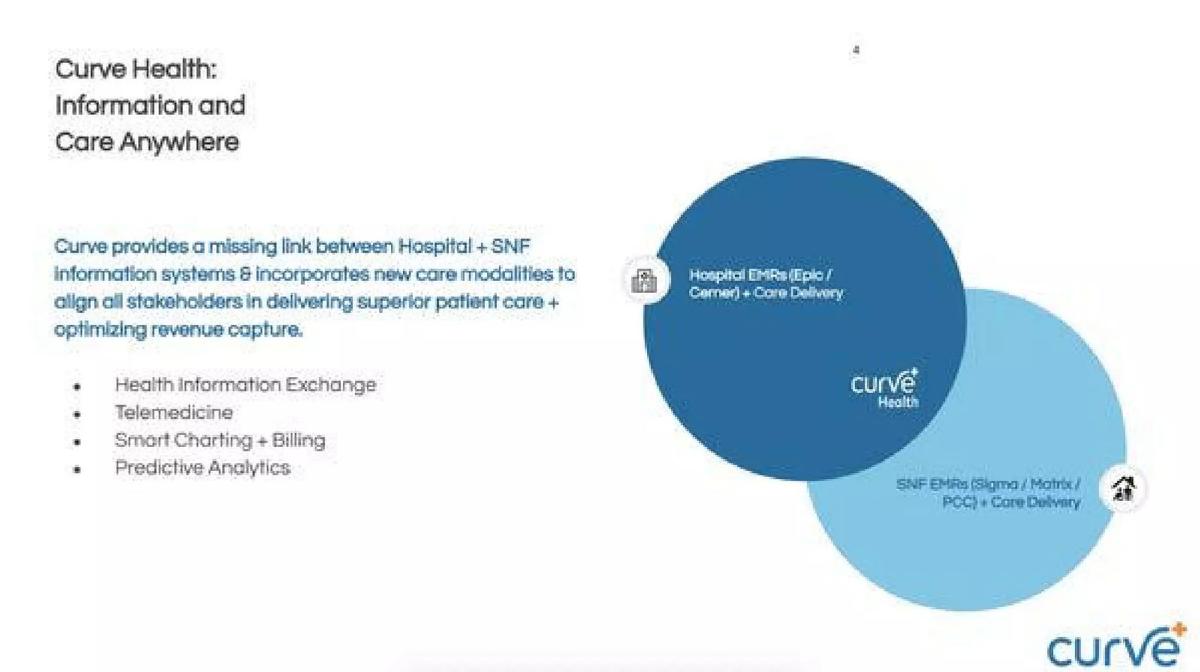
Slide 3 defines the problem with a staggering statistic: 2.1 million patients are transferred to the ED annually, and two-thirds of those transfers are unnecessary. They quantify the post-acute space at $163B. The visual representation uses overlapping circles to show how Hospital EMRs (Epic/Cerner) and SNF EMRs (PointClickCare/MatrixCare) are currently 'bound by walls.' Slide 4 introduces Curve Health as the 'missing link' that overlaps these silos, integrating Health Information Exchange, Telemedicine, Smart Billing, and Predictive Analytics.
Slides 5-9: The Product Architecture (Train, Connect, Bill, Predict)
The product section is broken down into a four-stage model. Slide 5 introduces the 'THE CURVE Model,' which is then expanded upon in individual slides.
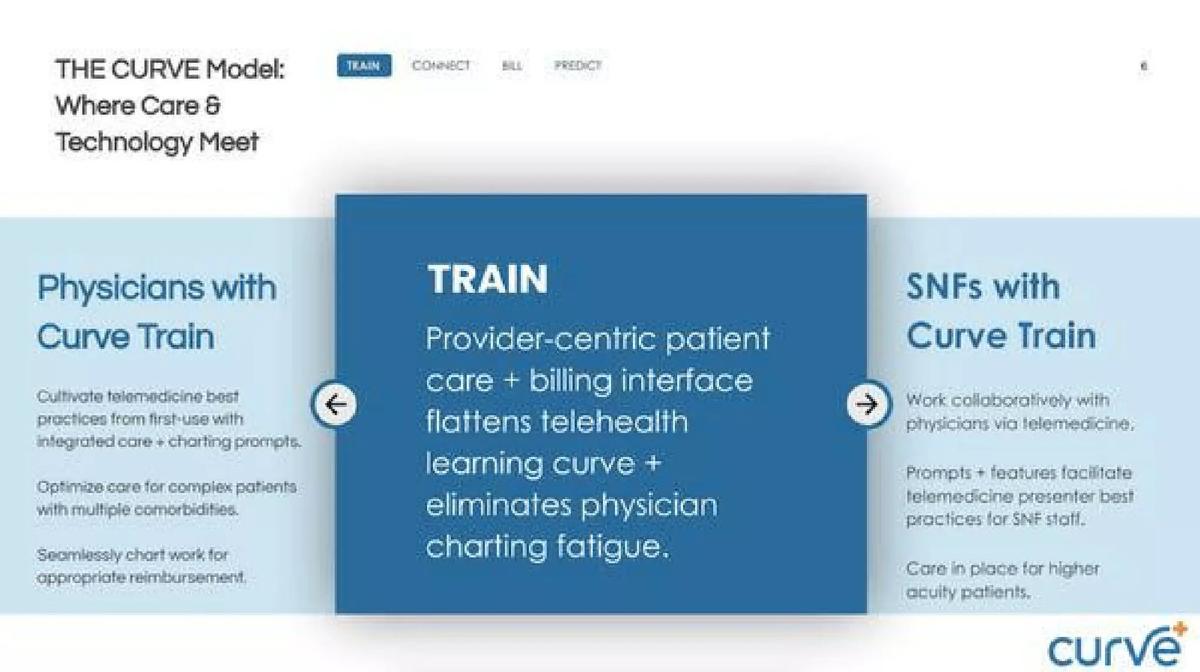
Train (Slide 6): Focuses on the 'provider-centric' interface to flatten the learning curve and eliminate charting fatigue. · Connect (Slide 7): Highlights 'location-agnostic' management, allowing physicians to treat multiple patients in different SNFs simultaneously. · Bill (Slide 8): This is a crucial 'value' slide. It mentions a 'Proprietary Telemedicine Superbill' developed over 5 years, which automates the transition from chart to billing for faster reimbursement. · Predict (Slide 9): Moves the platform from reactive to proactive, using algorithms to flag patients for earlier intervention, thereby avoiding unnecessary ED visits.
Slides 10-11: Market Opportunity and Timing
Slide 10 outlines the TAM of $4B+. It helpfully includes the business model: a monthly fee from both sides of the transaction, plus a percentage of billing from hospitals. Slide 11, 'Value Across Time,' is a sophisticated 'Why Now?' slide. It addresses the COVID-19 pandemic not as a temporary boost, but as a catalyst that permanently changed the reimbursement landscape. The quote from CMS Administrator Seema Verma—'The genie's out of the bottle on this one'—is a powerful third-party validation of their market timing.
Slides 12-13: The Proof of Concept
These are the 'heavy hitters' of the deck. Slide 12 provides three specific case studies. Case Study 1 shows 70% of patients avoided the ED, resulting in $9.5M in payor savings. Case Study 2 shows $10.3M in savings. These figures are massive and provide the 'ROI' argument that CFOs at hospital systems need to see. Slide 13 doubles down with a peer-reviewed research report from WestJEM, providing the clinical 'gold standard' proof that their intervention significantly reduces ED transfers (27% vs 71%).
Slides 14-16: Team and The Ask
The team slide (Slide 14) showcases a mix of clinical operations, product, and corporate development expertise, including veterans from Call9 and IDEO. Slide 15 outlines the 'RAISE: $5-$6M Seed Round.' (Note: Per the catalogue facts, the company eventually raised $18M at the Series A stage, suggesting this deck was an earlier iteration or used to bridge that growth). The funds are earmarked for R&D (EMR integrations, AI/ML) and Expansion (sales channel execution). The deck concludes on Slide 16 with the tagline 'The Path Ahead in Healthcare Delivery.'
What Works
Clinical Validation: Including a peer-reviewed study (Slide 13) is a rare and powerful move in a startup deck. It moves the conversation from 'we think this works' to 'the medical community agrees this works.' · Quantified ROI: By showing exactly how much payors saved ($9.5M and $10.3M in Slide 12), Curve Health makes the economic argument for their platform undeniable. · Regulatory Awareness: Slide 11 shows a deep understanding of the 'Post-COVID' regulatory environment, which is the single most important factor for healthcare reimbursement. · Clear Categorization: Breaking the product into 'Train, Connect, Bill, Predict' makes a complex, multi-sided platform easy for a generalist investor to understand.
What is Missing
Unit Economics: While the deck mentions a 'Monthly Fee + % of Billing,' it does not provide specific numbers for Customer Acquisition Cost (CAC) or Lifetime Value (LTV). · Competitor Analysis: There is no slide addressing the competitive landscape. In a crowded telehealth and EMR-integration market, investors would want to know how Curve defends against incumbents like Teladoc or specialized startups. · Sales Pipeline: The deck mentions 'existing sales channel opportunities' (Slide 15) but does not name specific hospital systems or SNF groups currently in the pilot or contract phase. · Implementation Timeline: For a platform that requires EMR integration, a slide explaining the typical 'time to go-live' would have addressed a common investor concern regarding healthcare sales cycles.
What a Founder Should Copy
The 'Why Now' Slide (Slide 11): Use a timeline to show how a major external event (like a pandemic or a regulatory change) has permanently shifted the market in your favor. · The ROI Case Studies (Slide 12): Don't just say your product saves money; show the specific dollar amounts saved by the customer and the specific percentage of 'bad outcomes' avoided. · The 'Missing Link' Visual (Slide 4): If your product sits between two existing systems, use a simple Venn diagram to show how you bridge the gap that incumbents cannot. · Third-Party Quotes: Using a quote from a high-ranking government official (Slide 11) or a medical journal (Slide 13) adds a level of authority that founder-written copy cannot achieve.
Frequently asked questions
- What is the core problem Curve Health solves?
- Curve Health addresses the 'silos' between Skilled Nursing Facilities (SNFs) and hospitals. Currently, 2.1 million seniors are sent to Emergency Departments (ED) annually, but two-thirds of these transfers are unnecessary. This creates $163B in wasted costs and missed revenue opportunities. Curve provides the 'missing link' through a platform that combines telemedicine and data exchange to treat patients in place.
- How does Curve Health generate revenue?
- According to Slide 10, the company employs a SaaS-plus-success model. They charge a monthly fee to both hospitals and SNFs, and for hospitals, they also take a percentage of the billing generated through the platform. This aligns their incentives with the providers' ability to capture revenue for remote care.
- What is the relationship between Curve Health and Call9?
- Slide 2 and Slide 12 indicate that Curve Health's product was developed on the Call9 platform. Call9 was a previous entity in the space; Curve Health appears to have refined and productized the technology, leveraging Call9's historical clinical data and 'best-in-class' results to prove the model works before scaling.
- How does the deck handle the impact of COVID-19?
- Slide 11, 'Value Across Time,' explicitly compares the Pre-COVID, COVID, and Post-COVID landscapes. It argues that while adoption was previously slowed by 'misaligned incentives,' the pandemic forced a regulatory shift. By quoting the CMS Administrator, they argue that telehealth reimbursement is now a permanent fixture, de-risking the investment.
- What clinical evidence does the deck provide?
- The deck is exceptionally strong on clinical proof. Slide 13 features a peer-reviewed report from the Western Journal of Emergency Medicine (WestJEM). The study found that Curve's intervention reduced ED transport rates to 27%, compared to 71% for the comparison group, providing a high level of scientific credibility.