Cybereye Community is an educational technology initiative aimed at fostering a community of learners and makers. The deck identifies a disconnect between traditional university education and the practical skills required to build products and generate income from technology. To solve this, the company developed a 'Portal System' and an Android application that provide members with downloadable PDF modules, video tutorials, and event notifications. While the deck clearly defines its mission to grow the 'production' of its home country through skills in IoT and mobile development, it lacks sta…
Key takeaways
- The problem slide identifies that while technology use is growing, users often lack the knowledge to create products or benefit financially from it (Slide 2).
- Traditional education is criticized for being overly theoretical and failing to teach 'real business' growth (Slide 2).
- The mission focuses on developing human resources in Internet of Things (IoT), Mobile Development (Android & iOS), and Web Development (Slide 3).
- The 'Portal System' at cybereye-community.com offers four main benefits: PDF modules, video tutorials, event notifications, and workshop documentation (Slide 4).
- A dedicated Android application is available on the Google Play Store to facilitate learning on smartphones (Slide 5).
- The deck emphasizes a collaborative culture of sharing knowledge with other communities, co-working spaces, and startups (Slide 6).
- The presentation lacks critical financial data, including a business model, revenue streams, or a requested investment amount.
- Edi Kurniawan is identified as the Co-Founder and CEO, though no other team members or advisors are listed (Slide 1).
Deck Overview
The Cybereye Community pitch deck is a brief, 7-slide presentation that outlines a vision for a technology-focused educational community. The deck is structured to introduce a problem—the gap between tech consumption and tech production—and offers a digital platform as the solution. However, the presentation feels more like a community manifesto or a project introduction than a professional fundraising deck intended for venture capitalists or angel investors.
Slide 1: Title Slide
The title slide introduces the company name, "Cybereye Community," accompanied by a logo featuring a stylized 'C'. The subtitle defines the entity as a "Community for edu technology." Edi Kurniawan is listed as the Co-Founder & CEO. The visual theme uses a brown and yellow cityscape silhouette, which is repeated in a blue variant on subsequent slides. The layout is simple and clearly identifies the leadership, though it lacks a compelling one-sentence value proposition.
Slide 2: The Problem
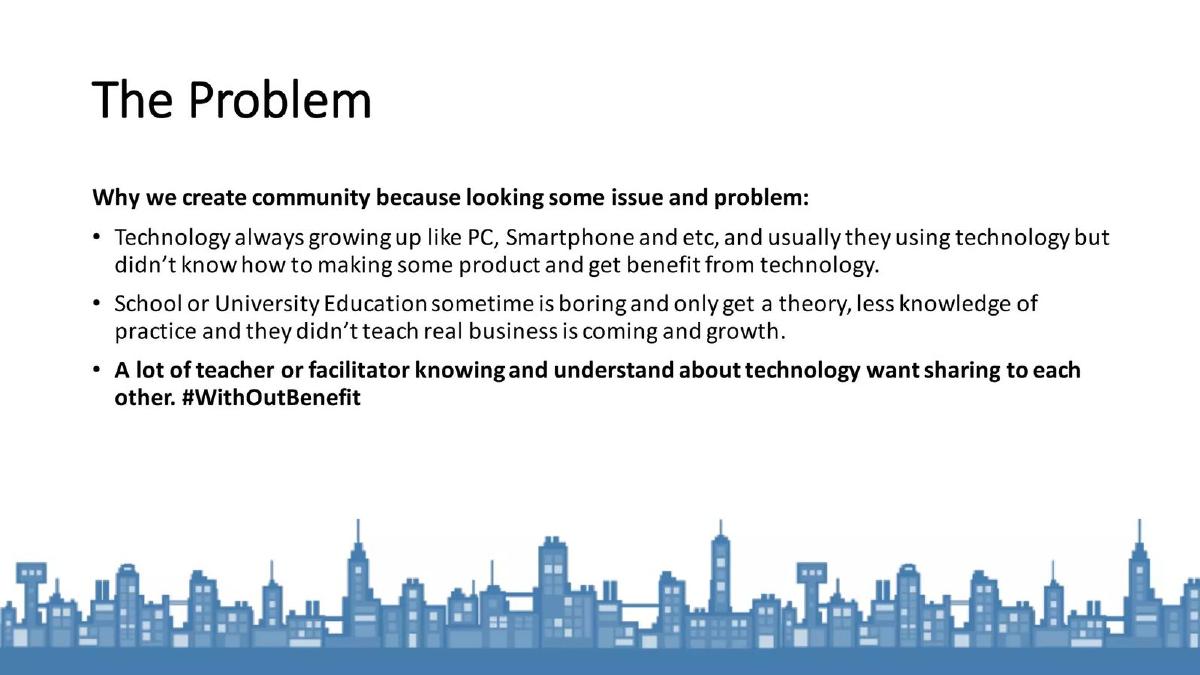
Slide 2 outlines the justification for the community's existence. It highlights three primary issues: 1. Technology (PCs, smartphones) is growing, but users don't know how to make products or benefit from them. 2. Formal education is often "boring" and lacks practical, real-business application. 3. There is a lack of platforms for knowledgeable facilitators to share their expertise. Notably, the slide includes the hashtag "#WithOutBenefit," which may imply a non-profit or altruistic motive, though this is not explicitly defined. The phrasing "real business is coming and growth" suggests a focus on the economic potential of technology skills.
Slide 3: Our Mission
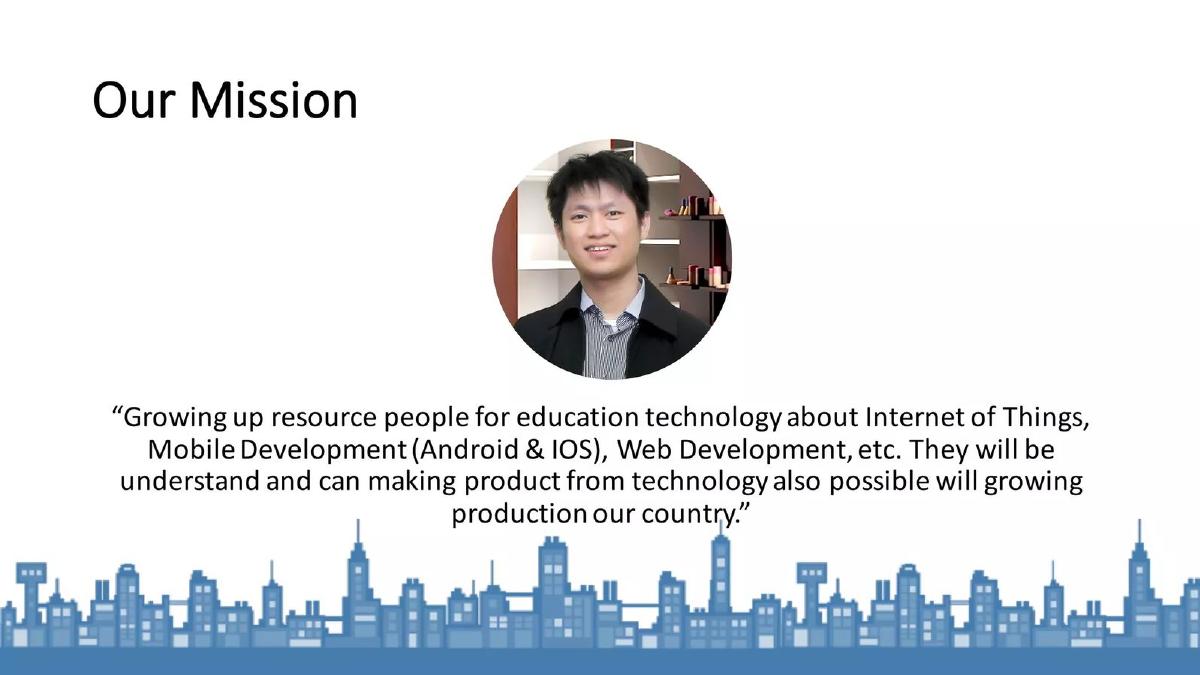
The mission slide features a portrait of the CEO and a quote regarding the growth of human resources. The stated goal is to educate people in Internet of Things (IoT), Mobile Development (Android & iOS), and Web Development . The ultimate objective is to enable people to make products, which the slide claims will "growing production our country." This indicates a nationalistic or regional economic development goal, though the specific country is not named on this slide (later slides suggest Indonesia based on the app screenshots).
Slide 4: Our Portal System
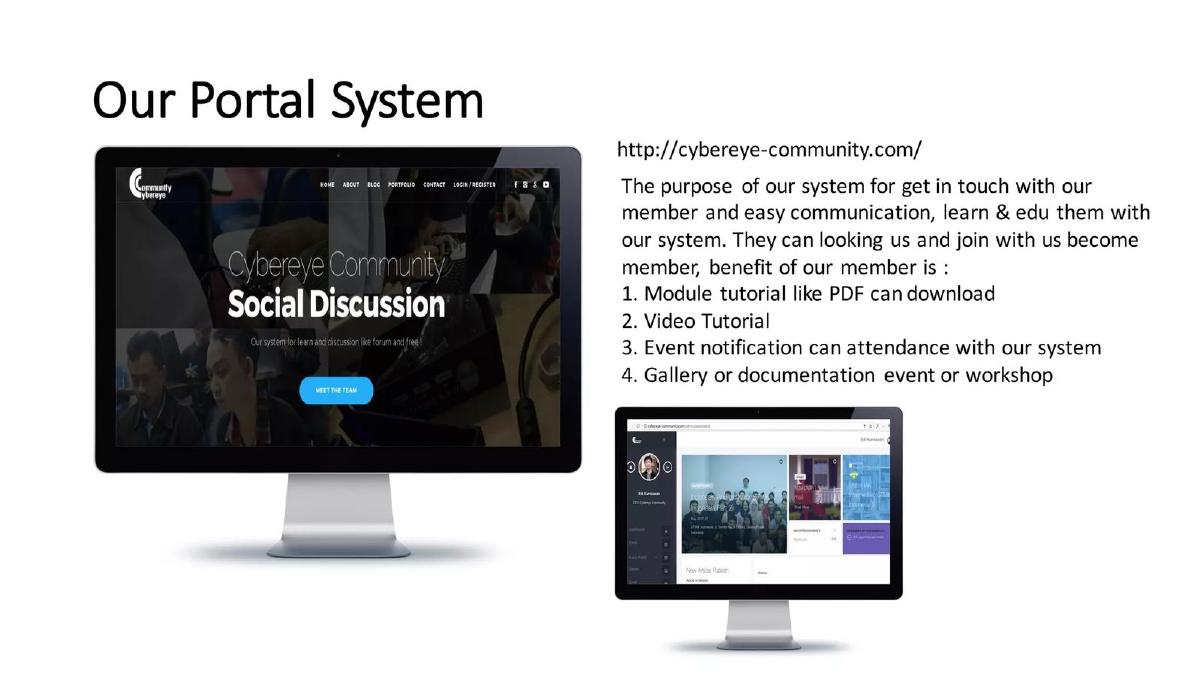
This slide introduces the technical solution: a web portal located at cybereye-community.com. The slide describes the system as a tool for "social discussion" and "easy communication." It lists four specific benefits for members: 1. Downloadable PDF modules. 2. Video tutorials. 3. Event notification and attendance tracking. 4. Documentation for workshops. The slide uses mockups of a desktop monitor and a smaller screen to show the user interface, which appears to be a dashboard-style learning management system.
Slide 5: Our Mobile App (Android)
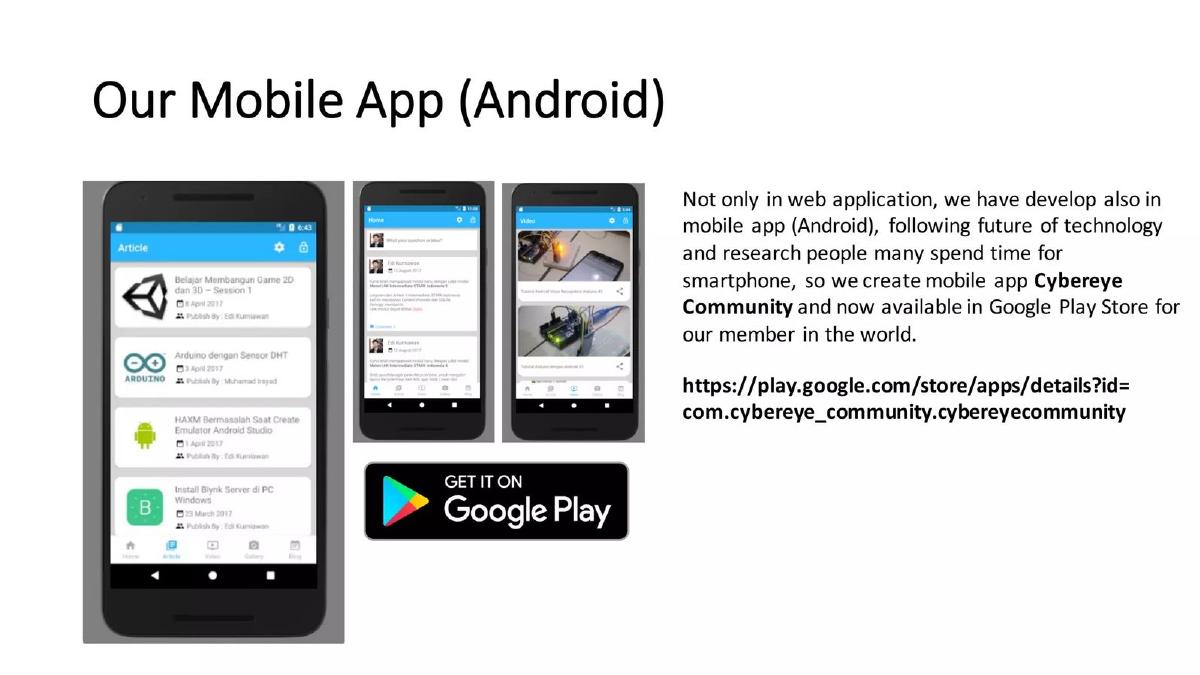
Recognizing the trend of mobile usage, the community developed an Android app. The slide provides a direct link to the Google Play Store and shows three screenshots of the app interface. The screenshots display articles on topics such as "Belajar Membangun Game 2D dan 3D" (Learning to build 2D and 3D games) and "Arduino dengan Sensor DHT." The presence of a live app provides a degree of "traction," proving that the founders can execute on product development, even if user metrics are not provided.
Slide 6: Community Integration
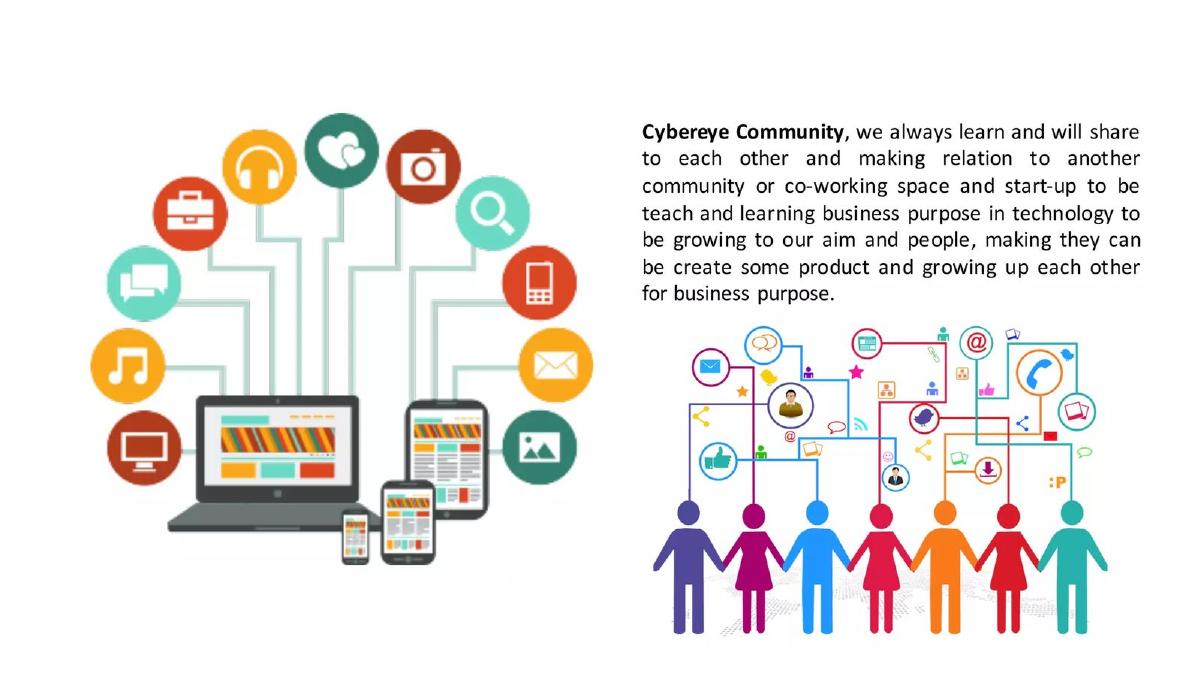
This slide uses generic clip-art to illustrate the concept of a connected ecosystem. The text explains that Cybereye Community intends to share knowledge with other communities, co-working spaces, and startups. The goal is to "be growing to our aim and people," emphasizing a collaborative rather than competitive approach. It reiterates the "business purpose" of technology, suggesting that the community serves as a pipeline for the local startup ecosystem.
Slide 7: Conclusion
The final slide is a duplicate of the title slide. It serves as a bookend to the presentation but misses the opportunity to provide a "Call to Action" or contact information beyond the CEO's name. There is no "Ask" slide in this deck, which is a significant omission for a fundraising teardown.
What Works
Clear Niche: The deck identifies a specific set of high-value skills (IoT, Mobile, Web) that are in demand. · Product Readiness: By showing both a web portal and a live Android app, the founders demonstrate that they are beyond the ideation stage and have a functional platform. · Problem Identification: The critique of theoretical education is a common pain point in emerging markets, making the mission relatable to potential partners or local government sponsors.
What is Missing
The Ask: There is no mention of how much money is being raised or what the funds will be used for. · Business Model: The deck does not explain how the community sustains itself financially. Without a revenue model, it is impossible to evaluate as a commercial venture. · Market Size: There is no data on the number of potential students or the size of the tech education market in their target region. · Traction Metrics: While the app exists, the deck does not list user counts, active members, or successful student outcomes (e.g., jobs landed or products built). · Competitive Landscape: The deck ignores other online learning platforms (like Udemy or Coursera) or local coding bootcamps. · Team Depth: Only the CEO is mentioned. A community-focused startup needs to show a broader team of educators, developers, and community managers.
Founder Recommendations
If this deck were to be used for actual fundraising, several major revisions would be required. First, the founder must decide if this is a non-profit project or a for-profit startup. If it is the latter, a Business Model slide is mandatory. This should explain if they charge for premium modules, take a cut of job placements, or sell corporate training packages.
Second, the Traction slide needs to be added immediately. Investors want to see growth curves. How many people have downloaded the app since it launched on the Play Store? How many active discussions happen on the portal weekly? Without these numbers, the project looks like a hobby rather than a business.
Third, the Market Opportunity needs to be quantified. The deck mentions "growing production our country." The founder should use data to show the shortage of developers in that specific country and how Cybereye Community fills that gap more efficiently than traditional universities.
Finally, the Visual Design should be modernized. The use of generic clip-art and repetitive city silhouettes detracts from the professional nature of the technology they are teaching. High-quality photos of actual community workshops or students using the app would be far more persuasive than the illustrations used on Slide 6.
Frequently asked questions
- What is the primary product offered by Cybereye Community?
- The primary product is a dual-platform educational ecosystem consisting of a web-based 'Portal System' and an Android mobile application. These platforms serve as a hub for social discussion and learning, providing members with access to downloadable PDF tutorials, video content, and a management system for attending workshops and events related to emerging technologies.
- What specific technologies does the community focus on?
- According to the mission statement on slide 3, the community focuses on three core pillars of modern technology: the Internet of Things (IoT), Mobile Development (specifically targeting both Android and iOS platforms), and Web Development. The goal is to move users from being passive consumers to active producers of these technologies.
- Does the deck include a plan for monetization or revenue?
- No. The deck is entirely focused on the social and educational mission of the community. There is no mention of membership fees, advertising, corporate sponsorships, or any other revenue model. The use of the hashtag '#WithOutBenefit' on the problem slide suggests the initiative may be structured as a non-profit or volunteer-led organization.
- Who is the target audience for this platform?
- The target audience includes students who find traditional university education too theoretical, technology enthusiasts who want to learn how to build products, and 'teachers or facilitators' who have technical knowledge and wish to share it with others. It aims to bridge the gap between academic theory and real-world business application.
- What is missing from this deck that an investor would require?
- This deck lacks almost all standard investment metrics. It does not provide a market size (TAM/SAM/SOM), a competitive analysis, a clear business model, a roadmap for future development, or financial history. Most importantly, it does not state how much capital is being raised or how that capital would be deployed to scale the community.