The Dado pitch deck is a concise, 10-slide presentation that prioritizes product interface and problem-solution alignment over financial metrics. Founded in 2020, the company targets the HR tech space by addressing the 'scattered' nature of employee journeys. The deck leans heavily on the founders' previous experience at Small Improvements, a known player in the HR software space, to establish credibility. While it effectively demonstrates the 'Admin App' and 'Employee App' interfaces, it notably omits a business model, financial projections, and a specific funding ask. The narrative focuses…
Key takeaways
- The deck identifies a high-cost problem, stating on slide 5 that replacing a highly skilled worker costs between $100K and $200K.
- Founder credibility is a core pillar, with two of the three founders having held leadership roles at Small Improvements, as shown on slide 2.
- The product is bifurcated into two distinct experiences: an 'Admin App' for HR planning (slide 6) and an 'Employee App' for task completion (slide 7).
- Dado positions itself as an orchestration layer that syncs data with existing HRIS and ATS systems rather than replacing them (slide 4).
- The market opportunity is framed by the 2021 'quit rate' of over 3% of all US employees, according to slide 5.
- The deck defines three clear customer segments: Enterprise (1500+ employees), Scale up (500+), and Small + visionary (50-250) on slide 8.
- There is a complete absence of financial data, including revenue, pricing, or unit economics, throughout the 10 slides.
- The presentation lacks a formal 'Ask' slide, failing to specify the amount of capital being raised or the intended use of funds.
Introduction and Vision
The Dado pitch deck, produced in 2020, is a 10-slide presentation that positions the company as a "People-First Employee Experience Platform." The deck is characterized by a clean, minimalist aesthetic and a heavy emphasis on product design and founder pedigree. It targets the inefficiencies of modern HR departments, specifically focusing on the employee journey from onboarding through various internal transitions.
Slide 1: Title Slide
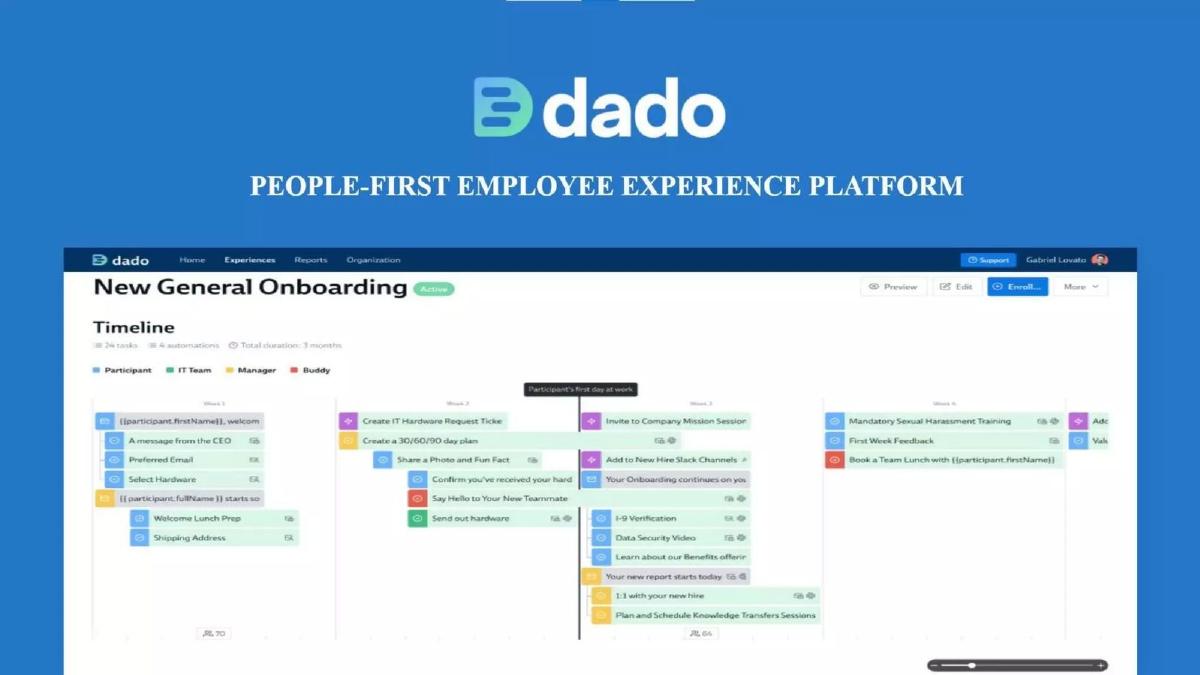
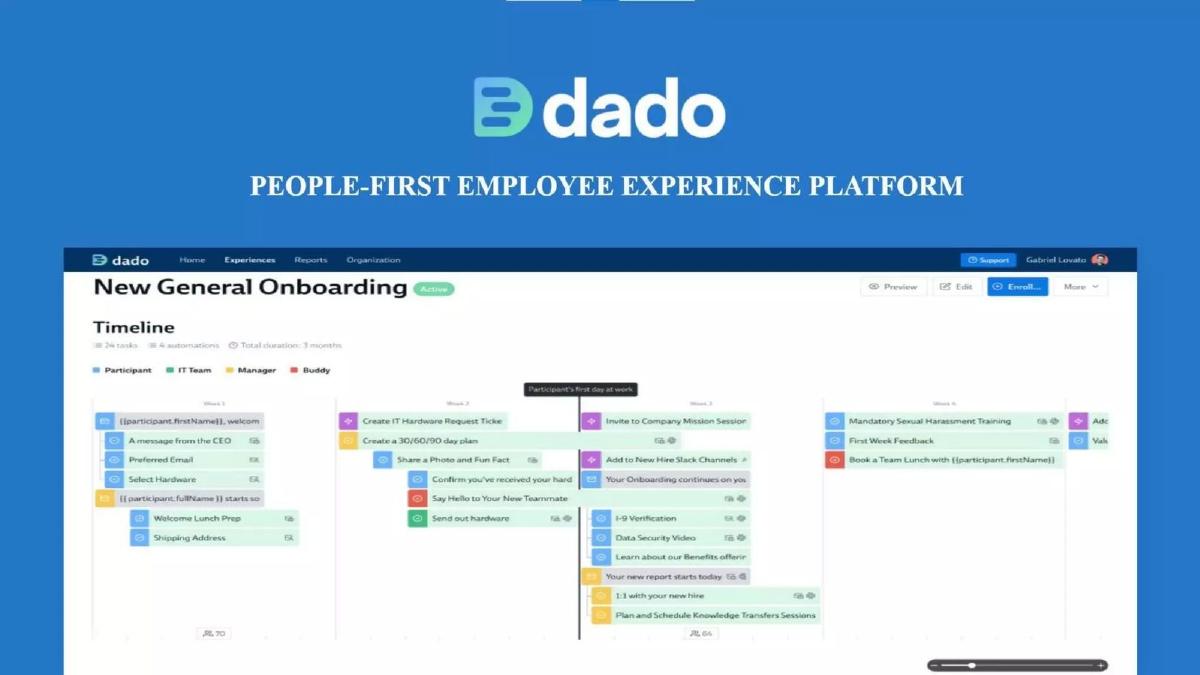
The opening slide introduces the brand identity with the Dado logo and the tagline "PEOPLE-FIRST EMPLOYEE EXPERIENCE PLATFORM." It features a large screenshot of the product's "New General Onboarding" timeline interface. This immediately establishes Dado as a workflow and orchestration tool. The interface shown on slide 1 displays a multi-week timeline involving various stakeholders: Participant, IT Team, Manager, and Buddy. This visual sets the stage for a product that manages complex, cross-functional human resources processes.
Slide 2: Founding Team
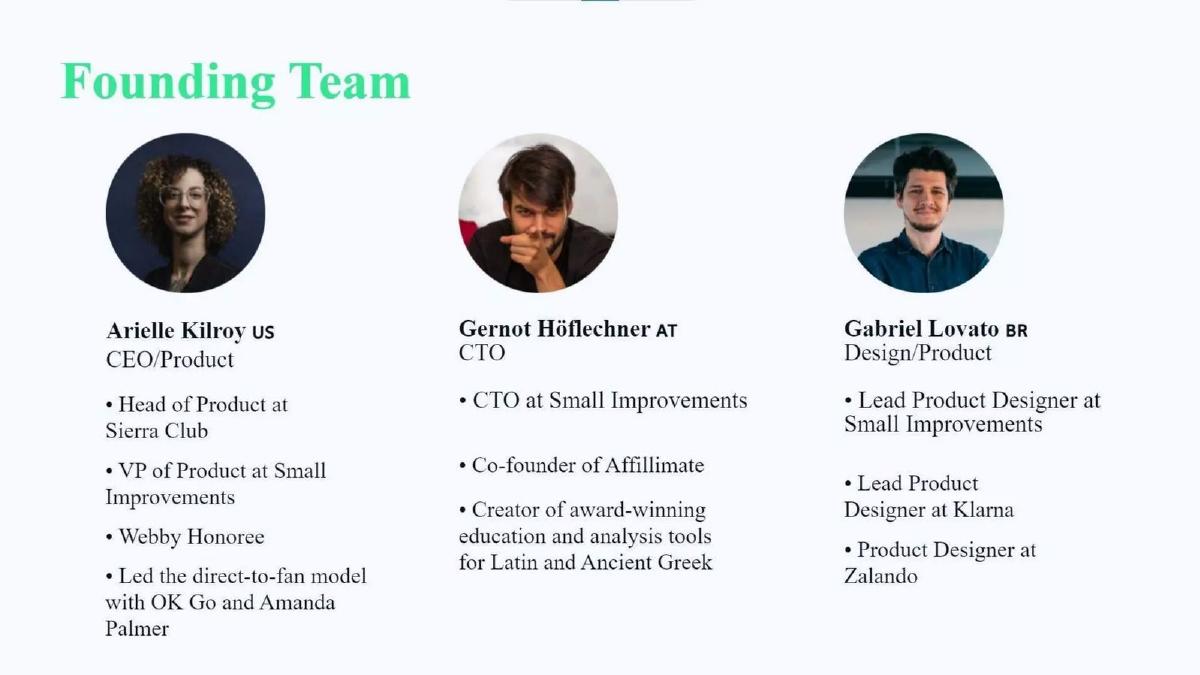
Slide 2 is perhaps the strongest slide in the deck regarding credibility. It introduces the three founders: Arielle Kilroy (CEO/Product), Gernot Höflechner (CTO), and Gabriel Lovato (Design/Product). The slide highlights a significant commonality: all three previously held leadership roles at Small Improvements, an established HR software company. Kilroy was VP of Product, Höflechner was CTO, and Lovato was Lead Product Designer. This "team-market fit" is a critical signal to investors that the founders understand the nuances and technical requirements of the HR tech industry. The slide also mentions Kilroy's background as a Webby Honoree and her work with OK Go, and Lovato's experience at Klarna and Zalando.
Slide 3: The Problem
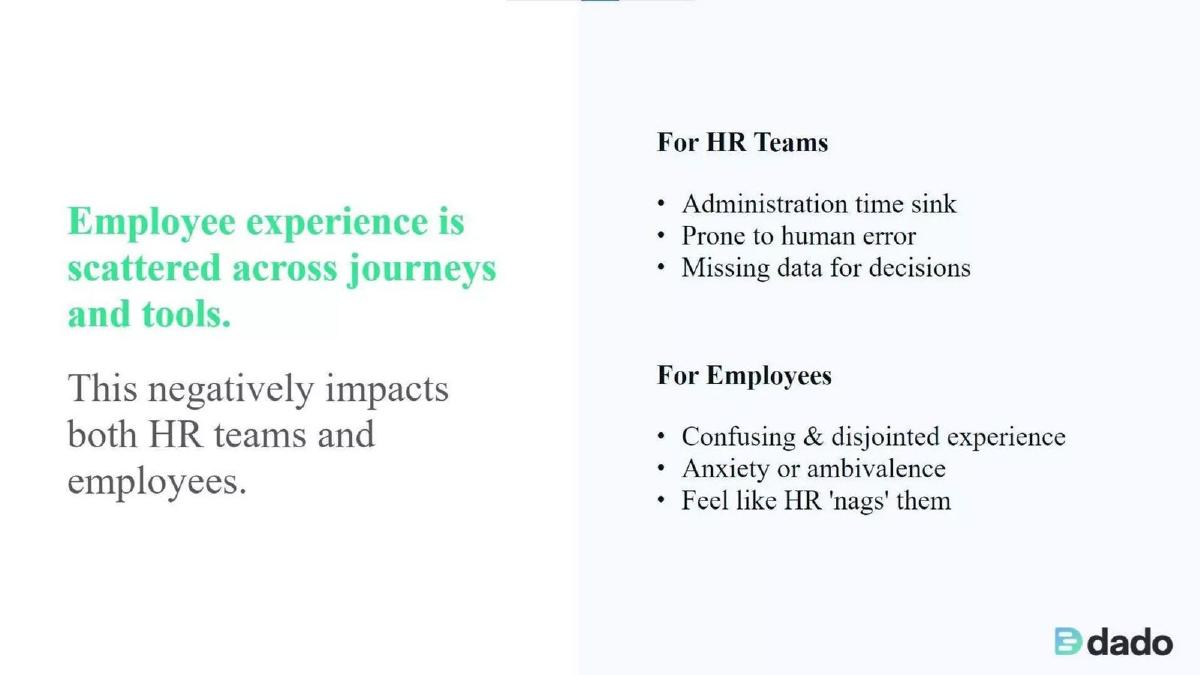
On slide 3 , Dado defines the core problem: "Employee experience is scattered across journeys and tools." The slide breaks down the negative impacts into two categories. For HR Teams, the process is an "administration time sink," "prone to human error," and "missing data for decisions." For Employees, the experience is "confusing & disjointed," leading to "anxiety or ambivalence" and the feeling that HR "nags" them. This slide effectively identifies the friction points in the status quo where multiple disconnected tools (email, spreadsheets, Slack, HRIS) create a sub-optimal experience for all parties involved.
Slide 4: The Solution
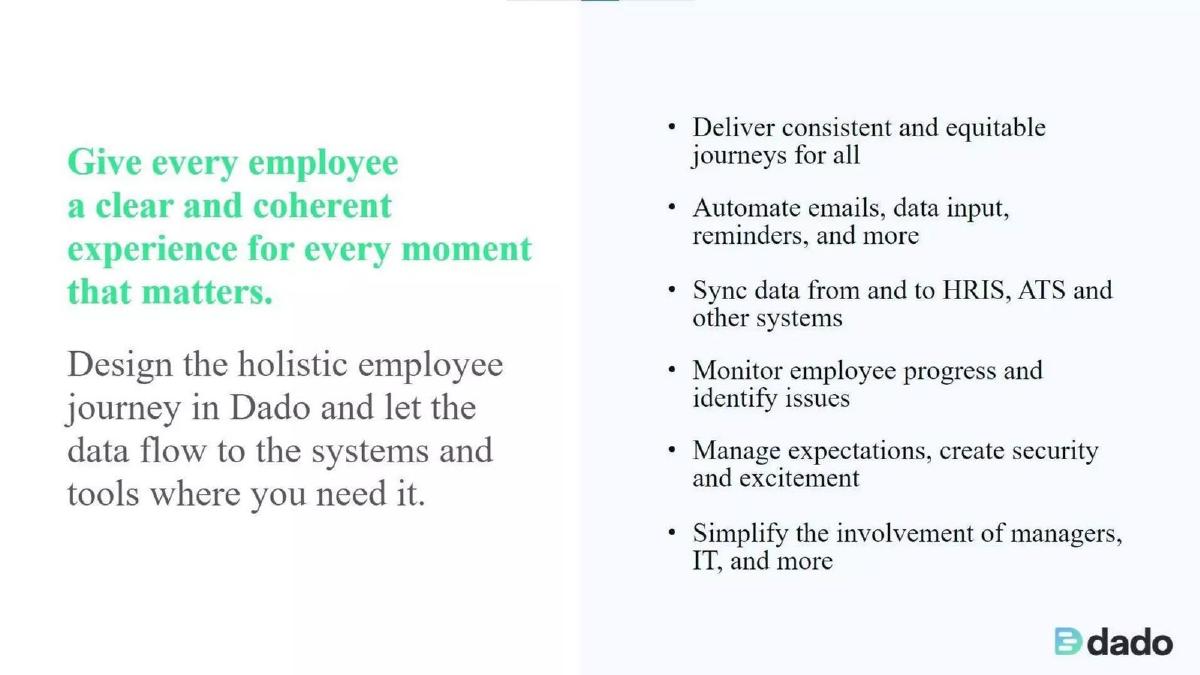
The solution is presented on slide 4 as a way to "Give every employee a clear and coherent experience for every moment that matters." The value proposition is centered on designing a "holistic employee journey in Dado" and letting data flow to other systems. Key features listed include automating emails and reminders, syncing data with HRIS and ATS systems, monitoring progress to identify issues, and simplifying the involvement of managers and IT. The emphasis here is on Dado acting as a connective tissue or an orchestration layer rather than a siloed database.
Slide 5: Market Context and Urgency
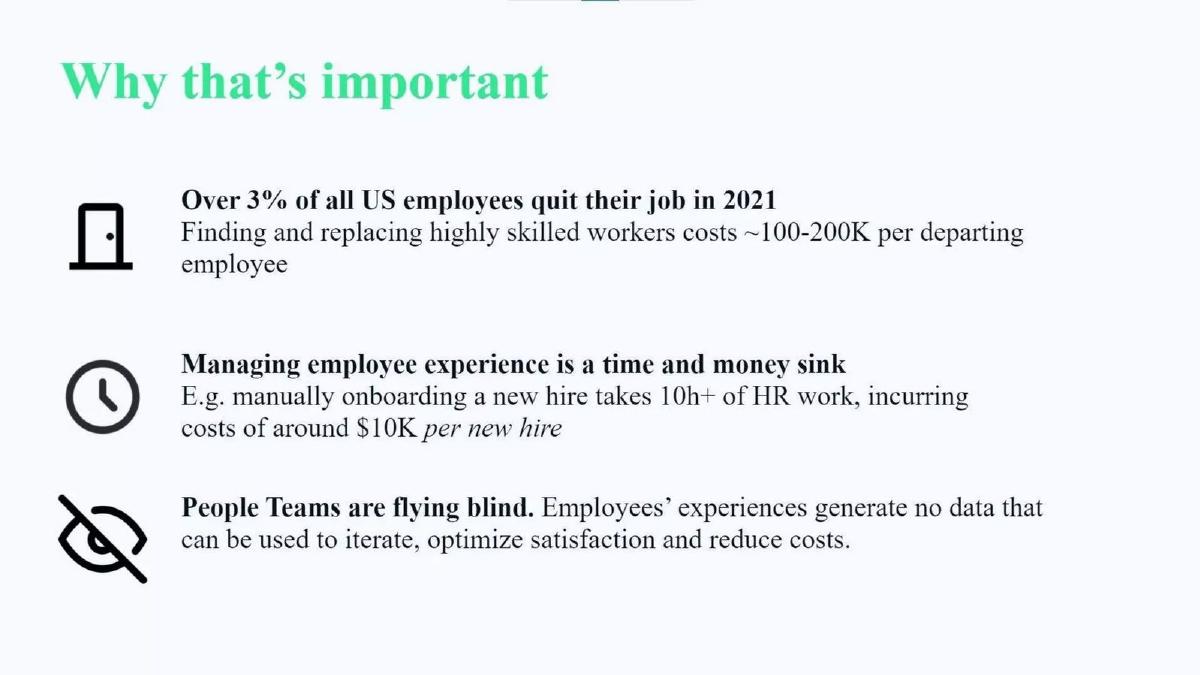
Slide 5 , titled "Why that’s important," provides the macro-economic justification for the product. It cites that "Over 3% of all US employees quit their job in 2021" and notes that replacing a highly skilled worker costs between "~100-200K per departing employee." It also quantifies the administrative burden, stating that manual onboarding takes "10h+ of HR work," resulting in costs of "around $10K per new hire." Finally, it reiterates that People Teams are "flying blind" because employee experiences currently generate no usable data for optimization. This slide successfully attaches a high dollar value to the problem described earlier.
Slide 6: Product Deep Dive - Admin App
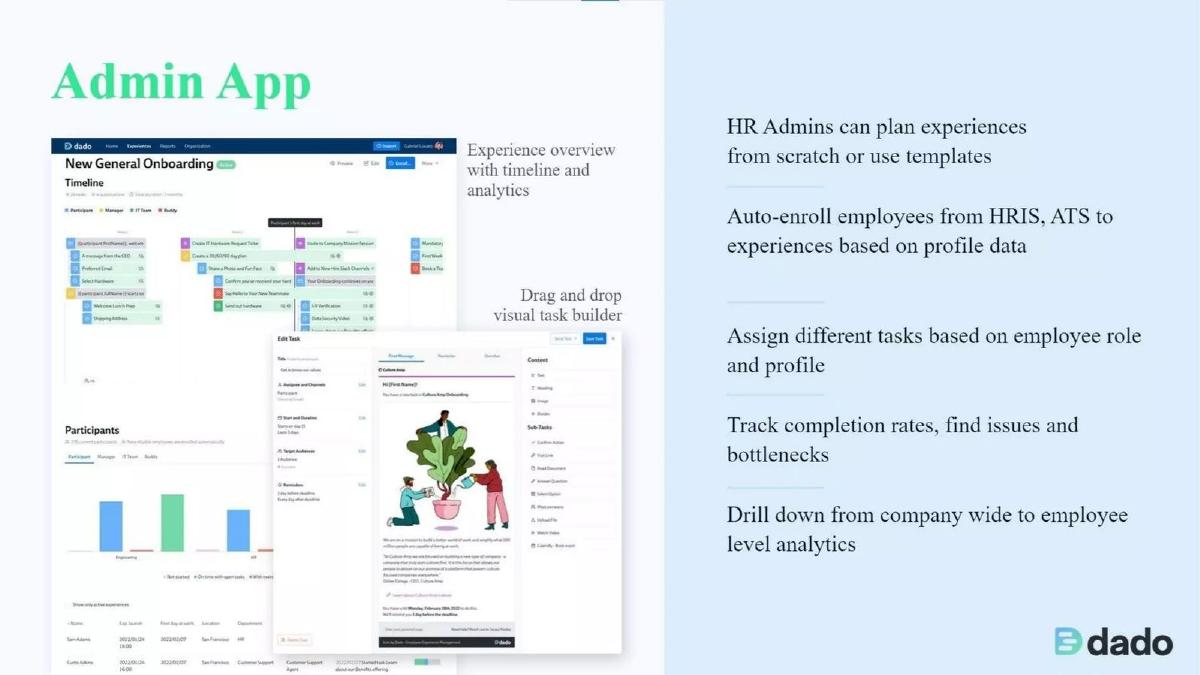
Slide 6 focuses on the "Admin App." It shows screenshots of the experience overview, timeline, and analytics. The text explains that HR Admins can use templates or build from scratch using a "drag and drop visual task builder." A key technical feature mentioned is the ability to "Auto-enroll employees from HRIS, ATS to experiences based on profile data." This indicates a level of automation that moves beyond simple checklists. The slide also promises the ability to "drill down from company wide to employee level analytics," addressing the "flying blind" problem mentioned on the previous slide.
Slide 7: Product Deep Dive - Employee App
Slide 7 showcases the "Employee App." It emphasizes a "branded and personalized employee page" that serves as a single source for communications and tasks. A critical feature highlighted is the Slack integration, which allows employees to "complete tasks directly in the flow of work." The slide notes that tasks require actual actions (like selecting hardware or uploading a file) to be marked as done, rather than relying on "self-reported checklists." This distinction is important for data integrity and ensuring that HR processes are actually completed.
Slide 8: Target Customers
Slide 8 segments the market into three tiers. "Enterprise" (1500+ employees) are those needing to compete for talent and improve the user-friendliness of systems like Workday. "Scale up" (~500+ and growing fast) need to onboard people quickly without slowing down processes. "Small + visionary" (50-250 employees) are culture-focused teams that want to test new initiatives quickly. This slide shows that Dado has a clear idea of its Ideal Customer Profile (ICP) across different organizational scales.
Slide 9: Social Proof
Slide 9 provides "Customer Feedback" via four quotes attributed to an HR professional, a Manager, a New Hire, and a VP of People. The quotes emphasize the visualization of the "HR brain," the consistency of the onboarding process, and the ease of use for new hires. While these are anonymous testimonials, they cover the full spectrum of stakeholders identified in the earlier slides, reinforcing the "people-first" claim.
Slide 10: Conclusion
The final slide ( slide 10 ) is a simple "Thank you!" with the company website, dadohr.com. It serves as a placeholder for the end of the presentation but provides no further information or call to action.
What Works
Founder Pedigree: The shared history at Small Improvements is a major asset. It proves the team has built and scaled products in this exact vertical before. · Quantified Pain Points: Using specific figures like the $100K-$200K replacement cost and the 10+ hours of manual work per hire makes the ROI case for the software very clear. · Product Clarity: The screenshots are legible and clearly demonstrate the difference between the administrative backend and the employee-facing frontend. · Integration Focus: By positioning itself as a tool that syncs with HRIS and ATS systems, Dado avoids the "rip and replace" objection that often kills enterprise software deals.
What is Missing
Business Model: There is no information on how Dado makes money. Is it per-employee-per-month (PEPM)? Is it a flat annual fee? The lack of a pricing slide is a significant omission. · The Ask: The deck does not state how much money the company is looking to raise or what the milestones for the next 18 months are. · Traction: While there are customer quotes, there are no hard metrics regarding the number of customers, revenue (ARR), or growth rates. · Competition: The deck does not mention competitors. In a crowded HR tech market (with players like Sapling, Enboarder, or even the onboarding modules of larger HRIS), this is a notable gap. · Go-To-Market (GTM): There is no explanation of how the company intends to acquire the customers in the segments identified on slide 8.
What a Founder Should Copy
The Team Slide Layout: Grouping founders by their specific roles and highlighting a shared successful past is an excellent way to build immediate trust. · Visualizing the Workflow: Using a timeline view (as seen on slide 1 and 6) is much more effective for explaining a workflow tool than a bulleted list of features. · Stakeholder Segmentation: Breaking down the problem and the solution by how they affect different users (HR vs. Employees) shows a deep understanding of the product's ecosystem. · Market Context: Tying the product to a specific, timely trend (the 2021 quit rate) creates a sense of urgency that helps move a deal forward.
Frequently asked questions
- What specific problem does Dado solve for HR teams?
- According to slide 3, Dado addresses three primary pain points for HR teams: the 'administration time sink' of manual tasks, the high frequency of 'human error' in scattered processes, and the lack of data available for making informed people-management decisions. Slide 5 quantifies this by stating that manual onboarding takes over 10 hours of HR work, costing approximately $10,000 per new hire.
- How does the product integrate with existing enterprise software?
- Slide 4 and slide 6 specify that Dado is designed to 'Sync data from and to HRIS, ATS and other systems.' It also highlights a Slack integration on slide 7, which allows employees to receive content and complete tasks directly within their existing communication workflow, rather than requiring them to log into a separate portal for every action.
- Who are the founders and what is their background?
- The founding team consists of Arielle Kilroy (CEO/Product), Gernot Höflechner (CTO), and Gabriel Lovato (Design/Product). As detailed on slide 2, Kilroy was the VP of Product at Small Improvements, Höflechner was the CTO at Small Improvements, and Lovato was the Lead Product Designer at Small Improvements. This suggests a team with deep, shared experience in building HR technology.
- What are the key features of the 'Admin App'?
- As shown on slide 6, the Admin App includes a 'drag and drop visual task builder,' the ability to plan experiences from scratch or via templates, and an auto-enrollment feature based on HRIS/ATS profile data. It also provides analytics to track completion rates and identify bottlenecks at both the company-wide and individual employee levels.
- What is missing from this pitch deck?
- The deck is missing several standard venture capital requirements. There is no slide detailing the business model or pricing strategy. It lacks a competitive landscape analysis, a go-to-market strategy, and any mention of current traction or revenue. Most importantly, it does not include a 'The Ask' slide to tell investors how much money is being raised.