Cyclectric is a conceptual-stage startup aiming to solve the lack of electric vehicle (EV) charging infrastructure by leveraging residential and small business properties. By utilizing wireless charging technology and a mobile app for activation, the company intends to create a peer-to-peer charging network similar to an 'Airbnb for EV charging,' but with a hardware-first approach. The deck highlights a significant market gap, noting that commercial charging stations can cost ~$20,000 to install (Slide 2). Cyclectric proposes a revenue-sharing model where homeowners can earn $5,000 to $10,000…
Key takeaways
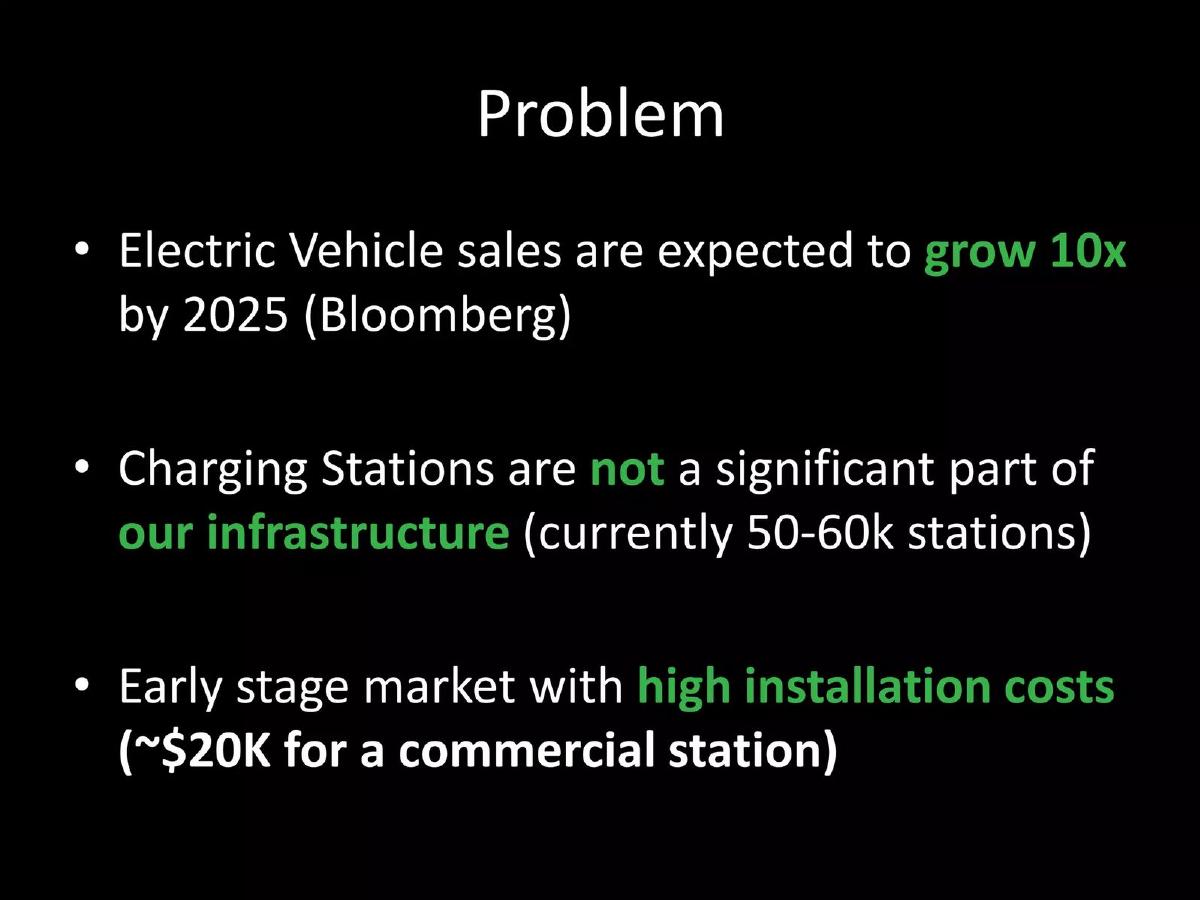
- The company identifies a massive infrastructure gap, citing that EV sales will grow 10x by 2025 while only 50-60k stations currently exist (Slide 2).
- Cyclectric claims commercial charging station installation costs are approximately $20,000, which they aim to undercut by using residential infrastructure (Slide 2).
- The business model relies on a revenue split: if a homeowner pays for installation, they keep 80% of revenue; if Cyclectric pays, the homeowner keeps 60% (Slide 10).
- Pricing for consumers is set at $0.35/kWh, which the deck states is based on the national average price of gasoline (Slide 10).
- Financial projections suggest a single station could generate up to $13,000 per year based on one full charge per day (Slide 14).
- The startup claims a six-month payback period for installation costs under the 'one full charge per day' assumption (Slide 14).
- The team consists of two mechanical engineers from the University of Vermont and Northwestern University, supported by one advisor (Slide 15).
- The $250,000 seed round is earmarked for mobile app development, building the first stations, and hiring a founding team (Slide 16).
Cyclectric Pitch Deck Analysis
Cyclectric presents a decentralized approach to the electric vehicle charging crisis. By moving away from centralized commercial hubs and into the driveways of private citizens, the company hopes to scale infrastructure at a fraction of the traditional cost. The deck is structured as a standard 17-slide pitch, focusing heavily on market opportunity and the financial incentives for hosts.
Slide 1: Title Slide
The deck opens with the company name, Cyclectric, and the tagline "Bringing you home to charge." The logo features a stylized green charging pump. The branding is simple and focused on the core utility of the product.
Slide 2: The Problem
The problem slide identifies three key friction points: 1) EV sales are expected to grow 10x by 2025 (citing Bloomberg), 2) there are currently only 50-60k charging stations, which is insufficient for the projected growth, and 3) commercial installation costs are high, cited at ~$20k per station. This sets the stage for a lower-cost alternative.
Slide 3: The Solution
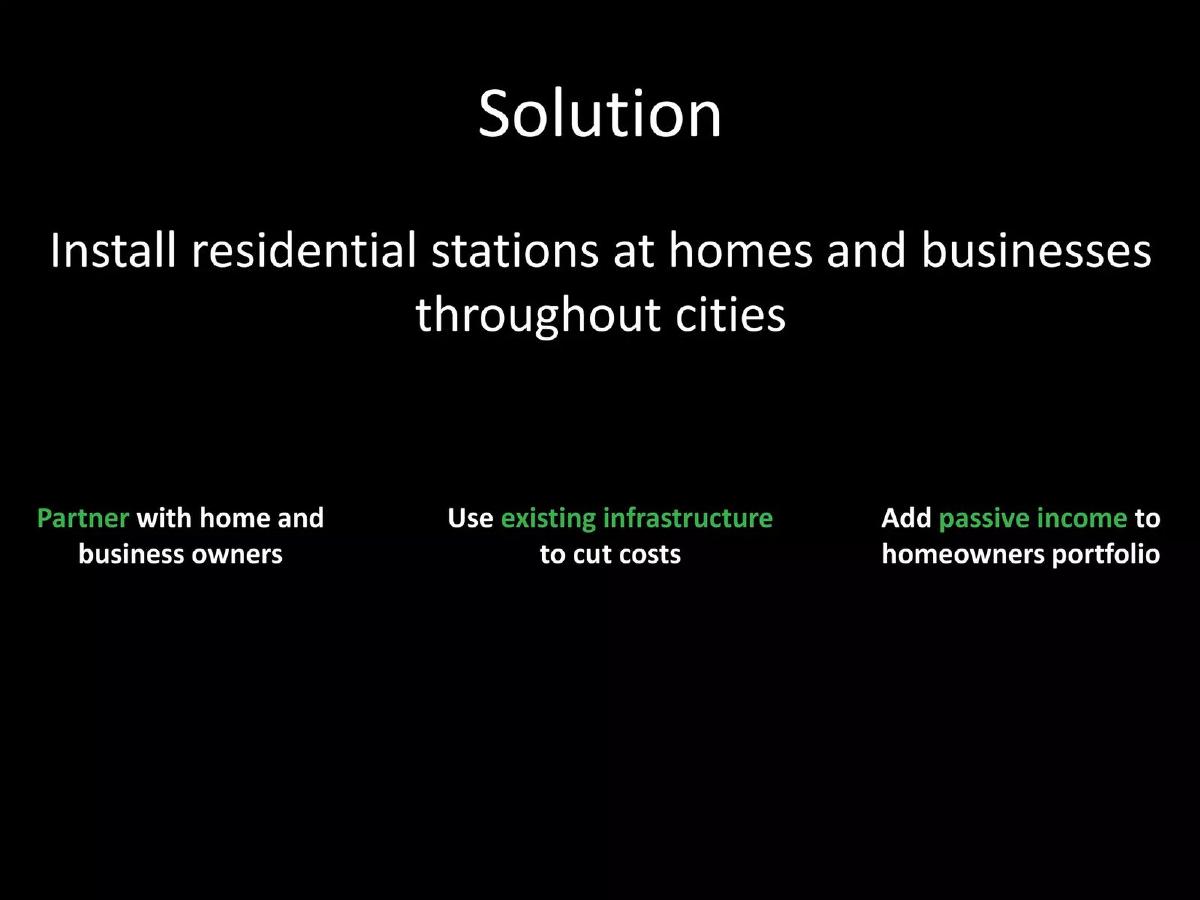
Cyclectric's solution is to install residential stations at homes and businesses. The strategy involves partnering with property owners to use existing electrical infrastructure to cut costs, while simultaneously offering those owners a new stream of passive income.
Slide 4: The Model
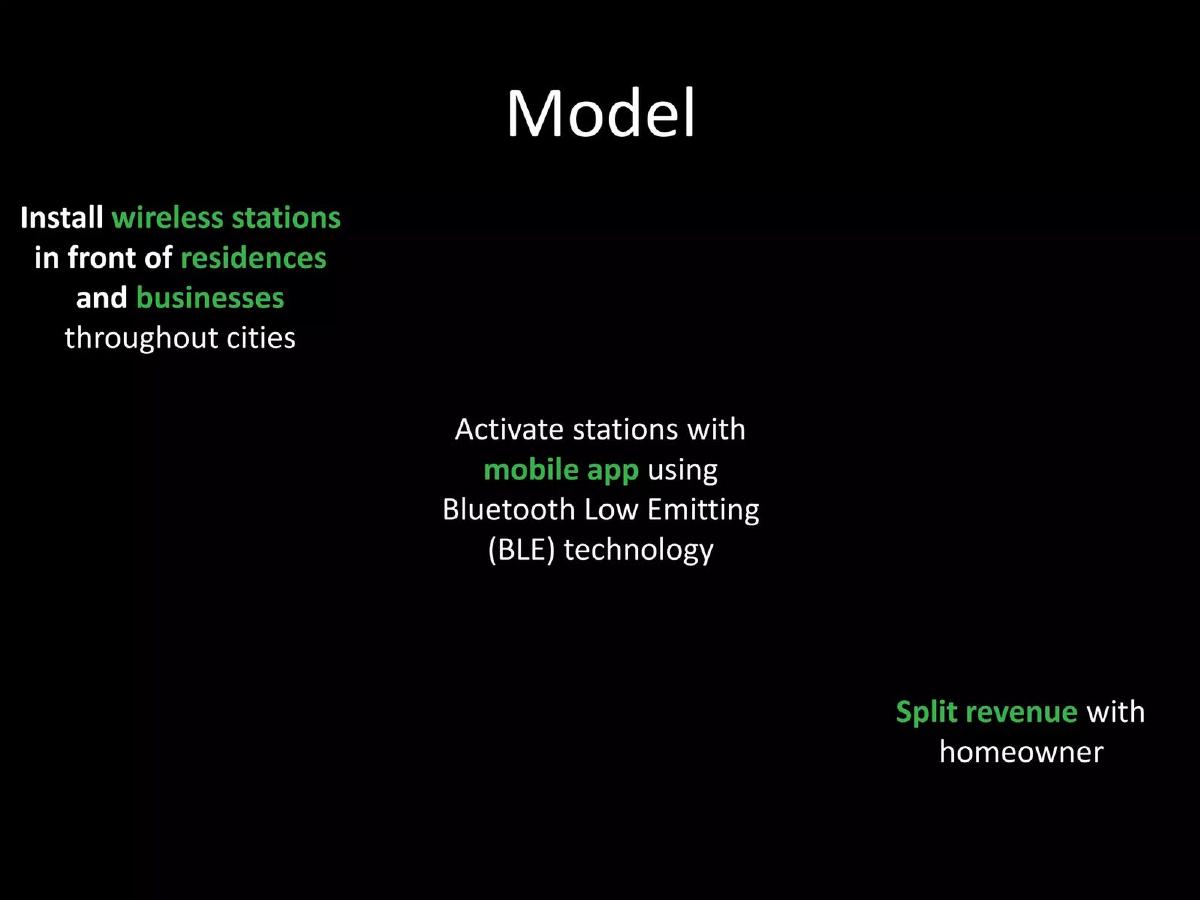
This slide outlines the operational flow: install wireless stations at residences/businesses, activate them via a mobile app using Bluetooth Low Emitting (BLE) technology, and split the resulting revenue with the homeowner. This is essentially a marketplace model for electricity and parking.
Slides 5-9: The User Experience (The "How")
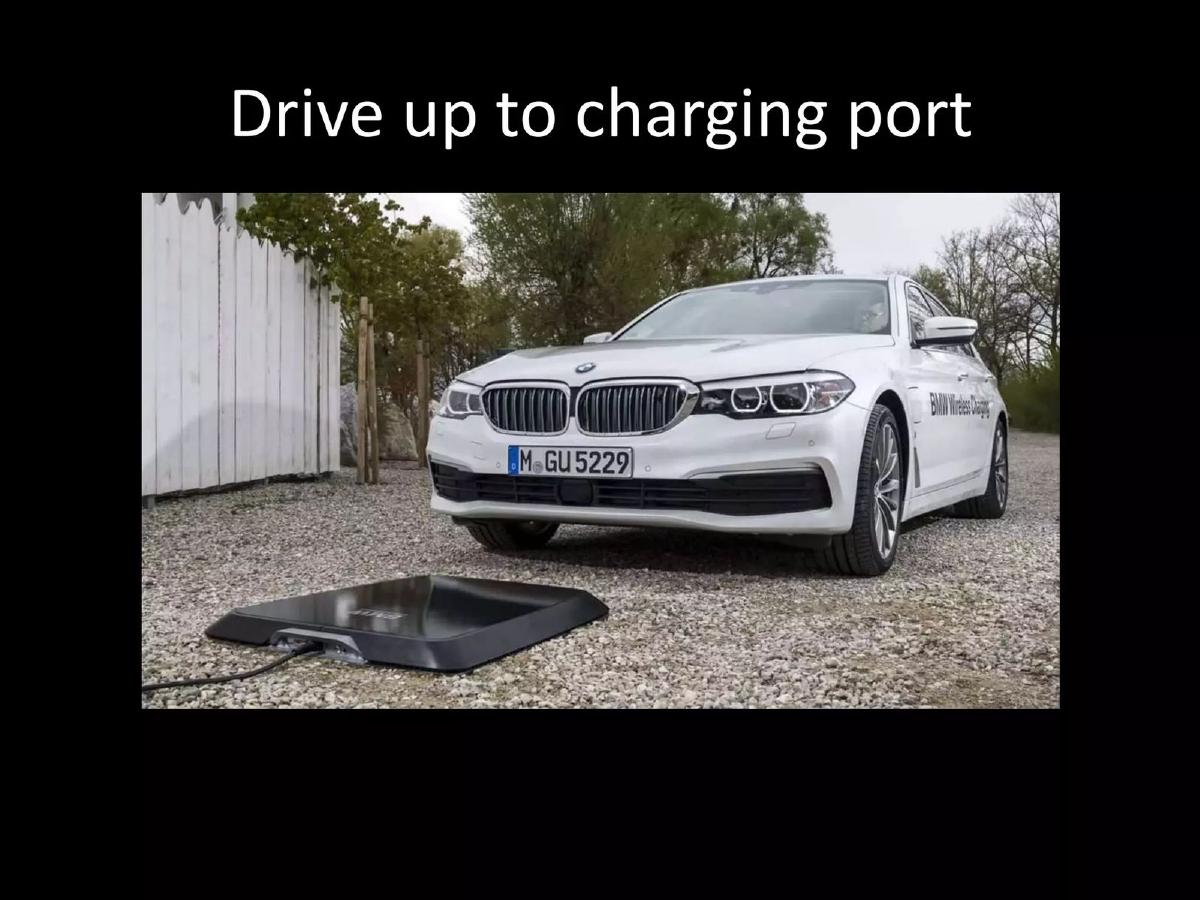
These slides walk through the user journey. Slide 7 shows a white BMW driving over a wireless charging pad. Slide 8 shows a mockup of the Cyclectric app with a map of Georgetown, D.C., featuring pins for available charging locations. The process is described as: drive up, open app, find destination, activate station, and "carry on with your day." Note: The image on Slide 7 appears to be a stock photo of a BMW factory wireless charging system, not proprietary Cyclectric hardware.
Slide 10: Revenue Model
The business model is clearly defined here. The consumer is charged $0.35/kWh, a price the company claims is based on the national average price of gasoline. The revenue split is divided into two categories: Homeowner pays to install: 80% to owner / 20% to Cyclectric. Cyclectric pays to install: 60% to owner / 40% to Cyclectric. This flexibility allows for faster network growth if the company has the capital to deploy units.
Slides 11-12: Market Validation and Size
Slide 11 uses media clippings from CNBC, Grand View Research, and GTM Research to validate the sector. Slide 12 provides a chart of "Global Passenger EV Sales by Type," showing a steep upward curve toward 2025. A purple line indicates the "Public Charge Ports Needed," highlighting a massive gap between current infrastructure ("We are here") and future requirements ("But need to be here").
Slide 13: Competitive Advantage
Cyclectric lists its advantages as being "First to market for wireless charging" and incentivizing hosts with $5-10k of passive income. They also claim their residential approach "mimics home installation costs," which they estimate at 20% of commercial costs. This suggests a target installation cost of roughly $4,000 per unit.
Slide 14: Financials
The financial projections are aggressive. They claim revenue of up to $13,000 per year per station based on one charge per day. They project a 6-month recoupment of installation costs and claim the company can reach profitability within four years on a single round of investment. These figures assume high utilization rates for residential driveways that may not have the same traffic as commercial lots.
Slide 15: The Team
The team consists of two mechanical engineers. Daniel Nowakowski (B.S. from University of Vermont) has four years of experience in concept development. Melanie Herschfeld (B.S. from Northwestern) is a manager at Boston Consulting Group with experience in Agile methodology. They are supported by advisor Al Yoon, President of The Lattice Group, who brings software engineering expertise.
Slide 16: The Funding Ask
Cyclectric is seeking a $250,000 Seed Round. The funds are allocated to four tasks: building and testing the mobile app, building and installing the first stations, hiring a founding team, and starting operations. This is a relatively small ask for a hardware-heavy startup, suggesting the initial goal is a limited pilot program.
Slide 17: Contact Information
The deck concludes with a contact number and email for Daniel Nowakowski, reiterating the company logo and green color scheme.
What Cyclectric Does Well
The deck identifies a very specific and high-growth pain point: the "infrastructure gap" in EV charging. By focusing on the cost difference between commercial and residential installations, they present a compelling economic argument for a distributed network. The revenue-sharing model is also well-explained, offering clear incentives for the supply side of their marketplace (the homeowners).
What is Missing from the Deck
The most significant omission is technical detail regarding the hardware. Wireless charging for EVs is a complex engineering challenge involving high-voltage induction; the deck does not explain if they have a proprietary design, a patent, or a manufacturing partner. Furthermore, there is no mention of regulatory hurdles, such as zoning laws for commercial activity in residential areas or utility company restrictions on reselling electricity. Finally, the financial projections assume one full charge per day per station, but there is no data or pilot study provided to support that such high utilization is achievable in a residential setting.
Founder Takeaways
Quantify the Cost Advantage: Cyclectric does an excellent job of comparing their $4k estimated cost to the $20k commercial standard. Founders in hardware should always highlight this "cost-to-serve" delta. · Clear Revenue Splits: If your business relies on a partnership or marketplace model, a slide like Slide 10 is essential. It tells the investor exactly how the company makes money and how it attracts partners. · Visualizing the Gap: The chart on Slide 12 is a strong visual aid. It doesn't just show market growth; it shows the growing deficit of the current solution, which creates the "vacuum" your startup intends to fill. · Be Wary of Stock Imagery: Using a BMW-branded charging pad to represent a startup's product can be misleading. Founders should use original prototypes or 3D renders to avoid confusion about what they have actually built.
Frequently asked questions
- What is Cyclectric's core product?
- Cyclectric is developing a wireless EV charging station designed for residential and business installation. The system is activated via a mobile app using Bluetooth Low Emitting (BLE) technology. The goal is to create a distributed network where EV owners can charge at private residences, bypassing the need for expensive commercial charging hubs.
- How does the revenue sharing model work for property owners?
- The deck proposes two tiers. If the homeowner pays for the hardware and installation, they receive 80% of the charging revenue while Cyclectric takes 20%. If Cyclectric covers the installation costs, the homeowner still receives 60% of the revenue, providing a passive income stream for the use of their space and electricity.
- What technology does Cyclectric use for charging?
- The deck specifies 'wireless stations' and shows an image of a BMW wireless charging pad (Slide 7). It mentions that stations are activated via a mobile app using Bluetooth Low Emitting (BLE) technology. However, the deck does not clarify if Cyclectric is manufacturing its own wireless pads or white-labeling existing technology.
- What are the projected financials for a single charging station?
- According to Slide 14, a single station can generate up to $13,000 in revenue per year, assuming it is used for one full charge every day. Based on this utilization rate, the company estimates that the cost of installation can be recouped in just six months.
- What is the current stage of the company according to the deck?
- Cyclectric appears to be at the pre-seed or conceptual stage. The funding ask for $250,000 (Slide 16) is specifically intended to 'build and test' the mobile app and 'build and install' the very first stations, indicating that a functional network does not yet exist.