CyberRidge’s 14-slide deck is a highly technical, product-centric presentation that successfully raised a $15M Seed round in 2024. The narrative centers on the 'Harvest Now, Decipher Later' threat, where attackers steal encrypted data today to crack it with future quantum computers. CyberRidge proposes a hardware solution that manipulates light directly, turning data into 'undecipherable optical noise' at the physical layer. While the deck excels at demonstrating technical feasibility through constellation diagrams and hardware specs, it notably omits traditional business slides such as a tea…
Key takeaways
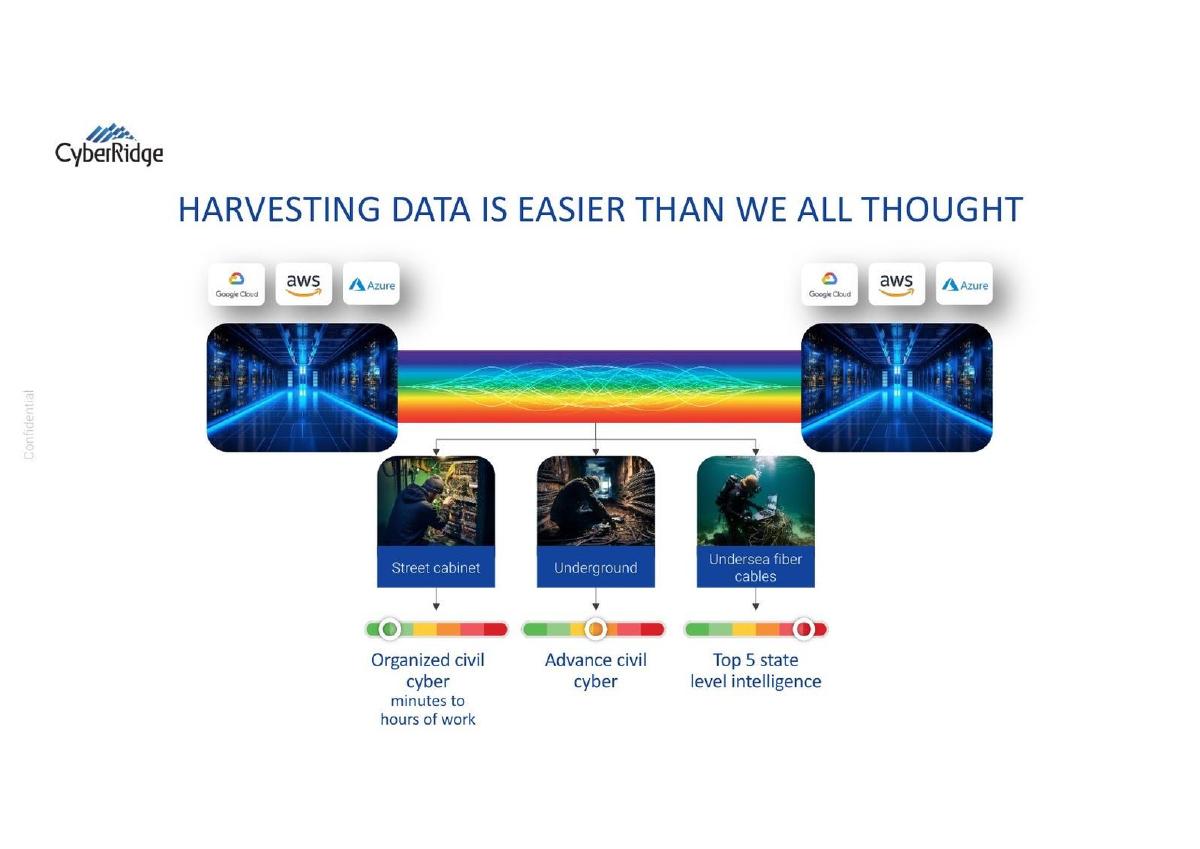
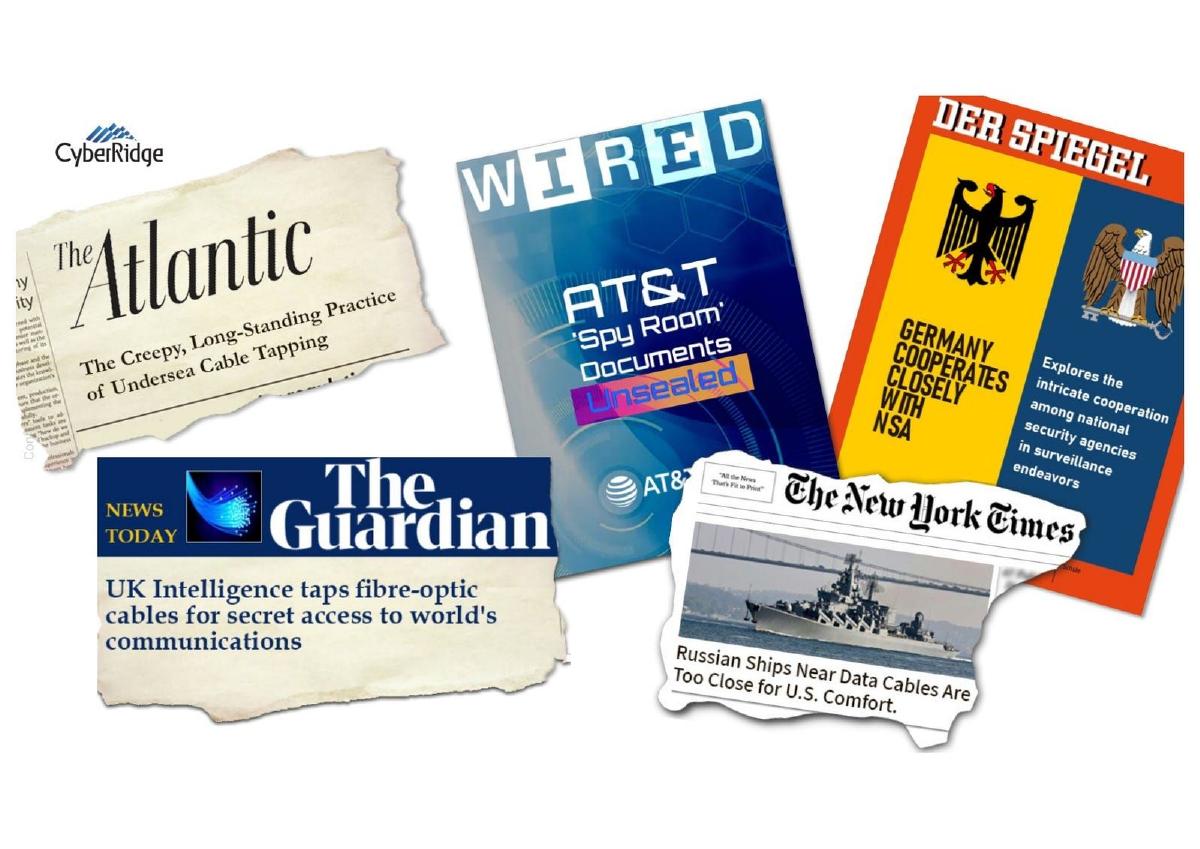
- The deck identifies three primary physical vulnerabilities for fiber data: street cabinets, underground cables, and undersea cables (Slide 2).
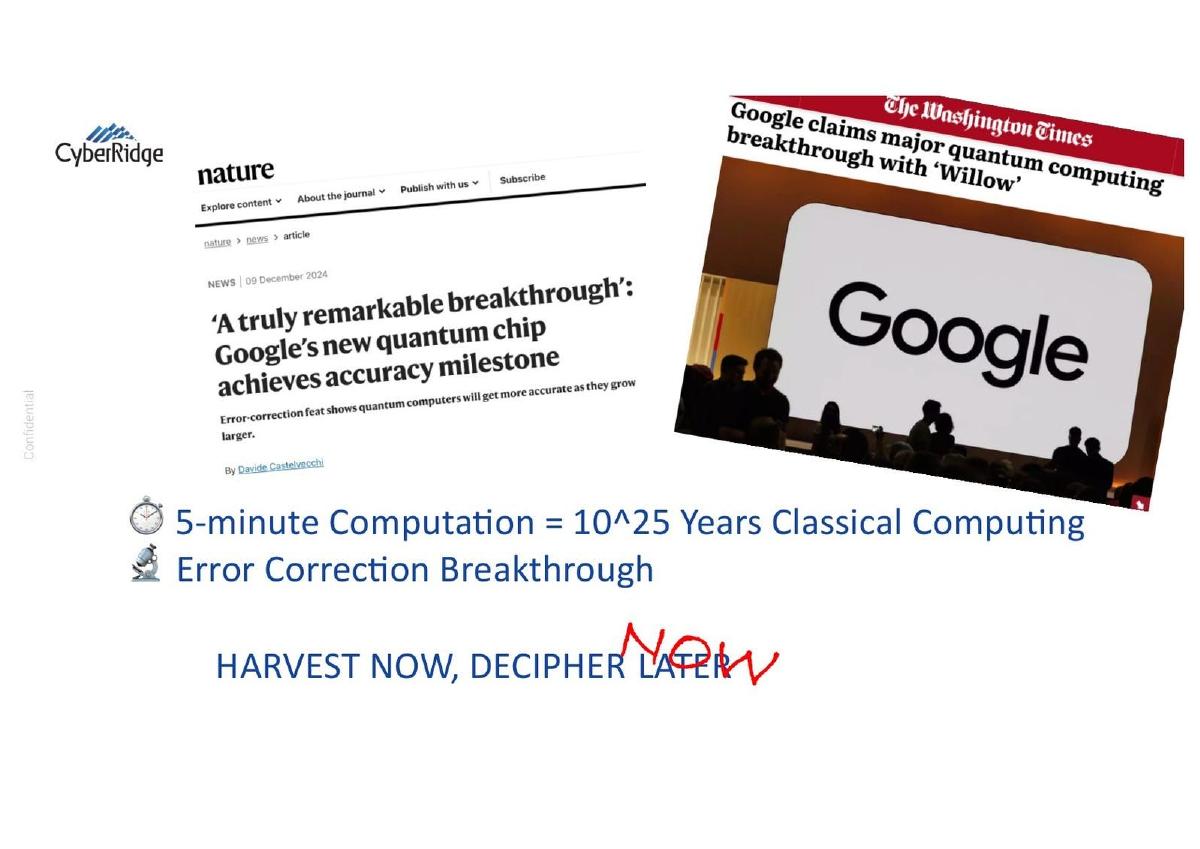
- CyberRidge positions quantum computing breakthroughs, specifically Google's 'Willow' chip, as the catalyst for immediate security upgrades (Slide 3).
- The core value proposition is preventing 'Harvest Now, Decipher Later' attacks by ensuring no raw data is ever captured by interceptors (Slide 4).
- The technology, termed 'Photonic Deconstruction,' transforms data into optical noise that remains undecipherable without a real-time photonic key (Slide 5).
- Technical validation is provided via constellation diagrams comparing 'Coherent' vs 'Incoherent' detection (Slide 6).
- The product is a physical 3U rackmount unit with a 200W initial power draw and 170W steady-state consumption (Slide 7).
- Hardware features include QSFP28 slots, dual redundant AC/DC PSUs, and a physical SD card slot for initial keys (Slide 7).
- The deck is entirely focused on the 'How' and 'Why Now,' omitting all 'Who' (Team) and 'How Much' (Business Model/Ask) information.
Introduction: The Hardware-First Approach to Quantum Security
CyberRidge’s pitch deck is a masterclass in technical storytelling for a specialized audience. In an era where most cybersecurity startups are software-defined, CyberRidge takes a hard pivot into the physical layer. The deck focuses on the vulnerability of fiber-optic infrastructure and the looming shadow of quantum computing. By focusing on the physics of light rather than just the mathematics of encryption, the company carves out a unique defensive niche.
Slide 1: Title Slide
The deck opens with a clean, corporate aesthetic. The logo features a stylized mountain ridge, and the subtitle 'Photonic Encryption' immediately establishes the sector. The background uses a blue radial burst pattern, common in tech decks to signify connectivity or data flow. A 'Confidential' watermark is present on the left margin, a standard practice for pre-seed and seed-stage deep tech companies.
Slide 2: Harvesting Data is Easier Than We All Thought
This slide serves as the 'Problem' introduction. It visualizes the journey of data between cloud providers (Google Cloud, AWS, Azure). The central graphic shows a rainbow-colored light spectrum representing fiber-optic transmission. Below this, three specific physical attack vectors are identified: Street cabinets , Underground cables, and Undersea fiber cables . Each is paired with a difficulty meter. Interestingly, the deck claims that 'Organized civil cyber' can harvest data from street cabinets in 'minutes to hours of work,' while undersea cables are reserved for 'Top 5 state level intelligence.' This establishes a broad threat profile ranging from local criminals to nation-states.
Slide 3: The Quantum Catalyst
Slide 3 introduces the 'Why Now?' factor. It features clippings from Nature and The Washington Times regarding Google’s 'Willow' quantum chip. The slide highlights a specific metric: '5-minute Computation = 10^25 Years Classical Computing.' This creates urgency. The red handwritten-style text 'NOW' over the word 'LATER' in the phrase 'HARVEST NOW, DECIPHER LATER' emphasizes that while the decryption happens later, the theft is happening today. This is a classic fear-based sell, but one grounded in recent scientific milestones.
Slide 4: The Problem - Raw Data Interception
This slide diagrams the current state of data transmission. It shows digital data being converted to analog electronic signals, then to light, and back again. The vulnerability is highlighted in the middle: an attacker (represented by a hooded icon) intercepts the light signal. The text notes that 'Decryption evolves as kept data remains encrypted by outdated encryption.' The core message is that even if data is encrypted today, if the raw light signal is captured, it can be 'hacked offline later' once computing power catches up.
Slide 5: The Solution - Harvest-Resistant Encryption
CyberRidge introduces its countermeasure here. The diagram is updated to include CyberRidge hardware at both the transmission and reception points. The process is labeled Photonic Deconstruction™ at the source and Photonic Reconstruction™ at the destination. The key takeaway is in the blue call-out box: 'Without the photonic key at the instant the light appears at the receiver, transmitted data remains undecipherable optical noise, with no raw data, forever.' By destroying the legibility of the data at the light level, they claim to make the 'Harvest Now' strategy impossible.
Slide 6: Technical Results and Validation
To prove the technology works, Slide 6 shows 'Constellation diagrams.' On the left, 'Multi Homodyne COHERENT Detection' shows clear, grouped data points labeled 'CyberRidge Decipherable.' On the right, 'Multi Homodyne INCOHERENT Detection' shows a scattered, noisy field labeled 'Undecipherable.' This slide is intended for a technical due diligence officer. It provides visual evidence that without the proper authorization, the signal is indistinguishable from random noise.
Slide 7: Hardware Specifications
The final slide in the provided sequence moves from theory to product. It features a high-resolution photo of a physical rackmount unit. Key specifications include:
Dimensions: 3U Rackmount, 60cm depth. · Power consumption: 200W initial, 170W steady state. · Connectivity: Client QSFP28 Slots and Optical Line Tx/Rx LC/UPC Duplex. · Management: Ethernet IP Management and a Local Console. · Security: SD Card for 'secure physical initial key.' · Reliability: Hot swap dual redundant AC/DC PSUs.
This slide proves that CyberRidge is not just a research project; they have a manufactured, enterprise-ready form factor.
What CyberRidge Does Well
The deck is exceptionally focused on the Product and the Problem . In deep tech, the biggest hurdle is often explaining a complex physical phenomenon in a way that highlights its commercial necessity. CyberRidge succeeds by using the 'Harvest Now, Decipher Later' narrative. It turns a future threat (Quantum) into a present-day infrastructure problem.
The use of technical validation (Slide 6) and physical hardware specs (Slide 7) builds significant credibility. It moves the conversation from 'this might work' to 'we have built the box, and here is how much power it draws.' For a $15M Seed round, this level of tangible progress is a strong signal to investors that the capital will be used for scaling and deployment rather than basic R&D.
What is Missing from the Deck
While the technical narrative is strong, the Business narrative is almost entirely absent from these 14 slides. The following omissions are critical:
Team Slide: There is no mention of the founders' backgrounds. In a hardware/cybersecurity play, the pedigree of the engineering team is usually the most important factor for a Seed investor. · Market Size (TAM/SAM): The deck doesn't quantify how many data centers, undersea cable landing stations, or government facilities need this hardware. · Business Model: It is unclear if this is a pure hardware sale, a lease model, or a 'Security-as-a-Service' model with recurring revenue for key management. · Competition: There is no mention of other Post-Quantum Cryptography (PQC) solutions or QKD (Quantum Key Distribution) competitors like ID Quantique or Toshiba. · The Ask: The deck does not state how much money is being raised or what the milestones for the next 18 months are.
Founder Takeaways: How to Apply This to Your Deck
1. Use 'Why Now' Catalysts: CyberRidge effectively uses Google's 'Willow' breakthrough to create urgency. If your industry has a 'tipping point' event, put it front and center to justify why your solution must be funded today.
2. Visualize the Invisible: Cybersecurity is notoriously difficult to visualize. CyberRidge uses clear diagrams to show where the 'thief' sits in the process. If you are building abstract software, find a way to map the 'flow' of value or risk so a non-technical investor can follow the logic.
3. Transition from Theory to Hardware: If you are building a physical product, show it. The detailed call-outs on Slide 7 regarding port types and power draw remove the 'vaporware' risk. It shows you have considered the realities of a data center environment (rack units, redundancy, cooling).
4. Address the 'Offline' Threat: Many security pitches focus on preventing a breach. CyberRidge focuses on making the breach useless. This 'fail-safe' narrative is very attractive to high-stakes clients like governments and financial institutions.
Conclusion
CyberRidge’s deck is a highly specialized document. Its success in raising $15M suggests that the missing business elements were likely handled in supplemental documents or through the founders' existing reputations. For most founders, omitting the team and market slides is a high-risk strategy. However, as a technical explainer of a complex hardware solution, this deck is an excellent example of how to communicate deep-tech value propositions through clear, sequential logic.
Frequently asked questions
- What is the primary problem CyberRidge is solving?
- CyberRidge addresses the 'Harvest Now, Decipher Later' threat. Currently, attackers can intercept encrypted data from fiber-optic cables and store it. While they cannot read it today, the deck argues that breakthroughs in quantum computing (like Google's Willow) will allow them to decrypt this stored data in the near future. CyberRidge aims to make the intercepted data itself useless noise.
- How does the technology differ from standard software encryption?
- Standard encryption happens at the digital layer. CyberRidge operates at the physical/photonic layer. By using 'Photonic Deconstruction,' they turn the light signals traveling through the cable into optical noise. If an attacker taps the line, they don't get encrypted digital data; they get undecipherable light patterns that cannot be reconstructed without the specific photonic key present at the receiver.
- What are the physical specifications of the CyberRidge hardware?
- According to Slide 7, the device is a 3U rackmount unit with a 60cm depth. It consumes 200W of power during the initial two minutes and settles into a 170W steady state. It features QSFP28 slots for client connections, LC/UPC Duplex ports for optical lines, and includes dual redundant hot-swappable power supplies.
- Is there a team slide in the CyberRidge deck?
- No. The 14-slide deck provided does not include a team slide, founder biographies, or advisor lists. This is unusual for a Seed round but common in highly technical 'stealth' or semi-stealth raises where the technology's performance and the founders' reputations are already established with the target VCs.
- Does the deck mention a specific fundraising goal or valuation?
- The slides themselves do not contain a financial ask, use of proceeds, or valuation. While Business Insider reported a $15M Seed round raise in 2024, the deck functions more as a technical whitepaper or product overview than a traditional financial pitch.