Opna, a London-based climate tech startup, raised a $6.5M Seed round in 2024 using a concise 11-slide deck. The presentation focuses heavily on the structural barriers preventing corporations from fulfilling net-zero pledges, specifically the lack of in-house expertise and the high cost of due diligence. By positioning themselves as a financing platform rather than a simple marketplace, Opna highlights a proprietary risk engine that evaluates over 280 data points per project. While the deck is visually polished and identifies a clear market gap—over 5,200 corporates committed to Net Zero—it n…
Key takeaways
- The deck identifies a massive target market of over 5,200 corporates covering 40% of global emissions committed to Net Zero (Slide 3).
- Opna positions its solution as a direct financing model rather than just a carbon credit marketplace (Slide 2).
- The platform addresses three core pain points: hard project discovery, expensive due diligence, and painful post-financing monitoring (Slide 3).
- A proprietary risk engine is a central value prop, claiming to evaluate over 280 data points to assess project impact (Slide 4).
- The product interface includes both 'Upfront financing' and 'Payment on delivery' options for diverse project types like Biochar and Mangroves (Slide 4).
- The deck omits a traditional team slide, listing only the CEO/Founder on the final contact page (Slide 6).
- There is no specific financial ask or valuation mentioned in the slides; the funding goal is broadly stated as accelerating revenue, team, and product (Slide 5).
- The deck uses a minimalist aesthetic with high-quality environmental photography to reinforce its climate-tech branding (Slides 1-6).
The Financing Platform for a Low-Carbon Future
Opna’s Seed deck is a study in minimalist storytelling. In an industry often bogged down by complex scientific jargon and regulatory minutiae, Opna chooses to focus on the financial and operational friction experienced by large corporations. As reported by Business Insider, this London-based startup secured $6.5M in 2024 to bridge the gap between corporate net-zero pledges and the actual funding of carbon removal projects. The deck consists of 11 slides, though the core narrative is delivered through a tight sequence of problem-solution framing and product visualization.
Slide 1: Title and Mission
The opening slide establishes the brand identity immediately. The tagline, "The financing platform for an equitable & thriving low-carbon future," positions Opna not as a carbon credit broker, but as a financial infrastructure provider. This distinction is critical in the climate tech space, where 'marketplaces' are common, but 'financing platforms' imply a deeper level of capital deployment and risk management.
Slide 2: The Strategic Shift
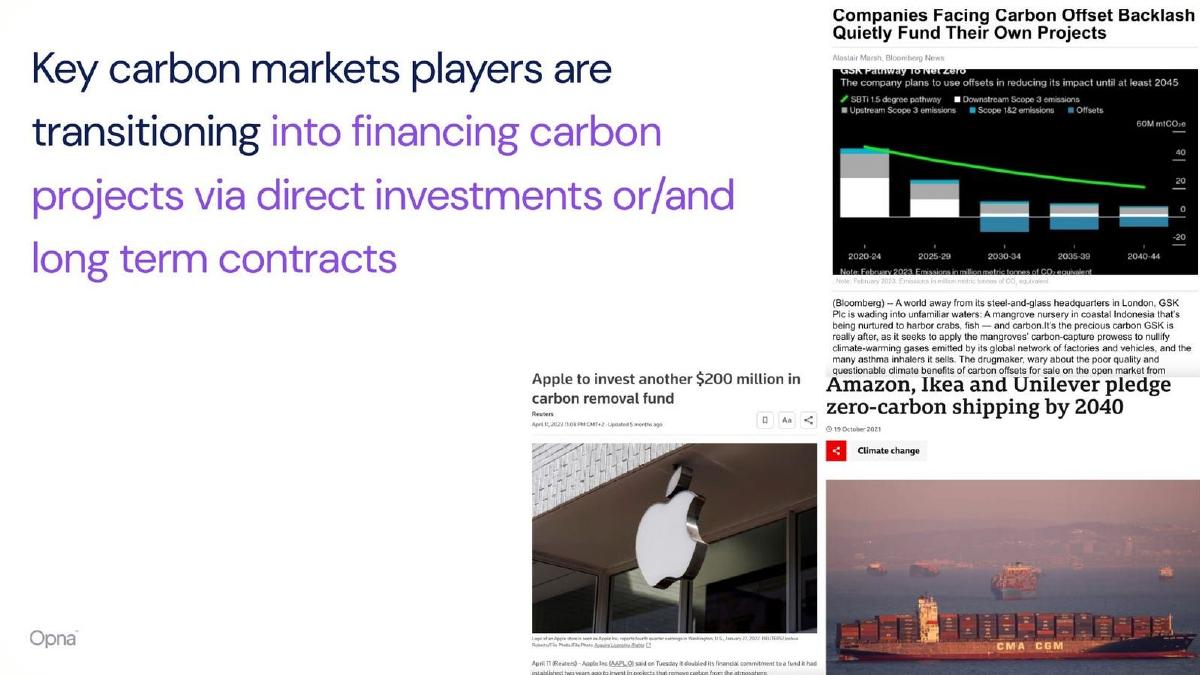
Slide 2 presents a thesis statement for the company: "The future-proof way to meet net-zero pledges is to contribute to, and finance carbon projects, directly." By emphasizing the word 'directly,' Opna is challenging the traditional model of buying offsets on the secondary market. The slide uses four pillars to support this: direct connection, visibility into supply/pricing, new revenue sources, and 100% transparency. This slide sets the stage for a 'Direct-to-Project' model that promises better economics and higher integrity for the corporate buyer.
Slide 3: The Problem Statement
This is arguably the most important slide in the deck. It quantifies the opportunity and details the friction. A footnote states that "Over 5200 corporates covering 40% of global emissions have committed to Net Zero," providing a clear sense of the Total Addressable Market (TAM). The slide then breaks down why these corporates are struggling, citing three specific hurdles:
Project discovery/origination: Lack of in-house expertise to find relevant projects. · Due Diligence: The high cost and lack of technical know-how to assess risk and impact. · Post-financing monitoring: The difficulty of managing contracts that last over a decade without proper infrastructure.
Slide 4: The Solution and Product
Opna introduces its platform as the remedy to the problems listed on the previous slide. The slide highlights a "proprietary risk engine" that evaluates over 280 data points to build a holistic picture of project risk. This is a key 'moat' slide, suggesting that Opna has a data advantage that a generalist financial institution or a simple listing site lacks. The product mockup shows a clean UI with projects categorized by technology (Biochar, Mangroves, Cookstoves) and impact type (Carbon Removal vs. Reduction). It also shows two distinct financial paths: "Upfront financing" and "Payment on delivery," catering to different corporate risk appetites.
Slide 5: The Use of Funds
Slide 5 is a transition slide that addresses the Seed fundraiser. It states the capital will "help us accelerate on revenue, team, and product." While this tells the investor where the focus lies, it is notably light on specifics. There is no mention of the $6.5M figure (which we know from publisher reports), nor is there a roadmap or a list of specific milestones the company intends to hit with this capital. In a Seed round, investors typically look for a more granular breakdown of how the 'team' will be expanded or which 'product' features are next on the list.
Slide 6: Contact and Leadership
The final slide provides contact information for Shilpika Gautam, CEO and Founder . While it serves its purpose as a closing slide, the deck's omission of a dedicated 'Team' slide is a significant departure from standard pitch deck structure. In early-stage venture capital, the 'who' is often as important as the 'what.' By only listing the founder at the very end, the deck relies heavily on the strength of the market opportunity and the product vision rather than the collective pedigree of the founding team.
What Opna's Deck Does Well
The deck excels at problem identification . By citing the 5,200 corporates committed to net-zero, Opna grounds its pitch in a massive, undeniable market trend. The breakdown of why these companies are failing—specifically the mention of 'unscalable' due diligence and 'painful' long-term monitoring—shows a deep understanding of the customer's operational pain points. Furthermore, the visual design is professional and cohesive, using high-quality imagery that aligns with the 'social impact' and 'climate tech' sectors without feeling like a generic stock-photo presentation.
The inclusion of the 280 data points metric is a strong tactical move. It gives the 'proprietary risk engine' a sense of weight and technical depth, moving it beyond a marketing buzzword into a quantifiable product feature. This is exactly the kind of detail that piques the interest of technical or fintech-focused investors during a Seed round.
What Is Missing from the Opna Deck
The most glaring omission is a Team Slide . While the founder is listed at the end, there is no information regarding their background, previous exits, or domain expertise in finance or climate science. For a $6.5M Seed round, investors usually require a clear picture of the 'founding DNA.'
Additionally, the deck lacks Unit Economics and Business Model details. While it mentions 'financing projects directly' and 'new revenue sources,' it doesn't explain how Opna itself makes money. Is it a SaaS fee for the monitoring tools? A percentage of the capital deployed? A success fee on carbon credits delivered? Without a business model slide, the path to profitability remains opaque.
Finally, there is no Competitive Landscape slide. The carbon market is currently flooded with startups, from registries like Gold Standard to marketplaces like Patch or Cloverly. Opna needs to explicitly show how its 'financing platform' approach differs from these existing players to justify its valuation and market position.
Founder's Guide: What to Copy
Founders should emulate Opna's narrative flow . The transition from the macro-trend (Net Zero pledges) to the micro-friction (due diligence is expensive) is seamless. It builds a logical case for the product before the product is even shown. This 'problem-first' approach ensures that the investor understands the 'why' before they are asked to evaluate the 'how.'
Another element worth copying is the quantification of the problem . Using the 5,200 corporates figure (Slide 3) provides an immediate sense of scale. If you are building in a niche or emerging market, finding a credible, third-party statistic that validates the size of the problem is essential for establishing urgency.
Lastly, the clarity of the product mockup (Slide 4) is excellent. It doesn't try to show every single feature; instead, it focuses on the core value proposition: discovery and financing. Founders should avoid cluttered screenshots and instead use 'hero' mockups that highlight the primary user actions.
Conclusion
Opna's Seed deck is a lean, high-level document that successfully raised $6.5M by focusing on a massive structural gap in the carbon market. While it leaves many questions unanswered—particularly regarding the team and the specific business model—it succeeds in framing Opna as a sophisticated financial layer for the climate transition. For founders, this deck serves as a reminder that a clear, well-articulated problem can often be the most persuasive part of a pitch.
Frequently asked questions
- How much did Opna raise with this deck?
- According to publisher reports from Business Insider, Opna raised $6.5M in a Seed round in 2024. The deck itself does not state the specific dollar amount, only that the funds will be used to accelerate revenue, team, and product development.
- What is Opna's core product?
- Opna is a financing platform that helps corporations discover, finance, and monitor carbon removal projects. Key features include a proprietary risk engine that analyzes 280 data points and a dashboard for managing long-term contracts and project performance.
- Who is the founder of Opna?
- The deck identifies Shilpika Gautam as the CEO and Founder on the final slide. While the deck lacks a full team slide, publisher reports confirm the company is based in London and operates within the climate tech sector.
- What market problem does the deck highlight?
- The deck focuses on the 'high barriers to entry' for corporates trying to meet net-zero goals. It cites a lack of in-house technical expertise for due diligence and the difficulty of monitoring projects that can span over a decade.
- Does the deck show any traction or revenue?
- No specific revenue figures or customer names are included in the provided slides. The deck uses a mockup of the platform showing hypothetical projects like 'Acme Char' and 'Blue Sagar' to demonstrate functionality rather than historical performance.