Optimity’s pitch deck for 500 Startups Batch 20 positions the company as a solution to the $1.1 trillion employer health cost problem. The narrative centers on a massive engagement gap in the wellness industry, where Optimity claims to achieve 77% participation among 3,000+ users, dwarfing the 10% industry standard. By utilizing 'microactivities' to reduce medication usage and securing validation from Sun Life Financial, the company shifts wellness from a 'perk' to a measurable financial instrument. While the deck lacks specific revenue figures, unit economics, and a clear funding ask in the…
Key takeaways
- The deck identifies a $1.1 trillion health cost problem for employers on slide 2.
- Optimity claims a 77% participation rate across 3,000+ users, significantly higher than the 10% industry average cited on slide 3.
- The product utilizes 'microactivities' designed to reduce medication usage through data-driven personalization as shown on slide 4.
- Return on Investment (ROI) claims are validated by Sun Life Financial and Insurance Research Labs according to slide 5.
- The founding team includes Jane Wang (CEO), Nicholas Raditsis (VP Client Success), and Stephan Massin (CTO) as listed on slide 6.
- The team slide highlights previous experience at high-profile firms including IMS Health, Biogen Idec, TD Bank, and AMD.
- The deck omits a specific financial ask, revenue growth charts, and a detailed competitive landscape in the provided slides.
- A call to action points to an AngelList profile (angel.co/myoptimity) on slides 5 and 6.
The Hook: A Trillion-Dollar Pain Point
Optimity opens its deck by framing corporate wellness not as a HR benefit, but as a massive financial liability. By citing a $1.1 trillion problem for employers on slide 2, they immediately elevate the conversation to the C-suite level. The use of a relatable anecdote—Starbucks spending more on healthcare than coffee beans—serves as a powerful anchor for the scale of the inefficiency they are targeting.
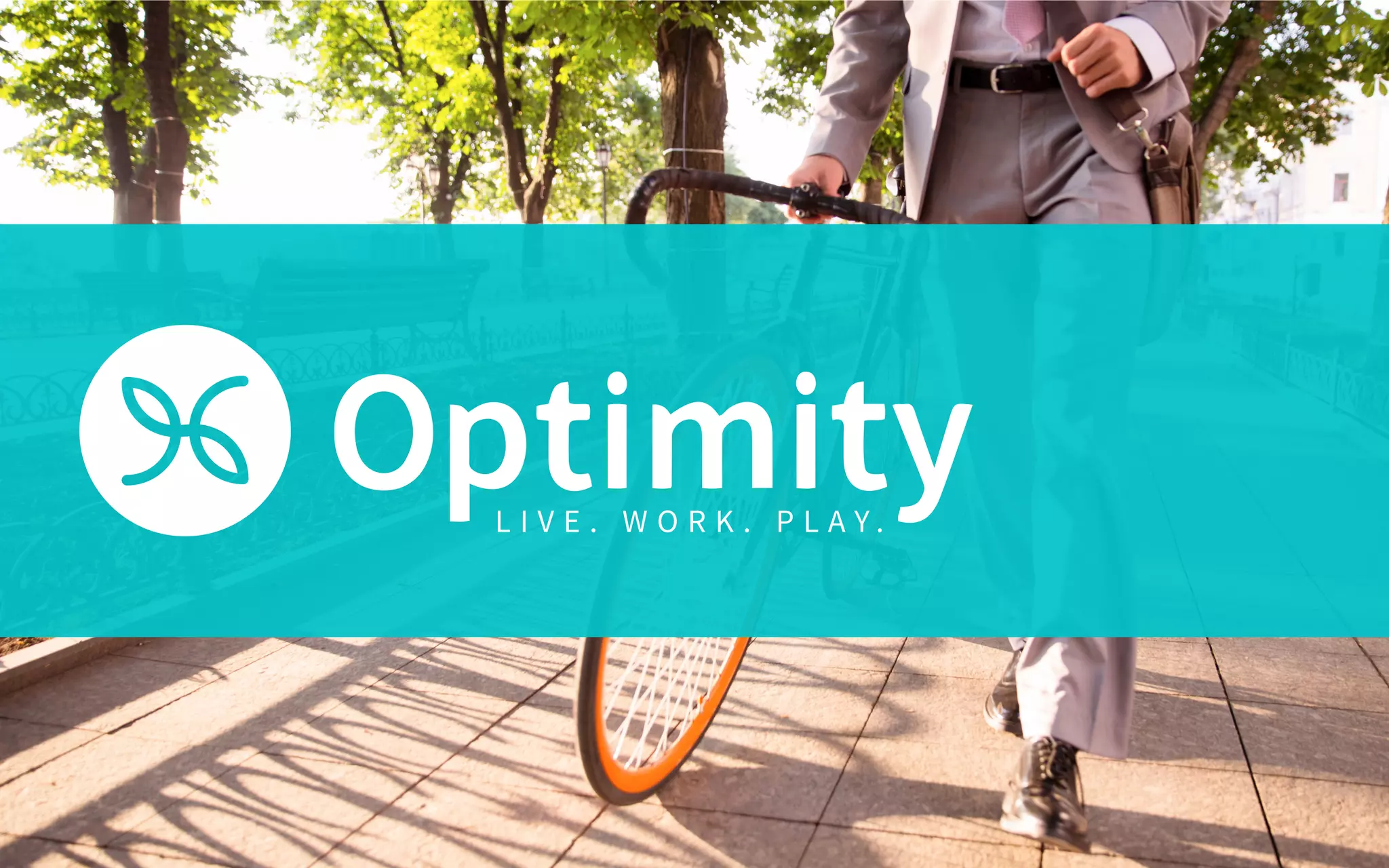
Slide 1: Title and Branding
The cover slide is minimalist, featuring the Optimity logo and the tagline "LIVE. WORK. PLAY." The background image of a professional walking with a bicycle reinforces the theme of active living and corporate wellness. It sets a clean, professional tone without providing specific data, which is standard for a title slide.
Slide 2: The Problem Statement
This slide defines the market opportunity. It states there is a "$1.1 Trillion Problem for Employers." The text highlights a specific, well-known fact: "Starbucks spend more on employee health cost than on coffee beans every year!" This slide is designed to create urgency. It identifies the 'why now' by showing that health costs are outstripping core business expenses for major corporations.
Slide 3: The Engagement Gap
Slide 3 presents Optimity's strongest metric. It claims "Optimity has the industry-best engagement" with "77% Participation Across 3000+ users." Crucially, it provides a benchmark at the bottom of the slide, stating the "Industry average is ~10%." This 7x delta is the primary differentiator for the company. It suggests that while other wellness platforms exist, they are largely ignored by employees, whereas Optimity has found a way to maintain active usage.
Slide 4: Product and Personalization
The deck moves from the 'why' to the 'how' on slide 4. Titled "Data-Driven Personalization," it introduces the concept of "Microactivities." These are described as "Adaptive, personalized activities to reduced medication usage." The slide is light on technical details but heavy on the outcome: reducing the reliance on expensive medications through small, data-informed behavioral changes. This positions the product as a preventative health tool rather than just a fitness tracker.
Slide 5: Validation and ROI
To counter the common criticism that wellness programs have 'soft' ROI, slide 5 focuses on "ROI Insurer Backed." It notes that "Claims analysis supported by Insurance Research Labs" and features the Sun Life Financial logo. This is a critical piece of social proof. By involving insurers in the validation of their data, Optimity moves from a 'nice-to-have' app to a 'must-have' financial tool for reducing insurance premiums and claims costs. The slide also includes a link to angel.co/myoptimity , indicating the deck was used for active fundraising.
Slide 6: The Team
The final slide in the provided set introduces the leadership team. Jane Wang (CEO) is shown with experience from imshealth and biogen idec , suggesting a strong background in healthcare data and pharmaceuticals. Nicholas Raditsis (VP Client Success) brings corporate experience from TD Bank and CPS Management Partners . Stephan Massin (CTO) provides the technical foundation with a history at AMD and ATI . This combination of health-tech, corporate sales, and hardware/software engineering is a standard 'balanced' team for a seed-stage startup.
What Works in the Optimity Deck
The deck excels at comparative metrics . By placing their 77% engagement rate directly next to the 10% industry average, they make a compelling case for their product's efficacy. The use of third-party validation (Sun Life Financial) is also a major strength. In the crowded HR-tech and wellness space, founders often make bold claims about ROI that are difficult to prove; Optimity bypasses this skepticism by citing insurance industry partners.
The narrative flow is logical: it starts with a massive financial problem, shows why current solutions fail (low engagement), presents their solution (microactivities), proves it works with data, and introduces the team capable of scaling it. The design is consistent, using a teal and white color palette that feels clinical yet modern.
What is Missing from the Deck
Despite the strong engagement metrics, the deck has several notable omissions in the provided slides:
Revenue and Growth: While 3,000+ users are mentioned, there is no information on Monthly Recurring Revenue (MRR), Annual Recurring Revenue (ARR), or the growth rate of the user base over time. · Business Model: It is unclear how Optimity makes money. Do they charge per employee, take a percentage of healthcare savings, or sell data to insurers? The pricing strategy is absent. · Competitive Landscape: The wellness space is highly fragmented with players like Virgin Pulse, Limeade, and various health insurance-native apps. The deck does not explain how Optimity wins against these incumbents beyond the engagement percentage. · The Ask: There is no slide detailing how much the company is raising, what the valuation is, or what the milestones for the next 18 months will be. · Unit Economics: There is no mention of Customer Acquisition Cost (CAC) or Lifetime Value (LTV), which are vital for a 500 Startups-style growth pitch.
Founder Takeaways
Founders should look at how Optimity quantifies the 'soft' benefits of their product. Instead of saying "employees feel better," they say "participation is 77%" and "medication usage is reduced." This shift from qualitative to quantitative language is essential for B2B sales and fundraising.
Additionally, the use of logos for credibility is well-executed. By featuring Sun Life, AMD, and TD Bank, the founders borrow the authority of established institutions to bolster their own brand. For an early-stage company, this 'halo effect' can be the difference between being seen as a risky experiment or a professional partner. Finally, the Starbucks analogy is a masterclass in making a dry, trillion-dollar problem feel tangible and urgent to a generalist investor.
Frequently asked questions
- What is the primary problem Optimity is solving?
- Optimity targets the rising cost of employee healthcare, which it values as a $1.1 trillion problem for employers. Slide 2 uses Starbucks as a case study, noting that the company spends more on employee health costs than on coffee beans annually. The deck suggests that current wellness solutions fail due to low engagement, which Optimity aims to solve.
- How does Optimity differentiate its engagement metrics?
- On slide 3, Optimity claims a 77% participation rate among its 3,000+ users. It contrasts this directly with a stated industry average of approximately 10%. This 7.7x improvement in engagement is the core value proposition, suggesting that their 'microactivities' approach is more effective at reaching employees than traditional programs.
- What is the 'Microactivities' feature mentioned in the deck?
- Slide 4 describes 'Microactivities' as adaptive, personalized activities. The goal of these data-driven interventions is to reduce medication usage. The slide uses icons for pills and heart rates to imply a clinical or physiological focus, moving beyond simple step-counting to more specific health outcomes.
- How does the company prove its ROI to skeptical employers?
- Optimity relies on third-party validation rather than self-reported data. Slide 5 explicitly states that their ROI claims are 'Insurer Backed.' It notes that claims analysis is supported by Insurance Research Labs and prominently features the logo of Sun Life Financial, a major insurance provider.
- What information is missing from this pitch deck?
- The provided slides lack several critical components for a full investment evaluation. There is no slide detailing the business model (SaaS vs. per-employee-per-month), no revenue or growth metrics beyond user count, no competitive analysis, and no 'Ask' slide detailing how much capital they are raising or their valuation expectations.