House Lab’s pitch deck is a concise 7-slide presentation centered on their 'PACER Software,' designed to identify pre-foreclosure properties significantly faster than traditional methods. The company aims to create a 'short term monopoly' by accessing market data 50-120 days before competitors. Their business model initially relies on selling leads for $50 each to realtors and REITs, with a long-term roadmap to pivot into direct real estate investment. While the deck provides clear revenue projections reaching $1.3M by 2020 and identifies key partners like BankruptcyWatch and Lincoln Law, it…
Key takeaways
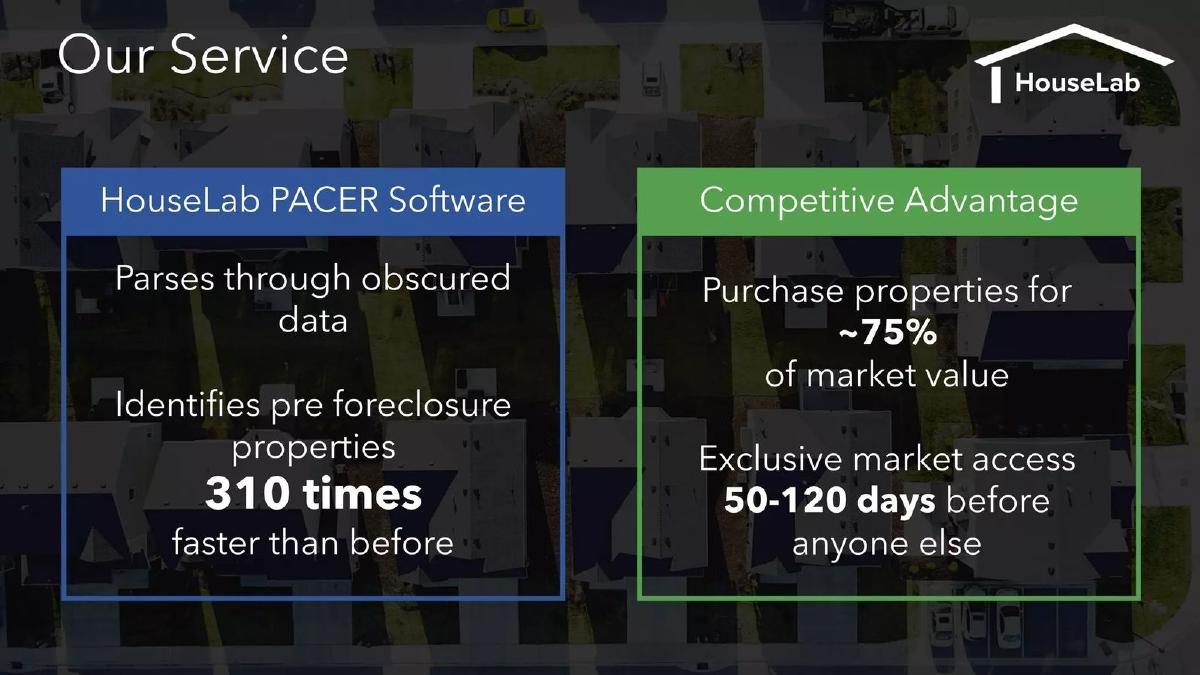
- The core product is HouseLab PACER Software, which claims to identify pre-foreclosure properties 310 times faster than existing methods (Slide 4).
- The company's value proposition is providing exclusive market access 50-120 days before other buyers, allowing for purchases at ~75% of market value (Slide 4).
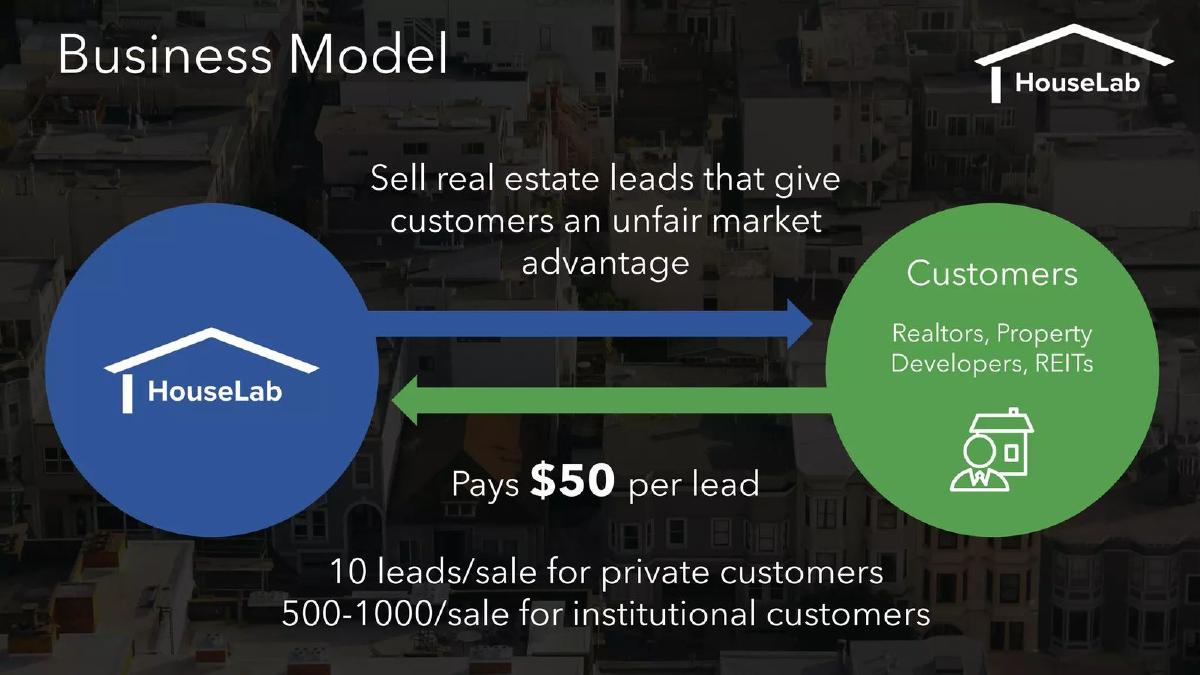
- The initial business model is a lead-gen service charging $50 per lead to realtors, developers, and REITs (Slide 5).
- House Lab lists BankruptcyWatch and Lincoln Law as official partners, suggesting a focus on legal and bankruptcy data streams (Slide 2).
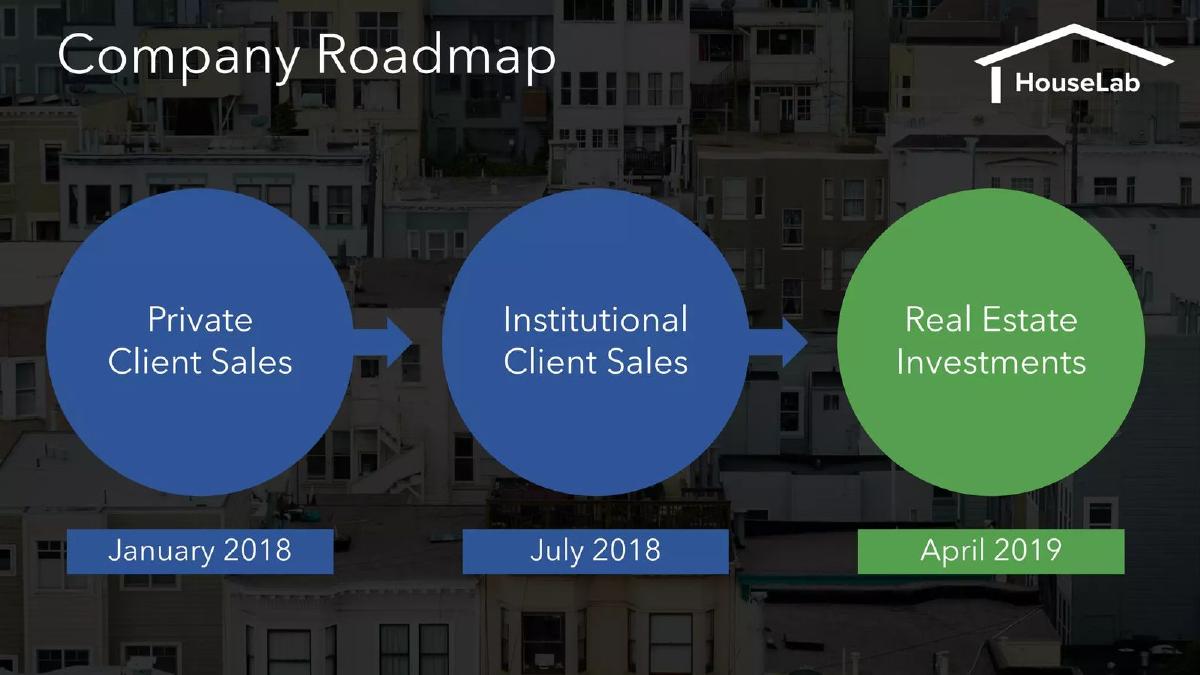
- The roadmap shows a three-stage evolution: Private Client Sales (Jan 2018), Institutional Client Sales (July 2018), and Real Estate Investments (April 2019) (Slide 6).
- Revenue projections are aggressive, forecasting a jump from $67,000 in 2018 to $1.3 million in 2020 (Slide 7).
- The team consists of five members with backgrounds in Chemical Engineering, Statistics, EE/CS, Economics, and Computer Science, but lacks professional bios (Slide 2).
- The deck completely omits a 'The Ask' slide, leaving investors without information on the capital required or the valuation sought.
Executive Summary: The Data-Speed Play in Real Estate
House Lab presents a lean, 7-slide pitch deck that focuses heavily on a technical advantage in the real estate data space. The company’s premise is built on the inefficiency of the pre-foreclosure market. By leveraging software to scrape and analyze PACER (Public Access to Court Electronic Records) data, House Lab intends to find distressed properties months before they hit traditional listing services. The deck follows a logical progression from team to technology, business model, and finally, a roadmap that transitions the company from a software-as-a-service (SaaS) lead provider to a full-scale real estate investment firm.
Slide 1: Title Slide
The opening slide features the HouseLab logo—a minimalist house outline—over a dark, aerial photograph of a densely packed residential neighborhood. There is no tagline or mission statement present on this slide, leaving the viewer to infer the company's purpose from the name and the imagery. The branding is clean, but the lack of an immediate value proposition is a missed opportunity to set the stage.
Slide 2: Team and Partners
Slide 2 introduces the five-man founding team: John Shotton (Chemical Engineering), Brandon Huang (Statistics), Ryan Gustafson (EE and Computer Science), Chris Yamamoto (Economics), and Sam Wiggins (Computer Science). While the academic backgrounds are diverse and suggest a strong technical foundation, the slide lacks any mention of professional experience, previous startups, or specific roles within House Lab. Notably, the slide also lists two partners: BankruptcyWatch and Lincoln Law. This is a critical inclusion, as it validates their access to the legal data streams necessary for their software to function.
Slide 3: Market Opportunity
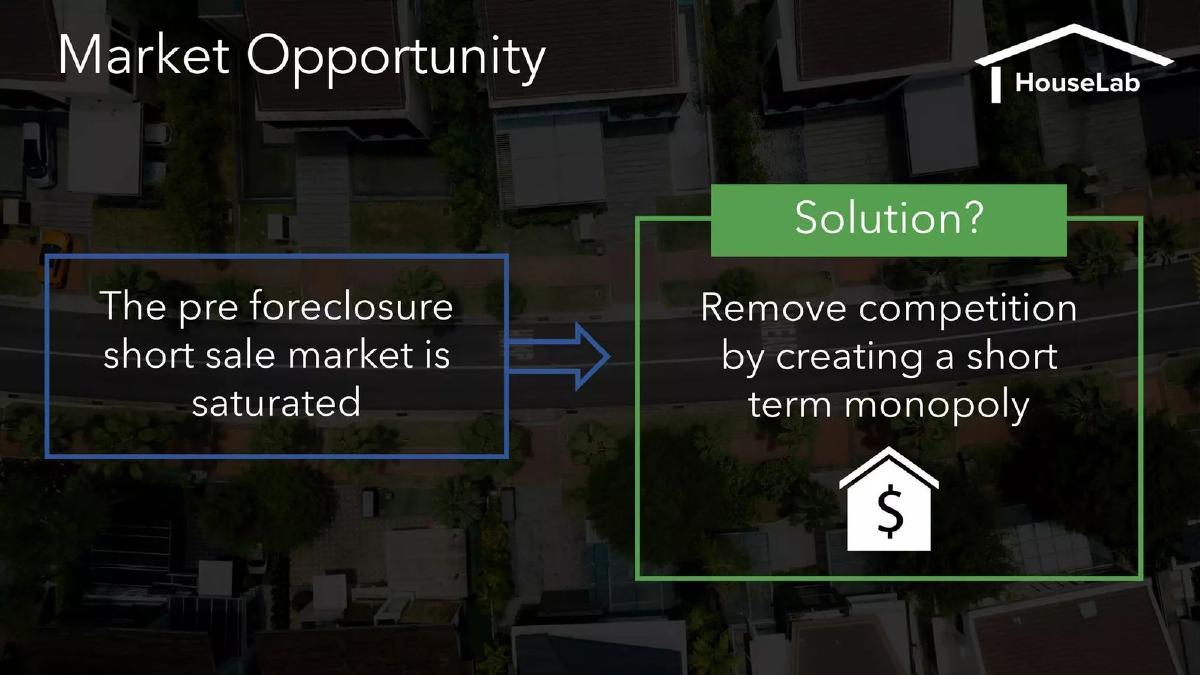
This slide defines the problem and the proposed solution. It states that "The pre foreclosure short sale market is saturated." The proposed solution is to "Remove competition by creating a short term monopoly." This is a bold claim, suggesting that speed is the only barrier to entry in this market. The slide uses a simple flow-chart aesthetic to move the viewer from the problem of saturation to the solution of exclusivity.
Slide 4: Our Service and Competitive Advantage
Slide 4 contains the most compelling metrics in the deck. It introduces the HouseLab PACER Software , which it claims "Parses through obscured data" and "Identifies pre foreclosure properties 310 times faster than before." The right side of the slide translates this technical speed into financial gain: the ability to purchase properties for ~75% of market value due to "Exclusive market access 50-120 days before anyone else." This slide successfully connects a technical feat to a specific, high-value business outcome.
Slide 5: Business Model
The business model is presented as a simple circular flow. HouseLab provides leads that give customers an "unfair market advantage," and in return, customers pay $50 per lead . The slide identifies the target audience as Realtors, Property Developers, and REITs. It also quantifies the scale of these sales: 10 leads per sale for private customers and 500-1000 leads per sale for institutional customers. This suggests a high-volume, low-friction sales process, though it does not address the cost of lead acquisition or the churn rate of these customers.
Slide 6: Company Roadmap
The roadmap outlines a clear three-step evolution for the company. It begins in January 2018 with Private Client Sales, moves to Institutional Client Sales in July 2018 , and culminates in "Real Estate Investments" by April 2019 . This indicates that the founders view the lead-generation business as a way to generate cash flow and validate their data before eventually becoming their own best customer by investing in the properties themselves.
Slide 7: Revenue Projection
The final slide provides a quarterly bar chart of projected revenue from 2018 through 2020. The milestones are clearly marked: 2018 Revenue is projected at $67,000 , 2019 at $336,000 , and 2020 at $1.3M . The chart also highlights key operational milestones, such as the "First institutional client" in Q3 2018, the "First investment property purchase" in Q2 2019, and the "First property sold" in Q4 2019. The jump in revenue in 2020 is attributed to the transition into property sales rather than just lead sales.
What House Lab Does Well
The House Lab deck is exceptionally focused. It does not waste time on fluff or generic market statistics about the size of the real estate industry. Instead, it focuses on a single technical lever: the speed of data parsing. By quantifying this speed (310x faster) and the resulting market lead (50-120 days), they provide a concrete reason for an investor to believe they have a proprietary advantage. The inclusion of specific partners like Lincoln Law also adds a layer of credibility that is often missing from early-stage technical decks.
What is Missing from the Deck
The most glaring omission is The Ask . There is no slide indicating how much capital the company is seeking, what the valuation is, or how the funds will be allocated. Furthermore, the Team Slide is weak; while academic degrees are listed, there is no evidence that this team has ever worked in real estate or successfully built a software product before. The deck also lacks a Competitive Landscape analysis. While they mention the market is "saturated," they do not name specific competitors or explain why those competitors cannot simply improve their own scraping algorithms to match House Lab’s speed. Finally, there is no mention of the Legal/Regulatory Risks associated with scraping PACER data for commercial lead generation, which is a common hurdle in this specific niche.
Founder's Guide: What to Copy and What to Avoid
Copy the quantification of your advantage. House Lab doesn't just say they are "fast"; they say they are "310 times faster." They don't just say they are "early"; they say they are "50-120 days" ahead. These specific numbers are what stick in an analyst's mind. Also, copy the Roadmap's clarity . Showing an evolution from a service-based model (selling leads) to a capital-intensive model (investing in property) shows long-term strategic thinking.
Avoid the lack of professional context. If you are a student or recent graduate, you must highlight relevant projects, internships, or advisors to compensate for a lack of full-time industry experience. Simply listing "Chemical Engineering" does not tell an investor why you are qualified to disrupt the foreclosure market. Most importantly, never leave out the Ask slide . A pitch deck is a functional document intended to initiate a transaction; if you don't tell the investor what you want, the deck has failed its primary purpose.
Frequently asked questions
- What is the primary technology behind House Lab?
- House Lab utilizes proprietary software called 'HouseLab PACER Software.' According to slide 4, this technology parses through 'obscured data' to identify pre-foreclosure properties. The company claims this process is 310 times faster than current industry standards, providing a significant speed advantage in lead generation.
- How does House Lab plan to make money?
- The business model is two-fold. Initially, as shown on slide 5, they sell real estate leads for $50 each to private and institutional customers. By slide 6 and 7, the strategy shifts toward using their own data to engage in direct real estate investments, with their first property sale projected for Q4 2019.
- Who are the target customers for House Lab's leads?
- Slide 5 identifies three primary customer segments: Realtors, Property Developers, and Real Estate Investment Trusts (REITs). They differentiate between 'private customers' (buying ~10 leads/sale) and 'institutional customers' (buying 500-1000 leads/sale).
- What is the significance of the 50-120 day window mentioned in the deck?
- Slide 4 highlights this as their primary competitive advantage. By parsing bankruptcy and foreclosure data faster than the market, they claim to give their clients (or themselves) a 50-120 day head start before a property becomes widely known as a short-sale or foreclosure opportunity, effectively creating a temporary monopoly.
- Is there a specific funding request in this deck?
- No. The 7-slide deck concludes with revenue projections on slide 7 but does not include a slide detailing how much money the company is looking to raise, the intended use of funds, or any equity terms. This is a significant omission for a fundraising document.