The Hot Hotels Demo Day deck, spanning 23 slides (8 provided for analysis), outlines a transition from a consumer-facing last-minute booking app to a B2B 'clearing platform.' The company identifies the core problem as the difficulty consumers face finding trusted last-minute deals and the inefficiency of distributing perishable hotel inventory. By integrating with the '10 Largest Wholesaler XML Integrations,' including Hotelbeds and Restel, Hot Hotels positions itself as a pricing engine that delivers liquidity without requiring behavioral changes from the user. The deck relies heavily on vis…
Key takeaways
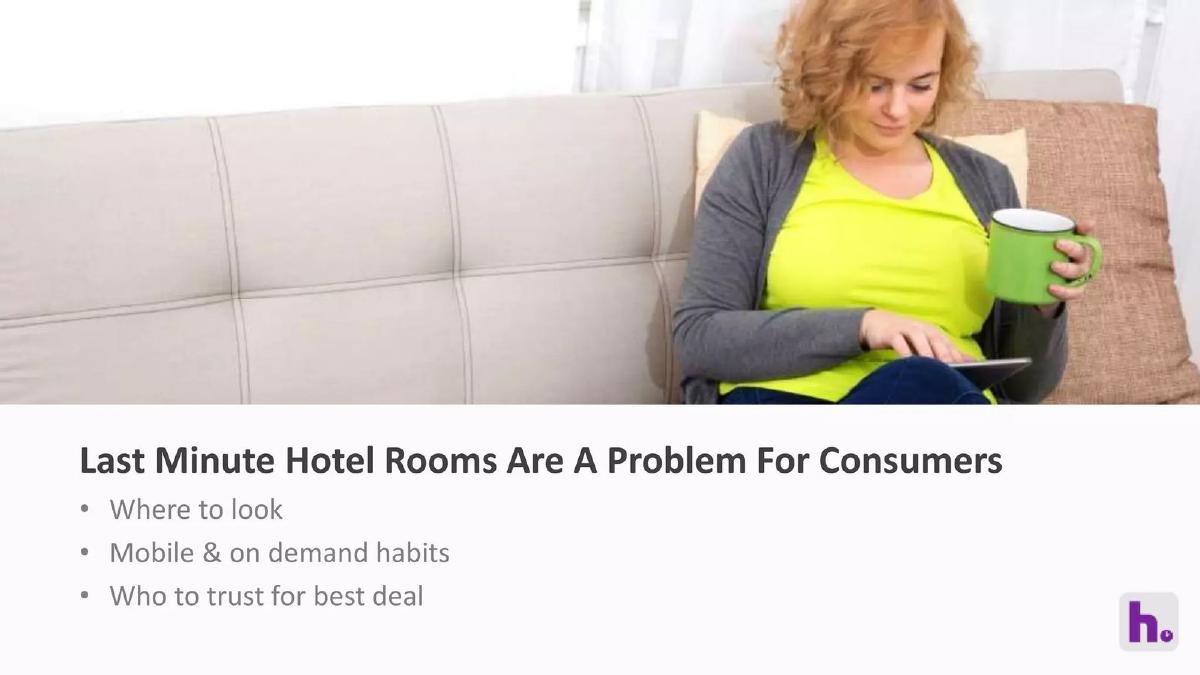
- The company defines the problem as consumer confusion regarding where to look and who to trust for last-minute, on-demand hotel deals (Slide 2).
- Hot Hotels utilizes meta-search integrations, showing a price comparison where their rate is $126 versus Kayak's $168 for the same property (Slide 3).
- The platform has launched in multiple European markets, indicated by a collage of iconic city imagery including London, Paris, and Venice (Slide 4).
- Strategic depth is demonstrated through partnerships with the 10 largest wholesaler XML integrations, specifically naming TransHotel, Restel, and Hotelbeds (Slide 5).
- The product is described as a 'Clearing Platform' designed to distribute perishable inventory via an open pricing engine (Slide 6).
- A key value proposition is that the service 'lives in your favorite portal,' suggesting a white-label or API-first approach that requires no consumer behavioral change (Slide 6).
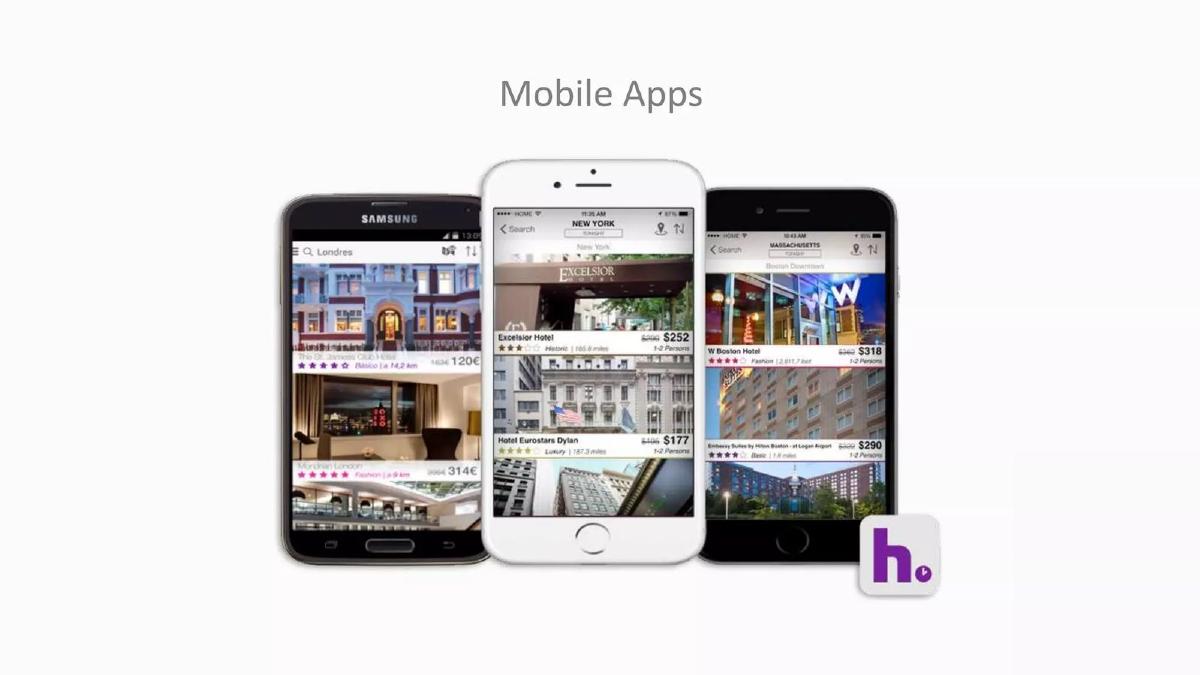
- Supply-side partners listed on mobile mockups include TeamAmerica, Tourico Holidays, JacTravel, Kuoni, and Hotelbeds (Slide 7).
- The deck concludes its narrative arc with a visual reference to Boston (the Citgo sign), likely indicating the location of the Demo Day or a target expansion market (Slide 8).
Slide-by-Slide Analysis
Slide 1: Title and Branding
The opening slide features the Hot Hotels logo—a purple lowercase 'h' with a clock icon—centered over a faded collage of travel-related imagery. The background images include 'Rooms Available' and 'Vacancy' signs, mobile devices showing app interfaces, and a 'Boston' block set. This establishes the company's focus on time-sensitive (the clock icon) hotel availability and mobile technology.
Slide 2: The Problem Statement
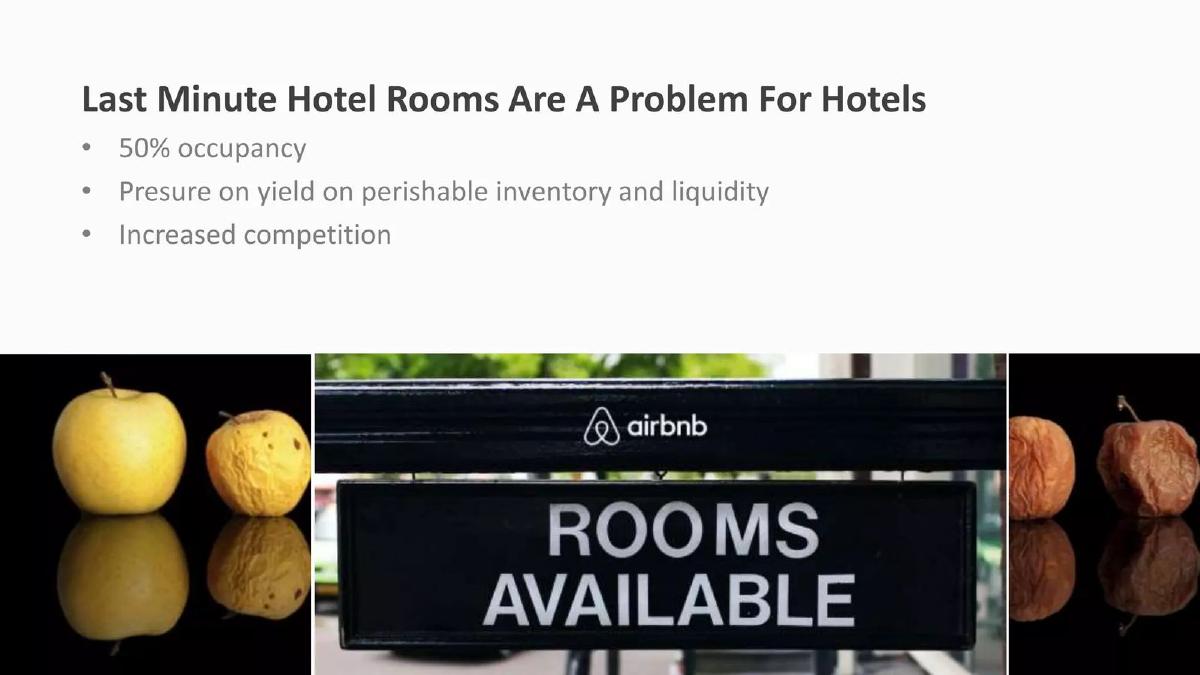
Slide 2 identifies the friction points for modern travelers. It states that 'Last Minute Hotel Rooms Are A Problem For Consumers.' The slide lists three specific pain points: 'Where to look,' 'Mobile & on demand habits,' and 'Who to trust for best deal.' The imagery shows a consumer using a tablet in a casual home setting, emphasizing the 'on-demand' nature of the problem they are solving.
Slide 3: Meta Search Integrations
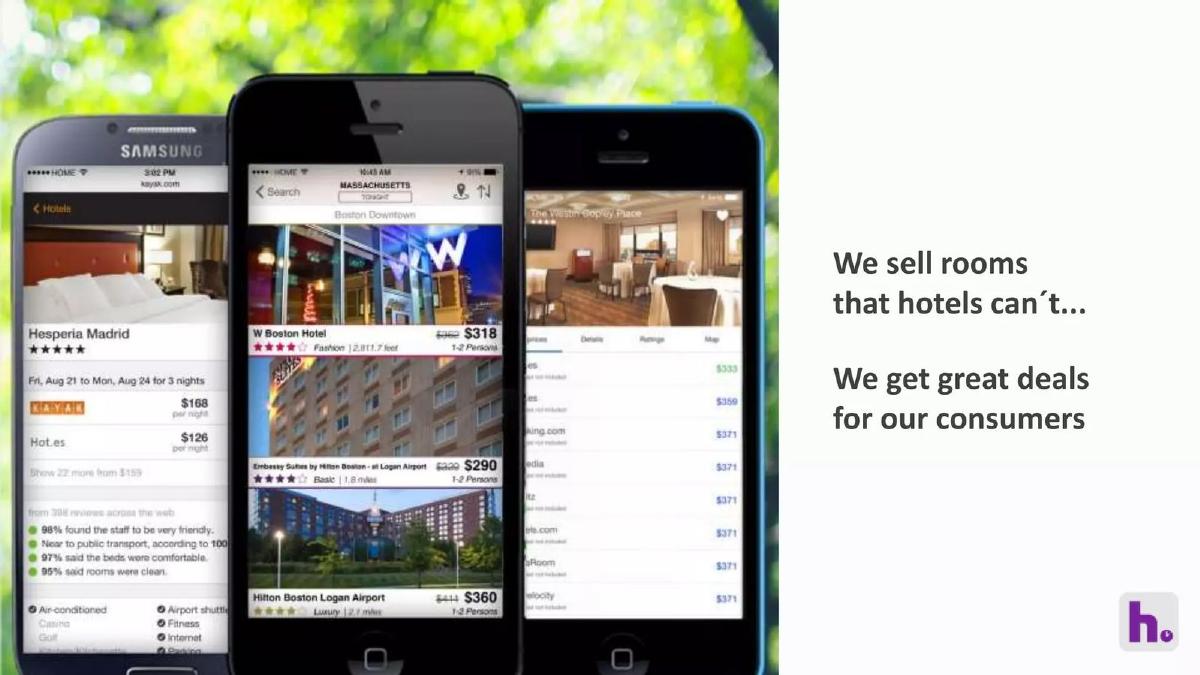
This slide serves as a proof of value proposition. It shows a hand holding a tablet displaying a meta-search result for the Hesperia Madrid. The interface compares two booking options: Kayak at $168 per night and Hot Hotels (represented by the 'h.' logo) at $126 per night. This 25% price difference is the core hook for the platform's utility within the broader travel ecosystem.
Slide 4: Market Presence
Titled 'We Launched In,' this slide uses a high-density photo collage to communicate geographic reach. While it does not list cities by name, the visual shorthand is clear: Madrid, Lisbon, London, Venice, Paris, and Florence are all represented. This indicates a focus on high-traffic European destinations where 'perishable inventory' (unsold rooms) is a constant issue for hotel operators.
Slide 5: Supply Side Partnerships
Slide 5 focuses on the backend strength of the platform. It states, 'We Partnered With 10 Largest Wholesaler XML Integrations.' The slide displays logos for TransHotel, Sidetours, Hotelbeds, Restel, Serhs, and Keytel. In the travel industry, these XML integrations are critical because they provide the raw data and booking capabilities for thousands of properties globally. Claiming the '10 largest' suggests significant technical heavy lifting has already been completed.
Slide 6: The Clearing Platform
This slide defines the product's evolution. It moves away from being 'just an app' to being a 'Clearing Platform.' The three bullet points describe it as an 'Open platform to distribute Perishable inventory,' a tool that 'Lives in your favorite portal, no behavioral change,' and a 'Pricing Engine... That delivers liquidity and the best deals out there.' The background image of a stock exchange floor reinforces the concept of a high-volume, high-speed clearinghouse for travel assets.
Slide 7: Supply Aggregation
Slide 7 reinforces the supply message with a mobile mockup showing a list of 'Supply' partners. It includes TeamAmerica, Tourico Holidays, JacTravel, Kuoni, and Hotelbeds. This slide likely serves to emphasize that the platform is a centralized hub for these disparate, often fragmented wholesale sources, making them accessible through a single mobile-optimized interface.
Slide 8: Regional Context
The final slide in the provided set shows the iconic Citgo sign in Boston. Given that this is a 'Demo Day' deck, this slide likely served as a transition to discuss the company's participation in a Boston-based accelerator (such as Techstars or MassChallenge) or to signal their entry into the North American market. It contains no text, serving purely as a visual anchor for a spoken presentation.
What Hot Hotels Does Well
Clarity of the 'Perishable' Problem: The deck correctly identifies that a hotel room is a perishable good; if it isn't sold tonight, its value drops to zero tomorrow. By positioning themselves as a 'Clearing Platform' rather than just another booking site, they appeal to the supply side (hotels/wholesalers) who are desperate for liquidity.
Visual Proof of Value: Slide 3 is the most effective slide in the deck. By showing a $42 per night difference against a major competitor like Kayak, the founders provide a tangible reason for their existence. It moves the conversation from 'we have an app' to 'we have better prices.'
Infrastructure Over Interface: The emphasis on '10 Largest Wholesaler XML Integrations' (Slide 5) tells investors that the company has built a significant technical moat. Integrating with legacy travel wholesalers is notoriously difficult; showing these logos suggests the 'plumbing' of the business is robust.
What Is Missing from the Deck
Unit Economics: There is no mention of the take rate, commission structure, or customer acquisition cost (CAC). For a clearing platform, understanding the margin on that $126 room is vital for assessing scalability.
The Team: The provided slides contain no information about the founders or their background in the travel industry. In a crowded market like travel tech, the 'why us' is as important as the 'what.'
Traction Metrics: While the deck shows where they have 'launched,' it does not provide data on booking volume, monthly active users (MAU), or revenue growth. Investors need to see that the 'liquidity' mentioned in Slide 6 is actually flowing.
The Ask: The deck ends without a clear call to action. There is no mention of the round size, valuation, or how the funds will be used to scale the 'Clearing Platform' model.
Founder's Guide: What to Copy
The 'No Behavioral Change' Angle: Founders building B2B2C products should emulate Slide 6. Acknowledging that users don't want to change their habits and that your product 'lives in your favorite portal' is a powerful way to address adoption friction.
Logo Walls for Credibility: If your startup relies on integrations, do not just list them in text. Use the logos of your partners (as seen in Slides 5 and 7) to borrow their brand equity and demonstrate that you are a serious player in the ecosystem.
Direct Price Comparison: If your primary advantage is cost, show a side-by-side screenshot. Hot Hotels' comparison to Kayak is much more effective than a bullet point saying 'we are cheaper.'
Use of Visual Shorthand: Using landmarks (Slide 4) to show market coverage is a clean way to demonstrate international presence without cluttering a slide with a list of 50 city names. It keeps the audience focused on the scale rather than the specifics.
Frequently asked questions
- What is the primary business model of Hot Hotels based on this deck?
- Based on Slide 6, Hot Hotels operates as a 'Clearing Platform' and 'Pricing Engine.' It focuses on the distribution of 'perishable inventory'—hotel rooms that would otherwise go unsold. Rather than forcing users to a new destination, it integrates into existing portals to provide liquidity and better deals through wholesaler XML integrations.
- Which specific partners provide the inventory for Hot Hotels?
- The deck explicitly names several major travel wholesalers. Slide 5 lists TransHotel, Sidetours, Hotelbeds, Restel, Serhs, and Keytel. Slide 7 adds TeamAmerica, Tourico Holidays, JacTravel, and Kuoni to the supply list. The company claims to have integrated with the 10 largest wholesalers in the industry.
- How does Hot Hotels differentiate its pricing from competitors?
- Slide 3 provides a direct comparison via a meta-search integration mockup. For a stay at the Hesperia Madrid, the deck shows a Kayak price of $168 per night, while the Hot Hotels ('h.') price is listed at $126 per night. This represents a 25% discount compared to the meta-search incumbent.
- What geographic markets has the company entered?
- Slide 4, titled 'We Launched In,' uses a photo collage to represent their footprint. The images depict landmarks from Madrid, London (red telephone booths), Venice (gondolas), Paris (Eiffel Tower), and Florence. This suggests a heavy initial focus on major European tourism hubs.
- What critical fundraising information is missing from these slides?
- The provided slides omit several standard pitch deck components. There is no team slide detailing founder expertise, no slide covering unit economics (CAC/LTV), no financial projections, and no 'The Ask' slide specifying how much capital is being raised or the intended use of funds.